

Unlocking California's Energy Future with Precise Battery Sizing
California homeowners are at the forefront of the clean energy revolution, increasingly embracing solar and battery storage systems to achieve energy independence, reduce utility bills, and enhance grid resilience. However, simply installing a battery isn't enough; the true power lies in precision: specifically, whole-home battery sizing. At Powercore Inc, we understand that a one-size-fits-all approach simply doesn't work for the diverse energy needs and unique regulatory landscape of the Golden State.
This comprehensive guide delves into the art and science of whole-home battery sizing, revealing how a meticulously planned system can maximize your investment, secure your energy future, and provide unparalleled peace of mind. From navigating California's complex Time-of-Use (ToU) rates to preparing for Public Safety Power Shutoffs (PSPS) and integrating future technologies like EV charging, precise sizing is the cornerstone of an efficient, cost-effective, and truly resilient home energy system.
Why Whole-Home Battery Storage is Essential in California
The urgency for reliable home energy solutions in California has never been greater. Several factors converge to make whole-home battery storage not just a luxury, but a strategic necessity:
Navigating NEM 3.0 and Time-of-Use (ToU) Rates
- NEM 3.0 Impact: The shift to Net Energy Metering 3.0 has fundamentally changed how solar homeowners are credited for excess energy sent back to the grid. Batteries become crucial for self-consumption, storing your generated solar power for use when grid export rates are low and import rates are high.
- ToU Optimization: California's utility companies employ complex ToU rate structures, charging more for electricity during peak demand hours (typically evenings). A properly sized battery allows you to store solar energy generated during the day and discharge it during these expensive peak periods, drastically reducing your reliance on the grid when prices are highest.
Enhancing Grid Resilience and Outage Protection
- Public Safety Power Shutoffs (PSPS): Wildfire risks have led to an increase in PSPS events, leaving many Californians without power for extended periods. A whole-home battery system provides reliable backup power, keeping essential appliances running and maintaining comfort and safety.
- Natural Disasters: Beyond wildfires, California faces other natural disaster risks. A robust battery storage system offers a critical layer of energy security, ensuring your home remains powered when the grid fails.
Achieving True Energy Independence and Sustainability
- Reduced Carbon Footprint: By maximizing your use of self-generated solar energy, you reduce your reliance on fossil fuel-based grid electricity, contributing to a cleaner, more sustainable future.
- Empowerment: Owning your energy production and storage grants a profound sense of independence and control over your utility costs, shielding you from future rate hikes and grid instability.
The Myth of "One-Size-Fits-All": Why Precision Matters for Your ROI
When it comes to whole-home battery sizing, there's no such thing as a universal solution. An improperly sized system can lead to significant drawbacks:
The Risks of Undersizing Your Battery System
- Insufficient Backup Power: If your battery is too small, it may not be able to power your essential appliances for the desired duration during an outage, leaving you vulnerable.
- Missed Savings Opportunities: An undersized battery won't be able to store enough solar energy to effectively offset peak ToU rates, diminishing your potential savings.
- Faster Cycling: Frequent, deep discharges can potentially shorten the lifespan of your battery, reducing its overall value.
The Pitfalls of Oversizing Your Battery System
- Wasted Investment: Batteries represent a substantial investment. Purchasing more capacity than you genuinely need means paying for unused storage, extending your payback period.
- Slower Return on Investment (ROI): Excess capacity doesn't generate additional savings or benefits if it's rarely used, diluting your financial returns.
- Inefficient Operation: An oversized system might not operate at its peak efficiency, as some capacity may sit idle.
The goal is to find the "Goldilocks zone" – a battery system that is just right for your specific energy profile and goals. This is where Powercore Inc's expertise shines, ensuring every dollar you invest is optimized for performance and savings.
Key Factors Influencing Whole-Home Battery Sizing in California
Accurate battery sizing requires a deep dive into your home's energy dynamics and your personal objectives. Here are the critical factors we consider:
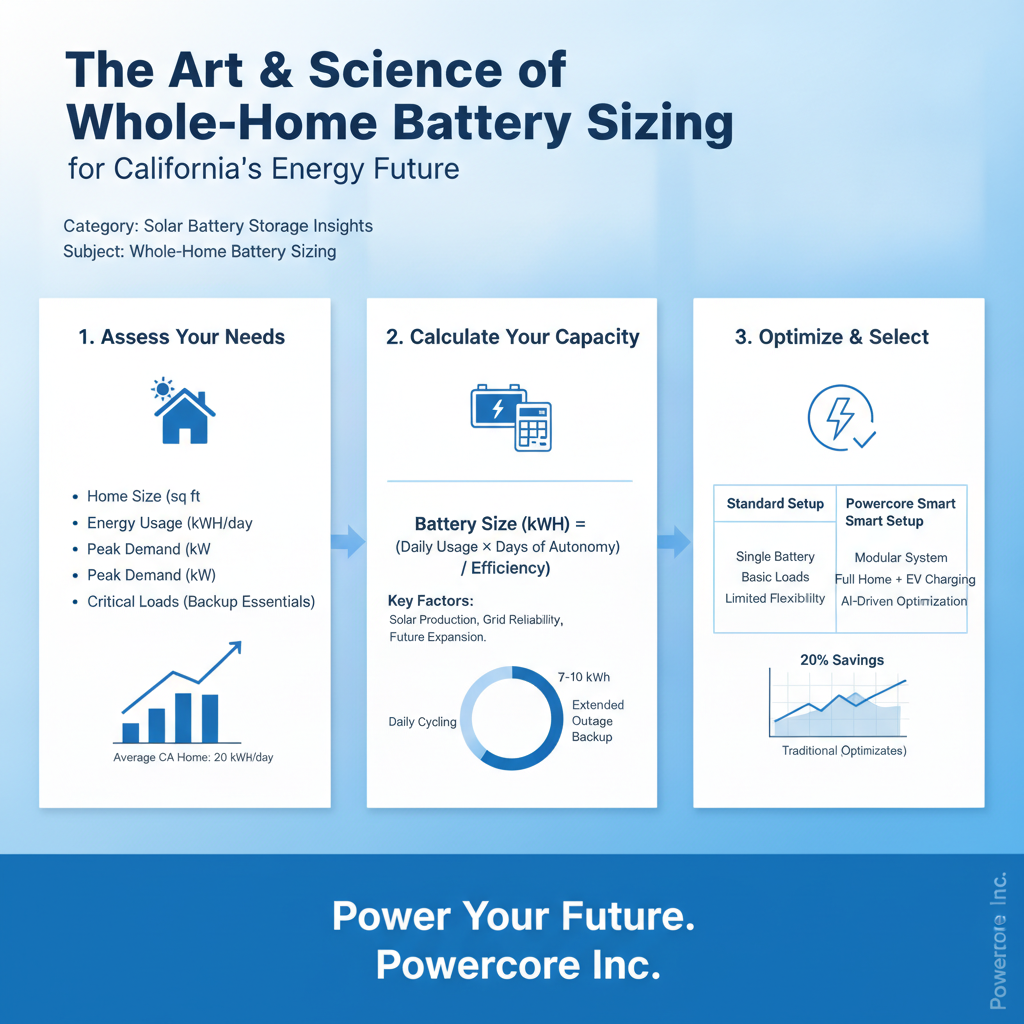
1. Energy Consumption Analysis: Your Home's Energy Fingerprint
Understanding how and when your home uses electricity is the foundational step. This involves:
- Daily Average Usage (kWh): Reviewing historical utility bills (at least 12-24 months) provides a clear picture of your total energy consumption patterns throughout the year, accounting for seasonal variations.
- Peak Usage Times: Identifying when your household consumes the most energy helps determine how much power needs to be discharged during those specific periods to avoid high ToU rates.
- Essential vs. Non-Essential Loads: During a power outage, what absolutely needs to stay on (refrigerator, medical devices, lights, internet)? What can be sacrificed (pool pump, secondary AC unit)? This distinction is crucial for backup planning.
- Specific Appliance Draw: Knowing the wattage and run-time of key appliances (e.g., HVAC, well pump, electric stove) helps calculate the necessary energy reserve.
2. Goals for Battery Storage: Your Energy Priorities
Your motivations for installing a battery heavily influence its size:
- Daily Self-Consumption & ToU Optimization: If your primary goal is to store excess solar for evening use and arbitrage ToU rates, the battery needs to match your evening consumption profile.
- Backup Power Duration & Scope: Do you need to power your entire home for 12 hours during an outage, or just essential circuits for 2-3 days? The longer the desired backup duration and the more appliances you wish to power, the larger the battery capacity required.
- EV Charging Integration: If you plan to charge an electric vehicle using stored solar energy, this significantly increases your daily energy demand and must be factored into the battery size. Powercore Inc also specializes in EV charging station installations, ensuring seamless integration.
3. Solar Production Profile: Your Renewable Resource
The amount of solar energy your residential solar system generates directly impacts how much energy you can store:
- System Size: Larger solar arrays produce more energy, potentially requiring greater storage capacity to capture all excess generation.
- Sunlight Hours & Shading: Local climate, seasonal variations, and any shading obstructions affect your daily solar output.
- Offsetting Grid Reliance: The goal is often to minimize grid imports, and a battery helps achieve this by making your home more self-sufficient.
4. Battery Chemistry, Efficiency, and Expandability
- Chemistry: Different battery chemistries (like LFP vs. NMC) have varying efficiencies, lifespans, and safety profiles. You can learn more about these differences in our article, LFP vs. NMC: Powering California's Future with Smarter Solar Battery Choices.
- Round-Trip Efficiency: This measures how much energy put into the battery can be retrieved. Higher efficiency means less wasted energy.
- Depth of Discharge (DoD): Most modern batteries shouldn't be fully depleted. The usable capacity is typically a percentage of the total capacity (e.g., 90-100% DoD for LFP).
- System Expandability: Consider if the battery system can be easily expanded in the future if your energy needs grow (e.g., adding an ADU, another EV, or increasing family size).
The Powercore Inc Sizing Process: A Strategic Approach
At Powercore Inc, we combine cutting-edge technology with deep industry expertise to provide a precise and tailored battery sizing solution for your California home. Our process ensures every aspect of your energy needs and goals is meticulously analyzed:
Step 1: Comprehensive Energy Audit and Load Profiling
We begin by thoroughly reviewing your historical energy consumption data, typically from utility bills and smart meter readings. We then work with you to create a detailed load profile, identifying peak usage times and categorizing essential versus non-essential appliances.
Step 2: Defining Your Backup and Savings Objectives
Do you need to keep critical medical equipment running for 24 hours, or power your entire home through a multi-day outage? Are you focused purely on ToU arbitrage savings? Our experts consult with you to clearly define your priorities, which directly inform the necessary battery capacity.
Step 3: Assessing Solar Production and Synergy
We evaluate your existing or planned residential solar system's output, considering factors like panel orientation, shading, and seasonal variations. This helps us determine how much excess solar energy will be available for storage, ensuring perfect synergy between your solar generation and battery capacity.
Step 4: Calculating Usable Battery Capacity and Power Output
Based on your energy needs and solar production, we calculate the required usable battery capacity (in kWh) and the instantaneous power output (in kW) needed to run your desired loads. We account for factors like battery efficiency and depth of discharge to ensure reliable performance.
Step 5: Considering Future Growth and Scalability
California homes are dynamic. We discuss your long-term plans – perhaps adding an ADU, purchasing an EV, or expanding your family. Our designs often incorporate options for future expansion, allowing your battery system to evolve with your needs.
Step 6: Integrating California-Specific Incentives
We help you navigate the various state and federal incentives available, such as the Self-Generation Incentive Program (SGIP) and the federal Residential Clean Energy Credit (IRS). These incentives can significantly offset the upfront cost of your battery system. Learn more about these opportunities on our California Battery Storage Incentives page.
Beyond Sizing: The Powercore Inc Advantage in California
Choosing the right battery size is only the first step. The quality of installation and ongoing support are equally vital. Powercore Inc stands out as California's trusted partner for comprehensive home energy solutions:
- Dual-Licensed Expertise: As a California dual-licensed General B (#1134334) and C-10 Electrical Contractor (#1098175), Powercore Inc offers a unique advantage. Our comprehensive licensing means we manage every aspect of your project, from structural considerations to complex electrical integrations, ensuring safety, compliance, and seamless execution.
- Holistic Home Solutions: We don't just do solar and batteries. Our extensive services include HVAC, roofing, ADUs, remodels, EV charging, and more. This integrated approach ensures all elements of your home work in harmony for optimal efficiency and value.
- Statewide Service: From the bustling cities to the quietest corners, Powercore Inc serves all of California, bringing expert energy solutions to every community.
- Commitment to Quality: We use only top-tier equipment and employ highly trained, certified technicians. Our focus is on long-term performance, reliability, and customer satisfaction.
Secure Your Energy Future with Powercore Inc
Don't leave your home's energy future to guesswork. Precise whole-home battery sizing is the key to unlocking maximum savings, unparalleled resilience, and true energy independence in California's evolving energy landscape. With Powercore Inc, you gain a partner committed to designing and installing a system perfectly tailored to your unique needs.
Ready to discover the ideal battery storage solution for your California home? Contact Powercore Inc today for a personalized consultation. Call us at 916-699-8778 to speak with an expert and take the first step towards a smarter, more resilient energy future.