

Introduction: Navigating California's Dynamic Energy Landscape
California homeowners face a unique set of energy challenges and opportunities. From fluctuating utility rates and increasingly frequent Public Safety Power Shutoffs (PSPS) to the evolving landscape of Net Energy Metering (NEM 3.0), achieving true energy independence and resilience has never been more critical. Solar panels have become a cornerstone of sustainable living, but to truly maximize their benefits and fortify your home against grid uncertainties, a robust battery storage system is indispensable.
As you explore home battery solutions, you'll encounter various technologies, each with its own strengths and considerations. At the forefront of this revolution are two dominant lithium-ion battery chemistries: Nickel Manganese Cobalt (NMC) and Lithium Iron Phosphate (LFP). Understanding the fundamental differences between these technologies is not just an academic exercise; it's a crucial step in making an informed investment that aligns with California’s specific demands for safety, longevity, and value.
This comprehensive guide from Powercore Inc, your trusted California dual-licensed General B & C-10 Electrical Contractor, will delve deep into the LFP vs. NMC debate. We'll unpack their technical specifications, evaluate their performance in real-world California scenarios, and help you determine which battery chemistry is the smartest choice for your home's energy future.
The Rise of Home Battery Storage in California
California's energy environment is a complex tapestry woven with ambitious renewable energy goals, a strained grid infrastructure, and the constant threat of natural disasters. These factors have propelled home battery storage from a niche luxury to an essential component of modern Californian homes.
NEM 3.0 and the Battery Imperative
The introduction of NEM 3.0 has fundamentally shifted the economics of solar ownership in California. Where once excess solar energy could be exported to the grid for near retail rates, NEM 3.0 significantly reduces these export credits. This change makes self-consumption and time-of-use (TOU) arbitrage paramount. A solar battery allows homeowners to:
- Store Excess Solar: Instead of sending surplus power to the grid for meager credits, store it for later use.
- Maximize TOU Savings: Charge your battery when solar production is high or electricity rates are low (typically midday), and discharge it during peak demand hours (evenings) when rates are highest, minimizing reliance on expensive grid power.
- Achieve Greater Energy Independence: Reduce your dependency on the utility grid and gain more control over your energy usage and costs.
Grid Resilience and PSPS Events
California's aging electrical infrastructure, coupled with the increasing severity of wildfires, has led to a rise in PSPS events. These planned power outages, designed to prevent wildfires, can leave homes without power for extended periods. A home battery system, especially when paired with solar, provides a critical backup power source, ensuring your essential appliances and systems remain operational when the grid goes down. This offers peace of mind and significantly enhances your home's resilience.
EV Charging and Load Management
With California leading the charge in electric vehicle adoption, home EV charging adds another significant load to a household's energy demand. A smart battery system can help manage this load, charging your EV during off-peak hours or using stored solar energy, further reducing your electricity bill and grid impact.
Understanding Lithium-Ion Batteries: A Quick Refresher
Before diving into the specifics of LFP and NMC, it's helpful to understand the basic principles of lithium-ion batteries. These rechargeable batteries use lithium ions as their primary charge carriers. During discharge, lithium ions move from the negative electrode (anode) through an electrolyte to the positive electrode (cathode). During charging, this process reverses. The specific chemical composition of the cathode largely defines the battery's characteristics, leading to the variations we see in LFP and NMC.
Nickel Manganese Cobalt (NMC) Batteries
NMC batteries are a prominent type of lithium-ion chemistry, widely recognized for their high energy density. This means they can pack a significant amount of power into a smaller, lighter package. Their cathode is composed of nickel, manganese, and cobalt in varying ratios, often expressed as 1-1-1, 5-3-2, 6-2-2, or 8-1-1 (referring to the nickel, manganese, and cobalt proportions).
Key Characteristics of NMC:
- High Energy Density: NMC batteries excel in applications where space and weight are critical, such as electric vehicles (EVs) and portable electronics. This allows for longer range or more compact designs.
- Good Power Output: They can deliver high power quickly, suitable for demanding applications.
- Moderate Cycle Life: Typically offering a decent cycle life, though often less than LFP under similar conditions.
- Higher Voltage: Generally operate at a slightly higher nominal voltage per cell.
Applications and Drawbacks of NMC:
Historically, NMC batteries were among the first lithium-ion chemistries to be adapted for grid-scale and residential energy storage due to their performance characteristics. However, they come with certain drawbacks:
- Thermal Stability and Safety: The presence of cobalt makes NMC batteries more prone to thermal runaway if overcharged, damaged, or subjected to extreme temperatures. While battery management systems (BMS) mitigate these risks, the inherent chemistry is less stable than LFP. This is a significant consideration, especially in wildfire-prone California.
- Cobalt Dependence: Cobalt is a finite and ethically controversial resource, often sourced from regions with questionable labor practices. Its price volatility and environmental impact are growing concerns.
- Cost: Due to the materials used, particularly cobalt, NMC batteries can sometimes have a higher upfront cost compared to LFP.
Lithium Iron Phosphate (LFP) Batteries
LFP batteries, sometimes referred to as LiFePO4, represent a significant evolution in lithium-ion technology, particularly for stationary energy storage. Their cathode uses lithium iron phosphate as the primary material, distinguishing them from NMC's metallic oxides.
Key Characteristics of LFP:
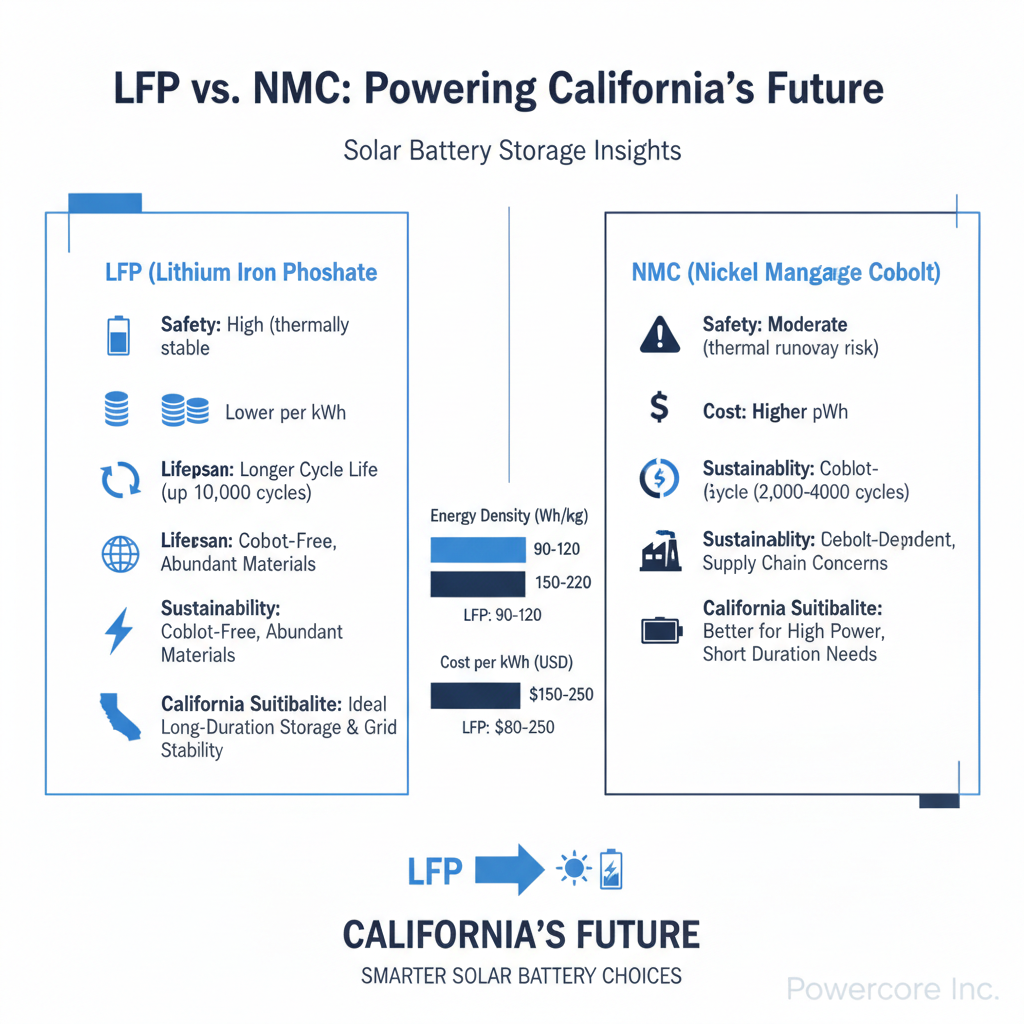
- Superior Safety and Thermal Stability: This is arguably LFP's most compelling advantage, especially for residential applications. The iron phosphate bond is incredibly strong, making the battery much more resistant to thermal runaway, even under extreme conditions like overcharging or physical damage. This inherent safety feature is highly valued by homeowners, particularly in areas like California where fire safety is paramount.
- Exceptional Longevity and Cycle Life: LFP batteries typically boast a significantly longer cycle life than NMC, often exceeding 6,000 to 10,000 cycles at 80% Depth of Discharge (DoD). This translates to a longer operational lifespan and a better return on investment over time.
- Wide Temperature Range: LFP batteries perform well across a broader range of temperatures, which is beneficial for outdoor installations in diverse California climates.
- Lower Cost Per kWh Over Lifetime: While the upfront cost might be comparable or slightly higher in some cases, LFP's extended lifespan often results in a lower total cost of ownership (TCO) over the battery's operational life.
- Environmentally Friendlier Materials: LFP uses more abundant and less toxic materials (iron and phosphate), reducing reliance on scarce and controversial elements like cobalt.
Applications and Considerations of LFP:
LFP batteries have rapidly become the preferred choice for residential and commercial solar battery storage systems globally. They are also gaining significant traction in the EV market, especially for standard range vehicles, due to their safety and longevity.
One primary consideration for LFP is its lower energy density compared to NMC. This means an LFP battery of equivalent capacity will be physically larger and heavier than an NMC battery. For most home installations, where space is often less constrained than in an EV, this difference is usually manageable but should be factored into installation planning. Another minor consideration is a slightly lower nominal voltage per cell, but this is managed by the battery management system and inverter.
The Critical Comparison: LFP vs. NMC for California Homes
Now, let's put these two technologies head-to-head, focusing on the factors most relevant to California homeowners considering solar battery storage.
Safety and Thermal Stability: A California Priority
In a state where wildfire season is a growing concern, battery safety is not just a feature; it's a necessity. This is where LFP truly shines.
- LFP: The iron phosphate cathode provides exceptional chemical stability. It resists thermal runaway even when punctured, overcharged, or exposed to high temperatures. If an LFP cell is compromised, it typically vents gas without igniting or exploding. This inherent safety makes LFP a preferred choice for residential installations, offering unmatched peace of mind for California families.
- NMC: While modern NMC batteries are engineered with advanced Battery Management Systems (BMS) to enhance safety, their underlying chemistry, particularly the presence of nickel and cobalt, makes them inherently more susceptible to thermal runaway. If a thermal event occurs, it can escalate rapidly and be more difficult to contain.
For Powercore Inc, prioritizing the safety of our clients' homes is paramount. This makes LFP an overwhelmingly compelling choice for most California battery storage projects.
Longevity and Cycle Life: Maximizing Your Investment
A solar battery is a significant long-term investment. Its cycle life directly impacts how many years it will effectively serve your home.
- LFP: Typically offers 6,000 to 10,000+ cycles at 80% DoD, translating to 15-20+ years of operational life, even with daily cycling. This exceptional longevity provides a superior return on investment, especially under NEM 3.0 where daily cycling for TOU arbitrage is common.
- NMC: Generally offers 2,000 to 4,000 cycles. While sufficient for many applications, this shorter lifespan means you might need to replace your battery sooner, increasing the total cost of ownership over two decades.
Given the long-term nature of solar investments and the desire for sustained energy independence, LFP's extended cycle life presents a clear advantage for California homeowners.
Performance, Efficiency, and Depth of Discharge (DoD)
Both chemistries are highly efficient, typically offering round-trip efficiencies of 90% or more. However, how deeply you can discharge them without impacting longevity varies.
- LFP: Can be safely discharged to nearly 100% DoD without significant degradation, though most manufacturers recommend 80-90% to further extend life. This means you can utilize almost all of its stored energy.
- NMC: While capable of deep discharge, operating at a lower DoD (e.g., 80%) is generally recommended to preserve its lifespan. Pushing it to 100% DoD repeatedly can accelerate degradation.
Energy Density and Footprint
Space considerations can be important for some homeowners, especially those with limited utility room or garage space.
- NMC: Higher energy density means a smaller physical footprint for a given energy capacity. If space is extremely constrained, NMC might offer a more compact solution.
- LFP: Lower energy density translates to a larger and heavier battery for the same capacity. However, for most residential installations, the size difference is manageable, and the benefits of safety and longevity often outweigh the minor increase in footprint. Modern LFP battery systems are designed to be sleek and can often be installed outdoors.
Cost and Value Proposition
The upfront cost of a battery system is a primary concern for many. However, it's crucial to look beyond the initial price tag to the total cost of ownership (TCO).
- LFP: Historically, NMC had a slight edge in initial cost due to economies of scale from EV adoption. However, LFP prices have dropped dramatically in recent years. When factoring in its longer lifespan and superior safety, LFP often presents a significantly lower TCO and a better overall value proposition for homeowners.
- NMC: While potentially having a competitive upfront cost, the shorter cycle life and inherent material costs (cobalt) can lead to a higher TCO over a 15-20 year period, especially if a replacement is needed.
Furthermore, state incentives like the Self-Generation Incentive Program (SGIP) in California can significantly offset the upfront cost of battery storage, making both options more accessible. However, the long-term value of LFP often makes it the more financially astute choice.
Environmental Impact and Resource Scarcity
For environmentally conscious Californians, the sustainability of battery materials is another factor.
- LFP: Uses abundant and less environmentally impactful materials like iron and phosphate. It avoids the ethical concerns and supply chain vulnerabilities associated with cobalt.
- NMC: Relies on cobalt, nickel, and manganese, which have more significant environmental and ethical implications in their extraction and processing.
Choosing LFP aligns more closely with California's commitment to sustainable and responsible energy solutions.
Making the Right Choice for Your California Home
Given California's specific energy landscape and homeowner priorities, LFP batteries emerge as the clear leader for residential solar battery storage in most scenarios. Their unparalleled safety, exceptional longevity, and favorable total cost of ownership make them the intelligent choice for homeowners seeking robust, reliable, and sustainable energy independence.
However, the "best" battery for you ultimately depends on your specific needs, budget, and site constraints. Here are key factors to consider:
- Primary Goal: Are you primarily seeking backup power during outages, maximizing savings through TOU arbitrage, or achieving near-total energy independence?
- Budget: While LFP offers better TCO, your upfront budget will influence your options.
- Space Availability: Do you have sufficient space for a larger LFP system, or is a more compact solution critical?
- Safety Concerns: In wildfire zones or areas where safety is a top priority, LFP's thermal stability is a significant advantage.
- Long-Term Vision: How long do you plan to stay in your home, and what is your desired lifespan for the battery system?
Why Choose Powercore Inc for Your California Battery Storage
Navigating the complexities of solar and battery storage installation requires expertise, experience, and a deep understanding of California's unique regulations and incentives. That's where Powercore Inc stands out.
- Dual-Licensed Expertise: As a California dual-licensed General B (#1134334) and C-10 Electrical Contractor (#1098175), Powercore Inc offers comprehensive, integrated solutions. We don't just install batteries; we understand how they integrate with your entire home's electrical system, solar array, and even HVAC, roofing, or EV charging infrastructure.
- California-Specific Knowledge: We are intimately familiar with California's building codes, electrical regulations, NEM 3.0 implications, and available incentive programs like SGIP. We ensure your system is compliant, optimized, and maximizes your financial benefits.
- Safety and Quality Assurance: Our commitment to safety is unwavering. We prioritize proven, reliable technologies like LFP and ensure every installation adheres to the highest safety and quality standards, giving you peace of mind, especially in California's challenging environment.
- Tailored Solutions: We don't believe in one-size-fits-all. Our team works closely with you to assess your energy needs, understand your goals, and design a customized solar and battery storage system that perfectly fits your home and lifestyle.
- Comprehensive Home Improvement Partner: Beyond solar and battery storage, Powercore Inc offers a wide range of services including HVAC, roofing, ADUs, remodels, EV charging, siding, decking, and interior remodeling. This holistic approach means we can be your single point of contact for enhancing your home's energy efficiency, comfort, and value.
The Future of Solar Battery Storage
The energy storage landscape is continuously evolving, but the trend is clear: LFP is becoming the dominant chemistry for residential and grid-scale applications due to its superior safety, longevity, and decreasing cost. As technology advances, we can expect even greater energy densities and efficiencies from LFP, further solidifying its position as the go-to choice for sustainable energy storage.
Investing in solar battery storage is an investment in your home's future, your financial stability, and California's energy resilience. By choosing the right technology and the right installation partner, you can unlock unparalleled benefits and enjoy true energy independence for decades to come.
Conclusion: Secure Your Energy Future with Powercore Inc
For California homeowners looking to navigate the complexities of NEM 3.0, achieve grid independence, and fortify their homes against power outages, the choice between LFP and NMC batteries is critical. While both have merits, LFP technology stands out as the superior option for residential solar battery storage, offering unmatched safety, exceptional longevity, and a compelling long-term value proposition that aligns perfectly with California's unique energy demands.
Don't leave your home's energy future to chance. Partner with Powercore Inc, your local Roseville-based, California-wide expert, to design and install a state-of-the-art solar and battery storage system tailored to your specific needs. Our comprehensive expertise, dual licensing, and commitment to quality ensure a safe, efficient, and reliable energy solution for your home. Empower your home with the best in battery technology and experience true energy independence. Contact Powercore Inc today for a personalized consultation at 916-699-8778. Let us help you unlock the full potential of your solar investment and secure your energy future.