

California homeowners stand at a critical crossroads concerning their energy future. As the Golden State continues to lead the nation in renewable energy adoption, a significant federal incentive—the Investment Tax Credit (ITC)—is set to undergo a crucial step-down starting in 2026. This isn't just a minor adjustment; it represents a vanishing opportunity for substantial savings on solar energy systems and related home improvements.
For those considering the transition to solar, understanding the implications of the federal solar ITC 2026 step-down is paramount. It’s about more than just installing panels; it’s about making a strategic financial decision that will impact your long-term energy costs and home value. Powercore Inc, your trusted California dual-licensed General B & C-10 Electrical Contractor, is here to guide you through this pivotal moment, ensuring you unlock every possible saving before this window closes.
Understanding the Federal Solar ITC: A Golden Opportunity
The Residential Clean Energy Credit, commonly known as the federal Solar Investment Tax Credit (ITC), has been a cornerstone of solar adoption across the United States. For years, it has empowered homeowners to significantly reduce the upfront cost of installing solar panels and related clean energy technologies. But what exactly is it, and why is 2026 such a critical year?
What is the ITC and Its Current Value?
The ITC allows homeowners to claim a percentage of the cost of their solar energy system as a credit against their federal income taxes. This isn't a deduction; it's a dollar-for-dollar reduction in the amount of tax you owe. Currently, the ITC stands at a robust 30% for systems installed and placed in service. This means if your solar installation costs $30,000, you could receive a $9,000 tax credit. This substantial incentive makes solar energy more accessible and accelerates the return on investment for homeowners.
The credit applies not only to solar photovoltaic (PV) systems but also to associated costs like labor for installation, solar energy storage equipment (batteries), and even certain fuel cell property. This comprehensive coverage makes it an incredibly powerful tool for Californians looking to embrace energy independence.
For official details on what qualifies and how to claim the credit, you can refer to the IRS Residential Clean Energy Credit page.
The Step-Down Schedule: What Changes in 2026?
The current 30% federal ITC is not permanent. While it was recently extended and enhanced by the Inflation Reduction Act, it is scheduled to step down in the coming years. Here’s the critical timeline:
- Through 2032: The ITC remains at 30% for residential and commercial solar installations.
- Starting in 2033: The residential ITC will decrease to 26%. Commercial and utility-scale projects will also see a reduction.
- Starting in 2034: The residential ITC will further decrease to 22%.
- Beyond 2034: The residential ITC is scheduled to expire completely, while commercial and utility-scale projects will settle at a permanent 10%.
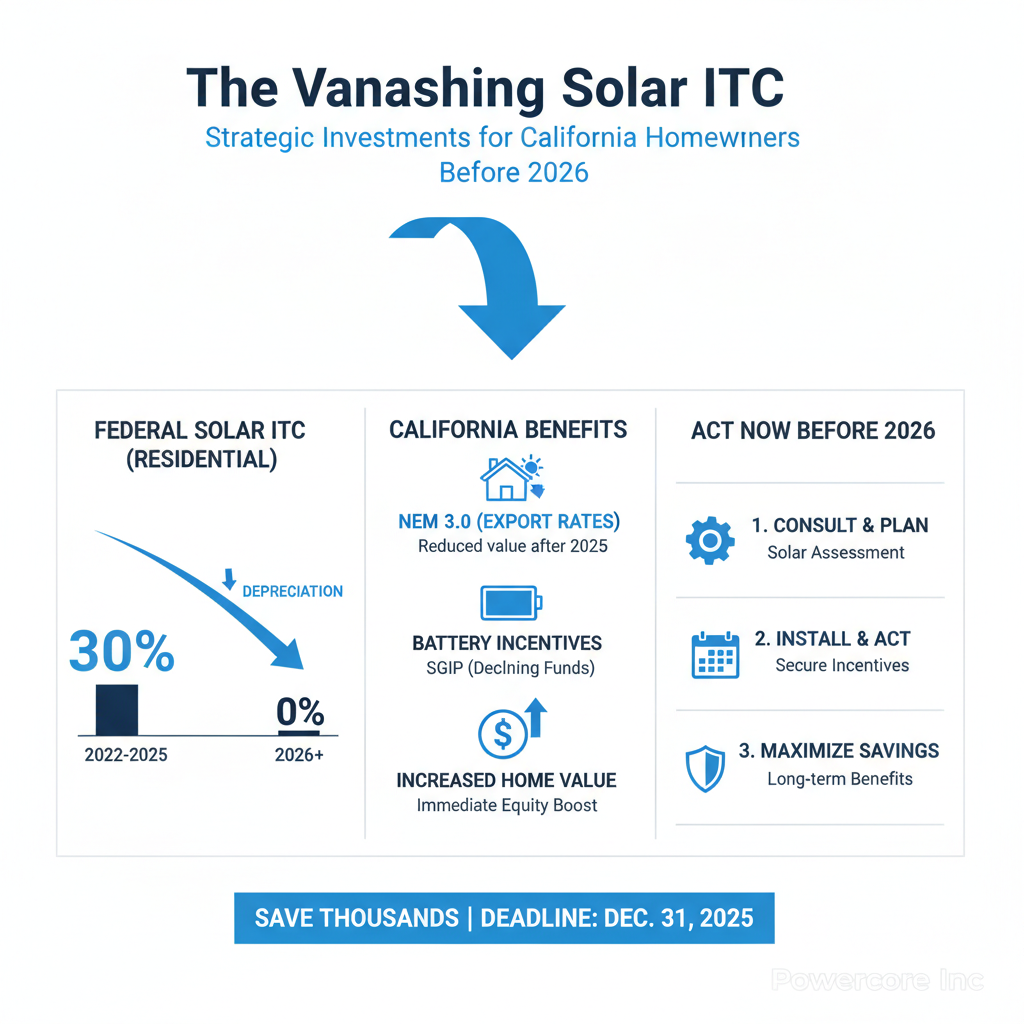
This phased reduction means that the maximum 30% credit is a time-limited offer. The window to capitalize on the most generous federal incentive is rapidly closing for those who plan to install solar in 2026 or later.
Why 2026 is a Critical Deadline for California Homeowners
For California homeowners, the approaching 2026 step-down isn't just a date on a calendar; it's a financial inflection point. The difference between a 30% and a 26% tax credit can amount to thousands of dollars in lost savings on an average-sized solar system.
Considering the high cost of living and energy in California, every dollar saved on a significant home investment like solar counts. Waiting until 2026 or beyond could mean leaving a substantial amount of money on the table. This urgency is compounded by the fact that other state incentives, such as those related to battery storage, can fluctuate. Pairing a high federal credit with existing state programs creates the ultimate savings stack.
Powercore Inc encourages California homeowners to consider the full scope of benefits. The higher ITC not only reduces your initial outlay but also shortens your payback period, increases your long-term return on investment, and enhances your property value. Delaying your solar project could mean missing out on this peak financial advantage.
The Financial Impact: Why Act Before the ITC Vanishes?
Understanding the ITC's step-down schedule is one thing; grasping its tangible financial impact is another. For California homeowners, the decision to go solar before 2026 isn't merely about environmental consciousness; it's a shrewd financial move.
Calculating Your Potential Savings Loss
Let's put some numbers to the change. Consider a typical California solar energy system installation:
- System Cost: $30,000
- With 30% ITC (before 2026): You receive a $9,000 federal tax credit.
- With 26% ITC (starting 2026): You receive a $7,800 federal tax credit.
- With 22% ITC (starting 2027): You receive a $6,600 federal tax credit.
As you can see, waiting from 2025 to 2026 means an immediate loss of $1,200 in federal tax credit for this example system. Waiting until 2027 could mean a $2,400 loss. These figures can be even higher for larger, more comprehensive systems, especially those including battery storage. This isn't a small sum; it's money that could be used for other home improvements, savings, or investments.
Long-Term ROI: The Opportunity Cost of Delay
The impact of the ITC step-down extends beyond the initial tax credit. It directly affects your system's long-term Return on Investment (ROI). A higher initial credit means:
- Faster Payback Period: Reducing your upfront costs by a larger margin means your system pays for itself in energy savings much sooner.
- Increased Lifetime Savings: Over the 25+ year lifespan of a solar system, a quicker payback period and lower net cost translate to greater overall savings on your electricity bills.
- Enhanced Property Value: Solar systems are proven to increase home value. A system installed with the maximum ITC offers a better cost-to-value ratio, making your home even more attractive on the market.
The opportunity cost of delaying your solar installation until after the 2026 step-down is significant. You're not just losing a percentage point; you're diminishing the financial viability of your investment for decades to come.
Beyond the ITC: Stacking State & Local Incentives
While the federal ITC is a major driver, California offers its own array of incentives that can be stacked with the federal credit to maximize your savings. These often focus on specific technologies like battery storage, which has become increasingly vital for California homeowners under the Net Energy Metering (NEM) 3.0 policy.
Programs like the Self-Generation Incentive Program (SGIP) provide rebates for installing battery storage systems, helping you achieve greater energy independence and resilience. Combining a 30% federal tax credit with state and local rebates creates a powerful financial synergy that may not be available indefinitely.
To dive deeper into California's specific battery storage incentives, visit our dedicated page: California Battery Storage Incentives. For a broader overview of financing options, you can also consult our article: Cracking the Code: Your Strategic Guide to California Solar Financing Options.
Powercore Inc specializes in navigating the complex landscape of incentives, ensuring our clients receive every available benefit. We can also provide a more detailed understanding of the federal ITC step-down in our related article: Navigating the Federal Solar Tax Credit Step-Down: A 2026 California Homeowner's Guide.
Strategic Solar Investments for California Homes
Given the impending changes to the federal ITC, now is the time for California homeowners to think strategically about their energy investments. Powercore Inc offers a comprehensive suite of services designed to help you not only go solar but to future-proof your home's energy ecosystem.
Solar PV Systems: Powering Your Home Efficiently
The foundation of any strategic energy plan is a high-performance solar photovoltaic (PV) system. A well-designed system can significantly reduce or eliminate your electricity bills, provide protection against rising utility rates, and enhance your home's environmental footprint. Powercore Inc designs and installs custom residential solar & storage solutions tailored to California's diverse climates and energy needs.
Our expert team considers factors like roof orientation, shading, and your household's specific energy consumption patterns to maximize efficiency and savings. Investing in solar now, with the full 30% ITC, ensures you lock in the best possible value for decades of clean, affordable energy.
Integrating Battery Storage: Maximizing Your Energy Independence
For California homeowners, solar energy is increasingly coupled with battery storage. This is especially true under NEM 3.0, where storing excess solar energy for use during peak evening hours or during power outages becomes a financial and practical necessity. Battery systems allow you to:
- Optimize Self-Consumption: Use your own generated solar power even when the sun isn't shining.
- Capitalize on Time-of-Use (ToU) Rates: Charge your battery when electricity is cheap (midday solar production) and discharge it when rates are expensive (evening peak).
- Ensure Backup Power: Keep essential appliances running during grid outages.
The federal ITC applies to battery storage systems as well, providing another compelling reason to integrate storage with your solar installation before the credit steps down. Powercore Inc specializes in seamless solar & battery storage solutions, helping you achieve true energy independence.
EV Charging Integration: Future-Proofing Transportation
As electric vehicles (EVs) become more prevalent, integrating an EV charging station into your home's energy system is a smart, future-forward move. Powering your EV with solar energy further reduces your carbon footprint and eliminates fuel costs, creating a truly sustainable transportation solution.
The cost of installing an EV charging station can also qualify for the federal ITC when part of a larger clean energy system. By bundling your solar, battery, and EV charging installation now, you can maximize your tax credit savings across all components, making your transition to a greener lifestyle even more affordable.
Considering Other Home Upgrades with Solar
Powercore Inc is a comprehensive home improvement contractor, meaning we can often integrate solar installations with other essential upgrades. If you're considering a new roof, an HVAC system upgrade, or even an ADU, combining these projects with your solar installation can offer logistical and financial efficiencies. While the ITC primarily applies to clean energy, coordinating projects can simplify permitting, reduce overall project timelines, and ensure optimal energy performance across your entire home.
Navigating the Process: Powercore Inc's Expertise
Embarking on a solar project, especially with the urgency of the federal ITC 2026 deadline, requires expertise and reliability. Powercore Inc stands as California's premier choice for strategic energy solutions.
Choosing the Right Contractor in California
In California, selecting a licensed and experienced contractor is non-negotiable. Powercore Inc holds both a General B (CSLB #1134334) and a C-10 Electrical (CSLB #1098175) license. This dual licensing means we are not just solar installers; we are comprehensive construction and electrical experts. This ensures that every aspect of your solar installation, from structural integrity to electrical code compliance, is handled with the highest level of professionalism and safety.
Our extensive experience across California, coupled with our commitment to quality and customer satisfaction, makes us the ideal partner for your solar investment. Don't compromise on expertise when making a long-term investment in your home's energy future.
Powercore Inc's Seamless Solar Installation Process
At Powercore Inc, we believe going solar should be a smooth and stress-free experience. Our process is designed to be transparent and efficient:
- Initial Consultation & Energy Assessment: We analyze your energy consumption, discuss your goals, and assess your property.
- Custom System Design: Our engineers design a solar and/or battery storage system optimized for your specific needs and the California climate.
- Incentive Maximization: We identify and help you apply for all applicable federal, state, and local incentives, including ensuring your project qualifies for the maximum federal ITC.
- Permitting & Approvals: We handle all necessary permits and utility interconnections, navigating California's regulations on your behalf.
- Professional Installation: Our highly trained and licensed crews perform the installation with precision and adherence to the highest safety standards.
- System Activation & Monitoring: Once installed and approved, we activate your system and can help set up monitoring so you can track your energy production and savings.
We are committed to delivering not just a solar system, but a complete energy solution that stands the test of time.
Ensuring Compliance and Maximizing Incentives
Navigating the intricacies of federal tax credits, state rebates, and local permitting can be daunting. Powercore Inc takes the guesswork out of the process. Our team is well-versed in the latest regulations and incentive programs, including the critical requirements for claiming the federal ITC.
We ensure that your installation meets all eligibility criteria, providing you with the documentation needed to confidently claim your tax credit. Our goal is to make sure you receive every dollar of savings you're entitled to, especially as the federal solar ITC 2026 deadline approaches.
FAQs on the Federal Solar ITC and 2026
Q: Can I still get the 30% ITC if I install in 2026?
A: No, the 30% ITC is for systems placed in service before January 1, 2033. For systems placed in service in 2026, the ITC will be 26%. To secure the full 30%, your system must be installed and operational by December 31, 2025.
Q: Does the ITC apply to battery storage?
A: Yes, if your battery storage system has a capacity of at least 3 kilowatt-hours (kWh) and is installed in connection with a solar PV system (or is charged at least 75% by solar), it can qualify for the same federal ITC.
Q: What if my project extends into 2026 or later?
A: The critical date for the ITC is when the system is 'placed in service.' This generally means when it's fully installed and operational. To receive the 30% credit, your system must be placed in service by December 31, 2025. Projects that begin in 2025 but are not fully operational until 2026 or later will fall under the lower ITC rates applicable in those years.
Seize the Opportunity: Secure Your Solar Future with Powercore Inc
The window for maximizing your solar savings with the full 30% federal Investment Tax Credit is rapidly closing. For California homeowners, the strategic decision to invest in solar before the federal solar ITC 2026 step-down is clear. It's an opportunity to lock in substantial savings, enhance your home's value, and achieve lasting energy independence for decades to come.
Don't let this critical deadline pass you by. Powercore Inc is ready to help you design, install, and optimize a custom solar and battery storage solution that meets your unique needs. As your trusted California dual-licensed General B & C-10 Electrical Contractor, we provide unparalleled expertise, quality craftsmanship, and a seamless process from start to finish.
Contact Powercore Inc today to begin your solar journey and secure your maximum savings. Call us directly at 916-699-8778 or visit our contact page to schedule your free consultation. Let's build a brighter, more sustainable, and financially smarter future for your California home, together.