

Introduction: Strategic Solar Investment in a Changing Landscape
For California homeowners considering the switch to solar energy, the coming years represent a critical window of opportunity. The federal solar Investment Tax Credit (ITC), a cornerstone incentive driving solar adoption nationwide, is set to undergo a significant step-down starting in 2026. This isn't just a minor adjustment; it's a call to action for anyone looking to maximize their financial benefits from solar installation. At Powercore Inc, your trusted California dual-licensed General B & C-10 Electrical Contractor, we understand that navigating these changes requires strategic planning and expert guidance.
This comprehensive guide will break down the Residential Clean Energy Credit (formerly the Solar ITC), explain the impending changes, and empower you with the knowledge to make informed decisions for your home. We'll delve into why acting sooner rather than later can secure substantial savings and how Powercore Inc is uniquely positioned to help California homeowners capitalize on this diminishing opportunity. Don't let valuable incentives slip away – let’s explore how to strategically plan your solar investment today.
What is the Federal Solar ITC and Why Does it Matter?
The federal solar Investment Tax Credit, now officially known as the Residential Clean Energy Credit, has been instrumental in making solar energy more accessible and affordable for millions of Americans. It allows homeowners to deduct a significant percentage of the cost of installing a new solar energy system from their federal taxes. This credit applies to the cost of solar panels, inverters, mounting equipment, and even labor costs for installation.
A History of Incentivizing Clean Energy
Initially established in 2005, the ITC has been extended multiple times due to its proven success in stimulating renewable energy growth. Its long-standing presence has helped reduce the upfront cost barrier for homeowners, accelerating the adoption of clean energy technologies across the nation, including here in California. It's not a deduction from your taxable income; it's a direct dollar-for-dollar reduction of your tax liability, making it an incredibly powerful incentive.
Current ITC Value and What it Covers
As of late 2023 and extending through 2024, the federal solar ITC stands at a robust 30% of the total cost of your solar energy system. This includes not only the solar panels themselves but also:
- Labor costs for on-site preparation, assembly, or installation.
- Permitting fees, inspection costs, and developer fees.
- Balance-of-system equipment, including wiring, inverters, and mounting hardware.
- Energy storage devices (batteries) charged exclusively by solar, installed in conjunction with or after the solar system.
For a typical California homeowner investing, for example, $30,000 in a new solar system, a 30% ITC translates to a $9,000 reduction in their federal tax liability. This substantial saving directly impacts the payback period and overall return on investment for solar energy systems.
The ITC Step-Down: What California Homeowners Must Know
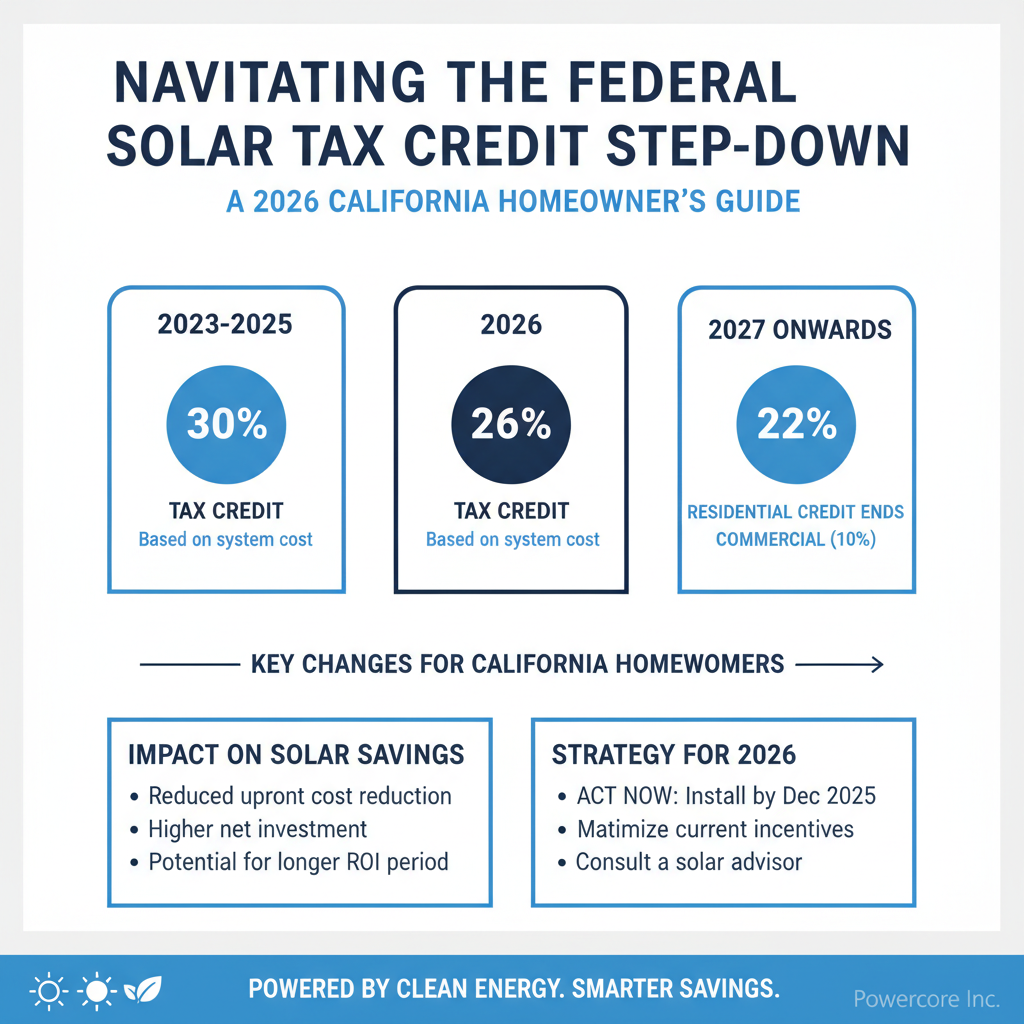
The current 30% federal solar ITC rate is not permanent. As part of its legislative design, the credit is scheduled to step down in value over the next few years. This impending change is why the urgency for strategic planning is paramount for California homeowners.
The ITC Step-Down Schedule
The Residential Clean Energy Credit is structured as follows:
- 30% for systems placed in service from January 1, 2022, to December 31, 2032.
- 26% for systems placed in service from January 1, 2033, to December 31, 2033.
- 22% for systems placed in service from January 1, 2034, to December 31, 2034.
- The credit is scheduled to expire for residential systems placed in service after December 31, 2034, unless renewed by Congress.
While the initial step-down to 26% is not until 2033, the focus keyword "federal solar ITC 2026" highlights the critical need for proactive planning. The current understanding is that the 30% rate is locked in through 2032. However, the *planning* needs to happen well before that to ensure systems are designed, permitted, and installed in time to qualify for the maximum credit. The key takeaway for our California homeowners is that now is the time to plan and act to lock in the highest possible credit.
To further understand the nuances of the schedule, you might find our article on understanding the federal tax credit step-down schedule helpful.
Implications for Your Solar Investment
A reduction from 30% to 26% might seem small, but it translates to thousands of dollars in lost savings on a typical solar installation. Consider our previous example of a $30,000 system:
- At 30% ITC: $9,000 tax credit.
- At 26% ITC: $7,800 tax credit.
That's a difference of $1,200, which is a significant sum that could otherwise contribute to your overall home improvements or be reinvested. The difference only grows larger as the credit further reduces. For homeowners in California, where electricity rates are among the highest in the nation, every dollar saved on installation costs directly enhances the long-term financial viability of solar.
Why Act Now? The Financial Imperative Before the ITC Changes
Beyond the direct impact of the ITC step-down, there are several compelling financial reasons why California homeowners should consider moving forward with solar installation sooner rather than later.
Maximizing ROI and Payback Period
The higher the initial tax credit, the lower your net investment in solar, and consequently, the faster your system pays for itself. A shorter payback period means you start enjoying pure energy savings sooner, increasing your overall return on investment (ROI) over the system's lifespan (typically 25+ years).
Rising Electricity Costs in California
California continues to experience some of the highest and most volatile electricity rates in the U.S. By locking in your energy costs with solar, you gain predictability and protection against future rate hikes. The sooner you install solar, the longer you benefit from generating your own clean, affordable power, compounding your savings over time.
Property Value Enhancement
Studies consistently show that homes with solar panel systems command higher resale values and sell faster than those without. Investing in solar not only reduces your monthly utility bills but also adds tangible value to your property. Securing the highest possible ITC rate means a lower net cost for an asset that boosts your home's market appeal.
Energy Independence and Resilience
With California's grid facing increasing pressure from extreme weather and planned outages (PSPS events), energy independence is more valuable than ever. Pairing your solar system with a solar and battery storage system provides true resilience, keeping your lights on and critical appliances running when the grid goes down. The federal ITC also applies to qualifying battery storage when installed with solar, making this essential upgrade more affordable.
Beyond the Federal ITC: California-Specific Incentives
While the federal ITC is a major driver, California offers its own suite of incentives that further sweeten the deal for solar adoption. Understanding these programs alongside the federal credit is key to comprehensive financial planning.
Net Energy Metering (NEM 3.0)
California's Net Energy Metering (NEM) policy allows solar homeowners to send excess electricity generated by their panels back to the grid in exchange for credits on their utility bill. While NEM 3.0, implemented in April 2023, altered the credit rates compared to previous versions, solar remains a compelling investment, especially when paired with battery storage. Strategic sizing and battery integration are more crucial than ever under NEM 3.0 to maximize self-consumption and offset grid reliance.
California Battery Storage Incentives: SGIP
The Self-Generation Incentive Program (SGIP) is a cornerstone of California's energy storage strategy. This program provides rebates for qualifying behind-the-meter energy storage systems. For many homeowners, especially those in high fire-threat areas or those who rely on medical equipment, SGIP offers significant financial assistance for installing battery backup systems. Powercore Inc can help you navigate the complexities of applying for these valuable California battery storage incentives, ensuring you receive all eligible benefits.
Local and Utility-Specific Programs
Depending on your location within California and your specific utility provider, there may be additional local incentives, rebates, or financing options available. Powercore Inc's team of experts stays up-to-date on all applicable programs to ensure our clients receive the maximum possible savings.
Strategic Planning for Maximum Solar Savings with Powercore Inc
To truly capitalize on the federal solar ITC before its step-down and leverage California's unique energy landscape, a well-thought-out strategy is essential. This is where Powercore Inc, with our deep expertise as a California dual-licensed General B & C-10 Electrical Contractor, becomes your invaluable partner.
Comprehensive Energy Assessment
The first step in any successful solar project is a thorough understanding of your energy consumption. Our team conducts detailed energy audits to assess your current usage patterns, identify opportunities for efficiency improvements, and accurately size a solar system that meets your needs while maximizing savings and preparing for the future.
Tailored Solar and Storage Solutions
We don't believe in one-size-fits-all solutions. Powercore Inc designs and installs custom residential solar solutions tailored to your home's unique characteristics, energy demands, and financial goals. This often includes integrating advanced solar and battery storage systems to optimize self-consumption under NEM 3.0 and provide critical backup power during outages. Our expertise ensures you get a system that performs optimally for decades.
Expert Guidance on Financing Options
Understanding the various financing avenues—cash purchase, solar loan, or even power purchase agreements (PPAs)—is crucial. We help you explore the best options, considering the federal ITC's impact, state incentives, and your personal financial situation. For a deeper dive into financing, refer to our strategic guide to California solar financing options.
Seamless Installation and Permit Navigation
The clock is ticking to secure the highest federal ITC rate. Our efficient project management and experienced installation teams ensure your project moves smoothly from design to energization. We handle all necessary permitting and inspections, navigating California's regulations to deliver a hassle-free experience. Our CSLB #1134334 (General B) and #1098175 (C-10 Electrical) licenses mean you're working with a fully qualified and insured professional.
The Powercore Inc Advantage: Your Trusted California Partner
Choosing the right contractor for your solar investment is as important as the investment itself. Powercore Inc stands out as the premier choice for California homeowners, offering unparalleled expertise and a commitment to quality that ensures your long-term satisfaction.
Dual Licensing: Unmatched Expertise
As a dual-licensed General B & C-10 Electrical Contractor, Powercore Inc brings a holistic approach to your home energy projects. This means we're not just solar installers; we understand the entire building envelope and electrical infrastructure of your home. This comprehensive expertise is crucial for seamless integration, optimal performance, and ensuring your solar system works in harmony with your entire property.
California-Focused Knowledge
Based in Roseville, CA, and serving all of California, we possess an intimate understanding of the state's unique regulations, climate challenges, and incentive programs. Our solutions are specifically designed to perform optimally in California's diverse environments, from the scorching Central Valley to the coastal regions.
Full-Service Home Improvement
Beyond solar and battery storage, Powercore Inc offers a wide array of services including HVAC, Roofing, ADUs, Remodels, EV Charging, Siding, and Decking. This comprehensive capability allows us to integrate your solar project with other home improvements efficiently, offering a single point of contact for complex projects and further optimizing your home's energy efficiency and value.
Understanding the Installation Timeline and Why it Matters
To secure the highest federal solar ITC rate, your system must be "placed in service" within the eligible period. This isn't just about signing a contract; it's about the entire process, from initial consultation to final inspection and utility interconnection. The timeline can vary based on several factors:
- Permitting: Local municipal permitting processes can take several weeks or even months in some areas of California.
- System Design & Engineering: Custom designs require careful planning and engineering reviews.
- Equipment Availability: While generally good, supply chain issues can occasionally cause delays.
- Installation & Inspection: The physical installation can take a few days to a few weeks, followed by local inspections.
- Utility Interconnection: Your utility company must approve and connect your system to the grid, which has its own timeline.
Given these variables, starting your solar journey well in advance of any impending ITC step-downs is crucial. Procrastination could mean missing out on significant tax savings. Powercore Inc works diligently to streamline this process, keeping you informed every step of the way to ensure your project is completed efficiently and on schedule.
The Long-Term Value of Solar Beyond 2026
Even as the federal solar ITC begins its step-down, investing in solar energy remains one of the smartest financial decisions a California homeowner can make. The fundamental benefits of solar transcend temporary incentives:
- Continued Energy Savings: You'll continue to generate your own electricity, significantly reducing or even eliminating your monthly utility bills.
- Environmental Impact: Reduce your carbon footprint and contribute to a cleaner, more sustainable future for California.
- Increased Home Value: Solar panels are a desirable home feature that continues to add value.
- Grid Independence: With battery storage, enjoy peace of mind knowing you have backup power during outages.
- Low Maintenance: Modern solar systems are durable and require minimal maintenance over their long lifespan.
While the step-down makes the near future particularly attractive, the long-term economic and environmental benefits of solar energy are undeniable and will persist for decades.
Conclusion: Act Strategically with Powercore Inc
The window of opportunity to maximize your savings with the full federal solar ITC is closing. For California homeowners, the current 30% rate is available for systems placed in service through 2032, making strategic planning and timely action essential to secure the maximum financial benefits for your solar investment. By partnering with Powercore Inc, you're choosing a dual-licensed, expert contractor dedicated to helping you navigate this evolving landscape and secure the maximum financial benefits for your solar investment.
Don't wait until it's too late to lock in the highest available incentives. Take control of your energy future, reduce your utility bills, increase your property value, and contribute to a sustainable California. Our team is ready to provide a personalized consultation, design a custom solar and storage solution for your home, and guide you through every step of the process.
Ready to strategically plan your solar investment before the federal solar ITC step-down? Contact Powercore Inc today for a free consultation. Call us at 916-699-8778 or visit our contact page to get started. Let Powercore Inc power your home, smarter and more efficiently.