

Introduction: Seizing the Solar Advantage Before the Step-Down
California, a beacon of innovation and environmental stewardship, continues to lead the nation in embracing renewable energy. For homeowners across the Golden State, transitioning to solar power isn't just an eco-conscious choice; it's a strategically sound financial investment. However, a crucial element impacting the long-term value of your solar journey is the Federal Solar Investment Tax Credit (ITC) – and more specifically, its impending step-down schedule.
At Powercore Inc, a dual-licensed General B and C-10 Electrical Contractor based in Roseville, CA, we empower homeowners from San Diego to Redding to make informed decisions about their energy future. We understand that navigating federal incentives, state regulations, and local programs can be complex. This comprehensive guide will illuminate the federal solar tax credit's step-down schedule, explain its profound implications for your potential savings, and outline how strategic planning can help you maximize your investment before these valuable incentives diminish.
Don't let opportunity pass you by. Understanding the ITC's trajectory is key to locking in the highest possible savings for your California home. Let's delve into how you can strategically leverage this powerful financial incentive.
What is the Federal Solar Investment Tax Credit (ITC)?
The Federal Solar Investment Tax Credit (ITC), often referred to simply as the solar tax credit, is one of the most significant incentives for homeowners and businesses to install solar energy systems in the United States. Established in 2005, its primary goal is to accelerate the adoption of solar power by reducing the upfront cost of installation, thereby making renewable energy more accessible and affordable.
How the ITC Works: A Direct Deduction
Unlike a rebate, which is a direct payment, the ITC is a tax credit. This means it directly reduces the amount of income tax you owe to the federal government. For example, if you owe $10,000 in federal taxes and qualify for a $5,000 solar tax credit, your tax liability for that year would be reduced to $5,000. If your credit exceeds your tax liability, you can typically roll over the remaining credit to future tax years, provided you meet certain criteria. It's important to note that the ITC applies to the total cost of your solar energy system, including equipment, installation, and often even associated costs like permitting fees and electrician services.
Eligible Solar Technologies
The ITC is not just for solar panels. It applies to a range of solar energy technologies for your home, including:
- Photovoltaic (PV) Panels: The most common form of solar, converting sunlight directly into electricity.
- Solar Water Heaters: Systems that use solar energy to heat water for your home. (Specific certification requirements apply).
- Battery Storage: Crucially for California homeowners, the ITC also covers standalone battery storage systems installed after December 31, 2022, and those coupled with solar PV systems. This is a game-changer for enhancing energy independence and resilience against power outages.
For California residents, coupling solar PV with battery storage is becoming increasingly vital, especially under the state’s evolving net metering policies. The ITC's inclusion of battery storage makes this strategic combination even more financially attractive, ensuring you can store excess solar energy for use during peak demand hours or grid interruptions.
The Solar Tax Credit Step-Down Schedule Unveiled: Timing is Everything
The ITC has proven incredibly successful in driving solar adoption. Recognizing its effectiveness, Congress has extended and modified the credit multiple times. However, the current iteration includes a defined step-down schedule, meaning the percentage of the credit will decrease in the coming years. Understanding this timeline is paramount for homeowners considering solar installation.
Current and Future ITC Percentages
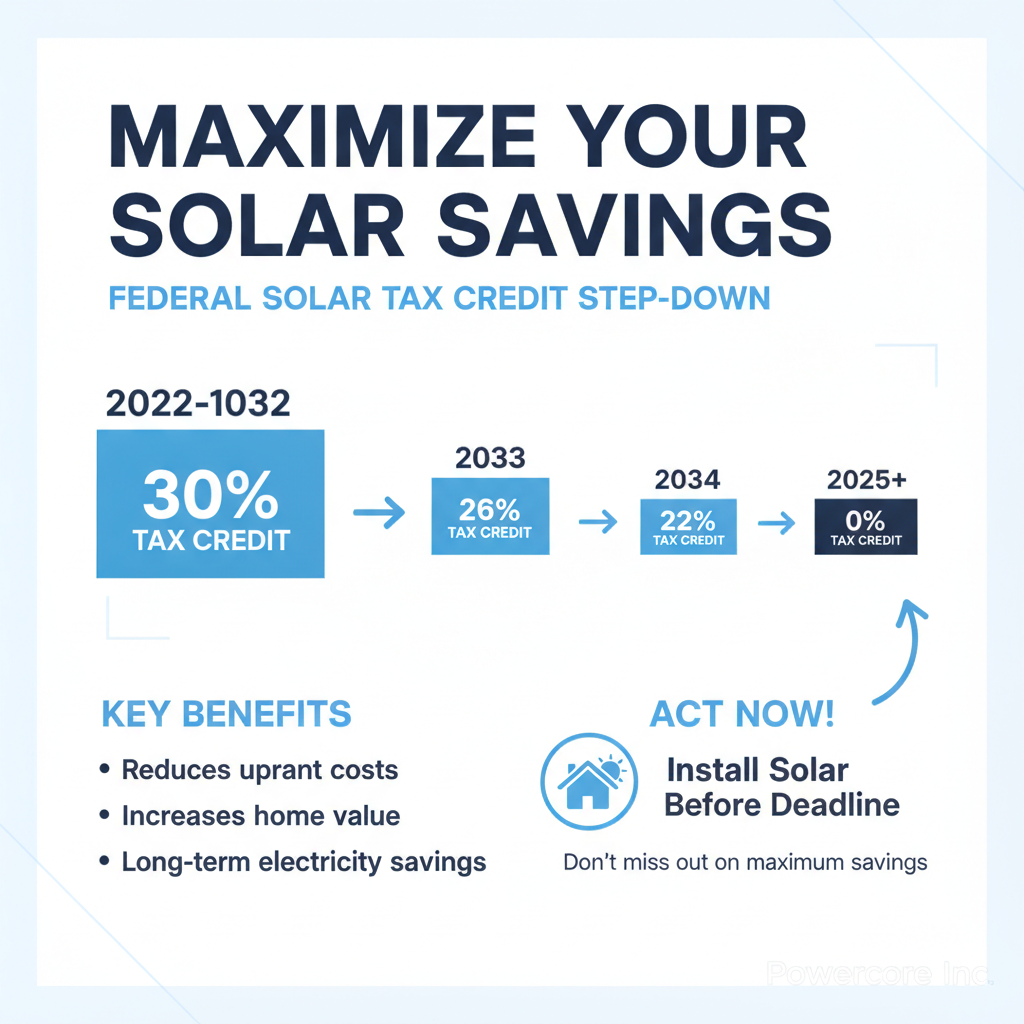
The federal solar tax credit is currently set at a robust 30% for systems placed in service through December 31, 2032. This means that if your solar energy system is installed and operational by the end of 2032, you can claim 30% of its total cost as a credit against your federal taxes.
However, this generous percentage is not permanent. The schedule dictates a reduction in the credit rate:
- 30% for systems placed in service from 2022 through 2032: This is the golden window, offering the maximum available credit.
- 26% for systems placed in service in 2033: A significant reduction from the current rate.
- 22% for systems placed in service in 2034: The credit further decreases.
- 0% for residential systems placed in service after 2034: Unless Congress acts to extend or modify it again, the residential solar tax credit is set to expire for new installations.
This step-down schedule underscores the urgency for California homeowners. Every year you delay could mean a substantial reduction in your potential savings. For a typical solar installation, the difference between a 30% and 26% credit can amount to thousands of dollars.
The Importance of the "Placed in Service" Date
A critical detail for homeowners is the definition of "placed in service." For the purposes of the ITC, a system is generally considered "placed in service" when it is fully installed, operational, and ready to generate electricity. This typically means after all necessary inspections are completed and the utility company has granted Permission to Operate (PTO). It's not enough to simply purchase the equipment or sign a contract; the system must be actively working by the deadline to qualify for that year's credit percentage.
This distinction is particularly important as the deadlines approach. Factors like permitting delays, utility interconnection queues, and even weather can impact installation timelines. Partnering with an experienced contractor like Powercore Inc, with our deep understanding of California's regulatory landscape and efficient project management, can help ensure your system is placed in service within the optimal timeframe.
Eligibility Requirements for the Federal ITC
While the ITC is widely accessible, certain conditions must be met for a homeowner to qualify. Understanding these requirements ensures you can confidently claim your credit.
Who Can Claim the ITC?
- Homeowners: The primary beneficiaries are individuals who own their homes and install solar PV systems on their primary or secondary residences.
- Tax Liability: To fully utilize the credit, you must have a sufficient federal income tax liability. As mentioned, if the credit exceeds your tax liability, you can usually carry forward the unused portion to subsequent tax years.
- Owned Systems: The credit applies to systems you purchase outright, whether with cash or through a solar loan. It does not apply to leased solar systems or power purchase agreements (PPAs), as in these scenarios, you do not own the equipment.
What Qualifies for the Credit?
The total cost that qualifies for the ITC includes:
- The cost of the solar panels or cells themselves.
- Contractor labor costs for on-site preparation, assembly, or installation.
- Permitting fees, inspection costs, and developer fees.
- Balance-of-system equipment, including inverters, wiring, and mounting equipment.
- Sales tax on eligible expenses.
- Battery storage components that are either charged exclusively by the solar PV system or have a capacity of at least 3 kWh (if standalone).
It’s important to keep meticulous records of all expenses related to your solar installation, as these will be needed when filing for the tax credit using IRS Form 5695, Residential Energy Credits.
Calculating Your Solar Tax Credit Potential
Understanding the percentage is one thing; seeing it in action with real numbers makes the financial impact truly clear. Let's walk through a hypothetical example relevant to California homeowners.
A California Solar Investment Scenario
Imagine a homeowner in Roseville, CA, decides to install a new solar energy system along with a battery storage solution to enhance energy resilience and maximize savings under NEM 3.0. The total cost of their Powercore Inc installed system is $35,000.
- System Cost: $35,000 (includes solar PV, battery storage, installation, and permitting).
- Current ITC Rate (2022-2032): 30%
- Calculation: $35,000 * 0.30 = $10,500
In this scenario, the homeowner would be eligible for a significant $10,500 federal tax credit. This directly reduces their federal tax liability, representing a substantial upfront saving on their investment.
Impact of the Step-Down
Now, let's consider the same $35,000 system installed in future years:
- If installed in 2033 (26% ITC): $35,000 * 0.26 = $9,100 (a $1,400 reduction in savings compared to 2032).
- If installed in 2034 (22% ITC): $35,000 * 0.22 = $7,700 (a $2,800 reduction in savings compared to 2032).
These examples vividly illustrate the financial urgency. Delaying your solar installation by just a year or two could cost you thousands of dollars in federal tax credits alone. This doesn't even account for the ongoing energy bill savings you'd be forfeiting during that delay.
Beyond the Federal ITC: California's Solar Landscape
While the federal ITC is a cornerstone of solar incentives, California offers its own dynamic array of programs and policies that homeowners should consider. Powercore Inc helps clients navigate this complex landscape to ensure maximum financial and energy benefits.
Net Energy Metering (NEM 3.0)
California transitioned to NEM 3.0 in April 2023, significantly altering how solar homeowners are compensated for excess energy sent back to the grid. Under NEM 3.0, the export rate for solar energy is generally lower than under previous NEM versions, making battery storage an almost essential complement to new solar installations. Storing your self-generated power for use during peak evening hours, when grid electricity rates are highest, maximizes your economic returns and reduces reliance on the utility.
Powercore Inc specializes in integrated solar + battery storage solutions tailored for NEM 3.0, ensuring our clients achieve optimal energy independence and savings.
Local and Utility Incentives
Beyond state-wide policies, many local jurisdictions and utility companies offer additional incentives. These can include:
- Property Tax Exclusions: In California, the added value to your home from a solar energy system is generally excluded from property tax assessments.
- Local Rebates: Some cities or counties may offer specific rebates or incentives for renewable energy installations.
- PACE Programs: Property Assessed Clean Energy (PACE) programs, while less common for new residential solar installations since NEM 3.0, previously allowed homeowners to finance energy-efficient upgrades through their property taxes. It's always worth exploring current local options.
Staying informed about these localized opportunities is part of Powercore Inc's commitment to providing comprehensive solutions for our California clients.
Strategic Planning for Maximum Solar Savings
Given the federal tax credit step-down and California's evolving energy policies, a proactive and strategic approach to solar adoption is more critical than ever.
Act Now to Lock In the 30% ITC
The most straightforward strategy is to begin your solar journey as soon as possible. By initiating the process with a reputable contractor like Powercore Inc, you increase the likelihood of having your system placed in service before the 30% ITC rate diminishes. The design, permitting, and installation process can take several months, so early engagement is key to meeting the deadlines for maximum savings.
Integrate Battery Storage for NEM 3.0 and Resilience
As discussed, battery storage is no longer just an add-on; it's a fundamental component for maximizing the financial benefits of solar under NEM 3.0. Storing your self-generated power allows you to use it when grid electricity is most expensive, or during power outages, providing true energy independence. The fact that battery storage now qualifies for the ITC (whether paired with solar or standalone) makes this integration even more compelling.
Consider Holistic Home Energy Upgrades
Solar is often part of a larger strategy for home energy efficiency and sustainability. Powercore Inc's extensive range of services—including HVAC, roofing, and general remodeling—means we can help you assess your home's overall energy consumption and identify areas for improvement. A new energy-efficient HVAC system or improved insulation can reduce your energy demand, allowing for a potentially smaller (and less expensive) solar system to meet your needs, further amplifying your savings.
Work with a Reputable and Experienced Contractor
Choosing the right contractor is paramount. Powercore Inc holds both a General B (General Building Contractor) and a C-10 (Electrical Contractor) license in California (CSLB #1134334 and #1098175). This dual licensure signifies our comprehensive expertise in all aspects of home construction and electrical systems, ensuring a seamless, high-quality, and compliant solar installation from start to finish. Our experience navigating California's unique permitting processes and utility requirements means your project will proceed smoothly and efficiently, increasing your chances of meeting the ITC deadlines.
The Long-Term Financial Benefits of Solar: Beyond the ITC
While the federal ITC provides a significant immediate financial boost, the benefits of going solar extend far beyond the initial tax credit, offering sustained financial advantages for decades to come.
Drastically Reduced or Eliminated Electricity Bills
This is perhaps the most obvious and enduring benefit. By generating your own electricity, you significantly reduce your reliance on utility companies and their fluctuating rates. Over the lifespan of your solar system (typically 25-30 years), these savings can amount to tens of thousands of dollars, effectively hedging against future electricity price hikes.
Increased Home Value
Studies consistently show that homes with owned solar energy systems sell for a premium and often faster than comparable non-solar homes. In California's competitive real estate market, a pre-installed solar system is a highly desirable feature, offering a substantial return on investment when it comes time to sell. Remember, under California law, the increased value from solar is exempt from property tax assessment.
Energy Independence and Grid Resilience
With a solar + battery storage system, you gain a degree of independence from the grid. You're less vulnerable to power outages, especially in California, where Public Safety Power Shutoffs (PSPS) and extreme weather events can disrupt electricity supply. This enhanced reliability provides peace of mind and ensures continuous power for essential appliances.
Environmental Impact and Sustainability
While the focus of this article is financial, the environmental benefits are undeniable. By choosing solar, you reduce your carbon footprint, contribute to cleaner air, and support the transition to a sustainable energy future for California and the planet. This aligns with the values of many California homeowners and offers a sense of pride in your contribution.
Why Choose Powercore Inc: Your California Solar Experts
Choosing a solar contractor in California means selecting a partner who understands the unique demands and opportunities of the state's energy landscape. Powercore Inc stands out as your trusted expert for several compelling reasons:
Dual Licensure and Unmatched Expertise
As a dual-licensed General B (#1134334) and C-10 Electrical Contractor (#1098175) in California, Powercore Inc offers a level of expertise and project management that few others can match. This means we are fully qualified to handle not just the electrical aspects of your solar installation but also any associated construction, roofing, or structural modifications, ensuring a truly integrated and code-compliant solution. From initial assessment to final inspection, our comprehensive capabilities mean fewer subcontractors, streamlined communication, and superior quality control.
Comprehensive Home Energy Solutions
Our services extend far beyond solar panels. We offer a holistic approach to home energy and comfort, including:
- Solar & Battery Storage: Custom-designed systems for optimal performance and NEM 3.0 compliance.
- HVAC: Efficient heating and cooling solutions that complement your solar investment.
- Roofing: Expert roofing services, perfect for integrating solar during a roof replacement.
- EV Charging: Seamless installation of electric vehicle charging stations for sustainable transportation.
- ADUs & Remodels: Enhancing property value and functionality with energy-efficient additions and renovations.
- Siding & Decking: Improving curb appeal and outdoor living spaces.
This integrated service offering allows us to provide truly tailored solutions that consider your entire home's energy ecosystem, maximizing efficiency and long-term value.
California-Focused and Community-Driven
Based in Roseville, CA, Powercore Inc is deeply rooted in the California community. We serve homeowners across the entire state, understanding the diverse climates, regulatory environments, and aesthetic preferences from the Bay Area to Los Angeles, the Central Valley to the desert regions. Our commitment is to provide transparent, reliable, and high-quality service that stands the test of time.
Navigating Your Solar Journey with Powercore Inc
Embarking on a solar installation project can seem daunting, especially with the complexities of tax credits, state policies, and technological choices. Powercore Inc simplifies this journey for you.
Our Streamlined Process
- Initial Consultation & Assessment: We begin with a thorough understanding of your energy needs, home structure, and financial goals.
- Custom System Design: Our experts design a solar + battery storage solution optimized for your specific property, energy consumption, and compliance with NEM 3.0.
- Permitting & Incentives Management: We handle all necessary permits and guide you through claiming the federal ITC and any other applicable state or local incentives.
- Professional Installation: Our dual-licensed teams ensure a safe, efficient, and high-quality installation, adhering to the highest industry standards.
- Activation & Monitoring: We ensure your system is properly interconnected with the utility and provide insights into monitoring your new energy production.
Conclusion: Act Now for Maximum Solar Savings
The federal solar tax credit represents an unparalleled opportunity for California homeowners to significantly reduce the cost of going solar. However, with the impending step-down schedule, the window for claiming the maximum 30% credit is closing. Strategic planning and timely action are essential to lock in these substantial savings.
Don't miss out on the chance to enhance your home's value, achieve energy independence, and contribute to a sustainable future, all while benefiting from the most generous federal incentive available. Powercore Inc is your trusted partner for navigating this landscape, providing expert guidance and seamless installation across all of California.
Ready to explore how solar can benefit your California home before the tax credit step-down? Contact Powercore Inc today for a personalized consultation. Call us at 916-699-8778 or visit our website to take the first step towards a brighter, more energy-independent future.