

Introduction: Unlocking Solar Savings in the Golden State
California stands at the forefront of the renewable energy revolution, offering unparalleled sunshine and a clear pathway to energy independence for homeowners. Yet, for many, the initial investment in a solar energy system can seem daunting. This is where understanding California solar financing options becomes not just helpful, but absolutely essential. It's not about whether solar is a good investment in California – it undeniably is – but rather, how to strategically fund it to maximize your financial benefits and long-term return on investment (ROI).
At Powercore Inc, a dual-licensed General B & C-10 Electrical Contractor based in Roseville, CA, we believe that every Californian home deserves access to clean, affordable energy. As experts in solar, battery storage, and comprehensive home improvements across the entire state, we guide homeowners through the intricate landscape of solar financing, ensuring you make an informed decision that aligns with your financial goals and energy needs.
This comprehensive guide will demystify the various financing pathways available, delve into crucial California-specific incentives, and equip you with the knowledge to choose the best option for your home. Get ready to crack the code on solar financing and pave your way to a more sustainable and financially secure future.
Why Solar in California is a Smart Financial Move (Beyond the Obvious)
Before diving into financing, it's vital to grasp the foundational financial benefits that make solar energy such a compelling investment in California:
Escalating Electricity Costs
California has some of the highest and fastest-rising electricity rates in the nation. By generating your own power, you effectively lock in your energy costs, insulating yourself from unpredictable utility rate hikes. Over the lifespan of your solar system, this translates into significant, predictable savings.
Property Value Appreciation
Numerous studies confirm that homes with owned solar energy systems sell faster and for a higher value. Appraisers increasingly recognize solar as a valuable asset, adding a tangible boost to your home’s market worth. This is particularly true in California, where energy efficiency is highly prized.
Energy Independence and Grid Resilience
While often viewed as an environmental benefit, reducing reliance on the grid also offers financial stability. With frequent power outages and increasing demand, generating your own power – especially when paired with battery storage – provides peace of mind and protection against energy disruptions, safeguarding your comfort and potentially critical functions.
The NEM 3.0 Imperative: The Urgency for Battery Storage
California's Net Energy Metering (NEM) 3.0 policy, implemented in April 2023, significantly changed how solar homeowners are compensated for excess energy sent back to the grid. Under NEM 3.0, the export credit rate is substantially lower than under previous policies, making it less financially attractive to simply export excess solar generation during the day. This shift has made integrating battery storage almost essential for maximizing solar ROI in California.
- Maximizing Self-Consumption: Batteries allow you to store surplus solar energy generated during peak production hours (mid-day) and use it during evening peak demand hours when electricity rates are highest and export credits are low.
- Arbitrage Opportunities: By charging your battery when rates are low and discharging when rates are high, you can intelligently manage your energy usage and further reduce your electricity bill.
- Enhanced Resiliency: Beyond financial benefits, batteries provide critical backup power during grid outages, a growing concern for many Californians.
Understanding NEM 3.0's impact is crucial when evaluating California solar financing options, as it often means factoring in the cost of battery storage for optimal performance and savings.
Core California Solar Financing Options: A Detailed Look
Navigating the financing landscape requires understanding the distinct characteristics of each primary option. Let's break them down:
1. Cash Purchase: The Highest ROI
A cash purchase is straightforward: you pay the full upfront cost for your solar energy system. This option offers the highest long-term financial benefits and the fastest payback period.
- Pros:
- Maximum Savings: No interest payments mean all your energy savings go directly into your pocket.
- Full Ownership: You own the system outright, qualifying for all available tax credits and incentives.
- Increased Home Value: Maximizes the property value increase.
- Simplicity: No monthly payments or complex contracts once installed.
- Cons:
- High Upfront Cost: Requires significant capital investment.
- Ties Up Capital: The funds used for solar are not available for other investments.
- Ideal Candidates: Homeowners with readily available funds, who prioritize maximum long-term savings and full control over their investment.
2. Solar Loans: Ownership Without the Upfront Cost
Solar loans allow you to finance the purchase of your solar system, spreading the cost over several years. This is one of the most popular California solar financing options, enabling homeowners to own their system without a large upfront payment.
- Types of Solar Loans:
- Secured Solar Loans: Often tied to your home's equity (e.g., Home Equity Line of Credit - HELOC, or a specific solar loan secured by the system itself). Generally offer lower interest rates due to the collateral.
- Unsecured Solar Loans: Personal loans not backed by collateral. Typically have higher interest rates but are easier to obtain and don't put your home at risk.
- PACE Programs (Property Assessed Clean Energy): Available in some California counties, PACE loans are repaid through an assessment on your property tax bill. They are tied to the property, not the homeowner, and are repaid over long terms (e.g., 20-30 years). While they can be easier to qualify for, they come with specific considerations and risks, including potentially higher interest rates and impacts on selling your home. It's crucial to understand local PACE program specifics.
- Pros:
- Ownership Benefits: You own the system, qualify for the federal ITC and other incentives.
- No Upfront Cost (or Low): Makes solar accessible without depleting savings.
- Predictable Payments: Fixed monthly payments make budgeting easier.
- Immediate Savings: Monthly loan payments are often less than or equal to your previous utility bill, creating immediate net savings.
- Cons:
- Interest Payments: You'll pay interest over the life of the loan, increasing the total cost compared to a cash purchase.
- Credit Requirements: Loan approval depends on your credit score and financial history.
- Ideal Candidates: Homeowners who want to own their system and capture incentives, but prefer not to pay the full cost upfront.
3. Solar Leases: Simplified Solar Access
With a solar lease, you essentially rent the solar energy system from a third-party company. You pay a fixed monthly payment for the use of the system, and the leasing company owns, installs, and maintains it.
- Pros:
- Zero Upfront Cost: Typically no money down.
- No Maintenance: The leasing company is responsible for all maintenance and repairs.
- Predictable Payments: Fixed monthly lease payments.
- Immediate Savings: Your monthly lease payment plus any remaining utility bill is usually less than your previous utility bill.
- Cons:
- No Ownership: You don't own the system, so you don't qualify for the federal ITC or other ownership-based incentives.
- Limited ROI: Savings are limited to the difference between your lease payment and your previous electricity bill.
- Complex Transfer: Selling your home with a leased system can sometimes be more complex, requiring the new homeowner to assume the lease.
- No Property Value Increase (Significant): While a leased system might be attractive, it doesn't add the same level of property value as an owned system.
- Ideal Candidates: Homeowners who want to reduce their electricity bill with no upfront cost or maintenance responsibilities, and who are less concerned with long-term ownership benefits or maximizing property value.
4. Power Purchase Agreements (PPAs): Pay for Power, Not Panels
Similar to a lease, a PPA involves a third-party company owning and maintaining the solar system on your roof. However, instead of paying a fixed monthly lease payment, you agree to purchase the electricity generated by the system at a predetermined per-kilowatt-hour (kWh) rate, often lower than your utility's rate.
- Pros:
- Zero Upfront Cost: No money down required.
- No Maintenance: The PPA provider handles all system maintenance.
- Immediate Savings: You pay less per kWh for solar electricity than you would for utility electricity.
- Predictable Rates: Often offers a fixed rate or a rate with a small, predictable annual escalator.
- Cons:
- No Ownership: You don't own the system or qualify for incentives.
- Less Control: You're tied to the PPA provider's terms and conditions.
- Limited ROI: Similar to leases, savings are primarily from the reduced cost of electricity.
- Contractual Obligations: Long-term contracts (typically 20-25 years) can be difficult to get out of.
- Ideal Candidates: Homeowners who want to utilize solar power immediately without capital investment, and are comfortable with a service agreement rather than ownership.
California-Specific Solar Incentives and Tax Credits
Beyond the financing structure, understanding available incentives is critical for maximizing your solar investment. These programs significantly reduce the net cost of solar installation, making it even more accessible for Californians.
Federal Solar Investment Tax Credit (ITC)
This is the most significant incentive nationwide. The ITC allows homeowners to deduct a percentage of the cost of installing a solar energy system from their federal taxes. For systems installed through 2032, the credit is 30% of the eligible system cost. This applies to both solar panels and qualified battery storage systems.
- Key takeaway: Only available if you *own* your system (cash purchase or solar loan).
California's Self-Generation Incentive Program (SGIP)
The SGIP is a crucial California-specific incentive, particularly relevant under NEM 3.0. It offers rebates for installing distributed generation technologies, with a strong focus on battery storage. The program is tiered, meaning the rebate amount per kWh of storage decreases as more capacity is reserved or installed. There are also equity and equity resiliency components that offer higher incentives for eligible low-income customers or those in high fire-threat areas.
- Why it matters for financing: SGIP significantly offsets the cost of battery storage, making it more feasible to integrate a battery system and maximize your NEM 3.0 savings. Powercore Inc specializes in designing and installing SGIP-eligible battery storage solutions.
Property Tax Exclusion
In California, the added value to your home from a newly installed solar energy system is excluded from property tax assessments. This means you won't pay higher property taxes just because you added solar, saving you potentially thousands of dollars over the system's lifetime.
Sales Tax Exemption (for certain equipment)
While not a blanket exemption, some solar equipment and installations may be exempt from California sales tax, further reducing your overall system cost. Your solar contractor, like Powercore Inc, can provide details on what applies to your specific installation.
Local & Utility Programs
While statewide incentives are significant, some local governments or utility companies (such as PG&E, SCE, SDG&E) may offer additional rebates or programs for solar installation or energy efficiency upgrades. These programs vary widely and can change frequently, so it's always worth checking for localized support. A knowledgeable contractor will be aware of these opportunities.
Comparing Your California Solar Financing Pathways
Choosing among the California solar financing options requires a careful consideration of your financial situation, long-term goals, and appetite for ownership. Here's a comparative overview to help you weigh the pros and cons:
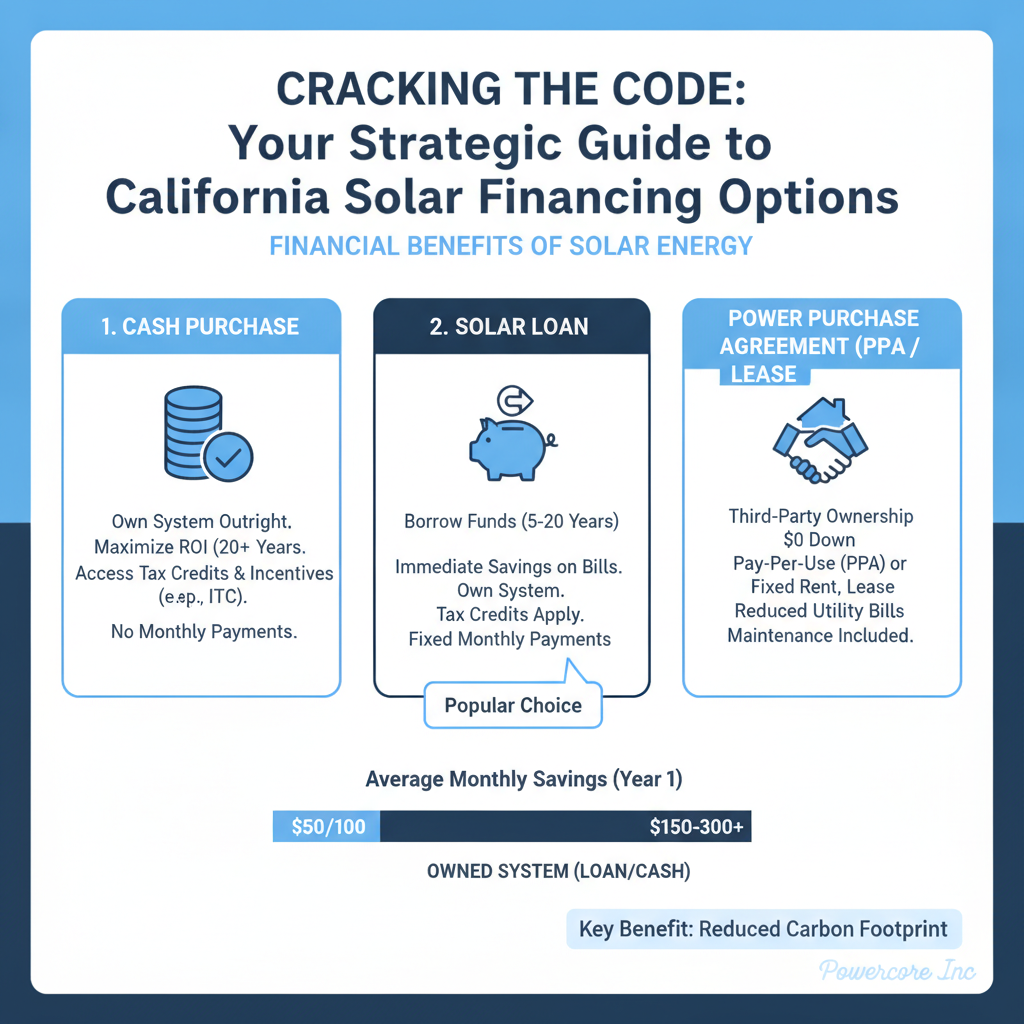
Key Factors to Consider:
- Upfront Cost: How much are you willing or able to pay upfront? (Cash: High; Loan: Low/Zero; Lease/PPA: Zero)
- Long-Term Savings & ROI: How important is maximizing your total financial return? (Cash: Highest; Loan: High; Lease/PPA: Moderate)
- Ownership & Incentives: Do you want to own the system and claim tax credits? (Cash: Yes; Loan: Yes; Lease/PPA: No)
- Maintenance Responsibility: Do you prefer to handle maintenance or have someone else do it? (Cash/Loan: Owner; Lease/PPA: Provider)
- Property Value Impact: How much do you want solar to boost your home's value? (Cash/Loan: Significant; Lease/PPA: Minimal/None)
- Credit Score: What is your credit standing? (Cash: N/A; Loan: Important; Lease/PPA: Less critical but still a factor)
- Flexibility: How much control do you want over your system and energy usage? (Cash/Loan: High; Lease/PPA: Lower)
For most homeowners seeking the best balance of accessibility and long-term financial gain, a solar loan (especially one with favorable terms) often presents the most attractive path, allowing ownership and the capture of significant incentives like the ITC and SGIP, without the large upfront capital requirement.
Beyond Financing: Maximizing Your California Solar ROI
Financing is just one piece of the puzzle. To truly maximize your return on investment in California, especially with NEM 3.0, consider these integrated strategies:
1. Integrate Battery Storage (Essential for NEM 3.0)
As discussed, battery storage is no longer optional for optimal solar performance in California. It allows you to store excess daytime generation for use during evening peak hours, reducing your reliance on expensive grid power and maximizing your energy independence. Powercore Inc specializes in seamlessly integrating state-of-the-art battery systems like Tesla Powerwall 3, ensuring you get the most out of your solar investment.
2. Optimize System Sizing and Design
An undersized system won't meet your needs, while an oversized one is an unnecessary expense. A professional solar contractor like Powercore Inc will conduct a thorough energy audit, analyze your historical consumption, and design a system perfectly tailored to your current and future energy demands, taking into account EV charging, potential HVAC upgrades, or ADU additions.
3. Consider Energy Efficiency Upgrades
The cheapest energy is the energy you don't use. Before going solar, or in conjunction with it, consider improving your home's energy efficiency. This could include upgrading insulation, sealing air leaks, replacing old windows, or installing high-efficiency HVAC systems. Powercore Inc offers a full suite of services, including HVAC, that can significantly reduce your overall energy consumption, allowing for a smaller, more cost-effective solar system.
4. Proactive Monitoring and Maintenance
Regular monitoring ensures your system is performing optimally. Most modern solar systems come with monitoring apps that allow you to track production. While solar panels require minimal maintenance, occasional cleaning and professional inspections can ensure longevity and peak efficiency. Powercore Inc provides ongoing support and expertise to keep your system running smoothly.
5. Plan for Future Electrification
California is moving towards greater electrification (EVs, heat pump water heaters, induction cooktops). When designing your solar system, consider your future energy needs to ensure your investment remains relevant and robust. Our team can help you project these needs and build a scalable solution.
Choosing the Right Partner for Your California Solar Journey
The complexity of California solar financing options, coupled with the technical nuances of system design and installation, underscores the importance of partnering with a reputable and experienced contractor. Here's why Powercore Inc is your ideal choice:
- Dual-Licensed Expertise: As a California CSLB #1134334 (General B) and #1098175 (C-10 Electrical) contractor, Powercore Inc offers comprehensive expertise. This means we don't just understand solar; we understand your entire home's electrical and structural needs, allowing for seamless integration of solar, battery storage, and other home improvements like HVAC, roofing, ADUs, and remodels.
- Statewide Service: From San Diego to Sacramento and beyond, Powercore Inc serves all of California, bringing our expertise directly to your community.
- Holistic Approach: We don't just sell solar panels; we provide integrated energy solutions. Our team considers your home's entire energy ecosystem, recommending solutions that truly maximize your savings and comfort.
- Customer-Centric Focus: We pride ourselves on transparent communication, expert guidance, and exceptional craftsmanship, ensuring a smooth and satisfying experience from consultation to post-installation support.
Conclusion: Your Path to a Brighter, More Sustainable Future
Investing in solar energy for your California home is one of the smartest financial decisions you can make, offering substantial long-term savings, increased property value, and energy independence. While the array of California solar financing options might seem overwhelming at first, understanding each pathway – from cash purchases and solar loans to leases and PPAs – empowers you to make a choice that perfectly fits your financial situation and goals.
Remember to leverage powerful incentives like the Federal ITC and California's SGIP, especially when integrating essential battery storage solutions to thrive under NEM 3.0. By taking a strategic, informed approach, and partnering with a trusted expert like Powercore Inc, you can unlock the full financial potential of solar energy for your home.
Ready to explore the best solar financing option for your California home? Contact Powercore Inc today for a personalized consultation. Our team of experts is here to answer all your questions and design a custom solar and energy storage solution tailored to your needs. Call us at 916-699-8778 and take the first step towards energy independence and significant savings!