

Introduction: Navigating California's Diverse Solar Landscape
California has long been at the forefront of solar energy adoption, setting ambitious renewable energy goals and empowering homeowners to embrace clean power. However, the path to solar savings isn't a one-size-fits-all journey, especially when you consider the unique operating environments of the state's major utility providers: Southern California Edison (SCE) and Pacific Gas & Electric (PG&E).
For millions of Californians, understanding the intricacies of their utility's solar rate structures is paramount to maximizing the financial benefits of a photovoltaic (PV) system. With the recent shift to the Net Billing Tariff, commonly known as NEM 3.0, the rules of engagement for solar homeowners have significantly evolved. This new framework introduces complexities that vary subtly yet significantly between SCE and PG&E territories, directly impacting how much you save, how quickly your system pays for itself, and the optimal design for your energy independence.
This comprehensive guide from Powercore Inc, your trusted California dual-licensed General B & C-10 Electrical Contractor, will demystify the differences between SCE and PG&E solar rates under NEM 3.0. We’ll break down the specific Time-of-Use (TOU) periods, export compensation mechanisms, and strategic considerations essential for homeowners across the Golden State. Our goal is to equip you with the knowledge to make informed decisions and ensure your solar investment delivers maximum value, no matter which utility serves your home.
Understanding NEM 3.0: The Net Billing Tariff Era
Before diving into the specifics of SCE and PG&E, it's crucial to grasp the foundational shift brought about by NEM 3.0, or the Net Billing Tariff, enacted by the California Public Utilities Commission (CPUC) in April 2023. This change fundamentally altered how solar customers are compensated for excess energy sent back to the grid, moving away from a one-for-one retail rate credit system to a new net billing structure.
What is Net Energy Metering (NEM)? A Recap
Historically, Net Energy Metering (NEM) allowed solar homeowners to send their excess electricity generated during sunny periods back to the grid. In return, they received credits on their utility bill, typically at the full retail rate of electricity. This effectively used the grid as a giant battery, allowing homeowners to offset their electricity consumption when their panels weren't producing enough (e.g., at night or on cloudy days).
The Shift to Net Billing Tariff (NEM 3.0)
NEM 3.0 introduces a significant change: export compensation is now based on the Avoided Cost Calculator (ACC) value, which is generally lower than the retail rate. The ACC reflects the value of the energy to the grid, taking into account factors like avoided generation costs, transmission, and distribution. This means that for every kilowatt-hour (kWh) of excess solar energy you send back, you'll receive a credit that is considerably less than what you pay to buy a kWh from the utility.
Key impacts of NEM 3.0 include:
- Reduced Export Compensation: The most significant change, directly affecting the financial payback period of solar-only systems.
- Increased Importance of Time-of-Use (TOU) Rates: Export credits vary dramatically by time of day and season, emphasizing the need for strategic energy management.
- Stronger Incentive for Battery Storage: Storing excess solar energy for self-consumption during high-cost peak hours, or for export when export compensation is highest, becomes far more financially advantageous.
- Mandatory TOU Plans: All new solar customers under NEM 3.0 are required to be on a Time-of-Use rate plan.
For more detailed information on the regulatory framework, you can refer to the California Public Utilities Commission (CPUC) website.
Southern California Edison (SCE) Solar Rates Under NEM 3.0
Serving a vast territory across Central and Southern California, SCE is a critical player in the state's energy landscape. For homeowners in SCE's service area considering or already with solar, understanding their specific TOU rate structure under NEM 3.0 is crucial for optimizing savings.
SCE Time-of-Use (TOU) Rates and Their Impact
SCE offers various TOU rate plans, and under NEM 3.0, new solar customers are typically defaulted to one of the residential TOU plans, such as TOU-D-4-9PM or TOU-D-5-8PM. These plans are designed to encourage energy usage during off-peak hours when demand is lower and electricity is cheaper, and to discourage usage during peak hours when demand is highest and electricity is most expensive.
- Peak Hours: Typically late afternoon to early evening (e.g., 4 PM to 9 PM or 5 PM to 8 PM). This is when electricity is most expensive to buy from SCE, and conversely, when the export compensation for your solar energy is generally highest, though still below retail rates.
- Off-Peak/Super Off-Peak Hours: These are usually morning, midday, and late-night hours. Electricity is cheapest during these times, but export compensation for solar is also at its lowest.
- Seasonal Variation: TOU periods and rates can also vary between summer and winter months, with summer often having higher peak rates and longer peak windows.
The challenge for SCE solar customers under NEM 3.0 is that most solar production occurs during midday off-peak hours when export compensation is lowest. Meanwhile, household consumption often peaks in the evening when solar production has waned, forcing reliance on grid power at its most expensive rate.
Optimizing Your SCE Solar Strategy
To maximize savings in SCE territory:
- Understand Your Specific TOU Plan: Know your exact peak and off-peak times and rates.
- Shift Energy Usage: Run high-consumption appliances (dishwashers, washing machines, EV charging) during super off-peak hours (e.g., late morning or overnight).
- Consider Battery Storage: A battery storage system is almost a necessity under NEM 3.0. It allows you to store your cheap midday solar energy and use it during expensive evening peak hours, drastically reducing or eliminating your need to buy power from SCE at high rates.
Pacific Gas & Electric (PG&E) Solar Rates Under NEM 3.0
PG&E serves a massive swath of Northern and Central California, from Bakersfield to the Oregon border. Like SCE, PG&E's solar customers under NEM 3.0 face a new reality where understanding Time-of-Use rates and managing energy flow are critical for financial success.
PG&E Time-of-Use (TOU) Rates and Their Impact
PG&E's residential solar customers under NEM 3.0 are also placed on specific TOU rate plans, with common options being EV-A or E-ELEC. These plans, while similar in principle to SCE's, often have different peak hour windows and rate differentials.
- Peak Hours: PG&E's peak hours frequently extend later into the evening, often from 4 PM or 5 PM to 9 PM, particularly in summer. This extended peak window can present both challenges and opportunities.
- Off-Peak/Partial-Peak Hours: Similar to SCE, off-peak hours are when electricity is cheapest, typically morning, midday, and late night. PG&E may also have a 'partial-peak' shoulder period with intermediate rates.
- Seasonal Variation: PG&E's rates and TOU periods also adjust seasonally, with summer months generally having higher peak rates and longer peak durations compared to winter.
For PG&E customers, the late evening peak hours mean that solar production is entirely absent during the most expensive consumption period. This makes strategic energy management and battery storage particularly vital to avoid significant charges.
Optimizing Your PG&E Solar Strategy
To maximize savings in PG&E territory:
- Pinpoint Your TOU Schedule: Verify your exact TOU plan and its associated peak, partial-peak, and off-peak hours and rates.
- Aggressive Load Shifting: Prioritize using major appliances during the extensive off-peak periods, especially for high-draw items like EV charging, which can significantly impact your bill. See our insights on EV Charging Stations for more details.
- Invest in Energy Storage: Battery storage is arguably even more critical for PG&E customers due to the late and often prolonged peak periods. Storing solar energy from midday to discharge during these expensive evening hours is the most effective way to reduce utility reliance and maximize self-consumption.
Key Differences & Strategic Implications for Solar Homeowners
While both SCE and PG&E operate under the NEM 3.0 framework, the subtle differences in their rate structures, particularly their Time-of-Use periods and associated costs, lead to distinct strategic implications for homeowners.
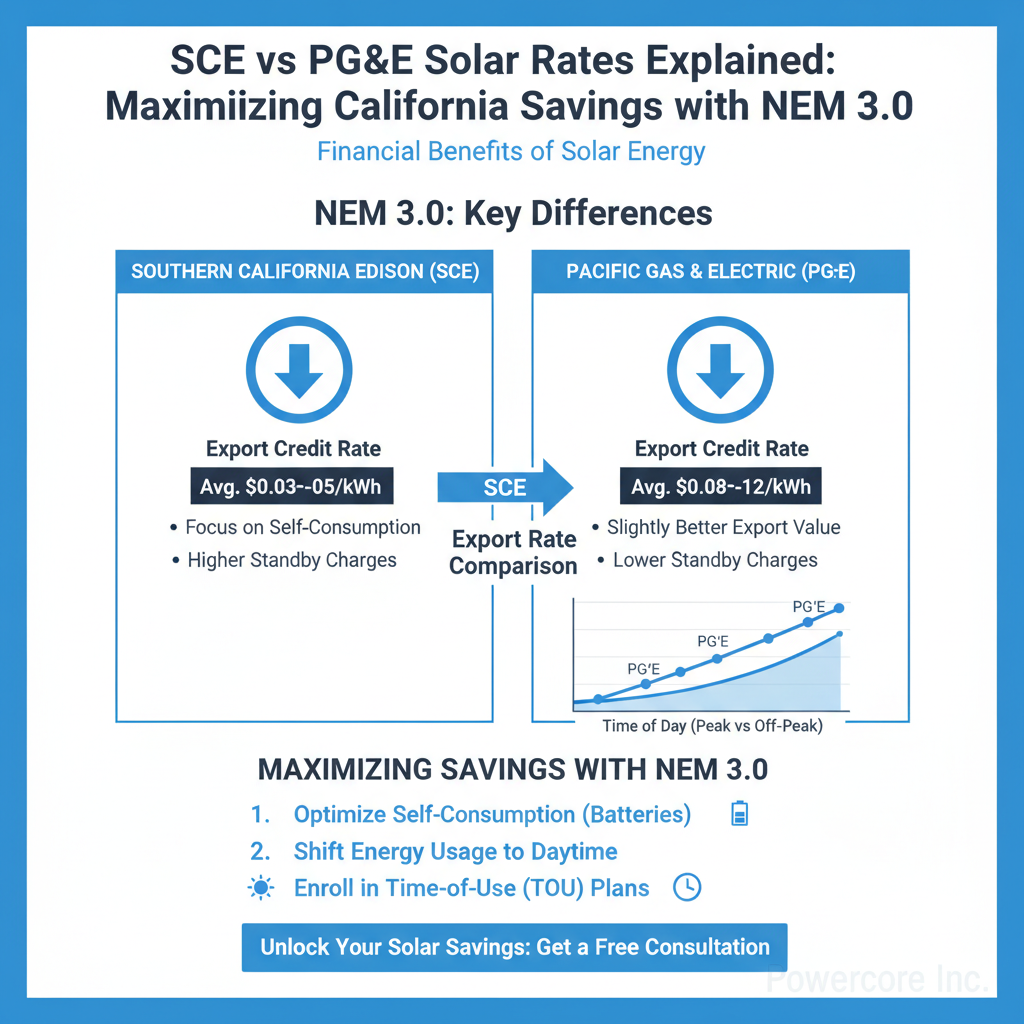
Comparison of Utility Approaches
The core distinction often lies in the specific hours designated as peak and off-peak, and the magnitude of the price differential between these periods. SCE's peak often ends earlier (e.g., 8 PM), while PG&E's can extend to 9 PM or even later. This seemingly small difference profoundly impacts the value proposition of solar and battery storage.
- Peak Period Timing: PG&E's later peak periods mean a longer stretch without solar production during the most expensive hours, increasing the reliance on the grid unless battery storage is implemented.
- Export Credit Value: While both use the ACC, the exact hourly and seasonal ACC values can differ, leading to variations in export compensation. Generally, export credits are highest during peak demand times and lowest during midday when solar production is abundant.
- Rate Structure Complexity: Both utilities have complex rate structures, but homeowners must meticulously analyze their projected consumption patterns against their utility's specific TOU schedule to understand their true savings potential.
The Crucial Role of Battery Storage in NEM 3.0
Under previous NEM versions, solar-only systems could often provide substantial savings by simply offsetting consumption with retail-rate credits. NEM 3.0 fundamentally changes this. Without battery storage, homeowners are effectively selling their excess midday solar energy to the utility at a low ACC rate and buying back grid power during expensive evening peak hours at a high retail rate. This disparity significantly erodes potential savings.
Battery storage acts as your personal energy bank, allowing you to:
- Store Excess Solar: Capture your solar energy generated during low-value midday hours.
- Time-Shift Usage: Discharge that stored energy during the high-value evening peak hours, minimizing or eliminating purchases from the utility when rates are highest.
- Maximize Self-Consumption: Increase the percentage of your own solar energy that you actually use, rather than selling it cheap and buying expensive.
- Provide Backup Power: Offer resilience during grid outages, a significant benefit for many California homeowners.
For a deeper dive into how battery storage can revolutionize your energy independence, explore our Solar & Battery Storage solutions.
Optimizing Solar System Sizing and Design
Under NEM 3.0, accurate solar system sizing is more critical than ever. The goal is no longer just to offset 100% of annual consumption with gross production, but to strategically match production with consumption, especially during peak periods, and to size the system optimally in conjunction with battery storage. Oversizing a system purely for export becomes less financially appealing due to reduced export compensation.
Powercore Inc specializes in Residential Solar & Storage design, ensuring your system is perfectly calibrated for your specific utility's rates and your household's unique energy profile, whether you're in SCE or PG&E territory.
Maximizing Your Solar Savings with Powercore Inc
Navigating the complexities of SCE and PG&E solar rates under NEM 3.0 requires expert guidance and a tailored approach. Powercore Inc, with our deep understanding of California's energy regulations and extensive experience as a dual-licensed General B & C-10 Electrical Contractor, is uniquely positioned to help you maximize your solar investment.
Strategic System Design and Installation
Our approach begins with a comprehensive energy audit and analysis of your specific utility's TOU rates. We design solar and battery storage systems that are optimized to:
- Minimize Grid Purchases: By maximizing self-consumption during expensive peak hours.
- Optimize Export Value: Strategically exporting excess power during periods when ACC values are relatively higher, if applicable.
- Integrate Seamlessly: Ensuring your solar and battery systems work in harmony with your home's energy demands and utility requirements.
The Power of Integrated Battery Storage
For most California homeowners under NEM 3.0, battery storage is no longer just an option; it's a strategic imperative for financial viability. Powercore Inc offers advanced battery storage solutions that integrate flawlessly with your solar panels, providing the ultimate control over your energy usage and bills. Our expertise ensures you get the right size and type of battery system to meet your needs and maximize your return on investment.
Smart Energy Management and Home Electrification
Beyond solar and batteries, Powercore Inc helps you create a holistic energy strategy. This includes advising on:
- Load Shifting: Intelligent scheduling of high-energy appliances.
- EV Charging Optimization: Integrating your EV charging station with your solar and battery system to charge during off-peak solar production or super off-peak grid hours.
- Home Electrification: Utilizing high-efficiency electric appliances, like heat pumps (which we also install through our HVAC Climate Control services), to further reduce reliance on fossil fuels and optimize energy use within your solar envelope.
Leveraging Incentives and Financial Programs
Even with NEM 3.0, significant financial incentives remain for solar and battery storage. Powercore Inc guides you through eligible programs, including:
- Federal Solar Tax Credit (ITC): The Residential Clean Energy Credit allows homeowners to claim a significant percentage of the cost of their solar and battery storage system as a tax credit. This is a crucial component of solar's financial appeal. For more information, you can consult the IRS website or our detailed article: Navigating the Federal Solar Tax Credit Step-Down: A 2026 California Homeowner's Guide.
- Local & State Programs: While direct solar incentives have shifted, other programs for energy efficiency or specific technologies may still be available.
- Strategic Ownership: Understanding the difference between purchasing and leasing your solar system is vital for maximizing long-term wealth. Explore our guide: Strategic Solar Investment: Purchase vs. Lease for Maximum California Home Value.
Powercore Inc: Your Trusted California Solar Partner
Choosing the right solar contractor is as important as choosing the right system. Powercore Inc is a California dual-licensed General B (#1134334) & C-10 Electrical Contractor (#1098175) based in Roseville, CA, serving the entire state of California. Our comprehensive expertise spans not only solar and battery storage but also HVAC, roofing, ADUs, remodels, EV charging, and more, providing a holistic approach to home energy and improvement.
We understand that every home and every homeowner's energy goals are unique. That's why we pride ourselves on delivering personalized, data-driven solutions that are transparent, efficient, and built to last. When you partner with Powercore Inc, you're not just getting a solar system; you're investing in a long-term energy strategy designed to deliver maximum financial savings and energy independence under California's evolving utility landscape.
Conclusion: Empowering Your Solar Future
The transition to NEM 3.0, coupled with the distinct rate structures of Southern California Edison and PG&E, presents both challenges and unparalleled opportunities for California homeowners. Understanding these nuances is the first step towards unlocking true solar savings. By strategically integrating solar with battery storage, optimizing energy usage, and leveraging available incentives, you can navigate the new energy frontier with confidence.
Don't let the complexity of utility rates deter you from embracing the financial and environmental benefits of solar energy. Powercore Inc is here to guide you every step of the way, from initial consultation and custom design to expert installation and ongoing support. Take control of your energy future today.
Ready to explore how solar and battery storage can maximize your savings under NEM 3.0 in SCE or PG&E territory? Contact Powercore Inc for a personalized consultation and a free, no-obligation quote. Call us today at 916-699-8778 or visit our contact page to get started.