

The Solar Dilemma: Lease or Purchase for Your California Home?
As a California homeowner, embracing solar energy is more than just an environmental choice; it's a significant financial decision that impacts your property value, monthly expenses, and long-term wealth. The golden state, with its abundant sunshine and commitment to renewable energy, offers an ideal environment for solar adoption. However, navigating the various financing options – specifically, whether to purchase or lease your solar panels – can feel daunting. This choice is crucial, dictating not only how you pay for your energy but also the financial returns and responsibilities you undertake.
At Powercore Inc, a dual-licensed General B & C-10 Electrical Contractor based in Roseville, CA, we understand that every homeowner’s financial situation and long-term goals are unique. Our mission is to empower you with the knowledge to make the most strategic investment for your home and future. This comprehensive guide will dissect the nuances of solar leases versus purchases, especially through the lens of California's dynamic energy market, helping you unlock maximum value and savings.
California's Solar Opportunity: Why Go Green?
California leads the nation in solar energy adoption for good reason. High electricity rates, generous incentives (historically), and a strong environmental ethos make solar an attractive proposition. Beyond the undeniable environmental benefits of reducing your carbon footprint, solar offers tangible financial advantages:
- Significant Savings: Drastically reduce or eliminate your monthly electricity bills.
- Increased Home Value: Owned solar systems are proven to increase property value.
- Energy Independence: Protect yourself from unpredictable utility rate hikes.
- Tax Incentives: Federal and state incentives can substantially offset initial costs for owned systems.
However, realizing these benefits to their fullest depends heavily on your financing strategy. Let's delve into the two primary pathways: purchasing and leasing.
Understanding Solar Financing Options: Lease vs. Purchase Explained
Choosing your solar financing model is perhaps the most critical decision after deciding to go solar itself. Each option comes with a distinct set of benefits, drawbacks, and financial implications. We’ll explore these in detail, focusing on what they mean for a California homeowner.
Solar Purchase: Owning Your Energy Future
Purchasing solar panels means you own the system outright, just like any other upgrade to your home. This can be done through a cash payment or a solar loan.
Cash Purchase: The Highest ROI
How it Works: You pay the full cost of the solar system upfront. This is the simplest method and often yields the highest long-term financial returns.
Benefits for California Homeowners:
- Maximum ROI: By avoiding interest payments and immediately owning all generated power, you maximize your lifetime savings and return on investment.
- Full Incentives: You are eligible for the federal solar tax credit (Investment Tax Credit - ITC), which currently allows you to deduct 30% of the system cost from your federal taxes. California may also offer local or utility-specific incentives for homeowners, which you can fully leverage.
- Increased Home Value: An owned solar system is a significant asset that demonstrably increases your home's resale value in California. Studies have shown homes with owned solar sell for more and faster.
- Complete Control: You have full control over your system's output and any future upgrades or modifications.
- No Monthly Payments: Once paid for, your electricity costs are virtually eliminated, aside from a minimal grid connection fee from your utility.
Considerations:
- High Upfront Cost: Requires substantial capital, which may not be feasible for everyone.
- Maintenance Responsibility: While solar systems are low-maintenance, you are responsible for any cleaning, repairs, or monitoring (though Powercore Inc offers comprehensive support and maintenance plans).
Solar Loan: Financed Ownership
How it Works: You take out a loan specifically for your solar system. This could be a secured loan (like a home equity loan or PACE program loan, though PACE has specific considerations) or an unsecured solar loan. You make monthly payments on the loan until it's paid off, at which point you own the system free and clear.
Benefits for California Homeowners:
- Ownership without Upfront Cash: Get the benefits of ownership (like the ITC and increased home value) without a large initial outlay.
- Lower Monthly Bills: Your loan payment combined with a reduced utility bill is often less than your previous utility bill, leading to immediate savings.
- Increased Home Value: Similar to a cash purchase, an owned system financed through a loan still adds value to your property.
- Eligible for Incentives: You still qualify for the federal ITC and any other applicable state/local incentives.
Considerations:
- Interest Payments: You'll pay interest over the life of the loan, which reduces your overall ROI compared to a cash purchase.
- Debt Obligation: It's another monthly payment, and the loan is typically secured against your home for longer terms, affecting your debt-to-income ratio.
- Maintenance: Similar to cash purchase, you are responsible for maintenance.
Solar Lease or PPA: Renting Your Savings
A solar lease or Power Purchase Agreement (PPA) is essentially renting solar panels. You don't own the system; a third-party company owns, installs, and maintains it on your roof.
Solar Lease: Fixed Monthly Payment
How it Works: You pay a fixed monthly fee to the solar company for the right to use the panels and the electricity they generate. This payment might escalate by a small percentage annually (e.g., 2.9% escalator) over the 20-25 year term.
Benefits for California Homeowners:
- No Upfront Cost: Often requires $0 down, making solar accessible to more homeowners.
- Predictable Payments: You have a consistent monthly payment for the lease, making budgeting easier.
- Maintenance Included: The solar company is responsible for all maintenance, repairs, and performance monitoring.
- Immediate Savings: Your combined lease payment and reduced utility bill is typically less than your previous utility bill, offering instant savings.
Considerations:
- No Ownership: You don't own the system, so you don't build equity or directly benefit from increased home value.
- No Incentives: The solar company claims the federal ITC and any other incentives, as they are the system owner.
- Potential Home Sale Complications: Transferring a solar lease to a new homeowner can sometimes complicate or delay a home sale, as the new buyer must qualify and agree to assume the lease.
- Less Long-Term Savings: While you save immediately, the overall lifetime savings are significantly less than with an owned system due to ongoing payments and lack of incentives.
Power Purchase Agreement (PPA): Pay for Power Produced
How it Works: Similar to a lease, a PPA involves a third party owning and maintaining the system. However, instead of paying a fixed monthly lease fee, you agree to purchase the electricity generated by the panels at a fixed rate per kilowatt-hour (kWh), which is typically lower than your utility's rate. This rate may also have an annual escalator.
Benefits for California Homeowners:
- No Upfront Cost: Like a lease, PPAs generally require no money down.
- Performance Assurance: You only pay for the power the system actually produces, aligning the solar company's interest with optimal system performance.
- Maintenance Included: The solar provider handles all maintenance.
- Immediate Savings: You pay a lower rate for electricity than your utility, leading to immediate savings.
Considerations:
- Variable Monthly Costs: Your bill fluctuates based on how much electricity your panels generate, which can vary with season and weather.
- No Ownership or Incentives: Similar to a lease, you don't own the system or receive any tax credits.
- Home Sale Complications: Transferring a PPA can also present challenges during a home sale.
California's Unique Solar Landscape: NEM 3.0 and Beyond
California's energy market is constantly evolving, and recent changes, particularly the implementation of Net Energy Metering (NEM) 3.0, profoundly impact the financial viability of solar, and thus, the lease vs. purchase decision. Under NEM 3.0, the export credit rates for solar energy sent back to the grid are significantly lower than under previous NEM policies. This change has made battery storage solutions almost essential for maximizing solar savings.
- Impact on Purchase: Homeowners who purchase a solar system, especially when paired with battery storage, are best positioned to navigate NEM 3.0. They retain full control over their generated power, allowing them to optimize battery charging and discharging strategies to minimize reliance on grid imports during expensive peak hours and maximize self-consumption. They also directly benefit from the federal ITC on both solar and battery components.
- Impact on Lease/PPA: While some lease/PPA agreements now include battery storage, the homeowner still doesn't own the assets. The third-party company dictates the battery's operational strategy, which may not always be perfectly aligned with the homeowner's individual consumption patterns or future utility rate changes. The financial benefits of storage are passed through in the lease/PPA payment structure, rather than directly accruing to the homeowner through reduced bills and incentives.
This emphasizes that for long-term financial gain and true energy independence in California's NEM 3.0 era, ownership (especially with battery storage) generally offers a more robust and adaptable solution.
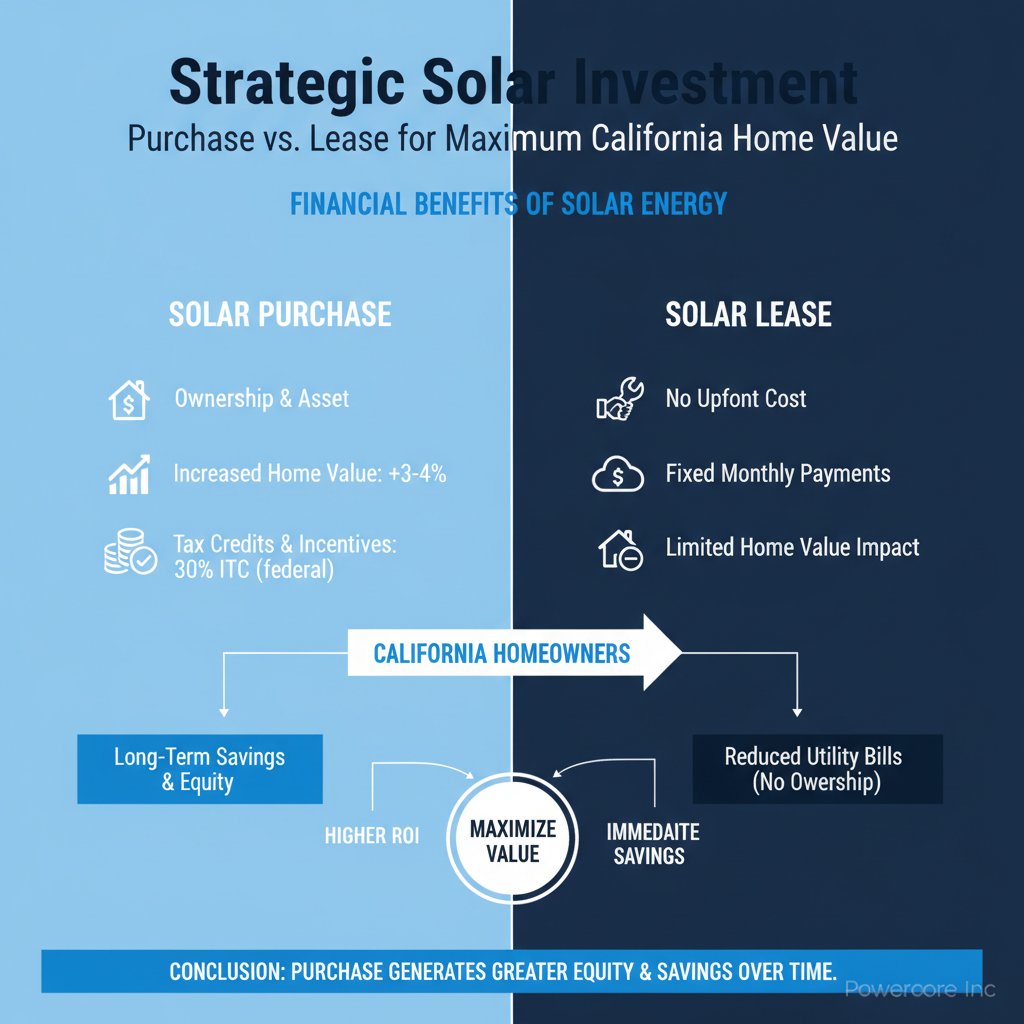
The Strategic Financial Play: Purchase vs. Lease – A Deep Dive
To truly make a strategic investment, it's crucial to compare these options across several key financial metrics. Let's look at how purchase (cash or loan) and lease/PPA stack up for California homeowners.
Long-Term Savings and ROI
- Purchase: Offers the highest long-term savings and ROI. After the system is paid off (either upfront or through a loan), your electricity costs plummet, leading to tens of thousands of dollars in savings over the system's 25-30 year lifespan. The federal ITC significantly boosts this ROI.
- Lease/PPA: Provides immediate, but more modest, savings. While your monthly payment might be lower than your old utility bill, you continue to pay for electricity for the entire contract term. The lack of tax credits and eventual system ownership means significantly less overall financial gain compared to purchasing.
Home Value Impact
- Purchase: An owned solar system is considered a home improvement that adds tangible value to your property. Appraisers often factor in the energy savings and improved marketability. In California, homes with owned solar typically sell for a premium and spend less time on the market.
- Lease/PPA: Leased systems generally do not add value to your home and can even become a liability during a sale. Potential buyers must assume the lease, which can be a turn-off or a hurdle if they don't qualify or prefer to own their energy system.
Tax Benefits
- Purchase: You are eligible for the substantial federal solar Investment Tax Credit (ITC), currently 30% of the system cost. This is a direct dollar-for-dollar reduction in your federal income tax liability. You may also be eligible for state or local property tax exemptions on the added value from solar.
- Lease/PPA: The solar company, as the owner, claims all tax incentives. You, as the homeowner, receive no direct tax benefits from the solar installation.
Maintenance and Responsibility
- Purchase: You are responsible for maintenance. However, modern solar panels are extremely durable and require minimal upkeep. Many systems come with long warranties (25+ years on performance) from manufacturers. Powercore Inc also offers optional maintenance packages to ensure your system performs optimally for decades.
- Lease/PPA: The leasing company is responsible for all maintenance and repairs, providing peace of mind from that perspective.
Flexibility and Resale
- Purchase: Offers maximum flexibility. You can upgrade, expand, or modify your system as your energy needs change or as technology advances. When you sell your home, the solar system is an asset that transfers with the property, enhancing its appeal.
- Lease/PPA: You are tied to a long-term contract (typically 20-25 years). Early termination usually incurs significant penalties. Transferring the lease to a new buyer can be a complex process, potentially delaying or even jeopardizing a home sale.
When Does a Solar Purchase Make Sense?
A solar purchase, whether cash or financed, is often the most financially advantageous option for California homeowners, especially if you:
- Plan to stay in your home long-term (5+ years): This allows you to fully realize the long-term savings and ROI.
- Have the upfront capital or access to favorable loan terms: If you can afford the initial investment or secure a low-interest solar loan, your overall savings will be maximized.
- Want to maximize your home's value: An owned solar system is a proven asset that boosts property value.
- Desire complete energy independence and control: You want to own your power generation and fully leverage incentives like the federal ITC.
- Are comfortable with minimal maintenance: While low, there's some responsibility for upkeep with an owned system.
- Prioritize maximizing financial returns: If your primary goal is the highest ROI and long-term savings, purchasing is the clear winner.
For strategic investors in their home and future, purchasing solar through Powercore Inc represents a smart, long-term play against rising energy costs and for increased property value.
When Might a Solar Lease Be Preferable?
While often less financially rewarding in the long run, a solar lease or PPA can be a viable option in specific circumstances:
- Limited Upfront Capital: If you have no savings for a down payment and don't qualify for a loan, a lease offers a zero-down pathway to solar.
- Shorter-Term Homeownership: If you anticipate moving within 3-5 years and don't want the long-term commitment of ownership or the potential hassle of transferring a loan, a lease might offer a simpler (though still potentially problematic) exit strategy.
- Desire for No Maintenance Responsibility: If you prefer to outsource all maintenance and performance monitoring, a lease provides this convenience.
- Immediate, Modest Savings are the Priority: If your primary goal is immediate, albeit smaller, monthly savings without any financial outlay or responsibility.
It's crucial to understand the long-term implications and potential resale challenges associated with leases and PPAs. Powercore Inc will always provide transparent information to help you weigh these factors against your personal circumstances.
Navigating Your Decision with Powercore Inc: Your Trusted California Partner
Making the right solar financing decision for your California home requires careful consideration of your financial situation, long-term goals, and the evolving energy landscape. As a California dual-licensed General B & C-10 Electrical Contractor (CSLB #1134334 and #1098175), Powercore Inc brings unparalleled expertise and a holistic approach to your home's energy and infrastructure needs.
Our team understands the intricacies of California's solar market, including the latest NEM 3.0 regulations and how they impact your ROI. We don't just install solar; we offer a comprehensive suite of services including solar, battery storage, HVAC, roofing, ADUs, remodels, EV charging, siding, decking, and interior remodeling, ensuring a cohesive and optimized solution for your entire property.
We pride as a strategic partner, helping you:
- Assess Your Energy Needs: A thorough analysis of your historical consumption and future energy goals.
- Design the Optimal System: Tailoring a solar and battery storage system specifically for your home's unique characteristics and California's climate.
- Understand Financing Options: Providing clear, unbiased explanations of purchase (cash/loan) vs. lease/PPA, including all applicable incentives.
- Maximize Your Investment: Guiding you towards the financing strategy that offers the highest long-term value, savings, and home equity.
With Powercore Inc, you gain access to a team of experts committed to delivering quality, reliability, and exceptional customer service across all of California. We pride ourselves on empowering homeowners to make informed decisions that future-proof their homes and finances.
Conclusion: Invest Wisely in Your Solar Future
The choice between leasing and purchasing solar panels is more than just a payment preference; it’s a strategic financial investment that will impact your home's value, your monthly budget, and your overall financial health for decades. While solar leases offer a low-barrier entry, purchasing your solar system almost invariably leads to greater long-term savings, increased home equity, and maximum financial benefit, especially in California's current energy environment. By owning your energy future, you harness the full power of the sun and secure a valuable asset for your home.
Ready to explore the best solar financing strategy for your California home? Contact Powercore Inc today for a personalized consultation. Our experts will help you navigate your options and design a system that maximizes your savings and enhances your property value. Call us at 916-699-8778 or visit gopowercoreinc.com to learn more about how we can transform your home's energy future.