

Introduction: Beyond the Basic Solar ROI Calculator in California
In the golden state of California, the sunshine is abundant, and so is the promise of solar energy. For homeowners considering a switch to solar, the term 'Return on Investment' (ROI) is often at the forefront of their minds. While a simple solar ROI calculator can provide a preliminary estimate, understanding the true, long-term financial benefits of solar in California requires a far more strategic and nuanced approach. It's about looking beyond the initial numbers and delving into the intricate factors that shape your savings and energy independence.
California's energy landscape is dynamic, with evolving utility rates, incentive programs, and grid policies like NEM 3.0. These elements significantly impact your solar system's performance and financial returns. At Powercore Inc, a dual-licensed General B & C-10 Electrical Contractor based in Roseville, CA, we understand that a successful solar investment is not just about installing panels; it's about crafting a personalized energy strategy that maximizes your ROI for decades to come, no matter where you are in California.
What is Solar ROI and Why It Matters in California
Simply put, Solar ROI (Return on Investment) measures the financial benefit you gain from your solar panel system relative to its cost. For California homeowners, this calculation is particularly compelling due to several factors:
- High Electricity Costs: California consistently has some of the highest electricity rates in the nation, making the savings from generating your own power substantial.
- Abundant Sunlight: Our sunny climate ensures optimal panel performance and significant energy production throughout the year.
- Environmental Impact: Beyond financial gains, solar energy offers invaluable environmental benefits, reducing your carbon footprint and contributing to a sustainable future.
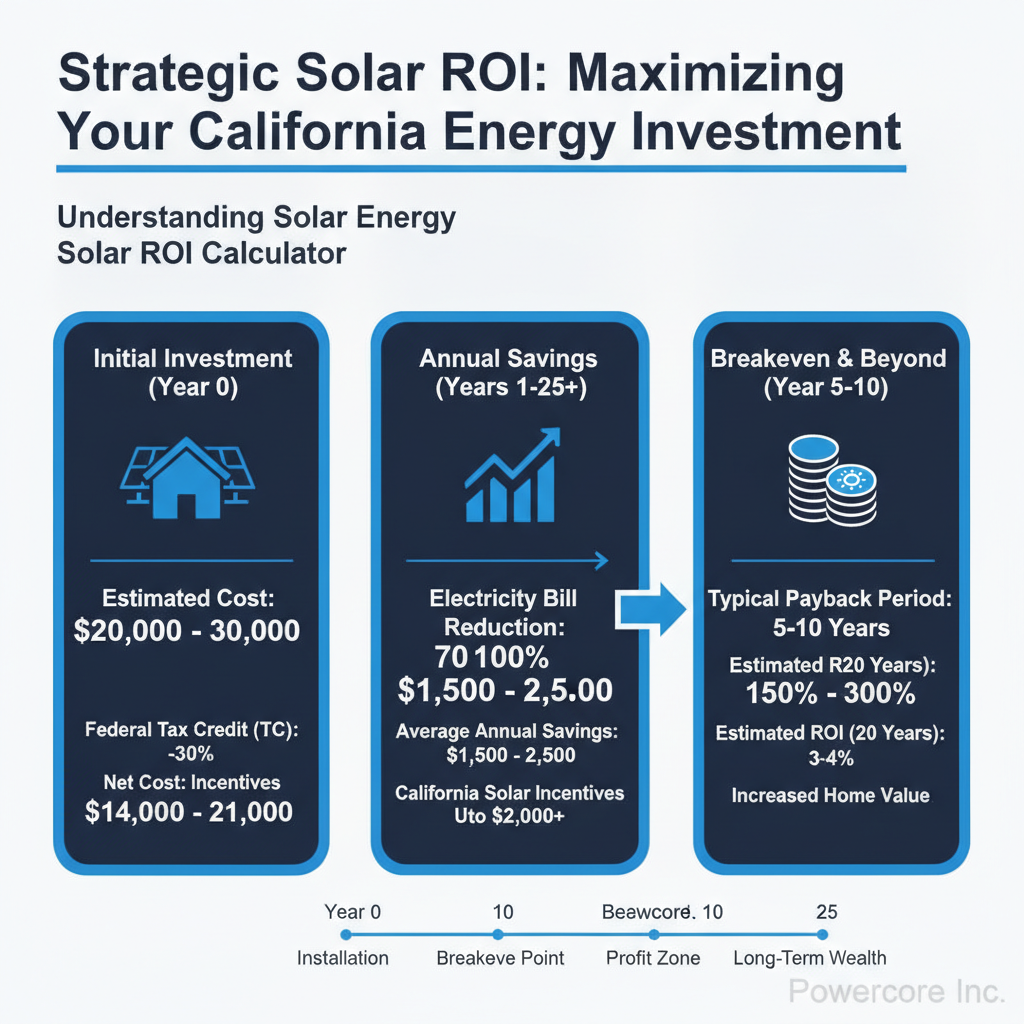
Calculating solar ROI involves comparing the total cost of your system (purchase, installation, maintenance) against the total savings and earnings it generates over its lifespan (reduced utility bills, potential earnings from excess energy, increased home value). A positive ROI means your investment pays for itself and then some, transforming your home into a self-sufficient power generator.
Key Factors Influencing Your California Solar ROI
While the concept of ROI is straightforward, its calculation for solar in California is anything but. Here are the critical elements that will shape your ultimate return:
Initial System Cost and Installation Quality
The upfront cost of your solar system includes panels, inverters, racking, and installation labor. While it's tempting to seek the lowest bid, remember that quality of equipment and installation directly impacts system efficiency, longevity, and ultimately, your ROI. A properly designed and installed system by experts like Powercore Inc minimizes future maintenance and maximizes energy production, ensuring consistent savings.
California's Utility Rates and Time-of-Use (TOU)
California's utility rates are complex, often featuring tiered pricing and Time-of-Use (TOU) structures. TOU rates mean electricity costs more during peak demand hours (typically late afternoon/early evening) and less during off-peak hours. Your solar ROI is significantly boosted by offsetting the most expensive peak-hour electricity. Strategic energy management, often paired with battery storage solutions, becomes crucial to maximize savings under these rate structures. For a deeper dive, check out our article on Mastering California's Time-of-Use Rates.
Solar Incentives, Tax Credits, and Rebates
These financial aids can dramatically reduce your net system cost and accelerate your ROI:
- Federal Solar Investment Tax Credit (ITC): The Residential Clean Energy Credit, as detailed by the IRS, offers a significant tax credit for solar system installations (currently 30% for systems installed through 2032). This is a direct reduction in your federal tax liability.
- California Battery Storage Incentives: Programs like the Self-Generation Incentive Program (SGIP) in California offer rebates for installing battery storage systems, which are increasingly vital for maximizing solar savings under NEM 3.0. Learn more about California Battery Storage Incentives.
- Local Programs: Some municipalities or utility companies may offer additional local incentives. It's important to research what's available in your specific area.
Net Energy Metering (NEM 3.0)
NEM 3.0, implemented in California, significantly changed how solar homeowners are compensated for excess energy sent back to the grid. While it reduces the export credit value compared to previous NEM versions, it makes home battery storage an even more critical component for optimizing solar ROI. Batteries allow you to store surplus solar energy generated during the day and use it during peak evening hours, avoiding expensive grid electricity and maximizing self-consumption.
System Size and Performance
An accurately sized system is paramount. Too small, and you won't offset enough of your electricity bill; too large, and you might overspend without proportional returns, especially under NEM 3.0. Factors like panel efficiency, inverter quality, roof orientation, shading, and local weather patterns all play a role in how much electricity your system will produce over its lifetime. Our experts at Powercore Inc ensure your system is perfectly tailored to your home's energy needs and California's unique conditions.
Maintenance and Longevity
Modern solar panels are durable and require minimal maintenance, but occasional cleaning and system checks ensure optimal performance. Most panels come with a 25-year performance warranty, meaning your investment continues to pay off for decades. A long-lasting system with consistent output translates to a higher overall ROI.
Increased Home Value
Studies consistently show that homes with owned solar panels sell for a premium and often faster than comparable non-solar homes. This added property value is a significant, often overlooked, component of your solar ROI, especially in California's competitive real estate market.
Beyond the Simple Solar ROI Calculator: A Strategic Approach
A generic online solar ROI calculator can give you a rough estimate, but it cannot account for the intricate details of your specific situation. These calculators often:
- Use Average Data: They don't factor in your exact energy consumption patterns, specific utility rate schedule, or precise roof characteristics.
- Omit Evolving Policies: They may not accurately reflect the latest incentive programs or the full impact of NEM 3.0 and battery integration.
- Ignore Quality Differences: They can't differentiate between high-quality components and installations versus lower-tier options that might underperform or require more maintenance over time.
A truly strategic approach to solar ROI in California involves a comprehensive energy assessment and personalized planning. This is where Powercore Inc, with our deep understanding of California's energy landscape and dual licensing (General B and C-10 Electrical), excels. We go beyond mere calculations to provide a holistic view of your potential savings and benefits.
The Power of Battery Storage in California
With NEM 3.0, battery storage has transitioned from an optional upgrade to a near-essential component for maximizing solar ROI. By integrating residential solar & storage, you gain the ability to:
- Arbitrage TOU Rates: Store cheap midday solar power and use it during expensive peak hours, significantly reducing your reliance on the grid when rates are highest.
- Increase Self-Consumption: Maximize the use of your own generated electricity, minimizing the amount you export to the grid under less favorable NEM 3.0 rates.
- Backup Power: Provide essential power during grid outages, offering peace of mind and energy resilience. Our article, Do Solar Panels Work During a Blackout?, provides more insights into this benefit.
Integrating Solar with Other Home Improvements
Your home's overall energy efficiency directly impacts your solar ROI. By combining solar installation with other strategic upgrades, you can amplify your savings and comfort:
- HVAC Upgrades: A high-efficiency HVAC climate control system reduces your heating and cooling load, meaning you need a smaller, less expensive solar system to meet your needs.
- Roofing: If your roof is nearing the end of its life, combining roofing and weatherproofing with solar installation can be highly cost-effective, avoiding future solar detach and reset costs.
- EV Charging: For electric vehicle owners, strategically pairing EV charging stations with solar allows you to power your car with clean, free energy, further boosting your overall savings.
Real-World Scenarios & Maximizing Your Returns
Let's consider two hypothetical California homeowners to illustrate how a strategic approach impacts ROI:
Scenario 1: The High-Energy Consumer (Family of 4 with EV)
Sarah and David live in Southern California, have two children, and own an electric vehicle. Their monthly electricity bill averages $400-500, with significant usage during peak evening hours for cooking, AC, and EV charging. A basic solar ROI calculator might show a decent return based on bill offset.
However, a strategic approach for them would include:
- Optimized Solar System: A system sized to offset 100% of their *historical* usage, with consideration for future needs (e.g., another EV).
- Integrated Battery Storage: Essential for storing midday solar energy to power their home and EV during expensive peak TOU hours, minimizing NEM 3.0 impacts.
- Smart Home Energy Management: Automating large appliance use and EV charging to occur during off-peak or solar production hours.
Their strategic ROI, factoring in maximized peak-hour savings, EV charging costs eliminated, and potential SGIP battery incentives, would be substantially higher and faster than a basic calculation.
Scenario 2: The Moderate-Energy Consumer (Retiree Couple)
Mark and Linda are retirees in Northern California with moderate energy consumption, averaging $150-200/month. They are home most of the day but are concerned about rising rates and potential outages.
Their strategic plan might involve:
- Right-Sized Solar: A smaller, precisely sized system to meet their daily needs, with careful consideration of shading on their roof.
- Modest Battery Storage: Primarily for backup power during outages and minimal TOU arbitrage, ensuring comfort and security.
- Energy Efficiency Audit: Before solar, ensuring their home is well-insulated and appliances are efficient, reducing the overall solar system size required.
For Mark and Linda, the ROI calculation would emphasize long-term fixed energy costs, increased home value, and the significant intangible benefit of energy independence and blackout protection, which a simple calculator often overlooks.
Choosing the Right Partner for Your California Solar Investment
Your solar ROI is only as good as the company that designs and installs your system. In California, choosing a reputable, licensed contractor is not just recommended; it's essential for protecting your investment and ensuring long-term performance.
- Dual Licensing Matters: Powercore Inc holds both a General B (general building contractor) and a C-10 Electrical Contractor license (CSLB #1134334 and #1098175). This means we are qualified to handle the entire scope of your project, from structural considerations of your roof to complex electrical integrations. You won't need to juggle multiple contractors.
- Comprehensive Services: Beyond just solar panels, Powercore Inc offers a full suite of services that can impact your overall energy strategy and home value, including solar and battery storage, HVAC climate control, roofing, and EV charging solutions. This integrated approach ensures all aspects of your home's energy ecosystem work together efficiently.
- California Expertise: Operating across all of California, we have an intimate understanding of local regulations, permitting processes, utility requirements, and the specific challenges and opportunities unique to the state's diverse climates and energy policies.
- Long-Term Partnership: A solar system is a 25+ year investment. You need a partner who will be there for the long haul, offering reliable support, maintenance, and expertise.
Conclusion: Powering Your California Future with Powercore Inc
While a solar ROI calculator provides a useful starting point, truly maximizing your solar investment in California demands a strategic, personalized approach. It requires a deep understanding of evolving energy policies, incentives, and the synergistic benefits of integrating solar with battery storage and other home energy improvements.
Powercore Inc is your trusted partner in navigating California's complex energy landscape. As your local, dual-licensed General B & C-10 Electrical Contractor, we are uniquely positioned to design, install, and optimize a solar solution that not only meets your energy needs but also delivers exceptional financial returns and lasting energy independence. Don't settle for generic estimates; let us craft a tailored solar strategy that puts your ROI on the fast track.
Ready to unlock the true potential of solar for your California home? Contact Powercore Inc today for a personalized energy consultation. Call us at 916-699-8778 or visit our contact page to schedule an appointment. Let's build a brighter, more sustainable future together.