

Introduction: Navigating California’s Evolving Energy Landscape with Solar
California has long been a leader in solar adoption, driven by abundant sunshine and a commitment to renewable energy. For homeowners considering or already enjoying solar power, understanding the intricate dance between your solar panels and your utility's billing structure is paramount. Central to this understanding are Time-of-Use (TOU) rates – a billing model that charges different prices for electricity based on the time of day, day of the week, and even the season. While designed to encourage energy conservation during peak demand, TOU rates introduce a layer of complexity for solar homeowners.
The shift to TOU rates, especially under California’s latest Net Energy Metering policy, NEM 3.0 (now known as the Net Billing Tariff), has transformed how solar systems deliver value. It's no longer just about generating as much power as possible; it’s about generating, consuming, and storing power strategically. At Powercore Inc, a leading California dual-licensed General B & C-10 Electrical Contractor, we specialize in helping homeowners navigate these complexities, ensuring their solar investment delivers the highest possible savings and energy independence.
This comprehensive guide will demystify California’s TOU rates, explain their profound impact on your solar system's economics, and arm you with actionable strategies – with and without battery storage – to master your energy consumption and maximize your solar savings.
What Are Time-of-Use (TOU) Rates?
Imagine paying different prices for a gallon of milk depending on whether you buy it at 8 AM or 5 PM. That's essentially how Time-of-Use (TOU) rates work for electricity. Instead of a flat rate, your utility charges you more for electricity during periods of high demand (peak hours) and less during periods of lower demand (off-peak or super off-peak hours). The goal is to incentivize customers to shift their electricity consumption away from peak periods, thereby reducing strain on the grid and potentially lowering the need for expensive, less efficient peaker plants.
Understanding Peak, Off-Peak, and Super Off-Peak Periods
- Peak Hours: These are typically late afternoon and early evening (e.g., 4 PM to 9 PM), when most people return home from work, turn on lights, cook dinner, and use air conditioning. This is when electricity is most expensive.
- Off-Peak Hours: These periods surround the peak hours, often extending from morning to late afternoon, and sometimes late evening. Rates are lower than peak but higher than super off-peak.
- Super Off-Peak Hours: Usually late at night and early morning (e.g., 10 PM to 8 AM), when demand is at its lowest. This is when electricity is cheapest. Some utilities also offer super off-peak rates during midday hours on weekends, aligning with high solar production.
The specific hours for each period vary significantly by utility (PG&E, SCE, SDG&E), rate plan, and even by season. For example, summer peak hours might be longer or have higher rates than winter peak hours. It's crucial for every California homeowner to understand their specific utility's TOU schedule.
Why Utilities Use TOU Rates
Utilities implement TOU rates for several key reasons:
- Grid Stability: By encouraging demand shifting, TOU rates help prevent grid overload during critical periods, reducing the risk of blackouts.
- Cost Reflection: It costs more for utilities to generate or purchase electricity during peak demand, as they often rely on more expensive or less efficient power sources. TOU rates pass these varying costs on to consumers.
- Environmental Benefits: Reducing peak demand can lessen reliance on fossil-fuel-intensive peaker plants, contributing to a cleaner energy mix.
- Integration of Renewables: As more solar comes online, midday production can create a surplus. TOU rates can be designed to encourage consumption during these periods or storage for later use.
The Evolution of TOU in California for Solar Homes
California's solar policies have undergone significant transformations, directly impacting how TOU rates affect solar homeowners. Understanding this evolution is key to appreciating the current landscape.
NEM 2.0 and the Initial TOU Integration
Under Net Energy Metering 2.0 (NEM 2.0), solar customers were required to be on a TOU rate plan. The system worked by crediting homeowners for excess solar electricity exported to the grid at the retail rate applicable at the time of export. When homeowners imported electricity from the grid, they were charged at the retail TOU rate. This meant that if you exported power during a super off-peak period and imported it during a peak period, the credits you earned might not fully offset the costs of your imports, necessitating some strategic energy management.
While NEM 2.0 still provided substantial savings, it began to highlight the mismatch between typical solar production (highest midday) and typical peak consumption (late afternoon/early evening). This setup gently nudged homeowners towards considering battery storage, though it wasn't strictly necessary for significant savings.
NEM 3.0 (The Net Billing Tariff): A Paradigm Shift
Introduced in April 2023, NEM 3.0, officially called the Net Billing Tariff, represents a dramatic change for new solar installations in California. Under NEM 3.0, the value of excess solar electricity exported to the grid has been significantly reduced, especially during midday hours. The export credit is now based on the Avoided Cost Calculator (ACC), which reflects the wholesale value of electricity at the time of export, rather than the higher retail rate.
This means:
- Lower Export Credits: Midday solar exports, when the grid is often flush with renewable energy, receive significantly less compensation.
- Emphasis on Self-Consumption: It becomes far more valuable to use your solar power directly as it’s generated, or to store it for later use during peak (expensive) import hours.
- Batteries Become Crucial: For many homeowners, battery storage is no longer just an enhancement but a near-essential component to maximize savings under NEM 3.0. By storing excess midday solar and discharging it during peak TOU periods, homeowners can avoid expensive imports and effectively increase the value of their solar generation.
The specific TOU rate structures under NEM 3.0 are even more critical, as the difference between peak export value and peak import cost is substantial. Understanding and optimizing around these fluctuating values is the new frontier for solar savings in California.
How TOU Rates Impact Your Solar Savings
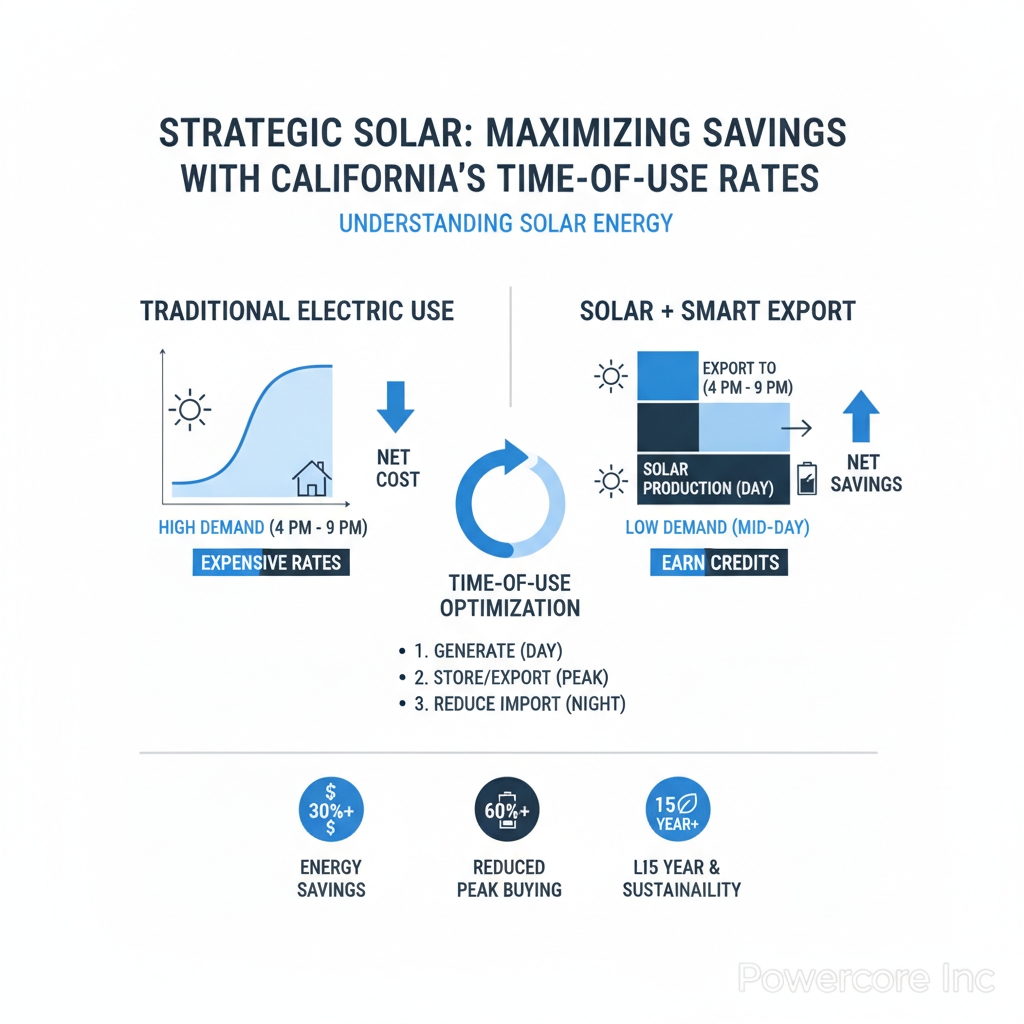
The fundamental challenge with TOU rates and solar is the typical mismatch between when your panels produce the most power and when your household consumes the most expensive power.
The Solar Production-Consumption Mismatch
Solar panels typically generate the most electricity during the middle of the day, when the sun is highest in the sky (e.g., 10 AM to 3 PM). However, for many households, peak electricity consumption occurs later in the day, after work and school (e.g., 4 PM to 9 PM), coinciding with the most expensive TOU peak rates. This creates a scenario where:
- You export excess solar power to the grid during midday off-peak hours, receiving a lower credit (especially under NEM 3.0).
- You import power from the grid during late afternoon/evening peak hours, paying the highest rates.
Without strategic management or storage, this can significantly erode your potential solar savings, making your electricity bill higher than anticipated, even with a robust solar system.
The NEM 3.0 Effect on Export Value
Under NEM 3.0, the financial incentive for exporting solar power to the grid during midday has been drastically reduced. This makes self-consumption and storage far more valuable. The new strategy focuses on avoiding high-cost imports. Instead of "selling" cheap and "buying" expensive, the goal is to:
- Maximize Self-Consumption: Use your solar power directly as it's generated.
- Store for Peak: Store excess solar power in a battery to discharge during peak TOU hours, avoiding expensive imports.
- Minimize Grid Reliance: Reduce reliance on the grid during costly periods as much as possible.
This shift makes intelligent energy management and, increasingly, battery storage, critical for anyone investing in solar in California today.
Strategies for Maximizing Solar Savings Under TOU Rates (Without Batteries)
Even without a battery, there are powerful strategies California homeowners can employ to optimize their solar savings under TOU rates. These primarily revolve around shifting your energy consumption patterns.
Energy Efficiency: The First Line of Defense
The cheapest energy is the energy you don't use. Before considering any other strategy, ensure your home is as energy-efficient as possible:
- LED Lighting: Replace old incandescent bulbs.
- Appliance Upgrades: Invest in Energy Star-rated appliances.
- Insulation & Weatherization: Improve your home's thermal envelope to reduce heating and cooling loads.
- HVAC Maintenance: Regular tune-ups ensure your system runs efficiently. (Powercore Inc also offers expert HVAC services to ensure your system is optimized for efficiency.)
Reducing your overall energy demand means you need to generate less, store less, and import less, leading to lower bills regardless of the TOU structure.
Strategic Load Shifting: Timing is Everything
This is the most direct way to combat high TOU rates without a battery. The goal is to shift energy-intensive activities to super off-peak or off-peak hours when electricity is cheapest:
- Dishwasher & Laundry: Run these appliances overnight or in the early morning. Many modern appliances have delayed start functions.
- Electric Vehicle (EV) Charging: If you own an EV, charging it during super off-peak hours (typically overnight) can save you hundreds of dollars annually. This is a significant load and one of the easiest to shift. (Powercore Inc provides expert EV charging installation services to ensure you have a safe and efficient setup.)
- Pre-Cooling/Pre-Heating: In summer, pre-cool your home during cheaper morning hours, then let your AC run less during peak afternoon hours. Similarly, pre-heat in winter.
- Pool Pumps: If you have a pool, run the pump during off-peak or super off-peak hours.
Smart Thermostat Optimization
Programmable or smart thermostats (like Nest or Ecobee) are invaluable tools for load shifting. They allow you to schedule your heating and cooling cycles to align with cheaper TOU periods, automatically adjusting temperatures to pre-cool or pre-heat your home before peak rates kick in.
Optimal Panel Orientation and Tilt for TOU
While most solar systems are designed for maximum annual production, a slight adjustment to panel orientation or tilt can sometimes be made to favor later afternoon production, aligning better with shoulder or early peak TOU periods. This is a design consideration that Powercore Inc’s experienced solar engineers evaluate during the initial consultation to maximize your solar panel installation's value under specific TOU rates.
The Game-Changer: Solar Battery Storage with TOU Rates
For California homeowners under NEM 3.0, solar battery storage has transformed from a luxury into a highly strategic, often essential, component for maximizing solar savings and achieving true energy independence.
How Batteries Master TOU Arbitrage
Battery storage fundamentally alters your relationship with TOU rates by enabling "time-shifting" your solar energy. Here's how it works:
- Midday Charging: When your solar panels are producing more electricity than your home is consuming (typically midday), the excess power is directed to charge your battery instead of being exported to the grid for low NEM 3.0 credits.
- Peak Hour Discharge: As peak TOU rates begin in the late afternoon/early evening, your home automatically draws power from your fully charged battery. This avoids importing expensive electricity from the grid during the costliest periods.
- Off-Peak Recharge (Optional): If your battery is depleted and you still need power, some smart battery systems can be programmed to recharge from the grid during super off-peak hours when electricity is cheapest, further enhancing savings.
This process, often called "time-of-use arbitrage," allows you to effectively "sell" your solar power to yourself at the highest possible value (by avoiding peak imports), rather than selling it to the utility for a low credit.
NEM 3.0: The Battery Imperative
Under NEM 3.0, the financial incentive for exporting solar power to the grid during midday has been drastically reduced. This makes self-consumption and storage far more valuable. A solar-only system under NEM 3.0 might still reduce your bill, but a solar-plus-battery system is designed to virtually eliminate it, capturing the full value of your generated electricity. Powercore Inc specializes in integrating advanced battery storage systems that are perfectly suited to California's unique energy policies.
Choosing the Right Solar Battery System
When considering battery storage, several factors come into play:
- Capacity: Measured in kWh, this determines how much energy the battery can store. It should be sized to meet your peak hour consumption and desired backup duration.
- Power Output: Measured in kW, this determines how many appliances the battery can run simultaneously.
- Chemistry: Lithium-ion batteries (e.g., LFP vs. NMC) are dominant. LFP (Lithium Iron Phosphate) are often favored for their safety, longevity, and cost-effectiveness in residential applications. (For a deeper dive, read our article: LFP vs NMC Solar Batteries: Powering California's Sustainable Future).
- Integration: Seamless integration with your solar inverter and home energy management system is key for optimal performance and automated TOU arbitrage.
Advanced Strategies with Solar + Storage
Beyond basic TOU arbitrage, solar-plus-storage systems, especially when combined with smart home technology, unlock even greater levels of control and savings.
Smart Energy Management Systems (HEMS)
Modern battery systems often come with sophisticated Home Energy Management Systems (HEMS) or can integrate with third-party platforms. These systems use AI and machine learning to:
- Forecast Production & Consumption: Based on weather forecasts and your historical usage patterns.
- Optimize Battery Dispatch: Automatically decide when to charge and discharge the battery to maximize TOU savings, factoring in current rates and grid conditions.
- Prioritize Loads: In a power outage, they can prioritize essential circuits to extend backup power.
These intelligent systems take the guesswork out of energy management, continuously optimizing your home's energy flow for peak financial benefit.
EV Charging Integration for Ultimate Savings
For EV owners, integrating your charger with your solar and battery system offers unparalleled savings. Instead of solely relying on cheap overnight grid power, you can configure your system to:
- Charge directly from Solar: Top off your EV during midday from direct solar production.
- Charge from Battery: Use stored solar power from your battery to charge your EV during off-peak hours, further reducing grid reliance.
- Smart Scheduling: Program your EV to charge only during super off-peak hours, automatically drawing from the cheapest available source (solar, battery, or grid).
Backup Power & Resilience
While maximizing savings is a primary driver, the added benefit of backup power cannot be overstated, especially in California with its occasional grid instability and Public Safety Power Shutoffs (PSPS). A well-designed solar + battery system provides peace of mind, ensuring your essential loads remain powered during outages, seamlessly integrating with your energy savings strategy.
Choosing the Right Solar Partner in California
Navigating California's complex energy policies, understanding diverse TOU rates, and designing a solar and storage system that truly maximizes your savings requires specialized expertise. This is where Powercore Inc excels.
As a dual-licensed General B & C-10 Electrical Contractor (CSLB #1134334 and #1098175), Powercore Inc brings a comprehensive understanding of both construction and electrical systems. This unique licensing allows us to handle every aspect of your project – from optimizing your roof for solar and integrating new roofing solutions, to installing advanced electrical systems and upgrades, and seamlessly integrating solar panels with state-of-the-art battery storage. Our Roseville, CA-based team serves homeowners across all of California, providing tailored solutions that account for your specific utility, TOU plan, and energy goals.
We believe in a holistic approach to home energy. Whether you're interested in solar, battery storage, EV charging, or even general home remodels and ADUs, our experts ensure all components work together efficiently, delivering long-term value and peace of mind. We stay ahead of policy changes like NEM 3.0 to ensure your investment is future-proofed.
Conclusion: Empowering Your Solar Journey with Smart Strategy
California’s Time-of-Use rates, particularly under the new Net Billing Tariff (NEM 3.0), have fundamentally reshaped the economics of residential solar. The era of simply installing panels and watching your meter spin backward is largely over. Today, maximizing your solar savings demands a strategic approach – one that prioritizes self-consumption, smart load shifting, and increasingly, integrated battery storage.
By understanding your utility’s specific TOU schedule and implementing the strategies discussed, you can transform your solar investment into a powerful tool for significant and sustained energy cost reduction. Don't let the complexity deter you; instead, see it as an opportunity to gain even greater control over your home's energy future.
Ready to Master Your California TOU Rates with Solar?
The journey to optimized solar savings begins with expert guidance. Let Powercore Inc be your trusted partner in designing and installing a solar and battery storage system perfectly aligned with California's TOU rates and your family's energy needs. Our team of experienced professionals is ready to provide a personalized assessment and a seamless installation experience across California.
Contact Powercore Inc today for a free consultation! Call us at 916-699-8778 or visit gopowercoreinc.com to learn more about how we can help you unlock peak savings and energy independence.