

Introduction: Unlocking Peak Savings with Solar & Storage in California
California, a pioneer in renewable energy, continuously evolves its approach to electricity pricing to encourage grid stability and efficient energy consumption. For homeowners with solar panels, understanding these changes – especially the widespread adoption of Time-of-Use (TOU) rates – isn't just about compliance; it's about strategic energy management that directly impacts your utility bill and overall savings. Gone are the days of simple net metering where every kilowatt-hour (kWh) exported was valued equally. Today, maximizing your solar investment means intelligently navigating peak and off-peak hours.
At Powercore Inc, a dual-licensed General B & C-10 Electrical Contractor based in Roseville, CA, we empower California homeowners to thrive in this dynamic energy landscape. Our expertise spans solar and battery storage solutions designed to not only generate clean energy but to strategically utilize and store it for maximum financial benefit. This comprehensive guide will illuminate the complexities of TOU rates, reveal the challenges they present for traditional solar setups, and, most importantly, demonstrate how integrating battery storage transforms these challenges into unparalleled opportunities for savings, resilience, and energy independence.
What Are Time-of-Use (TOU) Rates?
Time-of-Use rates are an electricity pricing structure where the cost of electricity varies depending on the time of day, day of the week, and even the season. Instead of paying a flat rate, consumers pay more when electricity demand is high (peak hours) and less when demand is low (off-peak or super off-peak hours). The goal of TOU rates, as implemented by utilities across California like PG&E, SCE, and SDG&E, is to incentivize consumers to shift their energy usage away from periods of high demand, thereby reducing strain on the grid, minimizing the need for expensive peaker plants, and promoting a more stable and sustainable energy infrastructure.
California's Shifting Energy Landscape
California's energy grid sees its highest demand during late afternoons and early evenings, typically between 4 PM and 9 PM. This is when people return home from work, turn on lights, cook dinner, and use air conditioning, while solar production begins to wane as the sun sets. This period is designated as "peak" or "on-peak" by utility companies, and electricity prices during these hours can be significantly higher than during "off-peak" or "super off-peak" times (e.g., late night, early morning, or midday).
Common TOU Rate Structures
- Peak Hours: Typically 4 PM - 9 PM or 5 PM - 8 PM, weekdays, when prices are highest.
- Off-Peak Hours: Midday (when solar production is high), late evenings, and weekends, with moderate prices.
- Super Off-Peak Hours: Overnight and early mornings, when prices are lowest.
Understanding your specific utility’s TOU schedule is the first critical step in optimizing your energy strategy. These schedules can vary by utility and even by plan within the same utility.
The Challenge for Traditional Solar Homeowners
Historically, residential solar panels were celebrated for their ability to significantly reduce or even eliminate electricity bills through net metering. Under traditional net metering, any excess solar energy your panels produced and sent back to the grid was credited at roughly the same rate you paid for electricity consumed. This was a relatively simple equation for savings.
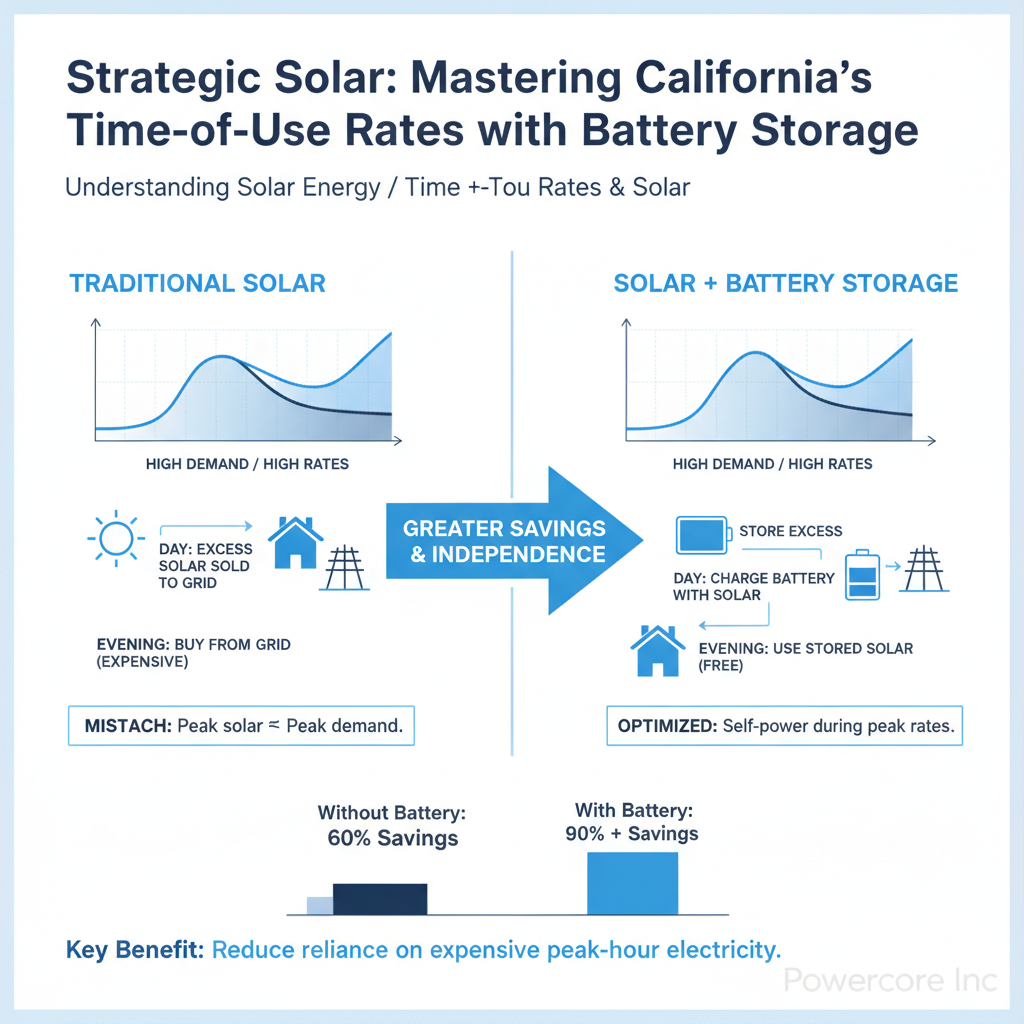
However, TOU rates complicate this equation. The challenge for a grid-tied solar system without battery storage is a timing mismatch:
- Solar Production Peak: Most solar energy is generated during midday, when the sun is highest. This often falls within off-peak or super off-peak rate periods.
- Home Energy Consumption Peak: A typical household's energy consumption often peaks in the late afternoon and evening, precisely when TOU rates are highest and solar production is declining.
This means that while your solar panels are producing abundant electricity during off-peak hours, you might be exporting this energy to the grid at a low value. Then, in the evening, when your panels are producing little to no power, you're forced to import expensive grid electricity during peak TOU hours. The result? Your solar savings are diminished, and you still face significant charges for peak-time energy consumption, even with a robust solar array.
The Impact of NEM 3.0
The introduction of NEM 3.0 in California has further amplified this challenge. The new Net Energy Metering tariff drastically reduces the export credit rates for solar energy sent back to the grid, especially during those valuable peak evening hours. While export compensation is still present, it is significantly lower than under previous NEM versions, making the direct export strategy less financially appealing. This shift makes the timing of energy consumption and generation even more critical, pushing battery storage from a "nice-to-have" to a "must-have" for optimizing solar investments in California.
The Strategic Solution: Solar + Battery Storage
This is where battery storage systems become an indispensable part of a modern California solar installation. By adding a home battery, you transform your solar system from a simple power generator into a sophisticated energy management hub. Batteries allow you to store the excess solar energy produced during off-peak hours (when electricity is cheap and abundant) and then discharge that stored energy during peak TOU hours (when grid electricity is expensive).
How Battery Storage Optimizes TOU Rates
- Self-Consumption Maximization: Instead of exporting your excess solar energy to the grid at low off-peak rates, you store it in your battery for later use. This maximizes your self-consumption of clean, free energy.
- Peak Shaving: During peak TOU hours, when your solar production has slowed or stopped, your home automatically draws power from your battery instead of the expensive grid. This "shaves" off your peak demand, significantly reducing your electricity bill.
- Enhanced Grid Independence: With a battery, you're less reliant on the grid during critical, high-cost periods, giving you greater control over your energy usage and spending.
- Backup Power: Beyond financial savings, a solar battery provides crucial backup power during grid outages, offering peace of mind and resilience against California's increasing power disruptions.
Key Benefits of a Solar-Plus-Storage System for California Homeowners
Investing in a combined solar and battery storage system with Powercore Inc offers a multitude of advantages beyond just navigating TOU rates:
1. Significant Cost Savings
By effectively shifting your energy consumption from expensive peak hours to stored solar energy, you can dramatically reduce your monthly utility bills. The battery acts as your personal energy bank, ensuring you're always using the cheapest available power source.
2. Energy Independence and Resilience
California faces unique energy challenges, from planned Public Safety Power Shutoffs (PSPS) to increasing wildfire risks and grid instability. A battery backup system ensures your essential appliances, and even your entire home, remain powered during outages. This provides invaluable peace of mind and true energy independence.
3. Enhanced Environmental Impact
By storing and using your own solar energy, you further reduce your reliance on fossil fuel-generated electricity, especially during peak demand times when less efficient peaker plants are often brought online. This deepens your home's commitment to sustainability and a greener future.
4. Increased Home Value
Homes equipped with modern solar-plus-storage systems are increasingly attractive to buyers, often commanding higher resale values. As energy costs rise and grid reliability becomes a concern, these systems are seen as a premium feature.
5. Smart Energy Management
Advanced battery systems come with sophisticated software that allows you to monitor your energy production and consumption in real-time, optimize charge/discharge cycles based on TOU rates, and even integrate with EV charging schedules to maximize efficiency. This level of control empowers you to make informed decisions about your home's energy use.
Navigating Incentives and Financing for Solar-Plus-Storage
The good news for California homeowners is that several incentives make investing in solar and battery storage more accessible and financially appealing. Powercore Inc helps you navigate these opportunities to maximize your return on investment.
1. Federal Solar Tax Credit (Residential Clean Energy Credit)
The Residential Clean Energy Credit (formerly the Investment Tax Credit, ITC) allows homeowners to claim a credit equal to 30% of the cost of installing a new solar energy system and eligible battery storage. This is a direct dollar-for-dollar reduction of your federal income tax liability, making it a significant incentive for both solar panels and standalone battery storage systems installed after 2022.
2. California Battery Storage Incentives (SGIP)
The Self-Generation Incentive Program (SGIP) is a long-standing California program that offers rebates for distributed energy generation and storage technologies. While specific funding levels and eligibility criteria can change, SGIP has historically provided substantial financial incentives for installing battery storage systems, particularly for homes in high-fire threat areas or those that have experienced multiple Public Safety Power Shutoffs (PSPS). Powercore Inc is well-versed in California battery storage incentives and can guide you through the application process.
3. Local Utility Programs
Some local utilities or municipalities may offer additional rebates or financing options for solar and storage. It's always worth checking with your specific provider, and Powercore Inc can assist in identifying these localized opportunities.
Choosing the Right Solar and Battery System for Your California Home
Selecting the optimal solar and battery storage system involves several considerations to ensure it meets your energy needs, budget, and lifestyle. As your trusted California dual-licensed contractor, Powercore Inc offers tailored solutions.
Sizing Your Solar Array
The first step is accurately sizing your residential solar system based on your current and projected energy consumption. A Powercore Inc expert will analyze your historical utility bills, consider future additions like an EV charger or an ADU, and design a system that generates enough power to offset your usage, with an eye towards maximizing off-peak production for battery storage.
Battery Capacity and Type
Battery capacity is measured in kWh and determines how much energy your battery can store. The ideal capacity depends on your household's energy usage patterns, your specific TOU rates, and your desired level of backup power. Most residential systems utilize lithium-ion batteries, known for their efficiency, longevity, and compact size.
Inverter Technology
Modern solar-plus-storage systems often utilize hybrid inverters that manage both solar production and battery charging/discharging. These intelligent inverters play a crucial role in optimizing energy flow based on TOU schedules and grid conditions.
Monitoring and Control
Look for systems with robust monitoring apps that provide real-time data on energy production, consumption, battery status, and savings. The ability to program your battery's behavior (e.g., prioritizing self-consumption, backup, or TOU optimization) is key to maximizing its value.
The Powercore Inc Advantage: Your California Energy Partner
When it comes to something as critical as your home's energy infrastructure, choosing the right contractor is paramount. Powercore Inc stands out as California's premier choice for comprehensive solar and battery storage solutions, backed by our General B and C-10 Electrical Contractor licenses (CSLB #1134334 & #1098175).
- Dual Licensing & Expertise: Our unique dual licensing means we're not just solar experts; we understand the entire home's electrical and construction ecosystem. This allows for seamless integration of solar and battery systems, ensuring optimal performance and compliance with all California building codes.
- Tailored Solutions: We don't believe in one-size-fits-all. Our team conducts thorough assessments to design systems specifically optimized for your home's energy profile, your utility’s TOU rates, and your financial goals.
- Comprehensive Service: From initial consultation and system design to permitting, installation, and ongoing support, Powercore Inc manages every aspect of your project with precision and professionalism. We ensure your system is perfectly tuned to navigate NEM 3.0 and maximize your TOU rate savings.
- Quality & Reliability: We partner with leading manufacturers to provide high-quality, durable solar panels and battery storage systems, ensuring long-term performance and peace of mind.
Beyond Solar and Battery: Holistic Home Energy Solutions
At Powercore Inc, we understand that true home energy optimization extends beyond just solar panels and batteries. As a comprehensive contractor, we offer a wide range of services that can further enhance your home's energy efficiency and overall value:
- HVAC Climate Control: Efficient heating and cooling systems reduce overall energy demand, making your solar and battery system even more effective.
- Roofing & Weatherproofing: A new, energy-efficient roof can improve insulation and provide the ideal foundation for your solar panel installation.
- EV Charging Stations: Seamlessly integrate your electric vehicle charging into your solar and battery strategy, utilizing stored solar energy for more cost-effective charging.
- Remodels & New Construction: For larger projects, we can design and integrate energy solutions from the ground up, ensuring maximum efficiency and future-proofing.
By addressing your home’s energy needs holistically, Powercore Inc helps you achieve true energy independence and significant long-term savings.
Conclusion: Take Control of Your California Energy Future
California's Time-of-Use rates and the evolving NEM 3.0 landscape present both challenges and incredible opportunities for solar homeowners. By strategically integrating battery storage with your solar panels, you can confidently navigate these changes, transforming peak demand into peak savings and securing your home's energy future. No longer are you at the mercy of fluctuating grid prices; with solar and storage, you become the master of your own energy destiny.
Ready to unlock the full potential of your solar investment and achieve true energy independence? Don't let complex rate structures diminish your savings. Partner with Powercore Inc, your trusted California solar and electrical experts. Our team is ready to design and install a customized solar-plus-storage system that maximizes your financial returns, enhances your home's resilience, and empowers you to take control of your energy bills. Contact us today for a personalized consultation.
Call Powercore Inc at 916-699-8778 or visit our website at gopowercoreinc.com/contact to schedule your free energy assessment. Let us help you build a smarter, more sustainable, and more resilient home energy system.