

Navigating NEM 3.0 California: A New Era for Solar Energy
California, a beacon of renewable energy, has long led the nation in solar adoption. For years, Net Energy Metering (NEM) programs incentivized homeowners to embrace solar power, allowing them to send excess electricity back to the grid for credits on their utility bills. This model fueled a solar boom, transforming rooftops across the Golden State into power-generating assets.
However, on April 15, 2023, the California Public Utilities Commission (CPUC) introduced significant changes with NEM 3.0 (Net Billing Tariff), fundamentally altering how solar homeowners are compensated for the energy they export. This shift has understandably raised questions and concerns among existing and prospective solar owners. While the landscape has evolved, the commitment to clean energy and the financial benefits of solar remain incredibly strong – especially when paired with strategic planning and advanced energy solutions.
At Powercore Inc, a dual-licensed General B and C-10 Electrical Contractor based in Roseville, CA, we understand that adapting to new regulations requires clear information and expert guidance. Our mission is to empower California homeowners to navigate these changes successfully, ensuring their investment in solar energy continues to deliver maximum value, resilience, and energy independence across the entire state.
This comprehensive guide will demystify NEM 3.0, explain its implications, and – most importantly – outline a strategic blueprint for maximizing your solar savings and home energy independence in this new era. We'll explore why integrating battery storage has become not just an option, but a critical component for optimizing your solar investment under the revised policies.
What is NEM 3.0 and Why the Change?
To truly understand the impact of NEM 3.0, it's essential to grasp the previous Net Energy Metering frameworks. Under NEM 1.0 and NEM 2.0, solar homeowners received near retail rate credits for any excess electricity they sent back to the grid. This meant that if your solar panels produced more power than your home consumed during the day, you would effectively 'sell' that power back to the utility, receiving a credit that offset your consumption during non-solar hours or on cloudy days.
The Shift from NEM 2.0 to NEM 3.0
NEM 3.0 introduces a new compensation structure for exported solar energy, moving from a full retail rate credit to a significantly lower, fluctuating 'avoided cost' rate. This new rate is designed to reflect the actual value of the electricity to the grid at the moment it's exported, taking into account factors like grid demand and the cost of other energy sources. The key changes include:
- Lower Export Compensation: The most impactful change is the reduction in what utilities pay for exported solar energy. Instead of near retail rates, homeowners now receive credits based on the 'Net Billing Tariff,' which can be substantially lower, especially during off-peak hours.
- Time-Varying Rates: Export rates now vary significantly by time of day and season. Generally, compensation is highest during late afternoon/early evening peak demand hours (when the grid needs power most) and lowest during midday when solar production is abundant.
- Increased Non-Bypassable Charges (NBCs): Homeowners under NEM 3.0 will still pay certain fixed charges to the utility that cannot be offset by solar credits, though the structure for these was slightly adjusted from initial proposals.
- Grandfathering: Existing solar customers under NEM 1.0 or NEM 2.0 (who submitted their interconnection applications before April 15, 2023) are largely grandfathered into their existing tariffs for 20 years from their system's interconnection date. This provides stability for current solar owners but highlights the urgency for new adopters to understand the revised rules.
CPUC's Rationale Behind the Change
The CPUC stated several reasons for implementing NEM 3.0, primarily focusing on grid stability, cost equity, and encouraging battery storage adoption:
- Grid Stability and Peak Demand: California frequently experiences a 'duck curve' phenomenon, where abundant solar production during the day dips sharply as the sun sets, creating a steep ramp-up in demand for traditional power sources. NEM 3.0 aims to incentivize solar production during critical peak hours and encourage energy storage to smooth out these fluctuations.
- Fairness for All Ratepayers: The CPUC argued that NEM 1.0/2.0 customers, by not paying certain grid maintenance costs (non-bypassable charges) on their exported energy, were effectively shifting some costs onto non-solar customers. NEM 3.0 seeks to address this perceived imbalance.
- Promoting Energy Storage: By lowering export compensation, NEM 3.0 makes self-consumption and storing excess solar energy significantly more financially attractive. This directly supports California's broader goal of deploying more grid-supportive battery storage.
The Core Impact of NEM 3.0 on Solar Savings
For homeowners considering solar after April 15, 2023, the traditional 'net metering' equation has fundamentally changed. The primary mechanism for saving money with solar under NEM 3.0 shifts from selling excess power back to the grid to maximizing your own self-consumption and strategic use of stored energy.
From Export to Self-Consumption: The New Paradigm
Previously, it was often beneficial to oversize a solar system slightly, knowing that any excess power would earn valuable credits. Under NEM 3.0, exporting large amounts of power during midday when rates are lowest offers minimal financial benefit. Instead, the focus is squarely on:
- Using What You Produce: Directly consuming the solar energy as it's generated, rather than drawing from the grid.
- Storing Excess for Later: Diverting surplus daytime solar production into a home battery to be used during evening peak hours or overnight.
This means a pure grid-tied solar system (without battery storage) will likely see a longer payback period and reduced overall savings compared to a similar system under NEM 2.0. The value proposition of solar is still strong, but the strategy for achieving maximum savings has evolved.
The Critical Role of Time-of-Use (TOU) Rates
California's Time-of-Use (TOU) electricity rates become paramount under NEM 3.0. TOU rates mean the price you pay for electricity varies depending on the time of day, day of the week, and season. Peak rates (typically late afternoon/early evening) are significantly higher than off-peak rates (midday, overnight). This creates a direct financial incentive for battery storage:
- Charge During Low-Cost Hours: Your solar panels produce energy during the day when grid rates might be lower (or when you'd otherwise be exporting for low compensation). A battery can store this energy.
- Discharge During High-Cost Hours: When evening peak rates hit, your home can draw power from your battery instead of buying expensive electricity from the utility, maximizing your savings.
Without a battery, homeowners under NEM 3.0 might find themselves exporting power during low-value midday hours and then purchasing expensive grid power during evening peaks, eroding their potential savings.
Strategic Adaptation: Why Solar + Battery Storage is the New Standard
The shift to NEM 3.0 fundamentally redefines the optimal solar strategy for California homeowners. While solar panels alone still provide significant environmental benefits and some financial savings, pairing them with a home battery storage system has become the gold standard for maximizing economic returns and achieving true energy independence.
Maximizing Self-Consumption and Financial Returns
Under NEM 3.0, the goal is to use as much of your self-generated solar power as possible. A battery system allows you to capture the excess energy your panels produce during sunny hours, rather than sending it back to the grid for meager compensation. This stored energy can then be utilized when your home's demand is highest, or when grid electricity prices are at their peak. This strategy directly translates to:
- Reduced Grid Dependency: By storing and using your own power, you significantly decrease the amount of electricity you need to purchase from the utility, especially during expensive peak periods.
- Optimal TOU Management: Batteries are smart. They can be programmed to charge when solar production is high or when grid electricity is cheapest, and then discharge when grid electricity is most expensive, effectively 'arbitraging' the difference in rates.
- Faster Payback Periods: While adding a battery is an upfront investment, the enhanced savings under NEM 3.0 often lead to a faster return on investment for the combined solar + storage system compared to solar-only systems.
Enhanced Grid Resilience and Power Security
Beyond financial savings, a solar + battery storage system provides invaluable peace of mind, especially for California residents familiar with Public Safety Power Shutoffs (PSPS) and other grid instabilities. When the grid goes down, a battery storage system can:
- Provide Backup Power: Seamlessly switch to battery power, keeping essential appliances (or your entire home, depending on system size) running during outages.
- Maintain Solar Operation: Unlike grid-tied solar systems that shut down during an outage for safety, a battery-equipped system can continue to generate and use solar power, recharging the battery as needed, providing true energy continuity.
Contributing to a Cleaner, More Stable California Grid
By installing battery storage, homeowners aren't just benefiting themselves; they're actively contributing to California's broader energy goals. Stored energy helps balance the grid, especially during peak demand, reducing the reliance on fossil fuel 'peaker plants.' This aligns perfectly with the CPUC's intent for NEM 3.0 – to encourage distributed energy resources that support a cleaner, more resilient energy infrastructure.
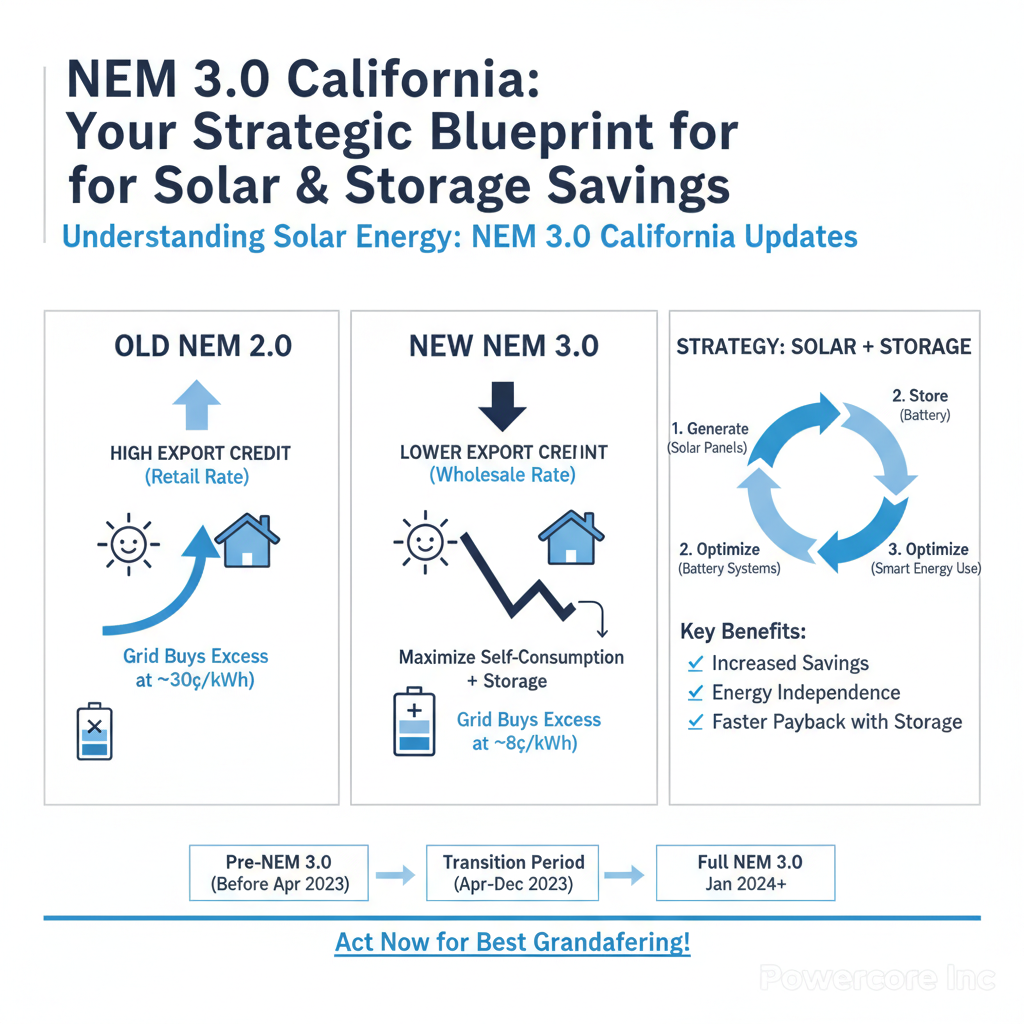
Designing Your NEM 3.0 Optimized Solar + Storage System
Crafting an effective solar + storage solution under NEM 3.0 requires a tailored approach. It's not a one-size-fits-all scenario; rather, it demands a deep understanding of your unique energy profile, home characteristics, and financial goals. This is where the expertise of a seasoned contractor like Powercore Inc becomes invaluable.
The Initial Assessment: Understanding Your Needs
- Comprehensive Energy Audit: The first step is to analyze your historical electricity usage. When do you consume the most energy? What are your peak usage times? Understanding your consumption patterns is crucial for designing a system that effectively offsets your grid purchases.
- Assessing Your Goals: Are you primarily focused on maximizing financial savings, achieving energy independence during outages, or a blend of both? Your priorities will influence the system's size and battery capacity.
Right-Sizing Your Solar PV System
Under NEM 3.0, the concept of 'oversizing' your solar array to generate significant export credits is less beneficial. Instead, the focus shifts to designing a system that closely matches your annual energy consumption, with an emphasis on producing enough excess power to charge your battery adequately. Factors considered include:
- Roof Space and Orientation: Maximizing sun exposure throughout the day.
- Shading Analysis: Identifying any obstructions that might reduce panel efficiency.
- Future Energy Needs: Accounting for potential increases in electricity usage, such as adding an EV charger, upgrading to an electric heat pump (HVAC), or expanding your home with an ADU.
Selecting the Ideal Battery Storage Solution
Battery sizing is paramount for NEM 3.0 optimization. Key considerations include:
- Capacity (kWh): How much energy can the battery store? This determines how long it can power your home or how much excess solar it can capture.
- Power (kW): How much electricity can the battery deliver at any given moment? This impacts what appliances it can run simultaneously.
- Chemistry and Cycle Life: Lithium-ion batteries are standard, offering excellent performance and longevity.
- Integrated vs. Modular Systems: Some batteries are designed to seamlessly integrate with specific inverter brands, while others offer more modularity.
- Smart Energy Management: Modern battery systems come with sophisticated software that learns your usage patterns and optimizes charging/discharging based on TOU rates and weather forecasts.
Powercore Inc specializes in designing and installing these sophisticated solar and battery storage systems. Our C-10 Electrical Contractor license ensures that every component is integrated safely and efficiently, complying with all California regulations.
Navigating Incentives and Rebates in the NEM 3.0 Era
While NEM 3.0 changes the financial mechanics of solar, robust incentives remain available to significantly reduce the upfront cost of going solar, especially with battery storage. Understanding and leveraging these programs is crucial for maximizing your investment.
The Federal Solar Investment Tax Credit (ITC)
The ITC, also known as the Residential Clean Energy Credit, remains one of the most powerful incentives for solar + storage systems. It allows homeowners to claim a credit equal to 30% of the cost of installing a new solar energy system, including qualified battery storage components. This is a dollar-for-dollar reduction in your federal income tax liability, not just a deduction. The ITC is scheduled to remain at 30% through 2032, providing a stable and substantial benefit.
California's Self-Generation Incentive Program (SGIP)
For battery storage, the California Self-Generation Incentive Program (SGIP) is a game-changer. SGIP provides significant rebates for installing energy storage systems, making the addition of batteries much more affordable. The program is structured into different tiers, with higher incentives for:
- Equity Resiliency: For customers in high fire-threat areas (HFRA), those who have experienced multiple PSPS events, or those reliant on well water, among other criteria.
- Equity: For low-income households or those in disadvantaged communities.
- General Market: Standard incentives for all other eligible customers.
SGIP has stepped down in incentive value over time as adoption increases, but it remains a critical component for reducing the cost of battery storage in California. Navigating the application process and ensuring eligibility can be complex, but Powercore Inc has extensive experience assisting clients in securing these valuable rebates.
Additional Local Incentives and Programs
Beyond federal and state programs, some local municipalities or utility districts may offer their own incentives for energy efficiency upgrades, solar, or battery storage. While less common than the ITC or SGIP, it's always worth exploring potential local benefits that could further reduce your overall project cost.
Powercore Inc: Your Trusted Partner for NEM 3.0 Solutions in California
The transition to NEM 3.0 underscores the importance of choosing an experienced, reliable partner for your solar and energy storage needs. Powercore Inc stands as California's premier dual-licensed General B and C-10 Electrical Contractor, uniquely positioned to deliver comprehensive, future-proof energy solutions for homes across the entire state.
Our deep expertise in solar installation, advanced battery storage systems, and holistic home energy management ensures that your investment is not only optimized for NEM 3.0 but also enhances your home's overall efficiency and value. From initial consultation and custom design to expert installation and ongoing support, we manage every aspect of your project with meticulous attention to detail.
Beyond solar and battery storage, Powercore Inc offers a full spectrum of services that contribute to a truly energy-independent home, including:
- HVAC: Upgrading to high-efficiency heating and cooling systems to reduce overall energy consumption.
- Roofing: Ensuring your roof is in optimal condition for solar panel installation and long-term durability.
- EV Charging: Integrating home EV charging solutions seamlessly with your solar + storage system.
- Siding & Decking: Enhancing your home's exterior envelope for improved insulation and curb appeal.
- ADUs & Remodels: Incorporating energy efficiency and solar into new constructions or major renovations.
Our dual licensing means we can handle complex projects that touch multiple aspects of your home's infrastructure, providing a streamlined, efficient, and quality-controlled experience. We pride ourselves on delivering solutions that are not just compliant with California's evolving energy regulations but are truly built for long-term savings and resilience.
The Future of California Solar: Beyond NEM 3.0
While NEM 3.0 represents a significant adjustment, it also paves the way for a more advanced, resilient, and intelligent energy grid in California. The emphasis on battery storage aligns with broader trends towards distributed energy resources and grid modernization.
Technologies like Virtual Power Plants (VPPs), where networks of home batteries can collectively support the grid, are becoming more prevalent. Homeowners with solar + storage systems will be at the forefront of this energy revolution, contributing to a more stable and sustainable energy future for the entire state.
The continuous innovation in battery technology, combined with ongoing incentives, ensures that investing in solar energy remains one of the smartest decisions a California homeowner can make for their property value, financial well-being, and environmental impact.
Conclusion and Your Next Step
NEM 3.0 has undeniably reshaped California's solar landscape, but it has not diminished the compelling value of going solar. Instead, it has sharpened the focus on strategic energy management, making solar + battery storage the most effective pathway to maximize savings, achieve energy independence, and future-proof your home against rising utility costs and grid instability.
Don't let the new regulations deter you from embracing clean, renewable energy. With the right design and expert installation, your solar and storage system can provide substantial financial benefits and unparalleled peace of mind for decades to come. Powercore Inc is here to guide you through every step, offering customized solutions that meet the specific needs of your California home.
Ready to explore your options and create a strategic energy plan tailored for NEM 3.0? Contact the experts at Powercore Inc today for a free consultation. Call us at 916-699-8778 and let us help you unlock the full potential of solar + storage for your home, anywhere in California.