

Beyond NEM 3.0: Strategically Stacking California Solar Incentives for Maximum Savings
California has long been a trailblazer in solar energy adoption, driven by abundant sunshine and a progressive environmental agenda. For homeowners considering the switch to solar, the Golden State offers a unique landscape of opportunities, but also complexities, especially with the recent evolution of Net Energy Metering (NEM 3.0). While NEM 3.0 has shifted the financial dynamics of solar, it has simultaneously underscored the immense value of strategic planning and the integration of home battery storage. The key to unlocking the full potential of solar in today's California market isn't just installing panels; it's understanding how to strategically stack California solar incentives to maximize your investment and achieve true energy independence.
At Powercore Inc, a dual-licensed General B & C-10 Electrical Contractor based in Roseville, CA, we understand that navigating the intricate world of solar incentives can feel overwhelming. Our expertise spans everything from residential solar & battery storage to comprehensive home remodels, ensuring a holistic approach to your energy future. This guide will cut through the noise, providing you with a clear roadmap to combine federal, state, and local programs, turning complexity into savings.
Understanding the Landscape: NEM 3.0 and the Shift in Solar Strategy
The introduction of NEM 3.0 by the California Public Utilities Commission (CPUC) in April 2023 marked a significant turning point for solar homeowners. Previously, NEM 2.0 offered generous credits for excess solar energy exported back to the grid. NEM 3.0, however, substantially reduced these export credits, making the financial benefits of simply sending power back to the utility less attractive.
This change doesn't diminish the value of solar; it redefines it. The new emphasis is on self-consumption. Homeowners now gain the most by using the solar energy they generate directly or storing it for later use, rather than relying heavily on selling it back to the grid. This paradigm shift makes home battery storage solutions not just an add-on, but an almost essential component of a financially optimized solar system in California.
Strategically, this means designing a solar system that aligns with your household's unique energy consumption patterns, maximizing the use of your own clean power, and leveraging incentives that specifically support this self-sufficiency model.
The Cornerstone: Federal Solar Investment Tax Credit (ITC)
Regardless of where you are in the U.S., the federal Solar Investment Tax Credit (ITC), officially known as the Residential Clean Energy Credit, remains the single most impactful incentive for homeowners investing in solar and battery storage. This powerful incentive allows you to deduct a significant percentage of the cost of installing a new solar energy system from your federal taxes.
What is the ITC?
- Currently, the ITC provides a 30% tax credit for eligible solar energy systems installed through 2032. This means if your solar system costs $30,000, you could receive a $9,000 credit on your federal income taxes.
- The credit applies to the cost of solar panels, inverters, mounting hardware, and importantly, standalone battery storage systems installed in conjunction with or after your solar system, provided they are charged at least 75% by a renewable energy source.
Eligibility and How It Works:
- To qualify, the solar system must be new and installed on a home you own and use as a residence.
- The credit is non-refundable, meaning it can reduce your tax liability to zero, and any unused portion can be carried forward to future tax years.
- It's not a rebate you receive upfront but a credit against the taxes you owe.
The ITC is your foundational incentive, significantly reducing the initial investment barrier. For the most up-to-date information on eligibility and claiming the credit, you can refer directly to the IRS Residential Clean Energy Credit page.
California-Specific Power Plays: State & Local Incentives
Beyond the federal ITC, California offers its own suite of programs designed to accelerate renewable energy adoption and grid resilience. These state and local incentives are crucial for maximizing your savings, especially when combined strategically.
The Self-Generation Incentive Program (SGIP)
The SGIP is California's flagship incentive for energy storage. Administered by the CPUC, this program provides rebates for qualifying distributed energy generation and storage systems. With NEM 3.0 emphasizing self-consumption, SGIP has become more vital than ever for homeowners looking to integrate battery storage.
- Focus: Primarily targets battery storage systems, making them more affordable for residential customers.
- Structure: SGIP uses an "escalating incentive" structure based on equity and resiliency needs, meaning higher rebates are available for specific customer categories.
- Equity Resiliency (Equity + Resiliency) Funding: This highly beneficial tier is for customers in High Fire-Threat Districts, those who have experienced two or more Public Safety Power Shutoffs (PSPS), or those with certain medical conditions/low-income status. These rebates can cover a substantial portion of battery storage costs.
- General Market Funding: While lower than the Equity Resiliency tier, this still provides a significant incentive for eligible battery storage systems for all other customers.
The SGIP is a fantastic opportunity to offset the cost of a home battery system, which is critical for maximizing self-consumption under NEM 3.0 and providing backup power during outages. Powercore Inc can help you determine your eligibility and navigate the application process for these valuable rebates. Learn more about California battery storage incentives on our dedicated page: California Battery Storage Incentives.
Local Programs and Utility-Specific Rebates
While the ITC and SGIP are statewide and federal, it's always wise to investigate local utility or municipal programs. Large utilities like PG&E, SCE, and SDG&E sometimes offer their own incentive programs, especially for energy efficiency upgrades or demand response initiatives that complement solar and storage.
- These programs can vary by region and often change, so it's essential to check with your specific utility company or consult with an expert like Powercore Inc, who stays abreast of these dynamic opportunities.
- Some local governments or clean energy programs might offer additional rebates or financing options for solar, energy efficiency, or even EV charging stations when paired with solar.
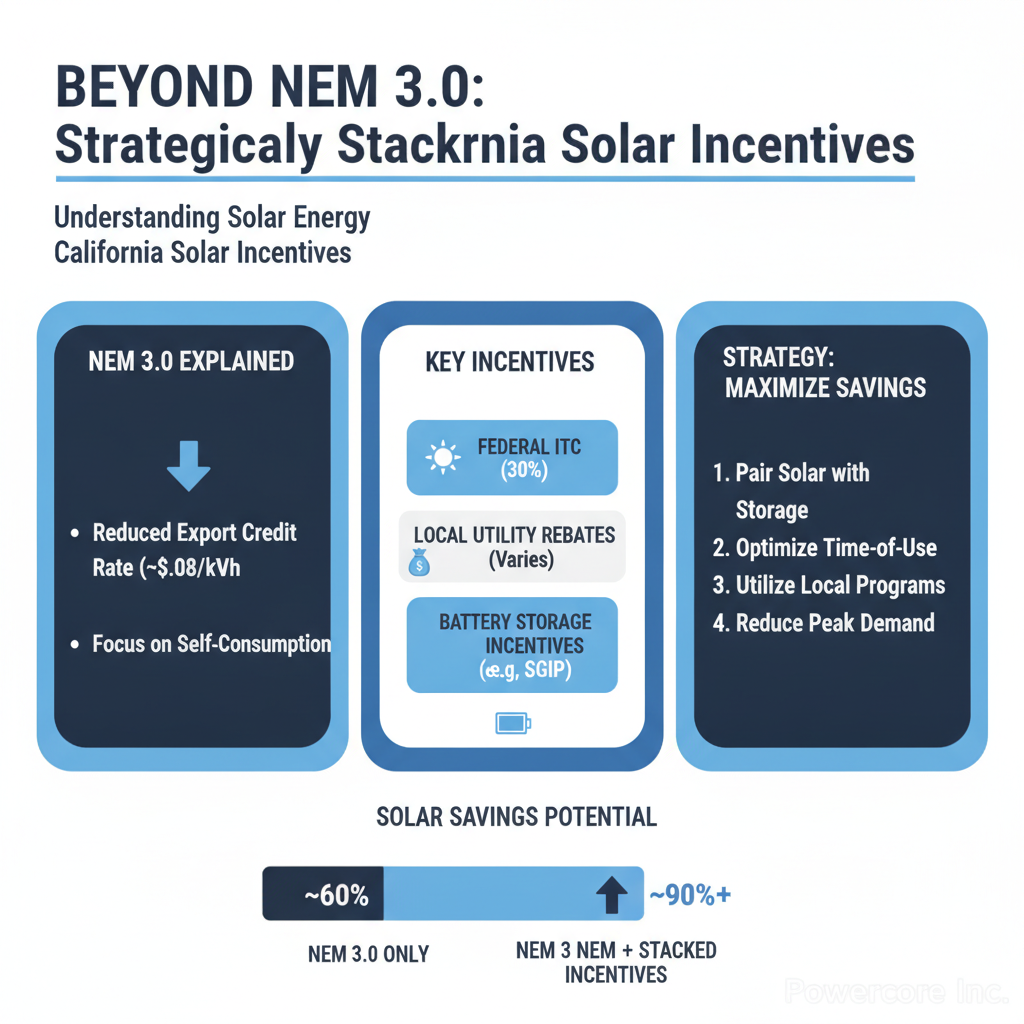
Strategic Stacking: Optimizing Your Solar & Storage Investment
The true power of California's solar incentives lies in their strategic combination. By understanding how to stack the federal ITC with state programs like SGIP, and by integrating other home improvements, you can unlock unparalleled savings and long-term value.
The Power of Combining ITC + SGIP
This is the most potent combination for California homeowners post-NEM 3.0. Here's how it works:
- ITC First: The federal ITC applies to the total eligible cost of your solar system AND your battery storage system (if charged by solar). This means you get a 30% tax credit on the battery's cost before any state incentives.
- SGIP Second: After the ITC has been applied (or rather, calculated on the gross cost), the SGIP rebate further reduces the net cost of your battery. In essence, SGIP acts as a direct discount or rebate, while the ITC is a tax credit.
Example Scenario:
- Battery System Cost: $15,000
- Federal ITC (30%): $4,500 tax credit
- Cost after ITC (for calculation purposes): $10,500 (though you get the ITC as a credit, not an upfront discount)
- SGIP Equity Resiliency Rebate (illustrative): Up to $8,000 (actual rates vary and depend on capacity and specific eligibility criteria)
- Effective out-of-pocket cost for battery: Significantly reduced.
This synergistic approach dramatically lowers the overall cost of integrating battery storage, making it more accessible and financially attractive. With a battery, you can store excess solar energy during the day and use it during peak evening hours when electricity rates are highest, thereby minimizing your reliance on the grid and maximizing savings under NEM 3.0's Time-of-Use (ToU) arbitrage opportunities. Powercore Inc specializes in designing and installing these integrated solar and battery storage systems, ensuring you maximize every incentive.
Bundling for Broader Impact: Whole-Home Energy Solutions
Think beyond just solar panels. Many home improvements can be bundled with your solar project, not only enhancing your home's energy efficiency and value but sometimes even qualifying for additional incentives or streamlining project costs.
- Solar + EV Charging: As electric vehicles become more common, charging at home becomes a necessity. Installing an EV charging station alongside your solar system allows you to power your car with clean, self-generated energy, further reducing your electricity bills and carbon footprint. Some local programs or utility providers may offer incentives for EV charger installation, especially when paired with renewable energy.
- Solar + HVAC Upgrades: Before going solar, optimizing your home's energy efficiency is paramount. Upgrading to a high-efficiency HVAC system can significantly reduce your overall energy demand, allowing for a smaller, more cost-effective solar system. While not a direct solar incentive, investing in HVAC climate control can indirectly enhance your solar ROI by lowering your baseline energy needs.
- Solar + Roofing: If your roof is nearing the end of its lifespan, combining a new roof installation with your solar project is a smart move. It allows for a seamless installation, ensures optimal structural integrity for your panels, and can reduce overall labor costs compared to doing them separately. Powercore Inc's dual licensing means we can handle both your roofing & weatherproofing and solar installation with unparalleled efficiency and coordination.
- Solar + ADUs or Remodels: New construction projects, including ADUs & guest homes or major remodels & new construction, often have specific energy efficiency and solar requirements in California. Integrating solar and battery storage from the outset allows for optimized design, compliance, and eligibility for any applicable incentives related to new, energy-efficient construction.
Powercore Inc's comprehensive service offerings, from siding & exterior to interior remodeling and decking & outdoor living, mean we can approach your project holistically, identifying every opportunity for synergy and savings across your entire home improvement vision.
Net Energy Metering 3.0 Adaptation: Maximizing Self-Consumption
With NEM 3.0, the focus shifts to using your generated power as much as possible within your home. This means:
- Right-Sizing Your System: Designing a solar system that closely matches your energy needs, potentially with a slight overproduction to account for future EV charging or increased usage, but not significantly over-producing for grid export. Powercore Inc helps determine "Will Solar Work On My House?" by conducting thorough energy audits and consumption analysis.
- Time-of-Use (ToU) Arbitrage: This is where batteries shine under NEM 3.0. Store cheap solar power generated during the day and discharge it during expensive evening peak hours. This effectively "sells" your stored energy back to yourself at the highest possible rate, delivering significant savings.
- Smart Home Energy Management: Utilizing smart thermostats, smart appliances, and energy management systems to automatically shift high-consumption activities (like running the dishwasher or laundry) to periods of high solar generation.
Understanding how a solar panel system works in conjunction with battery storage and smart energy management is key to thriving under NEM 3.0.
The Smart Approach: Before You Invest
Embarking on a solar journey requires careful consideration and expert guidance. To ensure you maximize your incentives and achieve the best possible return on investment, follow these smart steps:
Energy Efficiency First
The cheapest energy is the energy you don't use. Before sizing your solar system, conduct a home energy audit to identify areas for efficiency improvements. Upgrading insulation, sealing drafts, or replacing old appliances can reduce your overall energy demand, allowing for a smaller, more affordable solar system.
System Sizing and Design
Under NEM 3.0, precise system sizing is more critical than ever. An experienced solar contractor will analyze your historical energy usage, future energy needs (e.g., EV purchase, home expansion), and the specifics of your roof and property to design a system that maximizes self-consumption and economic benefits. This includes optimizing panel placement and angle for maximum sunlight capture, which you can read more about in articles like "How to Determine the Optimal Solar Tilt Angle."
Expert Consultation and Project Management
This is where Powercore Inc truly shines. As a California dual-licensed General B & C-10 Electrical Contractor (CSLB #1134334 and #1098175), we offer:
- Holistic Expertise: Our unique dual licensing allows us to manage every aspect of your project, from electrical design and installation to roofing considerations and overall construction. This means seamless coordination and accountability, avoiding the common pitfalls of multiple contractors.
- Incentive Navigation: We stay up-to-date on all federal, state, and local incentives, helping you identify every program you qualify for and assisting with the complex application processes.
- Tailored Solutions: Every home and homeowner is unique. We design custom solar and battery storage solutions that perfectly fit your energy goals and budget, ensuring you get the most out of your investment today and for years to come. Our understanding of solar panel degradation rates helps us project long-term value accurately.
Long-Term Value and Future-Proofing Your California Home
Investing in solar and battery storage in California is more than just a short-term financial decision; it's a strategic move that future-proofs your home and enhances your quality of life.
- Increased Home Value: Homes with solar panels consistently sell for more and faster than comparable homes without them, especially when paired with battery storage for resilience and energy independence.
- Energy Independence and Resilience: With a battery storage system, you gain peace of mind during grid outages, ensuring essential appliances remain powered. You also reduce your reliance on volatile utility rates, taking control of your energy future.
- Environmental Impact: By generating your own clean energy, you significantly reduce your carbon footprint, contributing to California's clean energy goals and a healthier planet.
- Protection Against Rate Hikes: Lock in your energy costs for decades, shielding yourself from unpredictable utility rate increases.
Why Choose Powercore Inc for Your California Solar Journey?
At Powercore Inc, we are more than just a solar installer; we are your trusted partner for comprehensive home energy and construction solutions across all of California. Our unique combination of a General B (General Building) and C-10 (Electrical) license means we offer a level of expertise and integration few others can match. From the initial consultation and system design to expert installation and incentive navigation, we handle every detail with precision and professionalism.
We pride ourselves on delivering not just superior solar and battery systems, but complete solutions that enhance your home's efficiency, value, and comfort. When you partner with Powercore Inc, you're choosing a company committed to transparency, quality craftsmanship, and maximizing your long-term savings.
Ready to Stack Your Savings?
Don't let the complexities of California's solar incentives deter you from achieving energy independence and significant savings. With the right strategy and the right partner, you can navigate the post-NEM 3.0 landscape with confidence. Powercore Inc is here to guide you every step of the way, designing a customized solar and battery storage solution that maximizes every available incentive. Contact Powercore Inc today for a personalized consultation and take the first step towards a brighter, more sustainable future for your California home. Call us at 916-699-8778 to speak with an expert.