

California Comfort Unlocked: Ductless Mini-Splits vs. Central Air
California's diverse landscape, from the sun-drenched valleys to the cool coastal breezes and arid deserts, presents a unique challenge for homeowners seeking optimal indoor climate control. With energy costs on the rise and a growing emphasis on sustainability, choosing the right HVAC system is more critical than ever. For many, the decision boils down to two prominent options: the traditional central air conditioning system or the increasingly popular ductless mini-split.
At Powercore Inc, a dual-licensed General B & C-10 Electrical Contractor based in Roseville, CA, we understand the nuances of California's climate and energy demands. Our mission is to empower homeowners across the state with the knowledge to make informed decisions for their comfort and long-term investment. This comprehensive guide will delve deep into the world of ductless mini-splits vs. central air, exploring their mechanisms, benefits, drawbacks, and ideal applications specifically for California homes.
Understanding Your Options: The Basics of HVAC Systems
Before we weigh the pros and cons, let's establish a foundational understanding of how each system operates.
Central Air Conditioning: The Traditional Approach
Central air conditioning systems are the most common form of whole-home climate control in many parts of the U.S. They work by cooling or heating air at a central unit, then distributing it throughout the house via a network of ducts. Key components typically include:
- Outdoor Unit: Contains the compressor and condenser coil, responsible for releasing heat outdoors (in cooling mode) or absorbing it (in heating mode, for heat pumps).
- Indoor Unit: Often integrated with a furnace or air handler, housing the evaporator coil and a blower fan to circulate conditioned air.
- Ductwork: A system of insulated passageways that carries conditioned air to various rooms and returns stale air to the indoor unit for re-conditioning.
- Thermostat: The control center, allowing you to set and maintain desired temperatures throughout the entire home.
While often associated primarily with cooling, many central air systems in California are heat pumps, offering efficient heating capabilities as well.
Ductless Mini-Split Systems: The Modern Solution
As the name suggests, ductless mini-splits operate without the need for extensive ductwork. These systems are highly versatile and are becoming increasingly popular for their efficiency and zoning capabilities. A typical mini-split system consists of:
- Outdoor Compressor/Condenser: Similar to a central air unit, it handles the refrigerant cycle.
- Indoor Air Handling Unit(s): One or more compact units mounted on a wall, ceiling, or floor within the conditioned space. Each unit contains an evaporator coil and a fan to deliver conditioned air directly into the room.
- Refrigerant Lines: Small conduits that connect the outdoor unit to each indoor unit, carrying refrigerant and electrical wiring through a small hole in the wall.
- Remote Controls/Thermostats: Each indoor unit often has its own remote control or can be managed via a central thermostat or smart home system, allowing for independent temperature control in different zones.
Mini-splits are inherently heat pumps, providing both highly efficient heating and cooling from a single system.
The Golden State's Unique Climate Challenges: Why Your HVAC Choice Matters
California is a land of microclimates. What works for a home in the fog-kissed Bay Area might be entirely inefficient for a property in Palm Springs or the Sierra foothills. Understanding these diverse conditions is paramount when selecting an HVAC system:
- Coastal Influence: Mild temperatures, but humidity can be a factor.
- Central Valley Heat: Intense, prolonged summer heat demands robust cooling.
- Mountain Extremes: Hot summers and cold, snowy winters require reliable heating and cooling.
- Desert Aridity: Extreme temperature swings, very hot days, cool nights.
Beyond comfort, California homeowners face some of the highest electricity rates in the nation. This reality places a premium on energy efficiency, making your HVAC choice a significant factor in your monthly utility bills and overall home operating costs. Furthermore, the state's stringent building codes and increasing focus on electrification and sustainability heavily influence HVAC trends and incentives.
Ductless Mini-Splits: Flexibility Meets Efficiency for California Homes
For many California homeowners, ductless mini-splits offer a compelling combination of advantages tailored to the state's specific needs.
The Advantages of Ductless Mini-Splits
- Unmatched Zoning Capabilities: This is arguably the biggest benefit. Each indoor unit controls the temperature of a specific room or zone independently. Imagine cooling your living room during the day while keeping the bedrooms warmer, or only heating your home office. This precise control means you only condition the spaces you're using, significantly reducing energy waste. For diverse California homes with varying sun exposure or occupancy patterns, this is a game-changer.
- Superior Energy Efficiency: Without ductwork, there are no duct losses – a common source of energy waste (up to 30% in traditional systems). Mini-splits use inverter technology, which allows the compressor to adjust its speed to precisely match the heating or cooling demand, rather than constantly cycling on and off. This leads to quieter operation and substantial energy savings, crucial in California's high-cost energy market.
- Easy Installation & Versatility: Installing a mini-split system is far less invasive than installing or replacing ductwork. This makes them ideal for:
- ADUs and Guest Homes: Providing independent climate control without extending existing home ducts.
- Home Additions and Remodels: Easily integrating new conditioned spaces without overhauling your entire existing HVAC system.
- Older California Homes: Many historic or older homes lack ductwork, making mini-splits a cost-effective and less disruptive retrofit solution.
- Both Heating & Cooling in One: As heat pumps, mini-splits provide efficient heating in cooler months and powerful cooling in summer, making them a year-round climate control solution perfect for California's varied temperatures.
- Improved Indoor Air Quality: Each indoor unit has its own filter, offering personalized air filtration for each zone. This can be beneficial for allergy sufferers or those concerned about localized air quality.
- Quiet Operation: The loudest components (compressor and condenser) are located outside, while the indoor units operate very quietly.
The Considerations of Ductless Mini-Splits
- Upfront Cost Per Zone: While overall installation might be simpler, if you need many indoor units to cover a large home, the cumulative cost can sometimes exceed that of a single central air system.
- Aesthetics: The indoor units are visible wall-mounted, ceiling-recessed, or floor-standing appliances. While designs are sleek, some homeowners prefer a completely hidden system.
- Maintenance Per Unit: While generally low maintenance, each indoor unit requires regular filter cleaning and occasional professional servicing.
Central Air Conditioning: The Tried-and-True Solution for California Homes
Central air conditioning has been the standard for decades, and for good reason. It offers a consistent, whole-home approach to climate control that appeals to many homeowners.
The Advantages of Central Air Conditioning
- Whole-Home Uniformity: Central air is designed to provide consistent temperatures across all rooms, assuming a well-designed and maintained duct system. This can be desirable for open-concept homes or those where consistent temperature is preferred throughout.
- Hidden System: Aside from vents and the outdoor unit, the entire system – including the furnace or air handler and ductwork – is hidden within walls, ceilings, and attics, maintaining a clean aesthetic.
- Familiar Technology: Most homeowners and contractors are familiar with central air systems, making troubleshooting and repairs generally straightforward.
- Initial Cost for New Construction: For new homes with planned ductwork, the upfront installation cost of a central air system can sometimes be lower than installing multiple mini-split zones.
The Considerations of Central Air Conditioning
- Duct Losses & Energy Inefficiency: Ducts can leak up to 30% of conditioned air before it reaches your living spaces, especially if they are old, poorly insulated, or located in unconditioned areas like attics. This directly translates to higher energy bills, a significant concern in California.
- Lack of Granular Zoning: While some central air systems can be outfitted with zoning dampers, these are often complex, expensive to install, and rarely offer the precise, room-by-room control of a mini-split.
- Invasive Installation for Retrofits: Installing new ductwork in an existing California home that lacks it can be a major, disruptive, and costly renovation project, often requiring opening up walls and ceilings. This is a common hurdle for older homes.
- Potential for Uneven Temperatures: Factors like sun exposure, vaulted ceilings, and inefficient duct design can lead to hot and cold spots throughout a home, even with a central system.
- Ductwork Maintenance: Ducts can accumulate dust, allergens, and even mold over time, requiring periodic cleaning to maintain indoor air quality.
A Head-to-Head Battle: Ductless Mini-Split vs. Central Air for California Homes
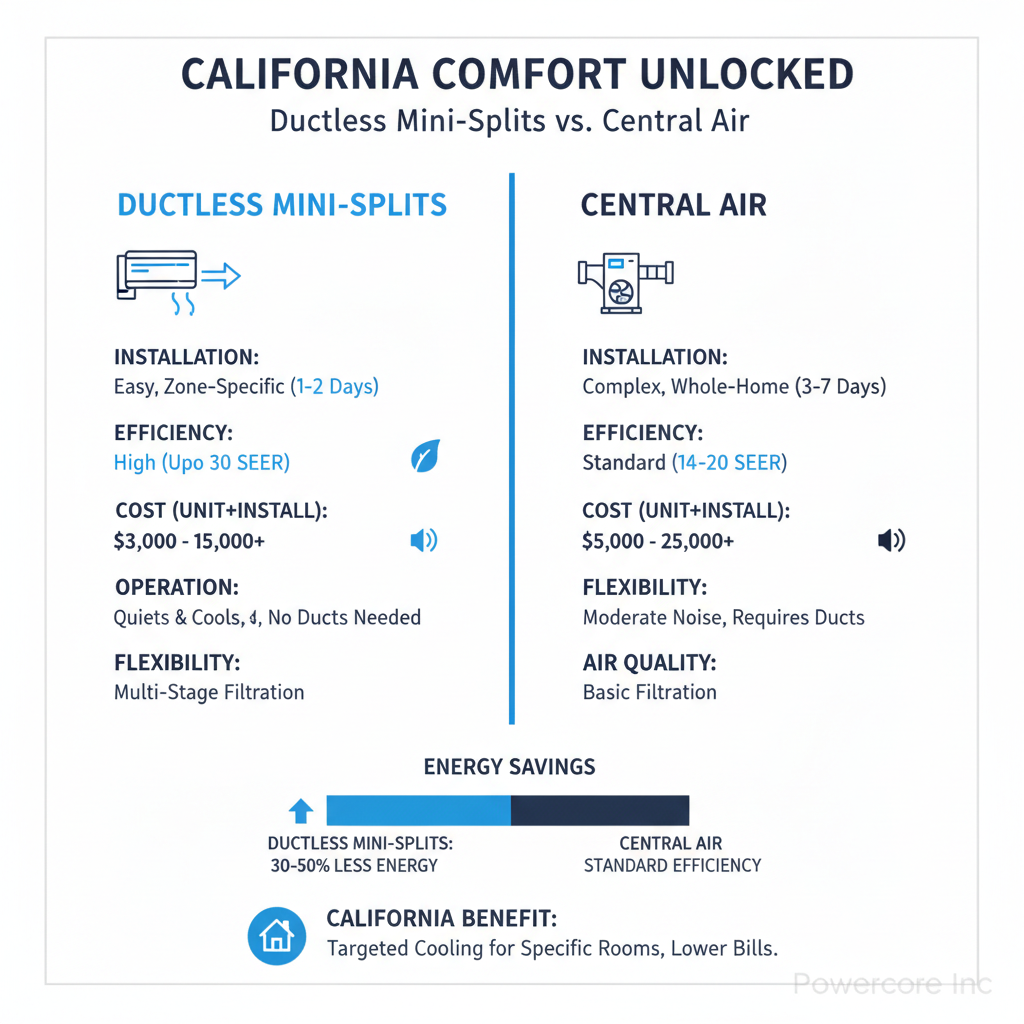
To help you visualize the differences, here's a direct comparison of key factors:
Energy Efficiency & Operating Costs
When comparing HVAC systems, efficiency ratings like SEER2 (Seasonal Energy Efficiency Ratio 2) are crucial. Both mini-splits and modern central air systems can achieve high SEER2 ratings. However, mini-splits inherently minimize energy waste by eliminating duct losses and utilizing inverter technology for precise load matching. This often translates to lower operational costs, especially in California where electricity rates are premium. Homeowners focused on long-term savings and reducing their carbon footprint will find mini-splits particularly attractive.
Installation & Renovation Flexibility
This is where the distinction becomes stark. Installing a central air system in a new construction is relatively straightforward. However, retrofitting an older California home without existing ductwork can be a massive undertaking, impacting ceilings, walls, and potentially requiring significant remodeling work. Ductless mini-splits, on the other hand, require only a small hole for the refrigerant lines, making them incredibly adaptable for existing homes, historic properties, or new ADUs and additions.
Zoning & Personalization
Mini-splits are champions of personalized comfort. Each indoor unit acts as an independent climate zone, allowing family members to set their preferred temperatures without affecting others. Central air, by default, offers a uniform temperature across the entire home, which can lead to disagreements and wasted energy in unoccupied rooms. While central systems can be zoned, it adds significant complexity and cost, rarely matching the granular control of a multi-zone mini-split system.
Aesthetics and Noise
For homeowners who prioritize an invisible HVAC system, central air has an advantage, as only the grilles and registers are visible indoors. Mini-split indoor units are visible on walls, ceilings, or floors. However, modern mini-split designs are sleek and unobtrusive. In terms of noise, mini-splits often have very quiet indoor units, while the outdoor compressor unit for both systems produces similar noise levels, though mini-splits with inverter technology can often operate at lower, quieter speeds.
Upfront Costs
The initial investment for ductless mini-splits vs. central air can vary wildly depending on the size of your home, the number of zones desired, and whether ductwork needs to be installed or replaced. Generally, for a single zone, a mini-split might be comparable or slightly more expensive than a basic central air system. For multi-zone coverage, the total cost of a mini-split system can be higher than a central air system for a similar square footage, especially if existing ductwork is usable. However, when considering the cost of *adding* ductwork to an existing home, mini-splits often become the more cost-effective and less disruptive option.
Ideal Scenarios for California Homeowners
So, which system is right for your California home?
Choose Ductless Mini-Splits if:
- You're adding an ADU, sunroom, garage conversion, or home office and need independent climate control.
- You live in an older California home without existing ductwork, and you want to avoid a major renovation.
- You desire room-by-room temperature control and personalized comfort for different family members or areas of your home.
- Energy efficiency and lower long-term operating costs are your top priorities.
- You experience hot or cold spots in specific areas of your home.
- You want to integrate your HVAC with your solar power system to reduce grid dependency (highly efficient mini-splits make solar and battery storage even more effective).
- You're undergoing an open-concept remodel and want to ensure precise climate control in various areas.
Choose Central Air if:
- You are building a new home and can design ductwork efficiently from scratch.
- Your home already has well-designed, existing ductwork that is in good condition.
- You prefer a completely hidden HVAC system.
- You desire uniform temperature throughout an open-plan home and don't require significant zoning.
Maximizing Your Investment: Beyond the HVAC System
No matter which HVAC system you choose, true climate control optimization in California extends beyond the primary unit. Consider a holistic approach:
- Insulation and Air Sealing: Proper insulation in walls, attics, and crawl spaces, combined with effective air sealing, dramatically reduces the load on your HVAC system, leading to greater efficiency and comfort.
- Window Upgrades: Energy-efficient windows can prevent significant heat gain in summer and heat loss in winter.
- Solar Integration: Pairing an efficient HVAC system with a residential solar power system and battery storage can virtually eliminate your energy bills and provide energy independence during peak demand or outages.
Powercore Inc: Your Trusted Partner for California HVAC Solutions
Choosing between a ductless mini-split vs. central air system is a significant decision that impacts your comfort, energy bills, and home value for years to come. With California's unique climate and energy landscape, it's essential to work with an experienced and licensed contractor who understands your specific needs.
At Powercore Inc, we bring unparalleled expertise as a dual-licensed General B & C-10 Electrical Contractor. This means we are uniquely qualified to handle every aspect of your HVAC project – from electrical upgrades and panel work to the installation of complex systems and any associated remodeling or ADU construction. We provide comprehensive, tailored solutions that ensure your home is not just comfortable, but also energy-efficient and future-ready.
Conclusion
Whether you lean towards the flexible, zoned comfort of a ductless mini-split or the traditional whole-home uniformity of central air, the best choice for your California home depends on a careful evaluation of your property's characteristics, your lifestyle, and your long-term energy goals. Both systems offer advanced technologies that provide reliable heating and cooling, but their delivery methods and ideal applications differ significantly.
Don't navigate this complex decision alone. Let the experts at Powercore Inc guide you through the process, providing a professional assessment and recommending the optimal HVAC solution that aligns with your vision for comfort and efficiency.
Ready to unlock unparalleled climate control for your California home? Contact Powercore Inc today for a personalized consultation. Call us at 916-699-8778 or visit our contact page to schedule an appointment. We look forward to partnering with you to create the perfect indoor environment.