

Introduction: Strategic Solar Savings in California
For California homeowners considering solar energy, the promise of reduced electricity bills and energy independence is incredibly appealing. However, navigating the complex world of utility rates, especially between major providers like Southern California Edison (SCE) and Pacific Gas and Electric (PG&E), can feel like deciphering a foreign language. Understanding the nuances of their respective net energy metering (NEM) programs and time-of-use (TOU) rate structures isn't just about choosing solar; it's about making a truly strategic investment that maximizes your return and long-term savings.
At Powercore Inc, a dual-licensed General B and C-10 Electrical Contractor based in Roseville, CA, we understand that every solar journey in California is unique. With our statewide service and deep expertise, we're here to help you cut through the complexity. This comprehensive guide will break down the key differences between SCE and PG&E solar rates, explain the crucial impact of NEM 3.0, and provide actionable strategies to ensure your solar system is optimized for maximum financial benefit, no matter where you are in the Golden State.
The California Solar Landscape: A Tale of Two Giants
California's vast geography means that energy consumers are served by different utility providers, with SCE predominantly covering Southern California and PG&E dominating the northern and central regions. While both operate under the regulatory oversight of the California Public Utilities Commission (CPUC), their specific rate structures, service territories, and even the historical context of their grid development have led to distinct operational models and, consequently, different implications for solar homeowners.
- Southern California Edison (SCE): Serving over 15 million people across a 50,000-square-mile service area, including metropolitan areas like Los Angeles and Orange County. SCE has a long history of integrating renewable energy and faces unique challenges related to population density and peak demand management in hot climates.
- Pacific Gas and Electric (PG&E): The largest utility in California, PG&E serves roughly 16 million people across 70,000 square miles, stretching from Bakersfield in the south to the Oregon border. Its service area encompasses diverse geographies, from agricultural valleys to mountainous regions, each presenting distinct energy demands and infrastructure needs.
These differences are more than just geographical; they translate into varying time-of-use periods, export compensation rates, and even the nuances of customer service that solar homeowners interact with. Understanding these foundational distinctions is the first step in strategically planning your solar installation.
Decoding Net Energy Metering (NEM) in California
The cornerstone of solar economics in California is Net Energy Metering (NEM), a billing mechanism that allows solar owners to send excess electricity generated by their panels back to the grid in exchange for credits. Historically, NEM 2.0 offered significant financial incentives, often allowing homeowners to achieve near-zero electricity bills.
The Transition to NEM 3.0 (Net Billing Tariff)
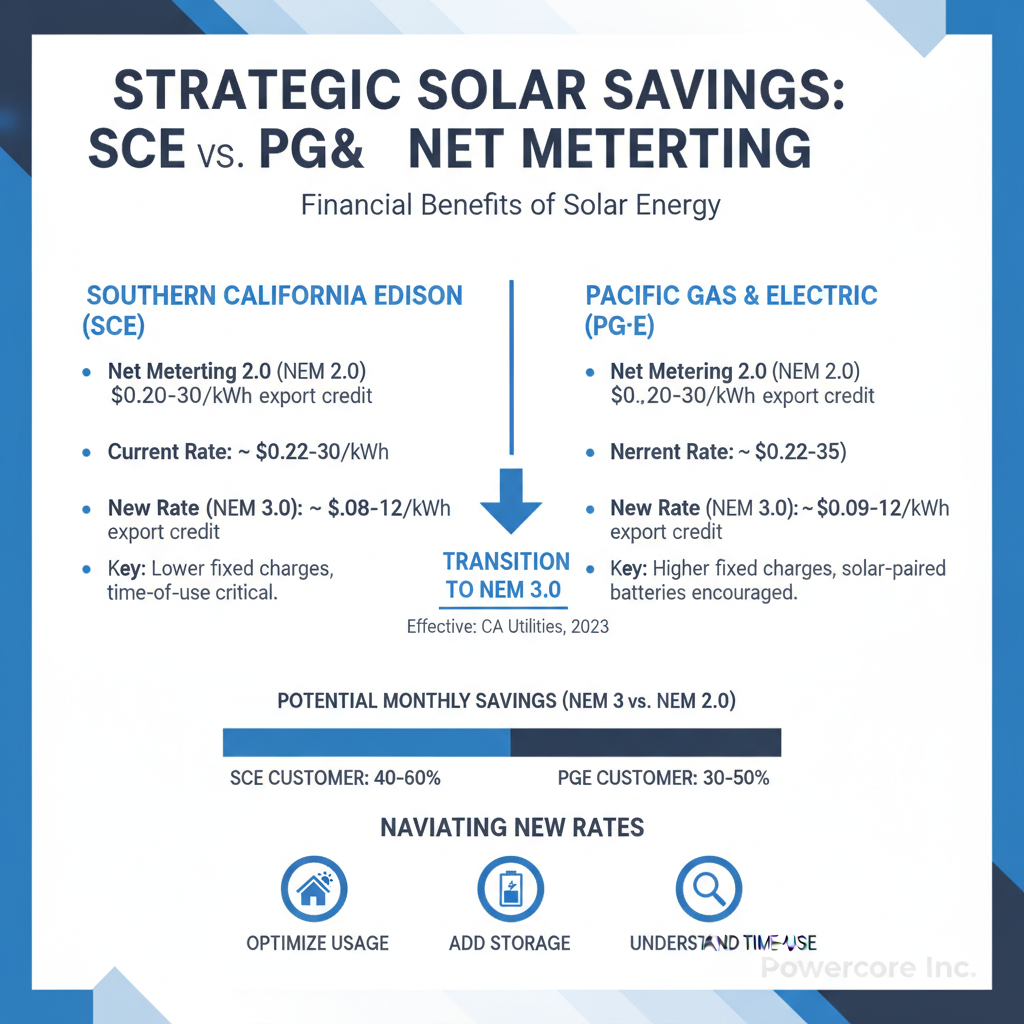
As of April 15, 2023, California transitioned from NEM 2.0 to NEM 3.0, officially known as the Net Billing Tariff. This change fundamentally altered how solar homeowners are compensated for excess energy. Under NEM 3.0, the value of electricity exported to the grid is significantly reduced, often compensated at an Avoided Cost Calculator (ACC) rate, which can be much lower than the retail rate you pay for electricity.
- Reduced Export Compensation: Instead of near-retail rate credits, excess solar energy is credited at a fluctuating wholesale rate, which varies significantly by time of day, season, and grid conditions. Peak export values are typically in the late afternoon/early evening when solar production is declining but demand is high.
- Increased Importance of Self-Consumption: With lower export compensation, maximizing the amount of solar energy you use directly in your home becomes paramount. Any energy you use as it's generated means you avoid purchasing it from the utility at the higher retail rate.
- Mandatory Time-of-Use (TOU) Rates: All new NEM 3.0 customers are placed on time-of-use rate plans, meaning the cost of electricity varies depending on the time of day it's consumed. This is crucial for both purchasing and exporting power.
The shift to NEM 3.0 has made strategic planning and system design more critical than ever. It's no longer just about generating as much power as possible; it's about generating and using it intelligently.
For the most up-to-date information on California's Net Billing Tariff and other solar policies, you can always refer to the California Public Utilities Commission (CPUC).
Southern California Edison (SCE) Solar Rates Explained
For homeowners in SCE's service territory, understanding their specific Time-of-Use (TOU) rate plans is key to maximizing solar savings under NEM 3.0.
SCE Time-of-Use (TOU) Rates for Solar Customers
SCE offers several TOU rate plans, and solar customers on NEM 3.0 are typically assigned to one that incentivizes energy use reduction during peak hours. The exact hours and pricing can vary by plan and season, but generally:
- Peak Hours: Often late afternoon to early evening (e.g., 4 PM to 9 PM), when electricity demand and prices are highest.
- Off-Peak Hours: Typically overnight and early morning.
- Super Off-Peak/Mid-Peak Hours: Varies, but often includes midday when solar production is abundant.
The cost difference between peak and off-peak hours can be substantial, sometimes by a factor of 3x or more. This means electricity purchased during peak times is very expensive, while electricity exported during those times might receive better compensation than off-peak exports (though still significantly less than retail import rates).
Export Compensation under SCE NEM 3.0
SCE's export compensation under NEM 3.0 is tied to the Avoided Cost Calculator (ACC) and varies significantly. During certain peak periods, particularly in the summer evenings when solar production wanes but demand is high, the export credits might be higher. However, during midday, when solar panels are at peak production across the grid, the export value can be very low, sometimes only a few cents per kilowatt-hour.
Strategic Implications for SCE Customers:
- Shift Energy Use: If you don't have battery storage, try to use high-energy appliances (washing machine, dishwasher, EV charging) during midday when your solar is producing abundantly and export value is low, or during super off-peak hours overnight.
- Battery Storage is Highly Recommended: A home battery system allows you to store excess solar generated during low-value export times (e.g., midday) and discharge it during high-value import times (e.g., peak evening hours), drastically reducing your reliance on expensive grid power and maximizing your self-consumption.
- Smart Home Integration: Technologies that automate appliance usage based on TOU rates and solar production can significantly enhance savings.
Pacific Gas and Electric (PG&E) Solar Rates Explained
Similar to SCE, PG&E solar customers under NEM 3.0 must navigate specific Time-of-Use (TOU) rate plans that influence their solar economics.
PG&E Time-of-Use (TOU) Rates for Solar Customers
PG&E's TOU plans are designed to encourage energy conservation during peak demand periods. Common characteristics for solar customers include:
- Peak Hours: Often 4 PM to 9 PM or 5 PM to 8 PM, typically with the highest rates during these evening hours.
- Off-Peak Hours: Overnight and early morning, when rates are lowest.
- Partial-Peak Hours: Mid-day periods that are more expensive than off-peak but less than peak.
PG&E's rate variations can also be quite significant, emphasizing the need for smart energy management. The peak period coincides with when many people return home, turn on lights, cook dinner, and use heating or AC, while solar production is often decreasing.
Export Compensation under PG&E NEM 3.0
PG&E's export compensation under NEM 3.0 also uses the ACC and exhibits similar trends to SCE: low compensation during midday when solar is abundant, and potentially higher (but still below retail) compensation during evening peak hours. The exact values are dynamic and influenced by grid supply and demand.
Strategic Implications for PG&E Customers:
- Maximize Midday Self-Consumption: If you're home during the day, try to schedule energy-intensive tasks during midday when your solar panels are producing the most and export value is low.
- Invest in Battery Storage: For PG&E customers, battery storage is arguably even more critical than ever. It allows you to arbitrage electricity: store cheap solar power during the day and use it to avoid expensive evening peak rates. Powercore Inc specializes in residential solar & storage solutions designed for precisely these scenarios.
- EV Charging Strategy: If you have an electric vehicle, consider charging it during off-peak hours (overnight) or during midday with your solar production, rather than during expensive peak evening hours. Explore our EV charging stations services to integrate this seamlessly.
Key Differences: SCE vs. PG&E Solar Economics
While both SCE and PG&E operate under the same NEM 3.0 framework, subtle differences in their service territories, historical load profiles, and specific rate plan structures can lead to variations in solar economics for homeowners.
Time-of-Use Window Variations
The most significant practical difference often lies in the exact timing and duration of peak, off-peak, and super off-peak windows. For example:
- SCE Peak: Might be 4 PM - 9 PM daily, with specific seasonal adjustments.
- PG&E Peak: Could be 5 PM - 8 PM on weekdays, with different weekend schedules.
These slight differences can have a substantial impact on when it's most valuable to self-consume solar, export power, or draw from a battery system. A system designed for optimal performance in SCE territory might need slight adjustments to maximize savings in PG&E territory, and vice-versa.
Export Value Differences
While both use the ACC, the specific values for export compensation can vary. This is due to local grid conditions, regional supply and demand, and transmission costs. Homeowners might find that their excess solar power is worth slightly more or less depending on whether they are in an SCE or PG&E region during specific times of the day or year.
Grid Resilience and PSPS
Both utilities face challenges with grid resilience, particularly concerning Public Safety Power Shutoffs (PSPS) during wildfire season. However, the frequency and duration can vary by region. For this reason, battery storage is not just a financial optimization tool but also a critical component for energy independence and backup power during outages, regardless of your utility.
Optimizing Your Solar Investment: Strategies for Both Regions
Given the complexities of NEM 3.0 and the distinct characteristics of SCE and PG&E's rate structures, a strategic approach is essential for maximizing your solar ROI. Powercore Inc recommends a multi-faceted strategy.
The Power of Battery Storage Under NEM 3.0
Under NEM 3.0, home battery storage has transitioned from a luxury to a near necessity for most solar homeowners. Here's why:
- Time-Shifting/Arbitrage: Store excess solar energy generated during midday (when export value is low) and use it during evening peak hours (when import rates are high). This directly offsets expensive grid purchases.
- Maximize Self-Consumption: By storing and using your own solar power, you reduce reliance on the grid and maximize the value of every kilowatt-hour your system produces.
- Backup Power: In the event of a grid outage (like a PSPS event), your battery provides essential backup power, keeping critical appliances running.
- Access to Incentives: California offers significant incentives for battery storage, such as the Self-Generation Incentive Program (SGIP) and the federal Residential Clean Energy Credit (formerly ITC), which can dramatically reduce the upfront cost of a battery system. Learn more about California Battery Storage Incentives.
Time-of-Use (TOU) Rate Optimization
Understanding and adapting to your utility's specific TOU schedule is critical. This involves:
- Energy Usage Audit: Knowing when and how your household consumes energy.
- Behavioral Changes: Shifting high-consumption activities (doing laundry, running the dishwasher, charging your EV) to off-peak hours or when your solar is producing abundantly.
- Smart Home Technology: Utilizing smart thermostats, smart plugs, and energy management systems to automate energy usage and optimize against TOU rates.
Optimal System Sizing and Design
Unlike NEM 2.0, where oversizing a system might have been beneficial due to high export credits, NEM 3.0 necessitates careful sizing. An oversized system might generate more power than you can self-consume or store, leaving you with low-value export credits. Powercore Inc's expert designers will:
- Analyze Your Specific Usage: Based on historical electricity bills and future energy needs (e.g., EV charging, new appliances).
- Factor in NEM 3.0 Rules: Design a system that balances self-consumption, battery integration, and the economics of export.
- Consider Future Needs: Account for potential increases in electricity demand, such as adding an electric vehicle or expanding your home with an ADU.
A properly sized and designed solar system is the bedrock of long-term savings. For insights into the financial considerations of various solar investments, consider reading our article on Strategic Solar Investment: Purchase vs. Lease for Maximum California Home Value.
Understanding Available Incentives
While NEM 3.0 changed export compensation, other powerful incentives still make solar a wise financial decision:
- Federal Residential Clean Energy Credit (ITC): A 30% tax credit for qualifying solar and battery storage installations. This significantly reduces the upfront cost of your system.
- Local Programs & Rebates: Depending on your specific location within California, additional local or municipal incentives might be available.
Combining these incentives with strategic system design and battery storage can greatly enhance your overall return on investment.
Powercore Inc: Your Trusted Partner in California Solar
Navigating California's dynamic solar landscape requires more than just installing panels; it requires a strategic partner who understands the intricate details of utility rates, regulatory changes, and advanced energy solutions. Powercore Inc is that partner.
As a California dual-licensed General B and C-10 Electrical Contractor (CSLB #1134334 & #1098175), we possess the comprehensive expertise to design, install, and optimize solar and battery storage systems across all of California. From initial consultation and custom design to seamless installation and ongoing support, we ensure your system is perfectly tailored to your home's unique energy profile and your utility's specific rate structures, whether you're in SCE or PG&E territory.
Our commitment is to empower California homeowners with sustainable, cost-effective energy solutions that provide true energy independence and maximize your financial returns. We pride ourselves on transparent communication, superior craftsmanship, and a deep understanding of the local energy market.
Making the Smart Switch to Solar in California
The transition to NEM 3.0 has undeniably reshaped the economics of solar in California, but it has by no means diminished its value. Instead, it has emphasized the importance of a thoughtful, integrated approach that leverages both solar generation and advanced battery storage.
By understanding the distinctions between SCE and PG&E rate structures, embracing battery technology, and optimizing your energy consumption, you can still unlock substantial savings and enjoy the myriad benefits of clean, renewable energy. The path to energy independence in California is clearer than ever, with the right strategy.
Ready to explore how a strategically designed solar and battery storage system can transform your home's energy future and maximize your savings under SCE or PG&E's Net Billing Tariff? Don't leave your investment to chance. Contact Powercore Inc today for a personalized consultation. Our expert team is ready to provide tailored solutions that optimize your energy costs and enhance your home's resilience. Call us at 916-699-8778 to get started on your strategic solar journey.