

Navigating California's Solar Landscape: Lease vs. Purchase
California, a beacon of renewable energy, presents homeowners with an incredible opportunity to harness the sun's power. Yet, as utility costs continue their upward trajectory, the decision to go solar becomes less about if and more about how. For many, the primary question boils down to a pivotal financial choice: should you purchase your solar energy system outright, or opt for a solar lease or Power Purchase Agreement (PPA)? This decision isn't just about saving money on your monthly bill; it's about building long-term equity, maximizing incentives, and securing true energy independence for your home.
At Powercore Inc, we understand that navigating the complexities of residential solar solutions requires clear, unbiased information. As a dual-licensed General B & C-10 Electrical Contractor based in Roseville, CA, we empower homeowners across California to make informed choices that align with their financial goals and lifestyle needs. This comprehensive guide will dissect the advantages and disadvantages of solar ownership versus leasing, helping you master your solar investment in the Golden State.
Understanding Solar Ownership: The Path to Asset Building
When you choose to purchase your solar system, you become the outright owner of the equipment installed on your property. This can be done with an upfront cash payment or, more commonly, through a solar loan that allows you to finance the system over time. Solar ownership is widely considered the most financially advantageous option for the vast majority of homeowners in California, particularly those looking to maximize long-term savings and increase their property value.
Key Benefits of Purchasing Your Solar System
- Significant Financial Savings: As an owner, you eliminate or drastically reduce your monthly electricity bills. Over the 25-30 year lifespan of a typical solar system, these savings can amount to tens of thousands of dollars, far exceeding the initial investment.
- Increased Home Value: A purchased solar system is a significant home improvement that adds tangible value to your property. Studies consistently show that homes with owned solar panels sell for more and spend less time on the market. It's an asset that appreciates alongside your home.
- Eligibility for Powerful Incentives: Owners qualify for the federal Residential Clean Energy Credit (ITC), which currently offers a 30% tax credit on the total cost of your solar installation. This alone can significantly offset your investment. Additionally, you may qualify for local or state incentives, further enhancing your return.
- Complete Energy Independence & Control: You have full control over the electricity your system generates. There are no escalator clauses on your energy rate, and you're shielded from volatile utility price hikes. This independence is particularly valuable in California's dynamic energy market.
- Maximize Net Metering Benefits: Under California's Net Energy Metering (NEM) policies, particularly NEM 3.0, owning your system allows you to capitalize on time-of-use rates and potentially pair your solar with battery storage to optimize energy usage and export credits.
- Environmental Impact: Owning your system means 100% of the environmental benefits, including carbon footprint reduction, are directly attributable to you.
Considerations for Solar Ownership
While the benefits are compelling, there are considerations:
- Upfront Cost: The initial investment for an owned system can be substantial, though various financing options (low-interest solar loans, PACE programs) make it accessible to more homeowners. Our team at Powercore Inc can help you explore these options.
- Maintenance Responsibility: As the owner, you're responsible for maintenance, though modern solar systems require minimal upkeep. Most panels come with long warranties (20-25 years) that cover performance and defects, and inverters typically have 10-12 year warranties.
- System Sizing and Future Needs: Proper sizing is crucial. Consider future energy demands like EV charging or adding an ADU. A well-designed system from Powercore Inc will account for these.
Exploring Solar Leasing and PPAs: The Zero-Down Approach
Solar leases and Power Purchase Agreements (PPAs) represent a different model of going solar, often marketed as a "zero-down" solution. In both scenarios, a third-party company (the lessor or PPA provider) owns, installs, and maintains the solar panel system on your roof. You, the homeowner, do not own the equipment.
- Solar Lease: You pay a fixed monthly fee to the leasing company for the use of the solar panels, similar to renting a car. This fee may have an escalator clause, increasing your payment by a small percentage each year.
- Power Purchase Agreement (PPA): Instead of a fixed monthly fee, you pay the solar provider a set rate per kilowatt-hour (kWh) for the electricity your system produces. This rate is typically lower than your utility's rate, offering immediate savings, but it also often includes an annual escalator.
Key Benefits of Solar Leasing or PPA
- No Upfront Cost: This is the primary appeal. Homeowners can go solar without a significant initial investment.
- Maintenance-Free: The leasing or PPA company is responsible for all maintenance, repairs, and monitoring of the system.
- Predictable Monthly Payments: With a lease, your monthly payment is fixed (or has a predictable escalator). With a PPA, your per-kWh rate is fixed, making your electricity costs more predictable than fluctuating utility bills.
- Immediate, Albeit Smaller, Savings: You'll typically see some savings on your utility bill from day one, as the lease payment or PPA rate is usually less than what you would have paid the utility for the same amount of electricity.
Considerations for Solar Leasing or PPA
- No Ownership, No Home Value Increase: Since you don't own the system, it doesn't add value to your home. It's essentially a utility service provided by a third party.
- No Eligibility for Incentives: The federal ITC and other significant incentives go to the system owner (the leasing company), not to you. This is a major financial drawback compared to ownership.
- Complex Contractual Obligations: Leases and PPAs often involve long-term contracts (20-25 years) with complex terms, including potential escalator clauses that can diminish savings over time.
- Challenges with Home Resale: Transferring a solar lease or PPA to a new homeowner can be complicated and, in some cases, deter potential buyers, impacting your home's marketability.
- Less Control: You have less say in system modifications or upgrades, as you are not the owner.
Direct Comparison: Ownership vs. Leasing in California
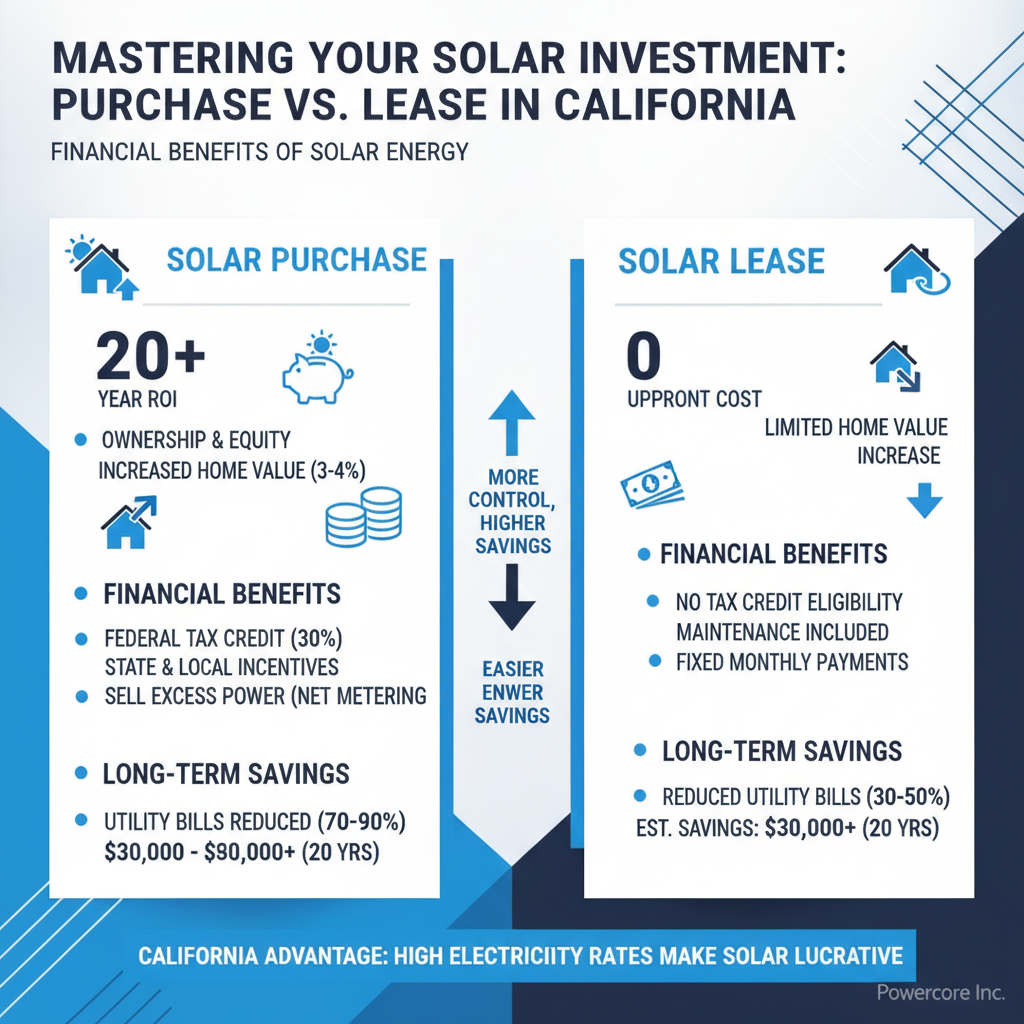
To truly master your solar investment, it's crucial to weigh these options side-by-side, especially with California's unique energy regulations. Here's a breakdown of how purchase and lease/PPA options stack up:
Financial Impact: Upfront Costs and Long-Term Savings
- Purchase: Higher upfront cost (or loan payments). Significantly higher long-term savings due to no monthly lease payments after payback, full benefit of incentives, and potential for selling excess power back to the grid. Total ROI is maximized.
- Lease/PPA: Zero upfront cost. Immediate but smaller savings. Long-term savings are eroded by fixed monthly payments or escalating per-kWh rates. No direct financial benefit from incentives.
Home Value and Asset Building
- Purchase: Boosts home value, considered an appreciating asset.
- Lease/PPA: Does not add value to your home. Can complicate selling your home as buyers must assume the lease or PPA.
Incentives and Tax Benefits
- Purchase: Eligible for the 30% federal ITC and any state/local incentives.
- Lease/PPA: Incentives are claimed by the leasing company, not the homeowner.
Maintenance and Responsibility
- Purchase: Homeowner is responsible, but systems are low-maintenance with long warranties.
- Lease/PPA: Leasing company handles all maintenance and repairs.
Flexibility and Control
- Purchase: Complete control over your system, including upgrades (e.g., adding battery storage) and monitoring.
- Lease/PPA: Limited control. System upgrades or modifications require lessor approval.
California-Specific Considerations: NEM 3.0
California's shift to NEM 3.0 has significantly altered the financial landscape for solar. For homeowners, this means that the value of exporting excess solar energy back to the grid has decreased. This change makes solar + battery storage solutions increasingly attractive, as batteries allow you to store your self-generated power and use it during peak utility rate hours or when the sun isn't shining, maximizing your self-consumption and reducing reliance on the grid.
- Under NEM 3.0, ownership with battery storage is generally the most financially robust strategy. It allows you to maximize the value of every kWh your system produces, truly achieving energy independence and shielding you from high peak-hour utility rates.
- Leases and PPAs under NEM 3.0 may offer less compelling savings compared to previous NEM versions, making the long-term financial benefits of ownership even more pronounced.
Factors Influencing Your Decision in the Golden State
Choosing the right solar path requires a careful assessment of your personal circumstances and financial goals. Consider the following:
Your Financial Situation and Risk Tolerance
Can you afford the upfront cost, or qualify for a solar loan? While a lease offers zero down, an owned system typically provides a much higher return on investment over its lifetime. Evaluate your comfort level with a long-term financial commitment versus the flexibility of a lease.
How Long Do You Plan to Stay in Your Home?
If you plan to sell your home in the next 5-7 years, a solar lease might seem appealing due to no upfront cost. However, the complexity of transferring a lease can be a significant hurdle during a home sale. An owned system, conversely, is a desirable upgrade that can expedite your home's sale and increase its value.
Your Energy Consumption and Future Needs
Do you have high electricity bills? Are you planning to purchase an electric vehicle and install an EV charging station, or add an ADU that will increase your energy demand? An owned system provides the flexibility to size your system for current and future needs, including seamless integration with battery storage to truly future-proof your home against rising energy costs and grid instability. Powercore Inc specializes in comprehensive energy solutions that anticipate your evolving needs.
Understanding California's Regulatory Environment
As discussed, California's NEM 3.0 has shifted the playing field. While solar is still highly beneficial, the economics favor strategies that maximize self-consumption and energy independence. This is where ownership, often paired with battery storage, shines, allowing homeowners to leverage time-of-use rates and reduce peak demand charges more effectively.
Maximizing Your Solar Investment with Powercore Inc
Making the right choice between a solar lease and purchase is a significant step toward energy independence and financial stability. At Powercore Inc, we believe in empowering California homeowners with the knowledge and the highest quality installations to ensure their solar investment delivers maximum returns.
Our expertise extends beyond just solar panels. As a dual-licensed contractor, we offer integrated energy solutions, from residential solar & storage to EV charging installations and comprehensive remodels. We design systems tailored to your unique energy profile, ensuring optimal performance and compliance with all California regulations, including the nuances of NEM 3.0.
When you choose Powercore Inc, you partner with a local, trusted expert committed to craftsmanship and customer satisfaction. We provide clear, transparent guidance on the financial implications of each solar option, help you navigate incentives, and deliver a seamless installation process from start to finish. Our commitment is to help you build a greener, more valuable, and energy-independent home.
For a deeper dive into how solar financing impacts your budget, you might find our article Understanding the Average Monthly Cost of Solar Panels: An In-Depth Tutorial helpful. Additionally, for information on maximizing the federal incentive, consider reading Federal Solar ITC 2026: Maximize Your Savings Before the Shift.
Ready to Illuminate Your Financial Future?
The decision between purchasing and leasing your solar system is a long-term commitment that significantly impacts your home's value and your financial well-being. Don't leave this crucial choice to chance. Contact Powercore Inc today for a personalized consultation. Our team of certified professionals is ready to assess your specific needs, provide a detailed comparison of your options, and design a custom solar solution that perfectly aligns with your goals. Call us at 916-699-8778 to begin your journey towards energy independence and a brighter financial future with solar.