

Seize the Sun: Maximizing Your Federal Solar ITC Before the Horizon Shifts
As a California homeowner, you're likely aware of the Golden State's pioneering spirit when it comes to renewable energy. But beyond our abundant sunshine and progressive policies, a powerful federal incentive has been supercharging solar adoption across the nation: the Federal Solar Investment Tax Credit (ITC). This critical financial benefit has made solar energy more accessible and affordable than ever before, dramatically reducing the upfront cost of going green.
However, the landscape of incentives is ever-evolving. While the Inflation Reduction Act (IRA) provided significant stability for the ITC, understanding its current structure, historical context, and future outlook is crucial for strategic planning. The concept of "federal solar ITC 2026" may spark questions about an impending deadline or change. This comprehensive guide from Powercore Inc, your trusted California dual-licensed General B & C-10 Electrical Contractor, will clarify the facts, help you navigate the nuances, and empower you to maximize your solar savings for years to come.
We'll delve into the mechanics of the ITC, its journey through legislative changes, and how Californians can strategically combine federal benefits with state-specific advantages to unlock unparalleled value. Don't leave money on the table – let's explore how to future-proof your home's energy independence and capitalize on this golden opportunity.
Understanding the Federal Solar Investment Tax Credit (ITC)
At its core, the Federal Solar Investment Tax Credit is a non-refundable tax credit that allows you to deduct a percentage of the cost of installing a solar energy system from your federal income taxes. It's not a rebate; it directly reduces the amount of tax you owe, dollar for dollar. This direct reduction makes it one of the most powerful financial incentives for solar adoption. If the credit amount exceeds your federal tax liability in a given year, you can typically carry forward the unused portion to future tax years, ensuring you don't lose out on the benefit over time. This carry-forward provision is a crucial aspect that makes the ITC accessible to a broader range of taxpayers.
Who is Eligible and What Does it Cover?
The ITC is broadly applicable to various property types, encouraging widespread solar adoption:
- Residential Property Owners: Homeowners installing solar on their primary or secondary residences are eligible. This includes single-family homes, townhouses, condominiums, and even some multi-family dwellings.
- Commercial and Industrial Property Owners: Businesses, non-profits, and agricultural entities can also claim the ITC for eligible solar projects, contributing to a greener business footprint and reduced operating costs.
The ITC generously covers a wide array of costs associated with your solar energy system, ensuring a comprehensive incentive:
- The cost of solar PV panels (photovoltaic cells), which convert sunlight into electricity.
- Labor costs for on-site preparation, assembly, and installation, including electrical wiring and structural reinforcements.
- Mounting equipment, wiring, inverters (which convert DC electricity from panels to AC for home use), and other balance-of-system components essential for a functioning solar array.
- Permitting fees, inspection costs, and developer fees, which are often significant components of a solar project's overall expense.
- Battery Storage: Crucially, energy storage devices (solar batteries) with a capacity of at least 3 kWh are also eligible for the ITC. For residential systems, they qualify if they are charged by solar panels at least 75% of the time. This integration is increasingly vital, especially in California's evolving energy landscape, as we'll discuss further.
It's important to remember that the tax credit applies to the net cost of your system after any other rebates or grants you might receive. However, it does not typically reduce the basis of your property for depreciation purposes (for commercial systems) or affect property tax assessments (for residential systems in California, thanks to Proposition 13 exemption for solar equipment, as we'll detail later).
The ITC's Journey: From 2026 Fears to IRA Stability
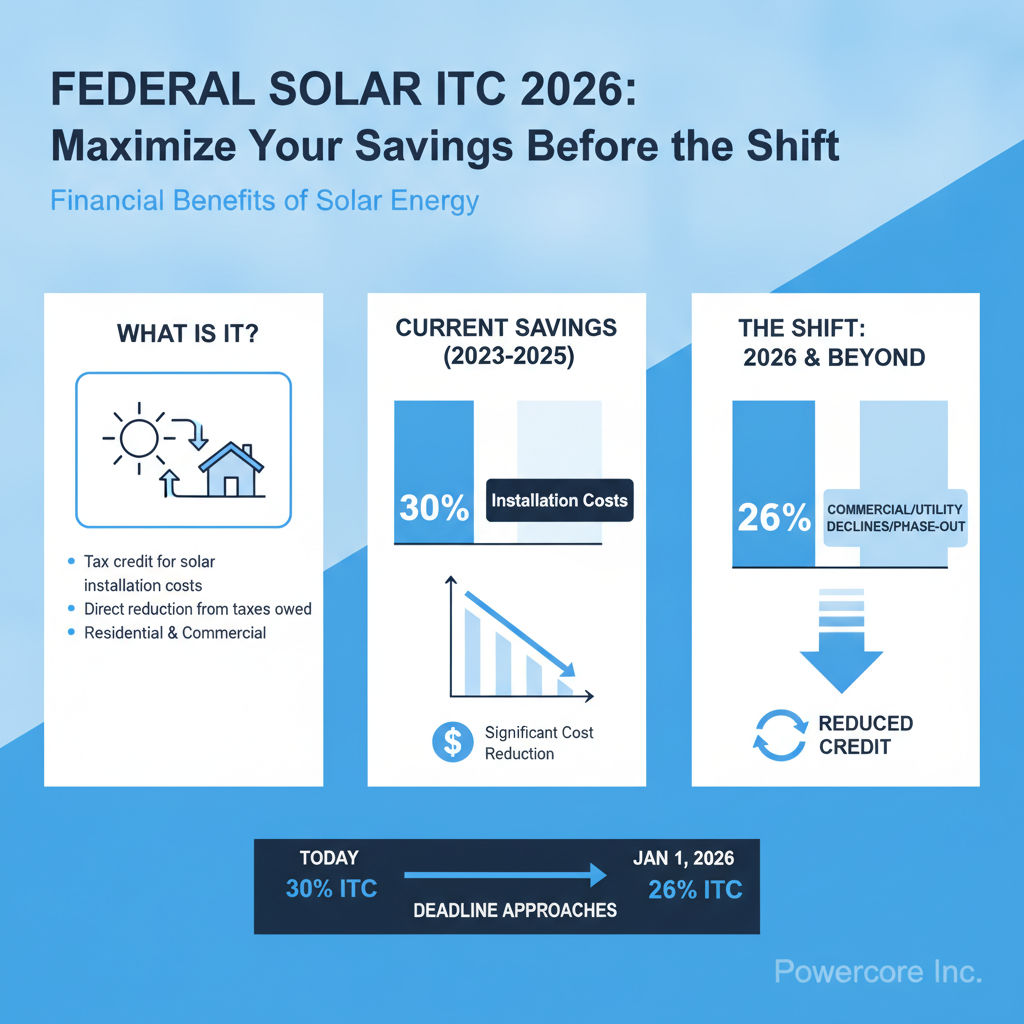
The concept of "federal solar ITC 2026" stems from the original legislative framework of the ITC. Initially enacted in 2006, the credit was designed to gradually step down over time to encourage early adoption. For many years, the schedule indicated a significant reduction in the credit's value starting in 2026, dropping from its peak (which varied between 26% and 30%) to a much lower rate, and eventually expiring for residential systems. This looming deadline created a sense of urgency for homeowners and businesses alike, encouraging them to go solar before the perceived window closed.
The Inflation Reduction Act's Game-Changer
However, the Inflation Reduction Act (IRA) of 2022 dramatically reshaped the future of the ITC. Recognizing the critical role of renewable energy in combating climate change and fostering energy independence, the IRA not only extended but also enhanced the solar tax credit, providing unprecedented long-term stability.
- 30% Credit Reinstated & Extended: The IRA retroactively reinstated the ITC to 30% for systems placed in service starting January 1, 2022. More importantly, it extended this generous 30% credit for a full decade, through the end of 2032. This means the 30% credit is locked in for installations completed over the next several years.
- New Step-Down Schedule: The credit is now scheduled to step down to 26% in 2033, and then to 22% in 2034. For residential systems, it is currently set to expire in 2035. Commercial and utility-scale projects, however, will see a permanent 10% credit from 2035 onwards.
This means the immediate urgency associated with a 2026 step-down has been alleviated. The 30% federal solar ITC is secure for many years to come, offering a stable and predictable incentive for homeowners and businesses to invest in solar. However, this doesn't mean you should delay. Market conditions, energy prices, and other incentives (especially state-level ones like in California) are always subject to change. Locking in your savings now, while the 30% is guaranteed, means you secure the highest current benefit and begin realizing savings on your utility bills immediately. Moreover, while the IRA provides stability, future legislative changes are always a possibility, making proactive action a wise choice.
California's Golden State Solar Landscape: Beyond the ITC
While the federal ITC is a cornerstone of solar affordability, California offers its own unique set of dynamics and incentives that further enhance the financial benefits of going solar. Understanding how these integrate is key to maximizing your overall return on investment and achieving true energy independence.
Navigating NEM 3.0: The Rise of Battery Storage
California's Net Energy Metering (NEM) policy has undergone significant changes with the introduction of NEM 3.0. This updated policy, which took effect in April 2023, has shifted the economics of solar for new customers by significantly reducing the export compensation rates for electricity sent back to the grid. While this might seem like a hurdle, it unequivocally elevates the importance and financial viability of battery storage, making it an almost essential component for new solar installations.
- Maximize Self-Consumption: With NEM 3.0, generating your own power and using it directly (self-consumption) or storing it in a battery for later use during peak hours becomes paramount. This allows you to avoid purchasing expensive grid electricity when export rates are low and maximize the value of every kilowatt-hour your panels produce.
- ITC Eligibility for Batteries: As mentioned, solar batteries are eligible for the 30% federal ITC when charged primarily by solar. This makes the crucial addition of storage much more affordable, sweetening the deal for a truly optimized system.
- Time-of-Use Optimization: Batteries enable you to strategically charge when solar production is high and electricity is abundant (and effectively free from your panels) and discharge when utility rates are highest (e.g., evening peak hours), optimizing your savings and reducing your reliance on the grid during costly periods.
Powercore Inc specializes in designing integrated solar and battery storage systems that are perfectly optimized for California's NEM 3.0 environment, ensuring you get the most out of every kilowatt-hour and achieve maximum savings on your utility bills.
SGIP and Other State/Local Incentives
- Self-Generation Incentive Program (SGIP): While residential SGIP funds have largely been depleted for general market customers in many utility territories, it's still worth investigating if you qualify for equity resiliency or other specific categories. SGIP has historically provided substantial rebates for battery storage systems, and it's always wise to check for any new funding rounds or localized programs. Eligibility for SGIP can significantly reduce the upfront cost of battery storage, making it even more accessible.
- Property Tax Exemption: In California, the added value of a solar energy system to your home is exempt from property tax assessments (as per Proposition 13 and subsequent legislation). This is a significant, often overlooked, financial benefit that compounds over the lifetime of your system, saving you thousands of dollars in increased property taxes that you would otherwise incur for a home improvement of similar value.
- Sales Tax Exemption: While not a direct exemption on solar equipment itself, certain energy efficiency upgrades may qualify for sales tax exemptions or rebates, especially for businesses. It's always beneficial to inquire about these ancillary incentives.
- Local Programs: Always check with your local municipality or utility for any specific local incentives, grants, or low-interest loan programs that might be available in your area. These can vary greatly by city or county and can provide an additional layer of savings.
Long-Term Value & Resilience
Beyond direct financial incentives, solar energy offers undeniable long-term value for California homeowners:
- Increased Home Value: Studies consistently show that homes with solar panels sell faster and for a higher price than comparable non-solar homes. Solar is seen as a premium feature that reduces future operating costs for the buyer.
- Energy Independence: Reduce your reliance on the grid and protect yourself from volatile utility rate hikes, a persistent concern for Californians facing some of the highest electricity prices in the nation. This independence offers peace of mind and budget stability.
- Power Outage Protection: With a battery storage system, your home can remain powered during Public Safety Power Shutoffs (PSPS) or other grid interruptions, providing invaluable peace of mind and security for your family. This resilience is increasingly important in California's climate-challenged environment.
- Environmental Stewardship: By generating clean energy, you significantly reduce your carbon footprint, contributing directly to California's ambitious clean energy goals and fostering a healthier planet for future generations.
Strategic Planning for Maximum Solar Savings
To truly unlock the full potential of solar energy and the federal ITC, a strategic and integrated approach is essential. This goes beyond just installing panels; it involves optimizing your entire home energy ecosystem, a specialty of Powercore Inc.
Integrate Battery Storage Smartly
Given California's NEM 3.0, a solar-only system is often not the most financially optimal solution for new installations. Integrating a well-sized battery storage system is crucial for maximizing self-consumption and leveraging time-of-use rates. The 30% federal ITC applies to these batteries, making them a more affordable and essential component of a modern solar setup. Our experts at Powercore Inc can help you determine the ideal battery capacity for your specific energy usage patterns and goals.
Holistic Home Energy Solutions with Powercore Inc
Powercore Inc isn't just a solar company; we're a comprehensive home energy and remodeling contractor. This unique dual-licensing (General B & C-10 Electrical) allows us to offer integrated solutions that maximize your savings and home efficiency from a single, trusted provider:
- HVAC Upgrades: Before sizing your solar system, ensuring your heating and cooling (HVAC) systems are efficient reduces your overall energy demand, allowing for a smaller, more cost-effective solar array. We handle expert HVAC installation and upgrades, guaranteeing optimal comfort with minimal energy consumption.
- Roofing & Siding: A new roof or upgraded siding provides the ideal, durable foundation for solar panels, ensuring longevity and preventing future costly re-installations. Our expert roofing and siding services ensure your home's exterior is ready for decades of solar production.
- EV Charging: If you own an electric vehicle, integrating an EV charging station with your solar system allows you to power your car with clean, free energy, further reducing your energy bills and carbon footprint. This synergy turns your home into a personal, sustainable fueling station.
- Remodels & ADUs: For larger projects like ADUs or major home remodels, considering solar and energy efficiency from the outset leads to maximum long-term savings and a truly future-proof home that meets modern energy demands.
Choose the Right Partner: Powercore Inc's Expertise
Navigating federal tax credits, state incentives, and complex energy regulations requires a knowledgeable and experienced partner. Powercore Inc stands out as California's expert choice:
- Dual-Licensed Advantage: Our California CSLB #1134334 (General B) and #1098175 (C-10 Electrical) licenses mean we have comprehensive expertise in both general construction and specialized electrical work. This ensures seamless, code-compliant, and high-quality installations across all our services, guaranteeing safety and reliability.
- Comprehensive Service Offering: From solar and battery storage to HVAC, roofing, and full remodels, we provide integrated solutions under one roof, simplifying your project and ensuring optimal coordination and efficiency.
- California Focus: Based in Roseville, CA, and serving all of California, we have an intimate understanding of local regulations, utility requirements, and climate considerations unique to the Golden State. We provide solutions tailored to your specific region.
- Commitment to Education: We believe in empowering our clients with clear, accurate information to make the best decisions for their homes and financial futures, ensuring transparency and trust throughout the process.
Common Misconceptions & FAQs About the ITC
Even with the ITC's stability, questions often arise. Let's address some common points of confusion to ensure you're fully informed:
Is the ITC "Free Money"?
Not exactly. The ITC is a tax credit, meaning it reduces your federal income tax liability. You need to have a sufficient tax liability to claim the full credit. For example, if your credit is $9,000 but your tax liability is only $7,000, you would pay $0 in federal taxes and carry forward the remaining $2,000 credit to the next tax year. It's not a direct cash rebate or a check in the mail, but it significantly reduces your out-of-pocket costs over time by offsetting what you owe the IRS.
What if I Lease My Solar System or Have a PPA?
The ITC is only available to the owner of the solar energy system. If you lease your system or enter into a Power Purchase Agreement (PPA), the leasing company or third-party owner claims the tax credit, and those savings are typically factored into your lower monthly payments. To claim the ITC yourself, you must purchase the system outright or finance it with a loan, thereby becoming the system owner.
Does the ITC Cover My Entire System Cost?
No, the current ITC covers 30% of the eligible costs of your solar energy system. This means if your system costs $30,000, you could receive a $9,000 tax credit. You are responsible for the remaining 70% (which can be financed through various solar loan options). This 30% reduction, however, makes solar significantly more affordable and accelerates your return on investment.
Can I Claim the ITC for Future Upgrades?
Yes, if you add eligible components like a new solar battery or expand your solar array, those additions can also qualify for the ITC based on their cost at the time they are placed in service, provided the credit is still active and the new components meet the eligibility criteria. This flexibility allows homeowners to scale their systems or add storage as their energy needs evolve.
What if My Tax Liability is Zero?
As the ITC is non-refundable, it can only reduce your tax liability to $0. However, the good news is that any unused portion of the credit can be carried forward to subsequent tax years. This means even if you have no tax liability in the year you install solar, you can still benefit from the credit by applying it to future tax bills, ensuring you eventually receive the full amount.
The Path Forward: Seizing Your Solar Future
The updated federal solar ITC, bolstered by the Inflation Reduction Act, presents an unprecedented opportunity for California homeowners to invest in clean, sustainable energy with significant financial backing. While the immediate pressure of a 2026 step-down has been lifted, the wisdom of acting sooner rather than later remains paramount. The opportunity cost of delaying your solar installation is significant, as you continue to pay high and escalating utility bills.
By installing solar and battery storage now, you lock in the current 30% federal tax credit, capitalize on California's evolving energy policies (like NEM 3.0), and insulate yourself from future utility rate increases. You're not just installing a system; you're investing in energy independence, increasing your home's value, and contributing to a greener future for California. Moreover, by reducing your reliance on fossil fuels, you're playing a direct role in mitigating climate change and improving air quality for your community.
Don't let the complexities of incentives or the dynamic energy market deter you. With Powercore Inc, you have a partner dedicated to simplifying the process, maximizing your savings, and delivering a high-performance, tailored energy solution that stands the test of time.
Conclusion & Your Next Steps with Powercore Inc
The federal solar ITC, now stable at 30% until 2032 thanks to the IRA, offers a compelling financial incentive for Californians to go solar. When combined with strategic planning, essential battery storage integration, and Powercore Inc's comprehensive dual-licensed expertise, the financial and environmental benefits are truly transformative. We're here to guide you through every step, from initial consultation and system design to expert installation and navigating incentives, ensuring a seamless and rewarding experience.
Ready to explore how solar energy can dramatically reduce your utility bills, enhance your home's value, and secure your energy future? Don't wait for another policy shift or for energy prices to climb higher. Contact Powercore Inc today for a personalized consultation and a free, no-obligation quote. Our team is ready to answer your questions and design a custom solution optimized for your California home, ensuring you leverage every available saving opportunity. Call us at 916-699-8778 or visit gopowercoreinc.com to learn more and begin your journey to energy independence.