

Navigating California's Solar Crossroads: SCE vs. PG&E Under NEM 3.0
California homeowners considering solar energy often find themselves at a critical juncture, particularly when trying to understand the financial nuances dictated by their specific utility provider. With the statewide transition to Net Energy Metering 3.0 (NEM 3.0), officially known as the Solar Billing Plan, the rules for how solar homes are compensated for excess energy have shifted dramatically. For residents under Southern California Edison (SCE) and Pacific Gas & Electric (PG&E) service, these changes carry distinct implications, making a clear understanding of each utility's rates and policies absolutely essential for maximizing your investment.
At Powercore Inc, we understand that decoding complex energy policies can be daunting. As a California dual-licensed General B & C-10 Electrical Contractor, we specialize in guiding homeowners through the intricacies of solar adoption, ensuring your system is optimized for your specific utility and lifestyle. This comprehensive guide will explain the critical differences between SCE and PG&E solar rates under NEM 3.0, empowering you with the knowledge to make informed decisions for your home's energy future.
The Evolution of California's Net Energy Metering (NEM) Policies
Before diving into the specifics of SCE and PG&E, it's crucial to grasp the statewide framework that governs solar compensation: Net Energy Metering. Historically, NEM allowed solar customers to receive full retail credit for the excess electricity they exported back to the grid. This made solar an incredibly attractive investment, as it effectively turned your home into a mini-power plant, offsetting your electricity bill dollar-for-dollar.
NEM 2.0: A Legacy for Early Adopters
Customers who interconnected their solar systems before April 15, 2023, likely fall under NEM 2.0. Under this plan, customers generally receive near-retail rates for their exported solar electricity, minus some non-bypassable charges. This means that for every kilowatt-hour (kWh) of excess solar energy sent to the grid, homeowners receive a credit on their bill that significantly reduces what they owe. NEM 2.0 remains a highly beneficial program for those already enrolled, offering substantial savings and a clear path to energy independence.
The Paradigm Shift: NEM 3.0 (The Solar Billing Plan)
For all new solar customers applying for interconnection after April 14, 2023, the rules have changed significantly with the introduction of NEM 3.0 by the California Public Utilities Commission (CPUC). The core difference lies in how exported solar energy is valued. Instead of near-retail rates, NEM 3.0 compensates homeowners based on the "Avoided Cost Calculator" (ACC) — essentially, the wholesale value of electricity. This value fluctuates significantly throughout the day and year, being highest during peak demand (typically late afternoon/early evening) and lowest during periods of high solar generation (midday).
Key characteristics of NEM 3.0 include:
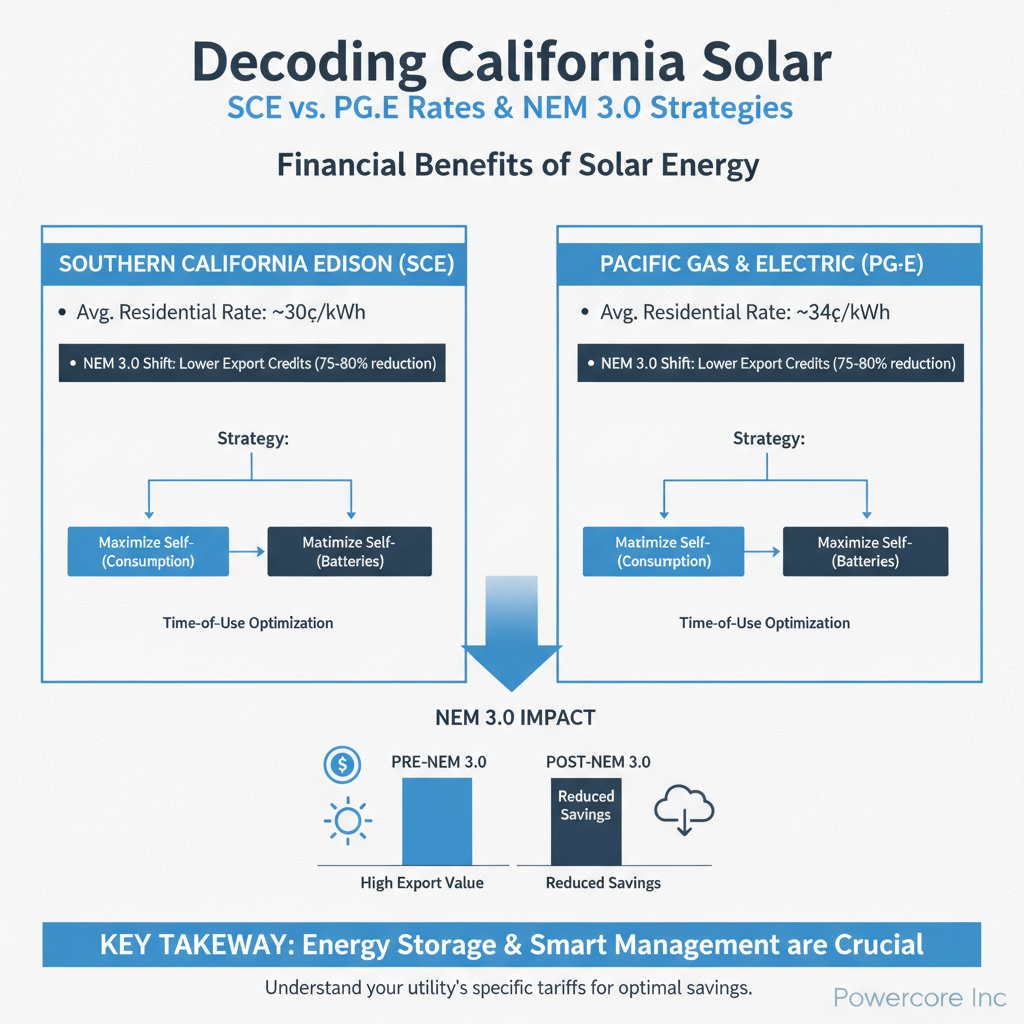
- Lower Export Compensation: Exported solar electricity is valued at wholesale rates, which can be 75-80% lower than retail rates, especially during midday when solar production is highest and grid demand is relatively low.
- Time-of-Use (TOU) Rates: TOU rates are more critical than ever. Export credits and import charges vary dramatically depending on the time of day and season. This incentivizes consuming your self-generated solar power when it's most valuable (i.e., when grid electricity is most expensive).
- Mandatory Battery Storage Integration: While not strictly mandated by law, battery storage has become a near-essential component for new solar systems under NEM 3.0 to make economic sense. Batteries allow homeowners to store excess solar generated during low-value midday periods and discharge it during high-value evening peak hours, significantly boosting savings.
- Non-Bypassable Charges: Similar to NEM 2.0, certain charges still apply to imported electricity, even if you are a net exporter.
Southern California Edison (SCE) Solar Rates Under NEM 3.0
For homeowners in SCE's expansive service territory, understanding their specific Time-of-Use (TOU) rate plans is paramount. SCE, like other California utilities, has several TOU options, and the specific plan you're on will heavily influence your solar savings under NEM 3.0.
SCE Time-of-Use (TOU) Rates and Their Impact
SCE's most common residential TOU rates typically feature peak periods in the late afternoon and early evening when electricity is most expensive. For example, a common SCE TOU plan might have:
- Off-Peak: Morning and late evening hours, and often all day on weekends/holidays.
- Mid-Peak: Midday to late afternoon.
- On-Peak: Typically 4 PM to 9 PM or 5 PM to 8 PM, weekdays.
Under NEM 3.0, the value of electricity you export to SCE during midday (off-peak solar production) is often quite low. However, the electricity you import from SCE during peak evening hours is very expensive. This creates a significant imbalance that solar homeowners must address.
Strategic Considerations for SCE Customers
To maximize savings with solar under SCE's NEM 3.0 structure, homeowners must focus on:
- Self-Consumption: Use as much of your solar-generated electricity directly as it's produced. This means running appliances during the day when the sun is shining.
- Battery Storage: A solar battery storage system is arguably the most critical component. It allows you to store excess midday solar generation and then discharge it during SCE's expensive evening peak hours, drastically reducing your need to import power from the grid when it's most costly. This strategy is often referred to as "time-shifting" your solar energy.
- Optimized System Sizing: Work with an expert like Powercore Inc to ensure your solar system is sized not just for your overall annual consumption, but specifically to meet your evening peak demand, especially when paired with a battery.
Pacific Gas & Electric (PG&E) Solar Rates Under NEM 3.0
PG&E customers, predominantly in Northern and Central California, face similar challenges and opportunities under NEM 3.0, though their specific TOU rate structures and peak periods can differ from SCE's.
PG&E Time-of-Use (TOU) Rates and Their Impact
PG&E also utilizes various residential TOU plans. A common structure might feature:
- Off-Peak: Mornings, late evenings, and weekends/holidays.
- Partial-Peak: Late morning to early afternoon, and late evening.
- On-Peak: Generally 4 PM to 9 PM or 5 PM to 8 PM on weekdays.
Similar to SCE, the export credit you receive from PG&E for your midday solar generation under NEM 3.0 is significantly reduced. This means that sending excess power back to the grid during the brightest parts of the day yields minimal financial benefit. The real savings come from avoiding costly imports during PG&E's on-peak hours.
Strategic Considerations for PG&E Customers
PG&E customers can employ similar strategies to SCE customers to maximize their solar investment under NEM 3.0:
- Maximize Direct Consumption: Shift energy-intensive tasks (laundry, dishwashing, EV charging) to daylight hours when your solar system is producing.
- Embrace Battery Storage: A residential solar system with integrated battery storage is paramount for PG&E customers. It enables you to bank your inexpensive midday solar energy and use it when PG&E's rates are highest, thereby optimizing your energy independence and financial returns.
- Understand Seasonal Variations: PG&E's TOU rates can also have seasonal adjustments, with summer peak hours often being more expensive. Battery storage becomes even more valuable during these periods.
The Crucial Role of Battery Storage Under NEM 3.0
It cannot be overstated: under NEM 3.0, solar battery storage is no longer a luxury but a fundamental component for achieving optimal financial benefits from your solar installation, whether you're an SCE or PG&E customer.
Here's why:
- Mitigating Low Export Rates: Instead of exporting your excess solar power to the grid for pennies on the dollar during midday, a battery allows you to store that energy for later use. This means you "self-consume" more of your own power, drastically reducing your reliance on the grid.
- Time-Shifting for Maximum Value: The true power of a battery under NEM 3.0 is its ability to time-shift energy. You charge your battery when solar production is high and electricity is cheap (or even free from your panels) and then discharge it during your utility's most expensive on-peak hours. This minimizes your imports from the grid during high-cost periods.
- Enhanced Energy Independence & Resilience: Beyond financial benefits, batteries provide invaluable backup power during grid outages, a growing concern across California. For more on incentives that can help with this, check out our guide on California Battery Storage Incentives.
A well-designed solar-plus-storage system transforms your home into a more resilient and economically efficient energy hub. Powercore Inc specializes in integrating state-of-the-art battery solutions that are specifically tailored to navigate the complexities of NEM 3.0 for both SCE and PG&E customers.
Maximizing Your Solar Investment: A Strategic Approach
Simply installing solar panels is no longer enough to guarantee maximum savings under NEM 3.0. A strategic, holistic approach is required.
1. Right-Sizing Your System for Current and Future Needs
Accurate system sizing is more critical than ever. It's not just about offsetting your current electricity bill; it's about optimizing for self- consumption and pairing effectively with battery storage to meet your peak demand. Consider future additions like an EV or an electric heat pump HVAC system, and size your system accordingly to avoid costly upgrades later.
2. Optimizing Energy Usage Through Smart Home Technology
Smart thermostats, smart appliances, and energy management systems can help automate the shifting of high-energy activities to off-peak (daytime solar production) hours. This proactive management of your home's energy consumption works hand-in-hand with your solar and battery system to reduce grid reliance.
3. Leveraging Available Incentives
The federal Residential Clean Energy Credit (formerly the ITC) offers a 30% tax credit for the cost of installing new residential solar and battery storage systems. This incentive is a significant factor in making solar-plus- storage economically viable. Don't miss out on these substantial savings; read more about it in our article: California Solar: Seize the 30% Tax Credit Before 2033 Step-Down.
4. Partnering with an Experienced Local Expert
Navigating NEM 3.0, understanding utility-specific rates, and designing an optimized solar-plus-storage system requires specialized knowledge. Powercore Inc brings unparalleled expertise in California's energy landscape, ensuring your system is designed, installed, and configured for maximum long-term savings and performance.
Why Choose Powercore Inc for Your California Solar Journey
Choosing the right solar contractor is the single most important decision you will make for your solar project. As a California dual-licensed General B & C-10 Electrical Contractor (CSLB #1134334 & #1098175), Powercore Inc offers a distinct advantage.
- Comprehensive Expertise: Our dual licensing means we have deep expertise not only in electrical systems but also in general construction, allowing us to handle complex installations seamlessly.
- Tailored Solutions: We don't believe in one-size-fits-all. We analyze your specific energy consumption, utility (SCE or PG&E) rates, and future needs to design a custom solar and battery storage system that delivers optimal performance and savings under NEM 3.0.
- Quality and Reliability: We use only the highest quality components and employ skilled, certified technicians to ensure a robust, long-lasting system.
- Full-Service Provider: From initial consultation and design to installation and ongoing support, Powercore Inc handles every aspect of your solar project, providing peace of mind.
- Statewide Service: Powercore Inc proudly serves all of California, bringing expert solar solutions to homes and businesses across the state.
Conclusion: Empowering Your Home with Smart Solar Strategies
The transition to NEM 3.0 has fundamentally changed the economics of solar in California, but it has also ushered in an era where strategic energy management and battery storage are more valuable than ever. Whether you're an SCE or PG&E customer, understanding your specific utility's TOU rates and adopting a solar-plus-storage solution is the key to unlocking significant savings and achieving true energy independence.
Don't let the complexities of NEM 3.0 deter you from embracing clean, renewable energy. Partner with Powercore Inc, your trusted California solar experts, to design a system that thrives under the new regulations. We're here to help you navigate these changes and build a resilient, cost-effective energy future for your home.
Ready to explore your solar and battery options under NEM 3.0? Contact Powercore Inc today for a personalized consultation. Call us at 916-699-8778 or visit our website to get started on your path to energy savings and independence.