

Unlocking California's Solar Advantage: Seize the 30% Tax Credit Before the 2033 Step-Down
As a California homeowner, you're uniquely positioned to harness the abundant sunshine and transform it into significant financial savings. The federal government offers a powerful incentive, the Residential Clean Energy Credit (formerly known as the Investment Tax Credit or ITC), which currently allows you to claim 30% of the cost of your new solar energy system as a tax credit. This isn't just a deduction; it's a direct reduction of the income taxes you owe, making solar more affordable than ever.
However, this golden opportunity has a timeline. While many homeowners might hear whispers of a 'solar tax credit step-down,' it's crucial to understand the accurate schedule. The full 30% credit is secure through 2032. After that, the credit percentage will begin to step down. For California residents considering solar, this means the window to maximize your investment and capitalize on the highest available incentive is now.
At Powercore Inc, a dual-licensed General B & C-10 Electrical Contractor based in Roseville, CA, we empower homeowners across the entire state to navigate these financial landscapes and make informed decisions. We're here to help you understand the Residential Clean Energy Credit, its step-down schedule, and how to integrate solar into a comprehensive home energy strategy that delivers maximum long-term value.
Understanding the Residential Clean Energy Credit (Formerly ITC)
The Residential Clean Energy Credit is the cornerstone of federal support for homeowners investing in renewable energy. It’s designed to encourage the adoption of solar and other clean energy technologies by making them more financially accessible.
What is the Federal Solar Tax Credit?
Simply put, the federal solar tax credit allows you to subtract a percentage of your solar energy system's cost directly from your federal income taxes. This includes not just the solar panels themselves, but also labor costs for on-site preparation, assembly or installation, and even battery storage components installed in conjunction with your solar system. There is no maximum amount that can be claimed.
The 30% Golden Window: Why 2022-2032 is Key
Thanks to the Inflation Reduction Act of 2022, the federal solar tax credit was not only extended but also increased and locked in at 30% for systems placed in service from 2022 through 2032. This means that for the next several years, you have the opportunity to claim a substantial portion of your solar investment back at tax time.
This 30% rate represents the peak of available federal incentives for residential solar. It's a significant factor in reducing the upfront cost of your system and accelerating your return on investment.
The Step-Down Schedule: What Happens After 2032?
While the 30% credit is stable for nearly a decade, it's not permanent. Understanding the step-down schedule is critical for strategic planning:
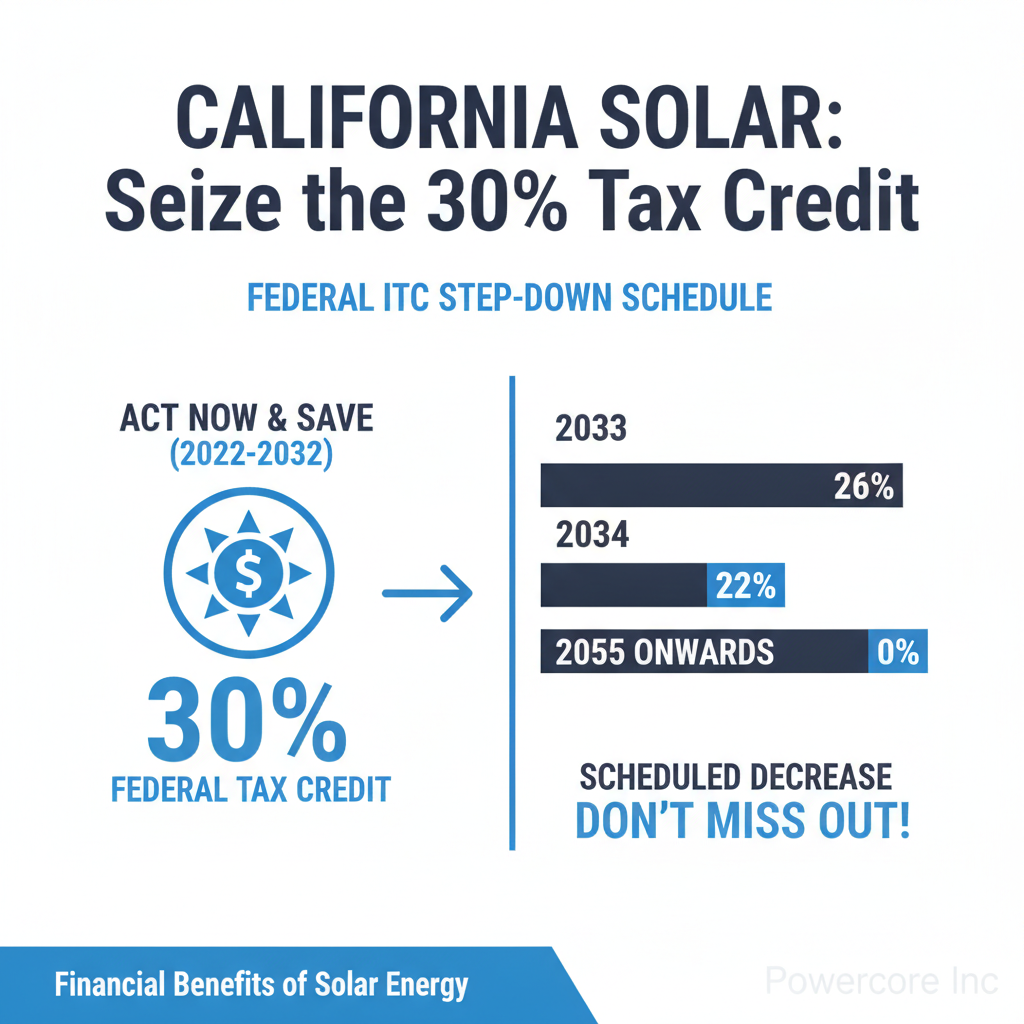
- Systems placed in service from 2022 through 2032: Eligible for a 30% tax credit.
- Systems placed in service in 2033: Eligible for a 26% tax credit.
- Systems placed in service in 2034: Eligible for a 22% tax credit.
- After 2034: The residential clean energy credit is set to expire, unless Congress renews it.
This clear step-down schedule underscores the importance of acting sooner rather than later. Every percentage point represents thousands of dollars in potential savings on a typical California solar installation.
For official information directly from the source, you can visit the IRS Residential Clean Energy Credit page.
Beyond the Federal: California's Unique Solar Landscape
While the federal tax credit is a significant national incentive, California offers its own dynamic environment for solar adoption, complete with specific regulations and additional opportunities that further enhance the value proposition.
NEM 3.0 and the Evolving Value Proposition
California's Net Energy Metering (NEM) policy underwent a significant change with the introduction of NEM 3.0 in April 2023. This updated policy altered how solar homeowners are compensated for excess energy sent back to the grid. Under NEM 3.0, the export rates for solar energy are generally lower than under previous NEM versions, placing a greater emphasis on self-consumption and integrating battery storage.
This shift doesn't diminish solar's financial benefits, but it does mean that a well-designed system, often paired with battery storage, is more critical than ever for maximizing savings. Battery storage allows you to store excess solar energy generated during the day and use it during peak evening hours when electricity rates are highest, thereby reducing your reliance on the grid and optimizing your NEM 3.0 returns. Powercore Inc specializes in tailoring residential solar and storage solutions to thrive under California's current energy policies.
State & Local Incentives: Complementing the Federal Credit
Beyond the federal tax credit, California residents may have access to other programs that can further reduce the cost of going solar and adding battery storage:
- Self-Generation Incentive Program (SGIP): This program offers rebates for installing energy storage systems, which can significantly offset the cost of adding batteries to your solar setup. The SGIP has equity provisions and varying incentive levels, making it a valuable resource for many homeowners. You can learn more about specific California battery storage incentives.
- Local Utility Programs: Some local utilities or municipalities may offer their own incentives or rebate programs. It's always worth checking with your specific energy provider for any localized opportunities.
- Property Tax Exclusion: In California, the value added to your home by a solar energy system is generally excluded from property tax assessments, meaning you won't pay higher property taxes just for going solar.
Navigating these various incentives can be complex, but Powercore Inc's experts stay up-to-date on all relevant California programs to ensure you capitalize on every available saving opportunity.
Maximizing Your Solar Investment with Powercore Inc
Choosing Powercore Inc means partnering with a trusted, dual-licensed California contractor committed to delivering superior results and maximizing your financial returns.
Strategic Planning: Designing for Optimal Savings
Our approach goes beyond simply installing panels. We conduct a thorough assessment of your energy consumption, roof characteristics, and financial goals to design a custom solar energy system that is perfectly sized and optimized for your home. This strategic planning ensures you generate enough electricity to offset your usage, maximize your NEM 3.0 benefits, and capitalize fully on the federal tax credit.
The Importance of Battery Storage for NEM 3.0
With NEM 3.0, battery storage has transitioned from an optional upgrade to a near-essential component for optimal solar savings in California. By integrating battery storage with your solar system, you gain:
- Time-of-Use Optimization: Store energy when generation is high and export rates are low, then discharge it when grid rates are expensive (peak hours).
- Energy Independence: Reduce reliance on the grid, especially during outages or fluctuating utility rates.
- Increased Self-Consumption: Maximize the use of your own generated power, which is more valuable than exporting it under NEM 3.0.
Our team expertly designs and installs advanced battery storage solutions, ensuring seamless integration with your new or existing solar array.
Comprehensive Home Energy Solutions: Beyond Just Solar
As a General B and C-10 Electrical Contractor, Powercore Inc offers a holistic approach to home energy efficiency and improvement. This means we can integrate solar with other vital home upgrades to create a truly energy-efficient ecosystem:
- HVAC Climate Control: Optimizing your heating and cooling systems can significantly reduce your overall energy demand, making your solar system even more effective.
- Roofing & Weatherproofing: A new, energy-efficient roof provides the ideal foundation for solar panels and enhances your home's thermal performance.
- EV Charging Stations: If you own an electric vehicle, pairing EV charging with solar allows you to fuel your car with clean, self-generated electricity, further boosting your savings and environmental impact.
By addressing multiple aspects of your home's energy profile, we help you achieve maximum efficiency and long-term financial benefits. Our expertise ensures a coordinated, high-quality installation across all services.
The Financial Impact: Long-Term Savings & ROI
Investing in solar with the federal tax credit is one of the smartest financial decisions a California homeowner can make.
Immediate Savings: The Upfront Tax Benefit
The 30% Residential Clean Energy Credit provides an immediate and substantial reduction in your overall project cost. For a typical solar installation costing, for example, $30,000, a 30% credit means $9,000 directly off your federal tax liability. This significantly lowers your net investment and shortens your payback period.
Long-Term Energy Bill Reduction
Once your solar system is operational, you'll experience dramatically reduced, or even eliminated, monthly electricity bills. Imagine the freedom from fluctuating utility rates and the certainty of predictable energy costs for decades to come. Over the lifespan of your system (typically 25+ years), these savings accumulate into tens of thousands of dollars.
For more insights into the financial aspects of solar, consider reading our article on Solar Ownership vs. Lease: Your California Wealth-Building Guide.
Increased Home Value & Energy Independence
Studies consistently show that homes with owned solar energy systems sell for a premium compared to comparable non-solar homes. Solar adds tangible value, making your property more attractive to environmentally conscious buyers and those seeking lower operating costs. Furthermore, achieving energy independence means less reliance on an unstable grid, providing peace of mind and security.
The Installation Process: What to Expect with Powercore Inc
When you choose Powercore Inc, you're choosing a seamless, professional experience from start to finish.
Initial Consultation & System Design
Our process begins with a comprehensive, no-obligation consultation. We listen to your needs, assess your property, and provide a detailed proposal outlining your custom solar solution, including projected savings and financial incentives.
Permitting & Installation
Powercore Inc handles all necessary permits and inspections with local authorities, ensuring your installation complies with all California regulations. Our certified technicians then meticulously install your solar panels and any integrated battery storage, adhering to the highest safety and quality standards. As a dual-licensed General B & C-10 Electrical Contractor, we manage all aspects of construction and electrical work in-house, ensuring a smooth and efficient process.
Post-Installation Support & Monitoring
Our commitment doesn't end with installation. We'll help you set up your system monitoring, so you can track your energy production and consumption in real-time. Powercore Inc provides ongoing support and stands by the quality of our work and the products we install.
Frequently Asked Questions About Solar & Tax Credits
Who is eligible for the federal solar tax credit?
The credit is available to homeowners who purchase and install new, qualified solar electricity generating equipment for their primary or secondary residence in the United States. You must own the system (not lease it) to claim the credit.
Does the credit apply to battery storage?
Yes, the Residential Clean Energy Credit applies to qualified battery storage technology with a capacity of at least 3 kilowatt-hours, provided it is installed in conjunction with a new solar energy system.
How do I claim the tax credit?
You claim the credit when you file your federal income tax return using IRS Form 5695, Residential Clean Energy Credit. It's advisable to consult with a tax professional to ensure proper filing.
What if I install solar in phases?
If you install your solar system in phases, the credit is generally claimed in the year the final phase is placed in service. However, it's essential to ensure that all components are placed in service within the eligible timeframe to qualify for the prevailing credit percentage.
Your Golden Opportunity: Act Now
The current 30% federal solar tax credit presents an unparalleled opportunity for California homeowners to invest in clean energy, dramatically reduce utility bills, and increase home value. With the step-down scheduled to begin in 2033, there's no better time than now to secure the maximum possible savings.
Don't let this golden window close. Take control of your energy future and explore the benefits of a custom solar and battery storage system with Powercore Inc. As your trusted California dual-licensed General B & C-10 Electrical Contractor, we’re ready to guide you every step of the way, from design to installation and beyond. Contact Powercore Inc today at 916-699-8778 or visit our website to schedule a consultation and start your journey towards energy independence and significant financial savings.