

California homeowners face a unique energy landscape: high electricity rates, a drive for sustainability, and evolving grid regulations. Amidst this, solar energy stands out as a powerful solution for reducing utility bills, enhancing property value, and achieving energy independence. But for many, the initial investment can seem daunting. This is where understanding California solar financing options becomes crucial. It's not just about installing panels; it's about making a smart, long-term financial decision that benefits your home and your wallet for decades to come.
At Powercore Inc, a dual-licensed General B & C-10 Electrical Contractor based in Roseville, CA, we believe that investing in solar should be an empowering experience. We guide homeowners across California through the complexities of financing, ensuring you choose a path that aligns with your financial goals and maximizes your returns. This comprehensive guide will demystify the various financing avenues available, from traditional loans to innovative programs, helping you transform your home into a sustainable, wealth-generating asset.
The Golden State Energy Dilemma: Why Solar Financing is Key
California's commitment to clean energy is undeniable, but it comes with a backdrop of some of the highest electricity prices in the nation. Frequent rate hikes, grid reliability concerns, and the transition to Net Energy Metering (NEM) 3.0 have reshaped how homeowners consume and contribute to the grid. Under NEM 3.0, the economic benefits of simply exporting excess solar power back to the grid are significantly reduced, making self-consumption and home battery storage more critical than ever.
This evolving environment means that simply going solar isn't enough; you need a strategic approach to financing that leverages incentives and optimizes your system for maximum savings. The right financing option can turn a significant upfront cost into a manageable monthly investment that quickly pays for itself, freeing you from volatile utility bills and enhancing your home's long-term value. It’s about building a more resilient, sustainable, and financially sound future for your California property.
Understanding Solar Acquisition Paths: Purchase vs. Third-Party
Before diving into specific financing mechanisms, it's essential to understand the two primary ways to acquire a solar energy system: purchasing it outright (or with a loan) or entering into a third-party ownership agreement (lease or Power Purchase Agreement).
Solar Purchase: Ownership for Maximum Benefits
Purchasing your solar system, whether with cash or a loan, means you own the equipment. This path offers the greatest financial rewards and long-term benefits:
- Full Financial Control: You retain all incentives, including the federal tax credit and any state/local rebates.
- Increased Home Value: Solar systems are proven to increase property value, often recouping more than their cost at resale. Learn more about this in our article: How to Use Solar for Home Price.
- Energy Independence: You generate your own electricity, hedging against rising utility rates.
- Environmental Impact: Direct ownership means direct contribution to a cleaner environment.
Solar Leases and Power Purchase Agreements (PPAs): Alternative Paths
With a lease or PPA, a third-party company owns, installs, and maintains the solar system on your roof. You pay them a fixed monthly fee (lease) or purchase the electricity generated at a set rate (PPA). While these options require no upfront cost, they come with significant drawbacks compared to ownership:
- No Ownership: You don't own the system and therefore don't qualify for the federal tax credit or other ownership-based incentives.
- Limited Savings: Your savings are generally lower than with ownership, as the third party captures a portion of the value.
- Transfer Challenges: Selling a home with a solar lease or PPA can sometimes complicate the sales process, requiring the buyer to assume the contract.
For these reasons, Powercore Inc primarily focuses on helping homeowners achieve direct ownership through smart financing, maximizing your long-term financial gain and energy independence.
California's Leading Solar Financing Options for Homeowners
Once you've decided on the ownership path, several financing options are available to make your solar dreams a reality without draining your savings:
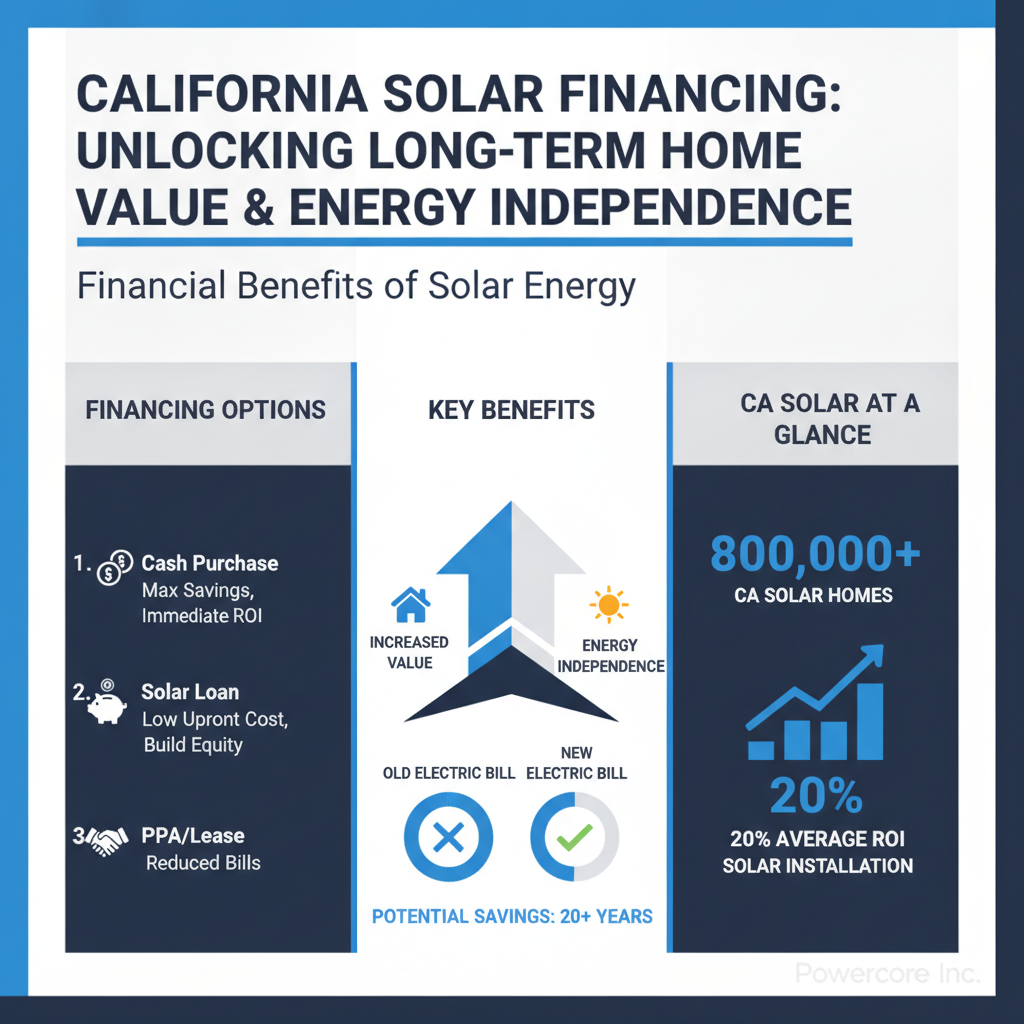
1. Dedicated Solar Loans
Many lenders offer specific loan products tailored for solar installations. These can be attractive due to competitive interest rates and terms designed for the lifecycle of a solar system.
- Secured Solar Loans (Home Equity Loans or HELOCs):
These loans use your home as collateral, often resulting in lower interest rates and longer repayment terms. A Home Equity Line of Credit (HELOC) provides flexibility, allowing you to draw funds as needed for your project. The interest on these loans may also be tax-deductible. - Unsecured Solar Loans (Personal Loans):
These don't require collateral, making the application process simpler and quicker. However, they typically come with higher interest rates and shorter repayment periods compared to secured loans. They are a good option if you prefer not to use your home as collateral or have limited home equity.
Key advantages of solar loans include predictable monthly payments, immediate access to incentives, and the ability to own your system from day one. Powercore Inc works with a network of trusted lenders who specialize in residential solar & storage financing, making the process seamless for our clients.
2. Property Assessed Clean Energy (PACE) Programs
PACE programs allow property owners to finance energy-efficient and renewable energy upgrades through a voluntary assessment on their property tax bill. This means the loan is tied to the property, not the individual, and is repaid over an extended period (typically 10-20 years).
- How it Works: PACE financing is repaid through an additional line item on your property tax bill. If you sell your home, the remaining balance may transfer to the new owner (depending on the program and terms).
- Advantages: No upfront costs, long repayment terms, and eligibility often based on property equity rather than personal credit score.
- Considerations: PACE programs have faced scrutiny in the past and are now highly regulated in California. While they can be a viable option for some, it's crucial to understand all terms, conditions, and potential implications for refinancing or selling your home. Always consult with a financial advisor to ensure it's the right fit for your situation.
3. Cash Purchase: The Highest ROI
For homeowners with available capital, a direct cash purchase offers the highest return on investment. You immediately own the system, qualify for all incentives, and begin saving on your electricity bills from day one without any loan interest payments. This option leads to the fastest payback period and maximizes your long-term savings.
Maximizing Your Solar Investment: California Incentives and Strategies
Financing is just one piece of the puzzle. To truly unlock the financial potential of solar in California, you need to understand and leverage the available incentives and optimize your energy consumption.
The Federal Solar Tax Credit (ITC)
The Residential Clean Energy Credit, commonly known as the Investment Tax Credit (ITC), is a powerful federal incentive that allows homeowners to claim a tax credit equal to 30% of the cost of their qualifying solar energy system (for systems placed in service through 2032). This is a dollar-for-dollar reduction in your federal income tax liability, not just a deduction. It significantly reduces the net cost of your solar installation.
- Eligibility: Applies to new solar electric systems (photovoltaic), solar water heaters, small wind energy property, geothermal heat pumps, and fuel cell property.
- Key Benefit: Directly reduces your federal tax bill.
For more details on how to maximize this benefit, refer to our article: Maximize Your Solar Savings: Understanding the Federal Tax Credit Step-Down Schedule. You can also find official information directly from the IRS.
Self-Generation Incentive Program (SGIP)
California's Self-Generation Incentive Program (SGIP) is a crucial incentive for battery storage systems. Given the shift to NEM 3.0, battery storage is no longer just an amenity; it’s a vital component for maximizing solar savings. SGIP provides rebates for installing energy storage technologies, helping to offset the upfront cost of batteries.
- Focus: Primarily targets battery storage for residential and commercial properties.
- Mechanism: A declining incentive, meaning the sooner you apply, the higher the rebate.
- Impact: Makes battery storage more affordable, enabling homeowners to store excess solar energy for use during peak hours or outages, thereby increasing self-consumption under NEM 3.0.
Optimizing with NEM 3.0 and Battery Storage
Under NEM 3.0, the value of electricity exported to the grid is significantly lower than under previous NEM versions. This fundamentally changes the economics of solar in California, making battery storage almost essential for new solar installations. With a battery, you can:
- Store Excess Solar: Capture surplus energy generated during the day.
- Discharge During Peak Hours: Use your stored energy when utility rates are highest (Time-of-Use periods), avoiding expensive grid purchases.
- Increase Self-Consumption: Maximize the use of your own clean energy, reducing reliance on the grid and maximizing your savings.
- Enhance Grid Resilience: Provide backup power during outages, ensuring your home remains operational.
Powercore Inc specializes in designing and installing integrated solar & battery storage systems that are perfectly optimized for California's NEM 3.0 landscape, ensuring you get the most out of your investment.
The Power of Electrification: Beyond Solar
Solar energy is the foundation, but true energy independence and cost savings come from a holistic approach to home energy. Integrating other electric systems amplifies your solar investment:
- EV Charging Stations: Charging an electric vehicle with your own solar power dramatically reduces transportation costs. Powercore Inc can seamlessly integrate EV charging stations into your solar-powered home.
- High-Efficiency HVAC: Upgrading to a modern, electric HVAC system (like a heat pump) reduces your overall energy demand, allowing your solar system to cover a larger portion of your remaining electricity needs. Powercore also offers HVAC climate control solutions.
- Energy-Efficient Appliances: Replacing old, inefficient appliances with ENERGY STAR-rated models further reduces your home's energy footprint.
Powercore's Whole-Home Approach: Your Trusted California Partner
Choosing a solar contractor in California means selecting a partner who understands not just solar, but also the broader implications for your entire home. Powercore Inc stands apart as a dual-licensed General B & C-10 Electrical Contractor, uniquely qualified to handle your entire project from start to finish.
- Comprehensive Expertise: Our General B license allows us to manage and execute extensive home improvement projects, from remodels and new construction to ADUs. This means we can integrate solar seamlessly into a larger renovation or new build, ensuring structural integrity and aesthetic appeal.
- Electrical Mastery: Our C-10 Electrical license signifies deep expertise in all electrical aspects of your solar installation, battery storage, and home electrification. This ensures safe, compliant, and optimized system performance.
- Holistic Planning: We don't just install solar panels. We consider your roof's condition (offering roofing and weatherproofing services), your existing electrical infrastructure, and your future energy needs (such as EV charging or interior remodeling that impacts energy use). This integrated approach provides you with a single point of contact and accountability, streamlining your project and ensuring superior results.
From the initial consultation and financing guidance to expert installation and ongoing support, Powercore Inc is committed to delivering exceptional value and peace of mind to homeowners across California. We navigate the complexities of permits, incentives, and regulations so you don't have to.
Making Your Solar Investment Count: A Step-by-Step Guide
- Assess Your Energy Needs: Understand your current electricity consumption and future plans (e.g., EV purchase, home additions).
- Explore Financing Options: Research the various loan types, PACE programs, and cash purchase benefits.
- Identify Incentives: Factor in the Federal ITC, SGIP (for batteries), and any local programs.
- Get Expert Consultation: Contact Powercore Inc for a personalized assessment and detailed proposal, including financing options tailored to your situation. We'll help you understand payback periods, long-term savings, and the best system design for your home under NEM 3.0.
- Seamless Installation: Our licensed professionals handle all aspects of design, permitting, and installation, ensuring a high-quality, efficient system.
- Enjoy the Savings: Watch your utility bills shrink and your home's value grow!
Ready to Unlock Your Home's Solar Potential?
Investing in solar is one of the most impactful financial decisions you can make for your California home. By understanding the diverse California solar financing options and leveraging powerful incentives, you can achieve significant long-term savings, enhance your property value, and contribute to a sustainable future. Don't let the initial cost deter you from harnessing the power of the sun.
Powercore Inc is your trusted partner for navigating the solar journey, from expert system design and seamless installation to comprehensive financing guidance. Our dual licensing and whole-home expertise ensure your project is handled with the highest standards of quality and efficiency. Ready to explore your personalized solar and battery storage solution? Contact us today for a free consultation. Call us at 916-699-8778 or visit our contact page to get started. Learn more about Powercore Inc and our commitment to powering California homes.