

Introduction: Powering Your California Future, Strategically
California continues to lead the nation in electric vehicle (EV) adoption, with more drivers than ever embracing a cleaner, more sustainable way to commute. As your sleek new EV pulls into the driveway, the next critical step is ensuring you have a reliable, efficient, and cost-effective way to charge it at home. While the convenience of home charging is undeniable, many homeowners are naturally concerned about the initial EV charger installation costs. It's a significant investment, but one that, when approached strategically, offers immense long-term value.
At Powercore Inc, a trusted California dual-licensed General B & C-10 Electrical Contractor, we understand that understanding these costs is more than just getting a quote; it's about making an informed decision that enhances your lifestyle, adds value to your property, and aligns with California's evolving energy landscape. This comprehensive guide will demystify the various factors influencing EV charger installation expenses across the Golden State, explore available incentives, and highlight how a strategic approach can turn an expense into a powerful asset for your home's future.
The California EV Landscape & Home Charging Imperative
California's commitment to zero-emission vehicles is driving unprecedented growth in EV ownership. With ambitious state mandates and a culture of innovation, more Californians are making the switch. While public charging infrastructure is expanding, the ultimate convenience and cost-effectiveness come from charging your EV right where you park it – at home.
Relying solely on public charging stations can be time-consuming, less predictable, and often more expensive than home charging, especially when leveraging off-peak utility rates or integrating with residential solar. Home charging provides daily readiness, peace of mind, and the ability to tailor your charging schedule to minimize electricity costs. For California homeowners, a dedicated home EV charging solution isn't just a luxury; it's rapidly becoming an essential component of modern living.
Deconstructing EV Charger Installation Costs: What You're Paying For
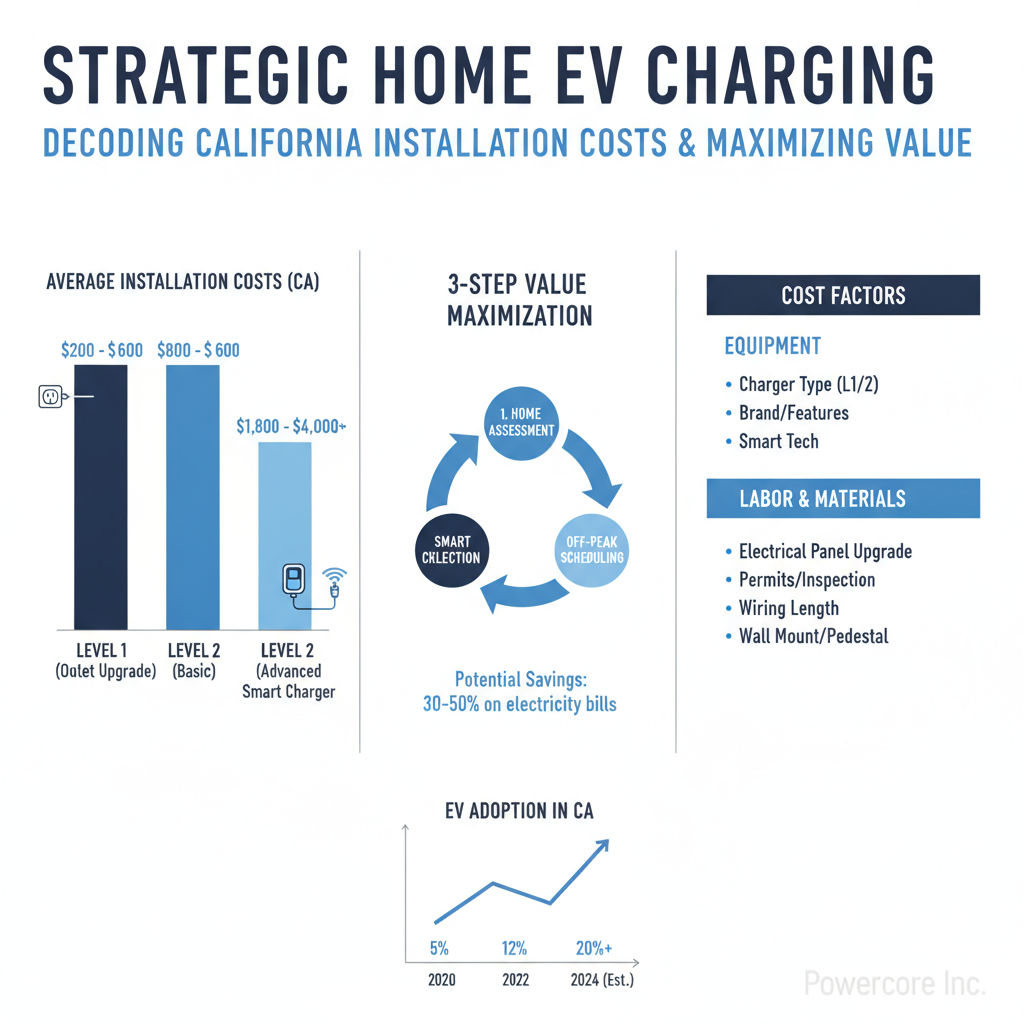
The total cost of installing an EV charger isn't a single figure; it's a sum of several variables. Understanding these components is key to accurately budgeting and making informed choices. Broadly, costs break down into hardware, electrical infrastructure upgrades, and labor.
Type of Charger: Level 1 vs. Level 2
Most discussions around home EV charging focus on Level 2 chargers, as Level 1 (standard 120V outlet) charging is often too slow for daily use. Here's a brief comparison:
- Level 1 (120V): Uses a standard wall outlet. Requires no special installation beyond the charger itself (often comes with the car). Adds about 2-5 miles of range per hour. While free to install, it's typically insufficient for most EV drivers.
- Level 2 (240V): Requires a dedicated 240-volt circuit, similar to an electric clothes dryer or oven. Adds about 20-60 miles of range per hour, fully charging most EVs overnight. This is the industry standard for home charging, offering an optimal balance of speed and cost. For more details on Level 2 costs, see our article: What You Need to Know About How Much a Level 2 EV Charger Costs.
Beyond basic Level 2 chargers, "smart" chargers offer features like Wi-Fi connectivity, app control, scheduling, and energy monitoring. These advanced features can slightly increase hardware costs but offer significant benefits in managing your charging and optimizing for Time-of-Use (TOU) rates.
Charger Hardware Costs
The charging unit itself (often called an EVSE - Electric Vehicle Supply Equipment) can range significantly in price:
- Basic Level 2 Chargers: Typically cost between $300 and $700. These are reliable units that provide essential charging functionality.
- Smart Level 2 Chargers: Can range from $500 to $1,200+. These often include advanced features like load management, integration with smart home systems, and robust outdoor ratings.
- Premium/High-Amperage Chargers: Some EVs can accept higher amperage (e.g., 80 amps), requiring more robust and expensive charging units, potentially costing $1,000 to $2,000+.
The choice of charger depends on your vehicle's charging capacity, your driving habits, and your budget for smart features.
Electrical Infrastructure Upgrades: The Primary Variable
This is where the majority of installation cost variability lies. The extent of electrical work needed depends heavily on your home's existing electrical system and the charger's location.
Main Electrical Panel Upgrades
A Level 2 charger typically requires a dedicated 240-volt circuit, drawing between 30 and 80 amps. If your existing electrical panel is full or lacks sufficient capacity to handle this additional load, a panel upgrade may be necessary. This can involve:
- Breaker Space: Simply adding a new breaker if space is available. (Least expensive)
- Sub-Panel Installation: Adding a smaller electrical panel near the main panel or in the garage to handle the EV charger and potentially other new loads.
- Main Service Panel Upgrade: Replacing your entire main electrical panel with a higher-capacity unit (e.g., upgrading from 100 amps to 200 amps). This is the most significant electrical upgrade and can be a substantial cost factor, often ranging from $2,500 to $7,000 or more, depending on complexity and utility requirements. This is a common requirement in older California homes.
Wiring Runs
The distance between your electrical panel and the desired charger location, as well as the path the wiring must take, significantly impacts cost:
- Short, Direct Runs: If the panel is in the garage and the charger is mounted nearby, the wiring run is minimal, keeping costs lower.
- Longer Runs: If the panel is on one side of the house and the charger is on the other, or in a detached garage, more wiring is needed.
- Concealed vs. Surface-Mounted Wiring: Running wiring through walls, attics, or crawl spaces (concealed) is more labor-intensive than surface-mounting conduit.
Trenching and Conduit
For outdoor installations or detached garages, wiring may need to be buried underground. This involves:
- Trenching: Digging a trench for the conduit. The length and depth of the trench, as well as the type of ground (soil, concrete, asphalt), affect cost.
- Conduit: Protecting the wiring within rigid or flexible conduit.
Trenching can add anywhere from $500 to several thousand dollars, depending on the distance and ground conditions.
Permits & Inspections
In California, most EV charger installations require an electrical permit from your local municipality. This ensures the work meets safety codes. Permit fees vary by jurisdiction but typically range from $100 to $500. A licensed contractor like Powercore Inc will handle all necessary permits and inspections as part of the project.
Labor Costs
The cost of labor is another key component, reflecting the expertise and time required for the installation. In California, labor rates for licensed electricians are generally higher than the national average. Factors influencing labor costs include:
- Complexity of the Job: Simple installations (short wire run, no panel upgrade) require less labor. Complex jobs (panel upgrade, long trenching, difficult routing) require significantly more.
- Time Required: A straightforward installation might take 4-8 hours, while a complex one could take 1-3 days.
- Contractor's Expertise and Licensing: Always choose a licensed and insured electrical contractor. Powercore Inc's dual CSLB licenses (General B and C-10 Electrical) ensure that all work is performed to the highest standards of safety and compliance.
California-Specific Cost Factors & Regulations
California's unique regulatory environment and high cost of living inevitably impact EV charger installation costs.
- Strict Building Codes & Permitting: California has stringent building and electrical codes. While ensuring safety, compliance often requires more detailed planning and inspection, contributing to overall project costs. Navigating these requirements demands experienced professionals like Powercore Inc.
- Higher Labor Rates: The cost of living in California translates to higher wages for skilled tradespeople, including electricians. This means labor costs for installation will be higher compared to many other states.
- Utility Requirements: California's major utilities (PG&E, SCE, SDG&E) may have specific requirements or recommendations for EV charging installations, especially concerning Time-of-Use (TOU) rates and potential grid impacts. Strategic planning for TOU rates can significantly reduce your long-term charging costs, even if the initial installation is slightly higher for smart technology.
- Wildfire Safety & Resiliency: In areas prone to wildfires, additional considerations for electrical infrastructure may be necessary, potentially adding to complexity and cost.
Navigating Incentives & Rebates: Reducing Your Out-of-Pocket Expenses
One of the most strategic ways to offset EV charger installation costs is by leveraging available incentives. California, in particular, offers a robust landscape of programs.
- Federal Tax Credit: The Residential Clean Energy Credit (formerly the Alternative Fuel Vehicle Refueling Property Credit) allows homeowners to claim a tax credit of 30% of the cost of qualified new clean energy property for your home, including EV charging equipment, up to a maximum of $1,000. This is a direct reduction in your federal tax liability.
- California State & Local Programs: The California Energy Commission (CEC) and various Air Quality Management Districts (AQMDs) frequently offer rebates or grants for EV charging infrastructure. These programs can be highly localized and may have specific eligibility requirements (e.g., income-based, multi-unit dwellings). It's crucial to check what's available in your specific county or city.
- Utility Company Rebates: California's major utility providers (e.g., PG&E, SCE, SDG&E) often have their own programs or incentives for EV charging customers, sometimes including rebates for hardware or installation. These might be tied to participation in demand response programs or opting into specific EV-friendly rate plans.
Powercore Inc can help you understand how these incentives might apply to your specific project, ensuring you maximize your savings. Always research current programs as they can change frequently.
The Strategic Investment: Maximizing Value Beyond the Initial Cost
While the upfront EV charger installation costs are a consideration, viewing it as a strategic investment reveals significant long-term benefits:
- Increased Home Value: As EVs become more mainstream, a home equipped with a dedicated Level 2 charger is a significant selling point. It signals a modern, future-ready property and can increase its market appeal and resale value.
- Unparalleled Convenience & Time Savings: No more detours to public charging stations. Wake up every morning to a "full tank" and reclaim your valuable time.
- Lower Fueling Costs: Electricity is generally cheaper per mile than gasoline, especially when you optimize charging during off-peak hours or generate your own power with solar and battery storage. This translates to substantial savings over the lifespan of your EV.
- Future-Proofing Your Home: The transition to electric is accelerating. Installing an EV charger now ensures your home is ready for future EV purchases, for an ADU tenant with an EV, or for guests. It's a proactive step towards a sustainable future.
- Integration with Home Energy Management: For homeowners with solar panels or home battery storage, an EV charger becomes a critical component of a holistic energy ecosystem. You can charge your car directly from your solar panels, further reducing your carbon footprint and electricity bills. Strategic load management panels can also be implemented to ensure your home's electrical system can handle all demands efficiently.
Choosing the Right Partner: Why Powercore Inc is Your California EV Charging Expert
Given the complexity of electrical work, local regulations, and the need for future-proof solutions, selecting the right contractor for your EV charger installation is paramount. Powercore Inc stands out as the premier choice for California homeowners for several key reasons:
- Dual California CSLB Licenses: As a General B (General Building Contractor) and C-10 (Electrical Contractor) licensed company (CSLB #1134334 and #1098175), Powercore Inc offers unparalleled expertise. This dual licensing means we understand not just the electrical intricacies of EV charging but also how it integrates with your entire home's structure and systems. This is especially vital if your installation requires significant electrical panel upgrades or structural modifications.
- Comprehensive & Integrated Solutions: We don't just install EV chargers. We offer a full spectrum of home improvement and energy solutions, including residential solar, battery storage, HVAC, remodels, and ADUs. This holistic approach means we can seamlessly integrate your EV charging solution with your home's broader energy strategy, ensuring maximum efficiency and cost savings.
- California-Specific Expertise: Operating exclusively in California, we are intimately familiar with the state's unique building codes, permitting processes, utility requirements, and incentive programs. Our experience ensures a smooth, compliant, and efficient installation, regardless of your location in the state.
- Unwavering Commitment to Quality & Safety: As licensed professionals, safety and adherence to the highest electrical standards are at the core of everything we do. You can trust Powercore Inc to deliver a reliable, safe, and durable EV charging solution for your home.
- Transparent & Strategic Planning: We provide transparent cost breakdowns and strategic guidance, helping you understand all factors influencing your EV charger installation and how to maximize your investment through incentives and energy management.
Conclusion: Powering Your EV Journey with Confidence
Investing in a home EV charging station is a strategic move for any California homeowner embracing the electric future. While EV charger installation costs can vary widely, understanding the contributing factors – from charger type and electrical upgrades to labor and California-specific regulations – empowers you to make an informed decision.
By leveraging federal and state incentives and partnering with a reputable, dual-licensed contractor like Powercore Inc, you can ensure your installation is not only cost-effective but also seamlessly integrated into your home's energy ecosystem. This isn't just about charging your car; it's about enhancing your home's value, convenience, and sustainability for years to come.
Ready to explore the ideal EV charging solution for your California home? Don't let uncertainty about costs hold you back. Contact Powercore Inc today for a comprehensive consultation and a transparent estimate tailored to your specific needs. Our expert team is ready to guide you through every step, ensuring a safe, efficient, and future-ready installation. Call us directly at 916-699-8778 to start your strategic EV charging journey with confidence.