

Strategic ADU Investment: Detached vs. Attached Cost & Value in California
California homeowners are increasingly turning to Accessory Dwelling Units (ADUs) as a versatile solution for additional living space, rental income, or enhanced property value. Whether it’s accommodating aging parents, providing a private sanctuary for adult children, or generating passive income, an ADU represents a significant investment. But before breaking ground, a critical decision looms: should you build a detached ADU or an attached ADU? The choice isn't merely aesthetic; it profoundly impacts construction costs, project timelines, privacy, and long-term return on investment.
At Powercore Inc, a dual-licensed General B & C-10 Electrical Contractor based in Roseville, CA, we understand the nuances of California's ADU landscape. Our expertise spans everything from initial design consultation to final construction, ensuring your ADU project aligns with your vision and budget. This comprehensive guide will dissect the cost comparison between detached and attached ADUs, exploring the various factors that influence their price tags and helping you make the most strategic decision for your property in the Golden State.
Understanding California's ADU Landscape
California has been at the forefront of encouraging ADU development, recognizing their potential to address the state's housing shortage. Recent legislative changes have significantly streamlined the permitting process, reducing fees, waiving certain development standards (like parking requirements in many areas), and making it easier than ever for homeowners to add these valuable structures. This favorable regulatory environment has made ADUs an attractive option for homeowners across the state, from bustling urban centers to serene suburban communities.
An ADU, sometimes referred to as a granny flat, in-law unit, or backyard home, is an independent housing unit located on the same lot as a primary residence. They come in various forms, but the most fundamental distinction is between detached and attached structures, each with its own set of advantages and cost implications. Understanding these differences is the first step toward a successful and financially savvy ADU project.
Detached ADUs: The Standalone Advantage
A detached ADU is a completely separate structure from the primary home, typically built in the backyard. Think of it as a miniature house on your property. This option offers maximum independence and privacy, making it highly appealing for long-term rentals or multi-generational living arrangements where distinct boundaries are valued.
Pros of Detached ADUs:
- Maximized Privacy: Both for the occupants of the ADU and the main home.
- Greater Design Flexibility: You have more freedom to match or contrast the architectural style of the main house, choose unique layouts, and even integrate solar panels and battery storage for energy independence from the main home.
- Higher Rental Income Potential: The perception of a separate home often commands higher rental rates.
- Enhanced Property Value: A standalone unit is often seen as a more significant asset by potential buyers.
- Minimal Disruption to Primary Home: Construction is largely isolated from your main living space.
Cons of Detached ADUs:
- Higher Upfront Costs: Generally, detached units require more extensive site work, separate foundations, and independent utility trenching.
- Larger Lot Size Requirement: You need sufficient space for the structure and mandated setbacks from property lines and the main dwelling.
- More Complex Utility Connections: Extending water, sewer, gas, and electrical lines further across the property can be costly.
- Longer Construction Timelines: Due to increased complexity in site work and independent construction phases.
Cost Factors Specific to Detached ADUs:
- Foundation: Requires a new, dedicated foundation, often slab-on-grade or raised foundation, depending on soil conditions and local codes.
- Utility Trenching & Connections: Significant costs associated with digging trenches for new sewer, water, electrical, and gas lines from the main house or street connections to the new structure. This can include charges for utility hookups and impact fees.
- New Roofing: A completely new roof system, distinct from the primary home. Consider durable, fire-resistant materials, especially in California's wildfire-prone areas. (Learn more about fire-resistant siding options)
- Independent HVAC System: A dedicated heating, ventilation, and air conditioning system. Powercore Inc can help design and install efficient HVAC solutions tailored for smaller spaces.
- Exterior Finishes: All four sides require new siding, windows, and doors.
Attached ADUs: Integrated Solutions
An attached ADU shares a wall with the primary residence. This category often includes garage conversions, additions built onto the existing home, or even converting existing unused space within the main house (like a basement or attic, if feasible and permissible). Attached ADUs are frequently chosen for their potential cost savings and efficient use of existing property infrastructure.
Pros of Attached ADUs:
- Potentially Lower Costs: Sharing walls, foundation, and some utility connections can reduce overall expenses.
- Faster Permitting (Sometimes): Especially for garage conversions, which may have a more streamlined process in some jurisdictions.
- Efficient Use of Existing Space: Repurposing an existing garage or adding onto an existing footprint can be space-efficient.
- Easier Utility Integration: Tapping into existing utility lines is often simpler and less costly than extending new ones.
- Accessibility: Can be easier to integrate into the existing home's access points for those requiring closer proximity.
Cons of Attached ADUs:
- Less Privacy: Proximity to the main house can mean less acoustic and visual privacy for both occupants.
- Design Limitations: The existing structure dictates much of the design, potentially limiting layout and aesthetic choices.
- Impact on Main Home: Construction can be more disruptive to daily life in the primary residence.
- Loss of Existing Space: A garage conversion means losing valuable parking or storage space.
Cost Factors Specific to Attached ADUs:
- Structural Modifications: Converting a garage or adding on requires careful structural engineering to ensure the new space is safe and meets building codes. This can include foundation reinforcement, new framing, and seismic upgrades common in California.
- Shared Utility Upgrades: While connecting to existing utilities can be cheaper, it often necessitates upgrading the main home's electrical panel or water heater to accommodate increased demand. Our remodels and new construction team handles these critical infrastructure upgrades.
- Fire-Rated Walls & Soundproofing: To meet California building codes for attached units, fire-rated drywall and sound insulation may be required between the ADU and the main home, adding to material and labor costs.
- HVAC Integration or Mini-Splits: May involve extending existing HVAC ductwork or installing a dedicated mini-split system, which is often more cost-effective for smaller, attached spaces.
- New Entrance & Exterior Finishes: Requires creating a separate entrance and updating the exterior to blend seamlessly with the main house, or to provide a distinct aesthetic.
The Core Comparison: Detached vs. Attached ADU Costs in California
When comparing the costs of detached vs. attached ADUs in California, it's crucial to understand that there isn't a single, fixed price. Costs vary wildly based on size, level of finish, site-specific challenges, local permitting fees, and the specific contractor you choose. However, we can highlight general trends and key cost differentiators.
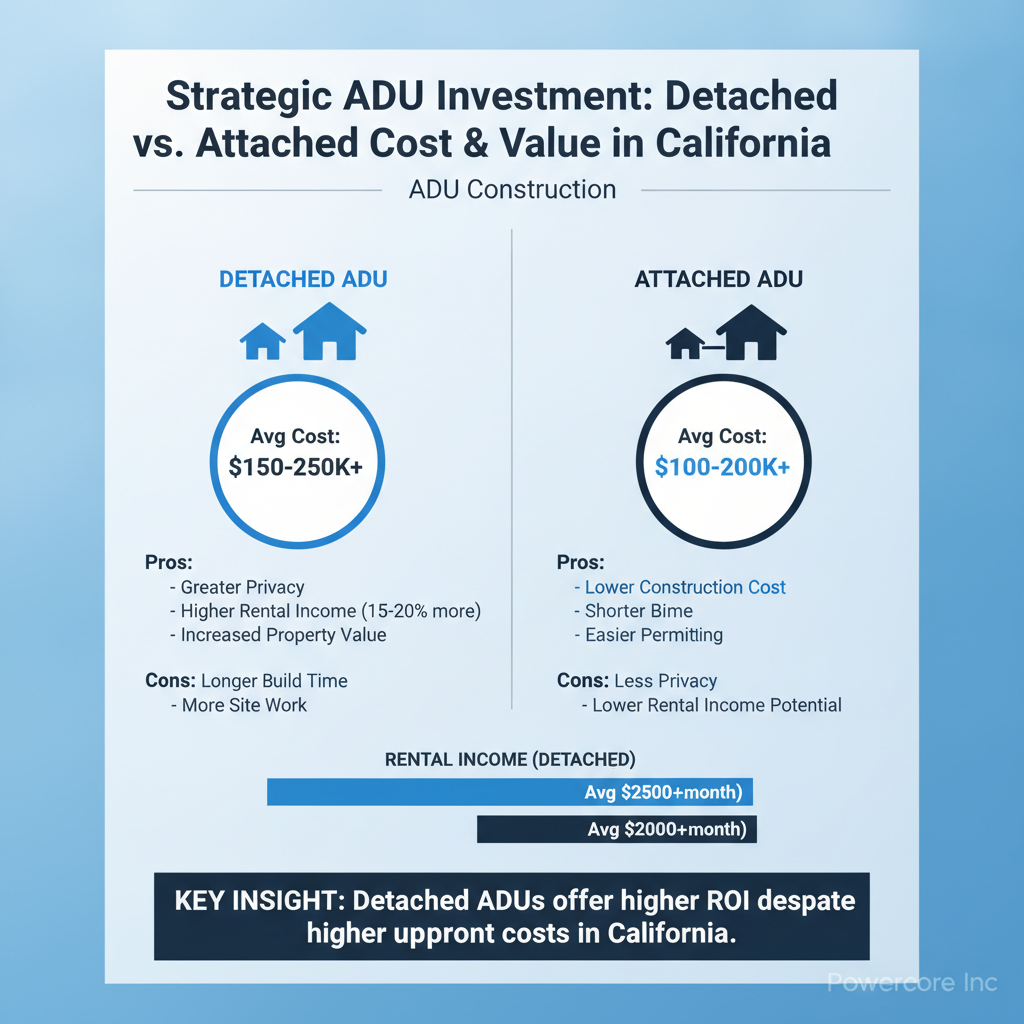
On average, a newly constructed detached ADU in California can range from $200,000 to $500,000+, depending heavily on size and luxury. A garage conversion or attached ADU addition typically falls between $100,000 and $300,000+. These are broad ranges, and a detailed quote from a qualified contractor like Powercore Inc is essential for an accurate estimate.
Key Cost Categories and Their Differences:
Permitting & Design Fees
These costs are often similar for both types, encompassing architectural plans, engineering, and city/county permits. However, complex structural modifications for attached units or extensive site work for detached units can slightly sway these fees. California has made efforts to standardize and reduce ADU permitting fees, but they still represent a significant initial outlay.
Foundation & Framing
- Detached: Requires a completely new foundation and full framing from the ground up. This is a primary cost driver.
- Attached: Garage conversions utilize the existing slab, which may need reinforcement or leveling. Additions require a new foundation only for the new footprint and integrate with existing framing. This typically makes attached units cheaper in this category.
Utility Connections
This is often the most significant cost differentiator.
- Detached: Requires trenching and connecting new lines for water, sewer, gas, and electricity from the main house or the street. The longer the run, the higher the cost. This can include substantial fees from utility providers. Integration of EV charging can also add complexity and cost to electrical planning.
- Attached: Can often tap into the main house's existing utility lines more directly. However, main service upgrades (e.g., a larger electrical panel or water heater) are frequently necessary to support the increased load, which can be costly.
Exterior Finishes
- Detached: Requires full exterior siding, roofing, windows, and doors for all four sides. This offers complete aesthetic freedom but at a higher material and labor cost. Our team excels in siding and exterior solutions to match your desired look and California's climate.
- Attached: Only requires new exterior finishes on the exposed sides (often one to three walls). The goal is usually to match the existing home's aesthetic, which can limit choices but potentially save on certain materials.
Interior Finishes
The cost of interior finishes (flooring, cabinetry, paint, fixtures) can be similar for both types, as this is driven by the homeowner's choices and desired luxury level. However, smaller attached units may naturally have lower total material costs due to reduced square footage. Powercore Inc's interior remodeling expertise ensures quality finishes regardless of ADU type.
HVAC & Electrical
- Detached: Typically requires a completely new, independent HVAC system (mini-split or central) and a dedicated electrical subpanel.
- Attached: May integrate with the main home's HVAC (if capacity allows) or utilize a smaller, dedicated system. Electrical work often involves extending circuits from the main panel, with potential upgrades to the main service.
Site Prep & Landscaping
- Detached: Requires significant site clearing, grading, and potentially new pathways or landscaping to integrate the ADU into the yard.
- Attached: Often requires less extensive site work, especially for garage conversions.
Beyond the Price Tag: Long-Term Value & ROI
While upfront costs are a major consideration, a truly strategic ADU investment looks at the long-term value and return on investment. The choice between detached and attached can significantly impact these factors in the California market.
Rental Income Potential
Detached ADUs often command higher rental rates due to their superior privacy and sense of independence. Tenants appreciate having their own space, separate from the main residence. This higher rental yield can lead to a faster recouping of the initial investment.
Property Value Appreciation
Both types of ADUs undoubtedly add value to your property. However, a well-designed and constructed detached ADU can often add more perceived value due to its flexibility and appeal as a separate, move-in-ready home. It broadens the appeal to a wider range of buyers who might be looking for multi-generational living options or a dedicated income stream.
Flexibility of Use
Detached units offer unparalleled flexibility. They can serve as a guest house, a dedicated home office, a private gym, or a long-term rental without significantly impacting the privacy or functionality of the main home. Attached units, while versatile, inherently maintain a closer connection to the primary residence, which might limit certain uses or user experiences.
Resale Appeal
A property with a permitted ADU is a highly desirable asset in California's competitive real estate market. Detached ADUs tend to have slightly broader appeal due to their autonomy, but both types significantly boost a home's marketability and value. Powercore Inc ensures that your ADU is built to the highest standards, maximizing its long-term value and appeal.
Navigating California's Regulatory & Site-Specific Challenges
Regardless of whether you choose a detached or attached ADU, California's unique regulatory environment and diverse topography present specific challenges and opportunities that must be addressed.
Local Zoning Ordinances
While state laws have largely streamlined ADU development, local jurisdictions still have some say in setback requirements, height limits, and lot coverage. These can particularly impact detached ADUs, which need more yard space. Attached ADUs (especially garage conversions) often benefit from more lenient setback rules.
Utility Connection Complexities
Connecting to existing utilities or extending new lines can be a bureaucratic maze. Understanding local utility provider requirements, capacity limitations, and associated fees is critical. Powercore Inc's C-10 Electrical license means we are uniquely qualified to handle all electrical planning and execution, from upgrading your main panel to installing an EV charger for your new unit, ensuring seamless and compliant utility integration.
Site Access & Construction Logistics
The ease with which construction materials and equipment can access your build site significantly impacts labor costs and timelines. Detached ADUs in tight backyards can face challenges, potentially requiring specialized equipment or more manual labor. Attached units, especially additions, may be easier to access but can cause more disruption to the main home.
Permitting Timelines
Despite state efforts, permitting can still take time. Having a contractor who is intimately familiar with California's ADU laws and local city/county processes, like Powercore Inc, can help expedite the approval process and prevent costly delays.
Financing Your California ADU
Financing an ADU project can be achieved through various methods, including home equity loans, cash-out refinances, construction loans, or personal loans. Given the significant investment, exploring all your options and understanding interest rates and repayment schedules is crucial. Many lenders are familiar with ADU financing as a valuable home improvement, and several state and local programs may offer assistance or incentives for ADU construction.
Why Choose Powercore Inc for Your ADU Project?
Embarking on an ADU project in California requires a partner with deep expertise, comprehensive capabilities, and a proven track record. Powercore Inc is that partner.
- Dual-Licensed Expertise: As a California dual-licensed General B (General Contractor) and C-10 (Electrical Contractor), Powercore Inc brings unparalleled, integrated expertise to your project. This means seamless coordination between structural, electrical, and other critical trades, eliminating the complexities often associated with managing multiple contractors. Our CSLB license numbers (#1134334 and #1098175) speak to our qualifications and commitment to excellence.
- Comprehensive Service Offerings: Beyond ADU construction, we offer a full spectrum of services that are often intertwined with ADU development. This includes remodels and new construction, solar and battery storage integration for energy efficiency, EV charging station installations, and advanced HVAC climate control systems. We provide a holistic solution for your property's needs.
- California-Specific Knowledge: Operating across all of California, from Roseville to San Diego, we possess an intimate understanding of state regulations, local zoning ordinances, and regional building challenges. This local expertise ensures your project is compliant, efficient, and optimized for your specific location.
- Commitment to Value: We don't just build; we build strategically. Our goal is to help you maximize the long-term value and functionality of your ADU, whether it's for personal use or income generation.
Conclusion: Making the Right ADU Choice for Your California Home
The decision between a detached and attached ADU is a multifaceted one, influenced by your budget, property size, privacy needs, and long-term goals. While detached ADUs generally offer greater flexibility and higher rental potential at a higher upfront cost, attached ADUs provide a more budget-friendly entry point with efficient use of existing space.
Ultimately, the "best" option is the one that aligns most closely with your specific objectives and property characteristics. By carefully weighing the cost factors, benefits, and challenges outlined in this guide, you're well on your way to making an informed decision. For personalized guidance and expert construction services across California, trust the experienced team at Powercore Inc. We're here to turn your ADU vision into a valuable reality.
Ready to explore your ADU options with California's leading experts? Contact Powercore Inc today for a consultation. Call us at 916-699-8778 to discuss your project and discover how we can help you strategically invest in your home's future.