

Unlocking California's Solar Goldmine: Strategic Planning for Homeowners
California has long been at the forefront of the solar energy revolution, a beacon for sustainable living and technological innovation. For homeowners across the Golden State, the dream of energy independence and significant savings on utility bills is more attainable than ever. However, the landscape of solar incentives is dynamic, constantly evolving to meet the state's ambitious clean energy goals.
Navigating these changes can feel complex, but with the right strategic approach, you can unlock a wealth of financial and environmental benefits. This comprehensive guide, brought to you by Powercore Inc, your trusted California dual-licensed General B & C-10 Electrical Contractor, will demystify California solar incentives, helping you make informed decisions for a brighter, more sustainable future.
At Powercore Inc, we understand that investing in solar is more than just installing panels; it's a strategic move towards long-term savings, increased home value, and a reduced carbon footprint. We're here to help you understand how to maximize your return on investment by leveraging every available incentive.
The Bedrock: Federal Solar Investment Tax Credit (ITC)
Before diving into California-specific programs, it’s crucial to understand the foundational incentive available nationwide: the Federal Solar Investment Tax Credit (ITC), also known as the Residential Clean Energy Credit. This powerful incentive allows homeowners to deduct a significant percentage of the cost of installing a new solar energy system from their federal taxes.
Currently, the ITC offers a 30% tax credit for solar systems installed through 2032. This means if your solar system costs $25,000, you could receive a $7,500 credit on your federal income tax liability. It’s not a deduction from your taxable income, but a direct dollar-for-dollar reduction in the amount of tax you owe, making it incredibly impactful.
Key aspects of the ITC:
- Eligibility: Applies to both new solar installations and certain additions to existing systems. The system must be new or being used for the first time.
- What it covers: Includes the cost of solar panels, inverters, mounting equipment, wiring, labor for installation, and even solar battery storage when installed in conjunction with a solar energy system.
- Non-refundable: While the credit is non-refundable, meaning you won’t get a refund for more than you owe in taxes, any unused credit can typically be carried forward to future tax years.
Understanding the ITC is the first step in calculating your potential savings. For the most up-to-date and detailed information, always refer to the official IRS guidance on the Residential Clean Energy Credit.
California-Specific Incentives: Navigating the Golden State Landscape
While the federal ITC provides a substantial baseline, California offers additional layers of incentives and regulatory frameworks that significantly enhance the financial viability of going solar. The state's commitment to clean energy has led to innovative programs designed to accelerate adoption, particularly for battery storage.
Net Energy Metering 3.0 (NEM 3.0): The Paradigm Shift
Perhaps the most significant development in California's solar landscape is the evolution of Net Energy Metering (NEM). NEM is the billing mechanism that credits solar energy system owners for the electricity they add to the grid. While previous versions (NEM 1.0 and 2.0) offered generous retail rate credits, NEM 3.0, implemented by the California Public Utilities Commission (CPUC), represents a substantial shift.
Under NEM 3.0, the export rate for excess solar electricity sent back to the grid is significantly lower than the retail rate. This change fundamentally alters the financial calculus of solar-only systems. However, it also strongly incentivizes the integration of home battery storage.
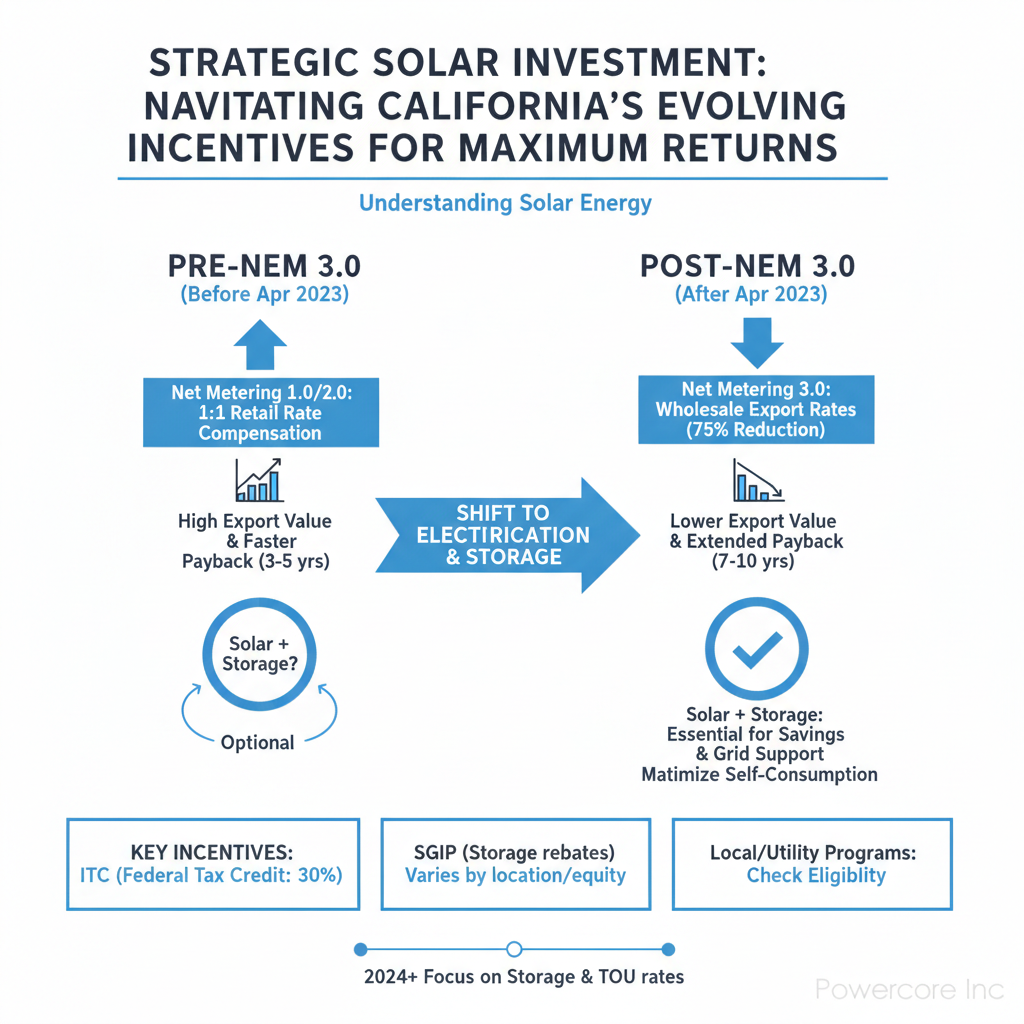
Key implications of NEM 3.0:
- Reduced Export Compensation: Homeowners receive less credit for excess solar energy exported to the grid compared to previous NEM tariffs.
- Increased Value of Self-Consumption: The most valuable solar energy is now the energy you consume directly or store for later use, avoiding purchasing power from the grid at higher Time-Of-Use (TOU) rates.
- Battery Storage Becomes Essential: To maximize savings under NEM 3.0, pairing solar panels with a battery storage system is almost a necessity. Batteries allow you to store excess solar generated during the day (when rates are low) and use it during peak evening hours (when rates are high), effectively performing “TOU arbitrage.” This strategic use of stored energy dramatically boosts your system's financial performance.
- Impact on ROI: While the payback period for solar-only systems might be extended under NEM 3.0, a well-designed solar-plus-storage system can still offer a compelling return on investment, especially when combined with other incentives. For a deeper dive into the mechanics of solar power, you might find our article “How Does Home Solar Power Work? A Caring Step-by-Step Guide” useful.
Self-Generation Incentive Program (SGIP)
The Self-Generation Incentive Program (SGIP) is California’s premier program designed to accelerate the deployment of distributed energy resources, with a strong emphasis on battery storage systems. Unlike the federal ITC, SGIP is a direct rebate that significantly reduces the upfront cost of installing a battery.
SGIP is administered by the CPUC and is typically funded by California utility ratepayers. It operates on a declining block structure, meaning the rebate amount per kilowatt-hour (kWh) decreases as more capacity is reserved. This encourages early adoption, as later applicants may receive lower incentives.
Who qualifies for SGIP?
- Equity Resiliency Track: This track offers the highest incentives and is designed for low-income households, those in areas prone to Public Safety Power Shutoffs (PSPS), or those with certain medical conditions. This is a critical component for ensuring energy equity and resilience across the state.
- General Market Track: Available to all other residential and commercial customers. While the rebate rates are lower than the Equity Resiliency track, they still provide substantial savings.
The SGIP program is constantly updated, so working with an expert like Powercore Inc, which specializes in residential solar & storage, is crucial to understanding current availability and eligibility. We help homeowners navigate the application process to secure these valuable rebates, dramatically improving the economics of adding battery storage to your home. This is particularly important for those concerned about power outages, as battery systems can provide critical backup power. Learn more in our article “Do Solar Panels Work During a Blackout? Your Essential Preparation Checklist.”
Additional Local and Utility Incentives
Beyond federal and state-wide programs, homeowners in California might find additional incentives offered by their specific city, county, or utility provider. These can include:
- Property Tax Exclusion for Solar Energy Systems: In California, the added value to your home from a solar energy system is generally excluded from property tax assessments. This means you won't pay higher property taxes just because you've increased your home's value with solar.
- Local Rebates and Programs: Some municipalities or public utility districts offer their own rebates or financing programs to encourage solar adoption. These are less common than state-wide programs but are worth investigating for your specific location.
- Low-Interest Loan Programs: Various financial institutions and state programs may offer low-interest loans specifically for energy-efficient home improvements, including solar installations.
It's always advisable to consult with a knowledgeable solar contractor like Powercore Inc who is familiar with the incentives available in your specific service area across California.
Strategic Planning: Maximizing Your Solar ROI
Understanding the incentives is one thing; strategically leveraging them is another. To achieve the maximum return on your solar investment in California, especially under NEM 3.0, a thoughtful and integrated approach is essential.
The Indispensable Role of Solar Battery Storage
As highlighted, battery storage is no longer an optional luxury but a cornerstone of a financially optimized solar system under NEM 3.0. By storing excess solar energy during the day and deploying it during peak demand (and higher TOU rates) in the evening, you significantly reduce your reliance on grid power when it's most expensive. This strategy not only maximizes your savings but also enhances your energy independence and provides backup power during outages.
Understanding Your Energy Consumption Patterns
Before designing any system, a thorough analysis of your household's energy consumption is critical. This involves reviewing past utility bills, understanding your peak usage times, and identifying opportunities for energy efficiency upgrades. A precise understanding allows for the accurate sizing of your solar array and battery storage, preventing both costly oversizing and insufficient power generation.
Choosing the Right System Size and Components
The ideal solar system size balances your energy needs with your budget and available roof space. A reputable contractor will assess these factors, consider future energy needs (like EV charging stations), and design a system optimized for maximum self-consumption and efficient battery usage. High-quality components, including efficient panels and robust inverters, contribute to better long-term performance and durability.
Financing Your Solar Investment
Several financing options are available for California homeowners considering solar. These typically include:
- Cash Purchase: Offers the highest long-term savings and full ownership benefits, including eligibility for all incentives.
- Solar Loan: Allows you to own the system with little or no upfront cost, spreading payments over time. You still benefit from incentives and increased home value.
- Power Purchase Agreement (PPA) or Lease: You pay a fixed rate per kWh for the solar energy produced, or a fixed monthly payment for the system, without owning the equipment. While this offers no upfront costs, the financial benefits are typically less than ownership, and the federal ITC often goes to the system owner (the leasing company).
Evaluating these options in the context of your financial situation and the available incentives is a key part of strategic planning.
Partnering with a Trusted California Expert: Powercore Inc
Navigating the intricacies of California solar incentives, NEM 3.0, SGIP, and system design requires specialized expertise. This is where Powercore Inc shines. As a California dual-licensed General B & C-10 Electrical Contractor (CSLB #1134334 and #1098175), we possess the comprehensive knowledge and experience to handle every aspect of your solar project.
- Expert Guidance: We stay abreast of the latest incentive programs and regulatory changes, ensuring your system is designed to maximize every available benefit.
- Seamless Installation: Our dual licensing means we manage all electrical and general construction aspects of your project, from residential solar & storage installation to any necessary roof modifications or electrical panel upgrades.
- Full-Service Approach: From initial consultation and system design to permitting, installation, and post-installation support, Powercore Inc provides a turnkey solution, making your transition to solar smooth and stress-free.
- Local Knowledge: Operating across all of California from our Roseville base, we understand the specific requirements and opportunities unique to different regions and utility providers.
The Long-Term Value Proposition
Investing in solar energy with strategic planning and the right partner offers enduring benefits far beyond immediate savings:
- Increased Home Value: Homes with solar panels often sell faster and at a higher price than comparable non-solar homes.
- Energy Independence & Price Stability: Reduce your reliance on fluctuating utility rates and protect yourself from future electricity price hikes.
- Environmental Impact: Contribute to a cleaner environment by reducing your carbon footprint and supporting California’s renewable energy goals.
- Grid Resilience: With battery storage, your home becomes a microgrid, offering resilience during grid outages and contributing to overall grid stability.
The Future of California Solar Energy
California’s commitment to a clean energy future remains unwavering. While the incentive landscape may continue to evolve, the fundamental advantages of solar power – economic savings, environmental responsibility, and energy independence – are here to stay. Staying informed and partnering with a proactive contractor like Powercore Inc ensures you are always positioned to take advantage of new opportunities and adapt to changes effectively.
Your Next Step Towards a Solar-Powered Future
Embracing solar energy in California is a smart investment that pays dividends for years to come. By understanding the federal ITC, strategically integrating battery storage to optimize NEM 3.0 benefits, and leveraging programs like SGIP, you can significantly enhance your home’s value and secure your energy future.
Ready to explore how California’s solar incentives can work for your home? Don't navigate the complexities alone. Contact Powercore Inc today for a personalized consultation. Our expert team is ready to design a custom solar and battery storage solution that maximizes your savings and meets your unique energy needs. Call us at 916-699-8778 or visit our contact page to schedule your free estimate. Let Powercore Inc power your home with confidence.