

The Future Is Bright: Solar Panel Efficiency in California by 2026
California, a global leader in renewable energy adoption, is constantly pushing the boundaries of sustainable living and business. As we look towards 2026, the landscape of solar energy is evolving rapidly, with significant advancements in solar panel efficiency promising even greater returns on investment for homeowners and businesses alike. The golden state's unique climate, ambitious energy goals, and increasing energy costs make maximizing every ray of sunshine more critical than ever.
At Powercore Inc, a dual-licensed General B & C-10 Electrical Contractor based in Roseville, CA, we're not just observing these trends; we're actively implementing them across California. Our expertise in solar and battery storage solutions positions us at the forefront of this energy revolution. Understanding what's on the horizon for solar panel efficiency is key to making informed decisions today that will yield powerful benefits tomorrow.
Understanding Today's Solar Efficiency: A Baseline
Before diving into the innovations of 2026, it's essential to understand the current state of solar panel efficiency. Today's commercially available solar panels typically boast efficiencies ranging from 17% to 23%, with premium residential models often reaching 21-23%. These panels primarily utilize monocrystalline silicon technology, known for its high purity and uniform crystal structure, which allows electrons to flow more freely.
- Monocrystalline Panels: The industry standard for high efficiency, often seen in residential and commercial installations where space is a premium.
- Polycrystalline Panels: A more budget-friendly option, slightly lower in efficiency (15-17%), but still robust.
- Thin-Film Panels: Less common for standard rooftop installations due to lower efficiency (10-13%), but offer flexibility and lighter weight for niche applications.
For California property owners, higher efficiency translates directly into more power generated per square foot. This is particularly crucial in urban areas with limited roof space or for maximizing energy independence. Factors like temperature, shading, and panel degradation over time also play a significant role in real-world performance. A comprehensive understanding of your 8000 kWh solar system, for instance, involves looking beyond just peak efficiency to total system output. (Learn more about understanding your 8000 kWh solar system).
The Drivers of Efficiency Gains Leading to 2026
The push for higher solar panel efficiency isn't accidental; it's fueled by a combination of technological breakthroughs, market demand, and policy initiatives. By 2026, several key drivers will have matured, shaping the next generation of solar technology:
Innovation in Cell Architecture
The evolution from conventional aluminum back surface field (Al-BSF) cells to Passivated Emitter Rear Cell (PERC) technology was a significant leap. Now, technologies like Tunnel Oxide Passivated Contact (TOPCon) and Heterojunction (HJT) cells are becoming more widespread. These designs minimize electron recombination losses, allowing cells to capture more sunlight and convert it into electricity more effectively. HJT cells, for example, combine the benefits of crystalline silicon with amorphous silicon thin films, offering excellent temperature coefficients and higher efficiencies.
Advanced Materials Science
Research into new photovoltaic materials is accelerating. Perovskites, a class of materials with a unique crystal structure, have shown remarkable efficiency in lab settings, often surpassing silicon. While commercialization faces challenges related to stability and lead content, hybrid perovskite-silicon tandem cells offer a path to significantly higher efficiencies by absorbing a broader spectrum of light than silicon alone. These multi-junction cells could redefine maximum efficiency targets.
Manufacturing Process Refinements
Improvements in manufacturing techniques, such as precision doping, advanced texturing, and better encapsulation methods, are reducing losses and improving durability. Automation and AI in production lines are also leading to more consistent, higher-quality panels with tighter tolerances.
California's Regulatory and Market Influence
California's stringent building codes and ambitious renewable energy mandates continue to spur innovation. The demand for compact, high-output solar solutions in space-constrained urban environments drives manufacturers to prioritize efficiency. Furthermore, the state's emphasis on electrification, including the rapid growth of EV charging stations, creates a robust market for integrated energy solutions that depend on efficient power generation.
Key Innovations Shaping Solar Panel Efficiency by 2026
As we approach 2026, several cutting-edge technologies are poised to elevate solar panel efficiency to unprecedented levels. These innovations aren't just incremental; they represent fundamental shifts in how solar cells capture and convert light.
Perovskite and Tandem Cells: The Next Frontier
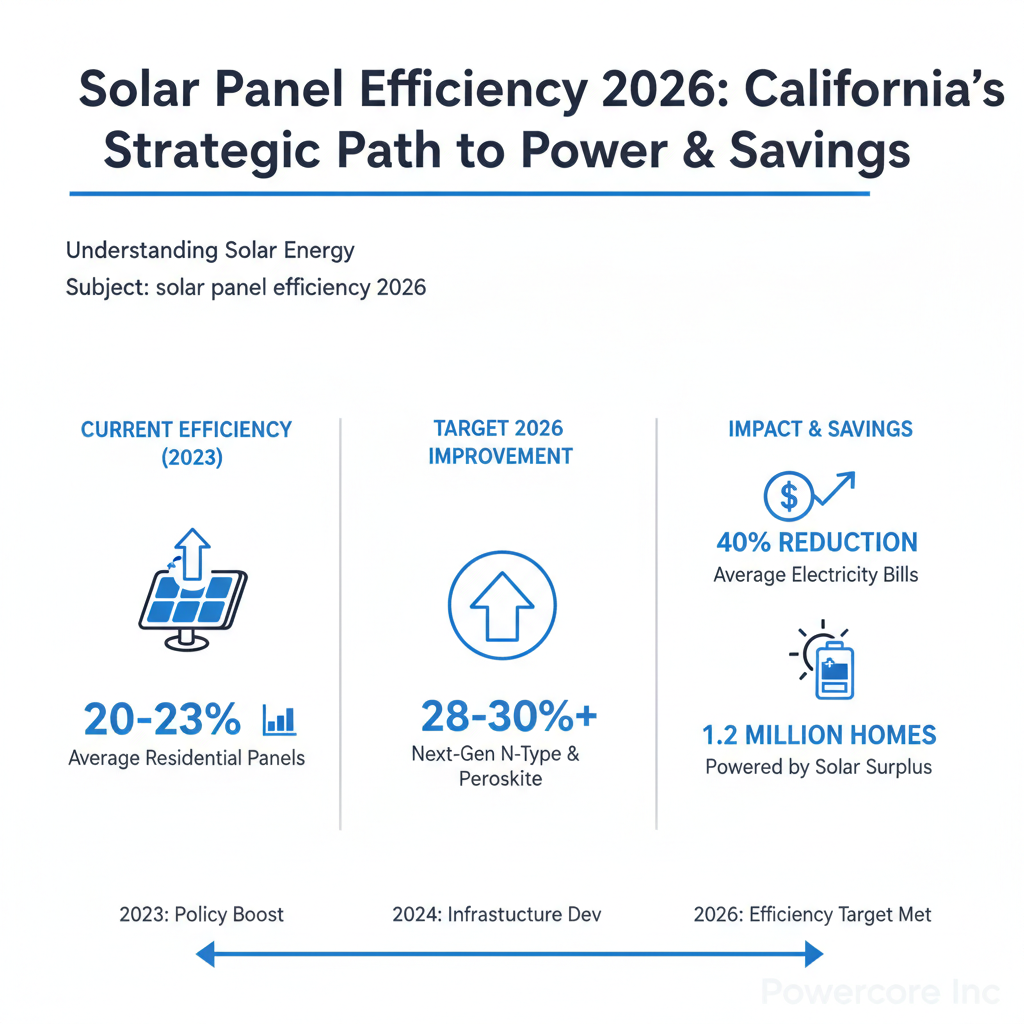
Often hailed as the 'miracle material,' perovskite solar cells hold the theoretical potential for efficiencies exceeding 30%. Their unique properties allow them to absorb light across a wider spectrum than traditional silicon. While standalone perovskite panels are still in early commercialization due to stability concerns, their integration into tandem cells with silicon is incredibly promising. By stacking a perovskite layer on top of a silicon cell, these tandem structures can capture different parts of the solar spectrum, pushing overall efficiency towards 28-30% and beyond.
Bifacial Solar Panels: Capturing More Light
Bifacial panels are designed to capture sunlight from both their front and rear sides. While not a brand-new concept, their efficiency gains are becoming more pronounced with advancements in module design and installation techniques. When installed correctly (e.g., elevated on light-colored surfaces or integrated into carports), bifacial panels can yield 5-25% more energy output than monofacial panels, effectively increasing overall system efficiency without requiring more roof space. For California businesses, this could mean significantly higher energy production from commercial solar installations.
Advanced Module Design and Materials
Beyond the cell itself, the module packaging is also undergoing significant improvements:
- Half-Cut Cells: Dividing cells in half reduces current, minimizing resistive losses and increasing overall module efficiency, especially in shaded conditions.
- Multi-Busbar (MBB) Technology: More busbars (the thin strips that collect current) lead to shorter current paths, less resistance, and higher efficiency.
- Transparent Backsheets: Essential for bifacial panels, these materials are becoming more durable and cost-effective.
- Anti-Reflective Coatings (ARC): Improved ARCs on the glass surface reduce light reflection, allowing more photons to reach the cells.
- Optimized Encapsulants: Better materials to protect cells from moisture and environmental degradation, improving longevity and sustained performance.
Quantum Dots and Concentrated Photovoltaics (CPV)
Though more niche, research into quantum dots for solar energy conversion is exploring ways to convert high-energy photons into multiple lower-energy photons, potentially overcoming the Shockley-Queisser limit of single-junction cells. CPV systems, which use lenses or mirrors to focus sunlight onto small, high-efficiency cells, are ideal for utility-scale applications in areas with direct sunlight, like parts of California's desert regions.
Decoding Solar Panel Efficiency Ratings: What to Look for in 2026
As solar technology advances, understanding what efficiency ratings truly mean becomes more important. By 2026, premium panels will likely push past the 23-24% mark, with cutting-edge tandem cells potentially reaching 26-28% in controlled environments. However, real-world performance involves more than just a single percentage point.
STC vs. NOCT: Understanding the Difference
- Standard Test Conditions (STC): This is the most common rating you'll see. It measures a panel's performance under ideal lab conditions: 1000 W/m² irradiance, 25°C (77°F) cell temperature, and an air mass of 1.5. While useful for comparison, these conditions rarely perfectly match real-world operation in California.
- Nominal Operating Cell Temperature (NOCT): Provides a more realistic performance estimate by simulating real-world conditions: 800 W/m² irradiance, 20°C (68°F) ambient temperature, 1 m/s wind speed. This rating gives a better indication of how a panel will perform on a hot California day.
Always consider both ratings. A panel with a high STC efficiency but a poor temperature coefficient (how much efficiency drops with rising temperature) might underperform in California's hotter regions compared to a slightly lower STC panel with an excellent temperature coefficient.
Temperature Coefficients and Degradation Rates
Hot temperatures reduce solar panel efficiency. A panel's temperature coefficient (expressed as %/°C) indicates how much its power output decreases for every degree Celsius above 25°C. Lower absolute values are better. By 2026, advanced cell technologies will feature even better temperature coefficients, ensuring more consistent performance even during California's heatwaves.
Degradation rate refers to the percentage of power output a solar panel loses each year. Most manufacturers guarantee minimal degradation, often 0.5% to 0.7% per year, ensuring 80-85% of initial power output after 25 years. Newer panels, leveraging improved materials and manufacturing, are showing even lower degradation rates, promising longer effective lifespans.
Beyond the Panel: Optimizing System-Level Efficiency
While panel efficiency is paramount, the overall efficiency of your solar energy system depends on a multitude of components working in harmony. Powercore Inc understands that a truly high-performing solar setup in California integrates these elements seamlessly.
Smart Inverters and Power Optimizers
Inverters convert the DC electricity generated by panels into AC electricity usable by your home or business. Modern inverters are incredibly efficient (97-99%) and come with smart features for monitoring and grid interaction. Power optimizers, often paired with string inverters, and microinverters (one per panel) mitigate the impact of shading or individual panel underperformance, ensuring that the entire system isn't bottlenecked by its weakest link. This is particularly valuable in California where complex rooflines or nearby trees can cause partial shading.
Integrated Battery Storage: Maximizing Self-Consumption
Even the most efficient solar panels can't generate power at night or during grid outages. Battery storage is crucial for maximizing the value of your solar investment, especially with California's evolving net metering policies. By storing excess solar energy generated during the day, you can power your home or business after sunset, reduce reliance on the grid during peak demand, and enhance energy resilience. Powercore Inc specializes in advanced solar and battery storage solutions, helping clients leverage incentives like the California Battery Storage Incentives.
Advanced Energy Management Systems
The synergy of high-efficiency panels, smart inverters, and battery storage is unlocked by sophisticated energy management systems. These systems use AI and machine learning to predict energy consumption and production, optimize battery charging and discharging, and even interact with the grid to maximize savings and efficiency. They provide homeowners and businesses with unprecedented control and insight into their energy usage, adapting to dynamic energy prices and weather patterns.
Strategic Investment for California Homes and Businesses in 2026
Investing in solar panel efficiency by 2026 is a strategic move for any California property owner. The confluence of technological advancement, favorable incentives, and the increasing cost of traditional energy makes solar an undeniable asset.
Residential Solar: Maximizing Rooftop Potential
For California homeowners, higher efficiency panels mean more power from less space, which is invaluable for smaller rooftops or those with complex architectures. This allows for greater energy independence, lower utility bills, and increased home value. Powercore Inc designs and installs bespoke residential solar and storage systems tailored to your specific energy needs and aesthetic preferences, ensuring optimal performance and seamless integration.
Commercial Solar and Microgrids: Powering California Enterprises
Businesses stand to gain significantly from enhanced solar efficiency. Larger installations mean greater energy production, leading to substantial operational cost reductions and a smaller carbon footprint. The ability to integrate these systems into microgrids provides critical energy resilience, safeguarding operations against power outages and ensuring business continuity. Powercore Inc is a trusted partner for commercial solar and microgrid solutions across California, helping businesses achieve energy autonomy and sustainability goals.
Financial Incentives and ROI in 2026
Several financial incentives continue to make solar an attractive investment:
- Federal Solar Investment Tax Credit (ITC): The Residential Clean Energy Credit offers a significant percentage (currently 30%) off the cost of installing new, qualified solar energy equipment for your home. This is a direct dollar-for-dollar reduction in your federal income tax liability. (For current details, consult the IRS Residential Clean Energy Credit).
- California-Specific Incentives: Beyond the federal ITC, California offers various local and state programs, particularly for battery storage (like SGIP) and new construction. These incentives, combined with ongoing energy savings, contribute to attractive payback periods and strong long-term ROI.
Calculating your return on investment involves considering not just the upfront cost and incentives, but also the projected energy savings over the system's 25+ year lifespan, increased property value, and the hedge against rising electricity prices. With higher efficiency panels, these benefits are amplified.
Choosing the Right Solar Partner in California
Navigating the evolving landscape of solar panel efficiency and system integration requires expert guidance. In California, selecting a contractor with the right licenses, experience, and comprehensive service offerings is crucial.
Powercore Inc stands out as a premier dual-licensed General B & C-10 Electrical Contractor (CSLB #1134334 and #1098175). Our extensive service portfolio, which includes everything from solar and battery storage to roofing, HVAC, and EV charging, means we can offer integrated solutions that optimize your property's entire energy ecosystem. We understand California's specific regulations, climate challenges, and incentive programs.
Our commitment is to provide customized, high-performance solar solutions that leverage the latest in solar panel efficiency to deliver maximum savings and sustainability for our clients across all of California. Whether you're considering a new installation, a solar detach and reset for a roofing project, or integrating an ADU with solar, Powercore Inc has the expertise to ensure a seamless and efficient project.
For a deeper dive into the foundational aspects of solar power systems, you might find our article Understanding Alternative Energy Solar particularly helpful.
The Environmental Impact: A Greener California
The pursuit of higher solar panel efficiency isn't just about economic benefits; it's a critical component of California's environmental stewardship. More efficient panels mean:
- Reduced Land Footprint: Generating more power from a smaller area is vital for preserving California's precious land resources.
- Lower Carbon Emissions: Maximizing clean energy production accelerates the transition away from fossil fuels, contributing directly to cleaner air and a healthier environment.
- Enhanced Grid Stability: Distributed solar generation, especially when coupled with storage, reduces strain on the grid and supports California's ambitious renewable energy targets.
By investing in the most efficient solar technology available by 2026, California homeowners and businesses will play an even greater role in creating a sustainable and resilient energy future for the entire state.
Powering Forward with Powercore Inc
The advancements in solar panel efficiency 2026 promise an exciting future for renewable energy in California. With panels poised to deliver more power from every ray of sunlight, now is the opportune time to explore how these innovations can benefit your home or business.
As California's trusted solar and electrical contractor, Powercore Inc is ready to guide you through the process, from initial design to expert installation, ensuring you harness the full potential of next-generation solar technology. Don't wait to embrace the future of energy. Contact Powercore Inc today for a personalized consultation and take the first step towards significant energy savings and environmental impact. Call us at 916-699-8778 or visit our contact page to learn more about how we can empower your property with efficient, reliable solar solutions.