

Introduction: Navigating California's New Solar Landscape with NEM 3.0
California has long been a trailblazer in solar energy adoption, leading the nation with innovative policies designed to encourage renewable energy and combat climate change. However, the landscape for solar homeowners underwent a significant transformation with the introduction of Net Energy Metering 3.0 (NEM 3.0), officially implemented on April 15, 2023. This update fundamentally shifts how new solar installations are compensated for the electricity they send back to the grid, presenting both challenges and unprecedented opportunities for maximizing home energy independence and savings.
For homeowners considering solar in California today, understanding NEM 3.0 is no longer optional; it's essential. The new rules redefine the economics of solar ownership, making battery storage not just a premium add-on, but a crucial component for optimizing value and ensuring a robust return on investment. Powercore Inc, a California dual-licensed General B & C-10 Electrical Contractor based in Roseville, CA, is at the forefront of helping homeowners navigate these changes, designing and installing integrated solar and battery storage solutions that thrive under NEM 3.0.
What is NEM 3.0 and Why It Matters for California Homeowners
To fully grasp the implications of NEM 3.0, it's helpful to understand its predecessors. Net Energy Metering (NEM) was designed to credit solar customers for the excess electricity their systems generated and fed back into the grid. Under NEM 1.0 and NEM 2.0, this credit was typically near the retail rate of electricity, meaning every kilowatt-hour (kWh) exported was almost as valuable as a kWh purchased from the utility.
Key Changes Introduced by NEM 3.0
NEM 3.0 dramatically alters this compensation structure for new solar customers. Here are the core shifts:
- Reduced Export Compensation: The most significant change is the drastically lower rate at which utilities compensate solar homeowners for excess electricity exported to the grid. Instead of near-retail rates, compensation is now based on the “Avoided Cost Calculator,” which reflects wholesale energy prices. These rates are significantly lower, often just a fraction of the retail rate, especially during non-peak hours.
- Shift to Time-of-Use (TOU) Rates: NEM 3.0 further entrenches the importance of Time-of-Use (TOU) rates. Export values fluctuate significantly throughout the day and year, with the highest values during late afternoon/early evening peak demand and lowest values during midday when solar production is high and demand is low.
- Higher Fixed Charges for Grid Connection: While not universally applied across all utilities, there's a trend towards higher fixed charges for connecting to the grid, further emphasizing the need for self-sufficiency.
- No Grandfathering for New Systems: Systems interconnected after April 15, 2023, fall under NEM 3.0. Existing NEM 1.0 and 2.0 customers are grandfathered in for 20 years from their interconnection date, but new installations face the new rules.
In essence, NEM 3.0 discourages sending excess power back to the grid, as the financial reward is minimal. Instead, it strongly incentivizes homeowners to maximize self-consumption of their generated solar power.
The NEM 3.0 Paradigm Shift: From Export to Self-Consumption
Under previous NEM structures, many solar homeowners aimed for systems that would produce more electricity than they consumed, relying on the grid to act as a “bank” for their excess generation. The new rules effectively close this bank, or at least make deposits far less profitable.
Why Self-Consumption is Now King
With NEM 3.0, the primary goal for solar homeowners has shifted:
- Maximize On-Site Use: Utilize as much of your generated solar electricity directly within your home as it's produced. This avoids exporting low-value power to the grid.
- Store Excess for Peak Hours: For any solar power you can't use immediately, store it for later, particularly during the expensive evening “peak” hours when utility rates are highest.
- Minimize Grid Imports: Reduce the amount of electricity you have to buy from the utility, especially during those costly peak times.
This paradigm shift underscores the critical role of solar battery storage. Without it, excess solar generated during the day (when export rates are lowest) would be sent to the grid for minimal credit, only for the homeowner to buy expensive electricity back from the utility in the evening when their solar panels are no longer producing.
Why Battery Storage is Now Essential for California Solar Under NEM 3.0
The solution to navigating NEM 3.0's reduced export compensation is clear: integrate battery storage with your solar PV system. A well-designed solar-plus-storage system allows homeowners to take control of their energy, significantly mitigating the negative impacts of NEM 3.0 and unlocking substantial savings.
Maximizing Self-Consumption and Minimizing Grid Dependence
A solar battery acts as your personal energy reservoir. During the day, when your solar panels are generating more electricity than your home consumes, the excess is directed to charge your battery instead of being exported to the grid for low compensation. Later, when your panels stop producing (e.g., in the evening) or when your home's demand exceeds your solar production, your home draws power from the battery first, before pulling expensive electricity from the utility grid. This significantly increases your self-consumption rate, directly reducing your utility bill.
Time-of-Use Arbitrage: A NEM 3.0 Power Play
This is arguably the most powerful financial strategy under NEM 3.0. California's TOU rates mean electricity prices can vary dramatically throughout the day. Typically, electricity is cheapest during the late night and early morning (off-peak) and most expensive during the late afternoon and evening (on-peak). With solar and battery storage:
- Your solar panels generate power during the day. Any excess charges your battery.
- If your battery is full, you might still export some power during midday, but increasingly, systems are designed to minimize this.
- In the evening, during the expensive on-peak hours, your home discharges power from the battery, avoiding purchasing high-cost electricity from the utility.
- Some smart systems can even be programmed to charge from the grid during super off-peak hours (if rates are extremely low) and discharge during peak, though the primary goal is usually solar self-consumption.
This strategic charging and discharging based on TOU rates, known as “time-of-use arbitrage,” allows you to “sell” your stored solar power to yourself at the highest possible retail rate, maximizing your financial savings.
Enhanced Home Resiliency and Blackout Protection
Beyond the financial benefits, battery storage provides invaluable peace of mind, especially in California, which is prone to Public Safety Power Shutoffs (PSPS) and other grid interruptions due to wildfires and extreme weather. When the grid goes down, a solar-only system without a battery also shuts down for safety reasons (unless it has a specific microgrid-forming inverter). A solar-plus-battery system, however, can:
- Automatically Isolate: Seamlessly disconnect from the grid and continue powering your essential loads.
- Recharge from Solar: Your solar panels can continue to charge your battery during an outage, providing continuous power as long as the sun shines.
This capability offers true energy independence and security, keeping your lights on, refrigerator running, and devices charged when your neighbors are in the dark.
Qualifying for Incentives: The ITC & SGIP
While NEM 3.0 changes compensation, significant incentives still exist to make solar-plus-storage more affordable:
- Federal Solar Investment Tax Credit (ITC): The ITC currently offers a 30% tax credit for qualified solar energy systems, including associated battery storage. This is a direct reduction in your federal tax liability, making a substantial difference in the overall cost.
- Self-Generation Incentive Program (SGIP): California's SGIP has historically offered incentives for qualifying energy storage systems. While the program's tiers and availability can change, it's crucial to work with an expert like Powercore Inc who can advise on the latest incentive opportunities and help you navigate the application process.
Partnering for Success: Choosing the Right Solar + Storage Provider
Installing a solar-plus-battery system under NEM 3.0 is a sophisticated endeavor that requires expert design, installation, and knowledge of regulatory compliance. Choosing the right contractor is paramount to ensuring your system performs optimally and delivers the promised savings and reliability.
The Powercore Inc Advantage: Integrated Home Energy Solutions
Powercore Inc stands out as California's premier choice for comprehensive home energy solutions. As a dual-licensed General B & C-10 Electrical Contractor (CSLB #1134334 and #1098175), we possess the unique expertise to handle every aspect of your project, from initial design and permitting to seamless installation and ongoing support. Our dual licensing means we're not just solar specialists; we understand the entire structure and electrical system of your home, ensuring a holistic and compliant installation.
Our services extend beyond just solar and battery storage to include HVAC, roofing, ADUs, remodels, EV charging, siding, decking, and interior remodeling. This integrated approach allows us to consider your home's total energy footprint and structural integrity, delivering solutions that are not only efficient but also enhance your home's overall value and safety. We pride ourselves on meticulously designing systems that maximize your self-consumption and time-of-use arbitrage opportunities under NEM 3.0, ensuring you get the most out of your investment.
When you partner with Powercore Inc, you benefit from:
- Expert Design & Engineering: Custom-tailored solar-plus-storage systems optimized for your specific energy needs and California's unique climate and regulations.
- Seamless Installation: Our highly skilled and certified technicians ensure a professional, efficient, and code-compliant installation process.
- Permitting & Paperwork: We handle all necessary permits and utility interconnection paperwork, making the process hassle-free for you.
- Comprehensive Warranties & Support: We stand behind our work with robust warranties and dedicated customer service, ensuring long-term performance and peace of mind.
- Holistic Home Improvement: The ability to integrate solar and storage with other home upgrades, offering a unified solution for your property.
Understanding the Economics: Solar + Storage ROI in the NEM 3.0 Era
While the initial investment for a solar-plus-battery system is higher than a solar-only system, the long-term return on investment (ROI) under NEM 3.0 is significantly enhanced with storage. The ability to avoid purchasing expensive peak-time electricity from the grid and maximize the value of your self-generated power drastically accelerates payback periods and increases lifetime savings.
Factors Affecting Your Solar + Storage ROI
Several key factors influence the financial performance of your system:
- System Size & Battery Capacity: Appropriately sizing both your solar array and battery bank to match your home's energy consumption patterns.
- Utility & TOU Rates: Your specific utility provider (PG&E, SCE, SDG&E) and their current Time-of-Use rate structures will dictate savings potential.
- Energy Consumption Habits: Homes with higher evening energy usage stand to benefit more from battery discharge during peak hours.
- Incentives: The ITC and any available state or local incentives can substantially reduce upfront costs.
- Future Energy Price Escalation: By locking in your energy costs, you hedge against future utility rate hikes, which have historically been significant in California.
Example Scenario: How Solar + Battery Works in Practice Under NEM 3.0
Consider a typical California home. During midday, solar panels produce abundant electricity. Instead of sending all excess to the grid for a low NEM 3.0 export credit, a significant portion charges the home battery. As the sun sets and evening peak rates begin, the home seamlessly switches to drawing power from the battery. This avoids purchasing electricity from the utility at rates that could be 3-5 times higher than midday off-peak rates. The battery then recharges from solar the next day, cycling daily to optimize savings and minimize grid reliance.
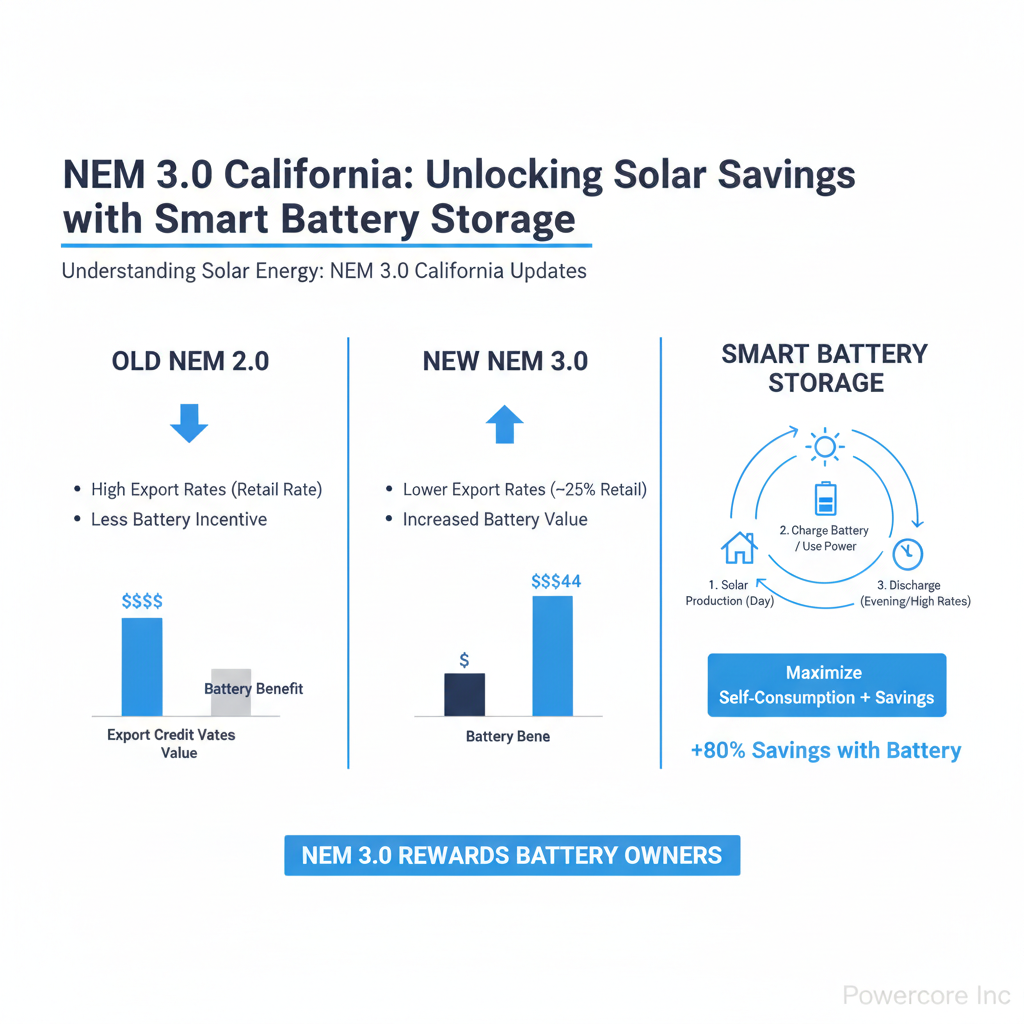
This strategic management of energy flow is precisely what Powercore Inc specializes in designing and implementing. We analyze your historical energy usage, assess your property's solar potential, and recommend a system tailored to your unique needs, ensuring maximum efficiency and cost savings under the new NEM 3.0 rules.
Beyond NEM 3.0: Future-Proofing Your California Home
Investing in solar-plus-battery storage under NEM 3.0 is more than just a financial decision; it's a strategic move to future-proof your home and enhance your lifestyle.
EV Charging Integration & Electrification
As California accelerates its transition to electric vehicles, the demand for home EV charging will skyrocket. A solar-plus-battery system provides the ideal platform for efficient and cost-effective EV charging. You can charge your vehicle with clean, self-generated solar power, further reducing your carbon footprint and transportation costs. Powercore Inc can integrate dedicated EV charging solutions directly into your home energy system.
Smart Home Energy Management
Modern solar and battery systems often come with sophisticated energy management platforms. These allow you to monitor your production and consumption in real-time, optimize battery charging/discharging schedules, and even integrate with other smart home devices. This level of control empowers you to make informed decisions about your energy usage and continuously refine your savings strategy.
Increased Energy Independence and Environmental Impact
Ultimately, a solar-plus-battery system reduces your reliance on a centralized grid and its fluctuating prices and vulnerabilities. You gain a significant degree of energy independence, contribute to a cleaner environment by reducing fossil fuel consumption, and increase the value and resilience of your property.
Conclusion: Embrace the Future of California Solar with Powercore Inc
NEM 3.0 represents a new chapter for solar energy in California, one where smart energy storage is no longer optional but foundational for maximizing value. While the rules have changed, the opportunity to harness the sun's power for significant savings, enhanced home resilience, and environmental stewardship remains stronger than ever, provided you have the right strategy and the right partner.
Powercore Inc is your trusted expert in navigating this evolving energy landscape. Our deep understanding of California's regulations, combined with our dual contractor licensing and extensive experience across solar, battery storage, and comprehensive home improvements, ensures that your investment is optimized for long-term performance and peace of mind. We are dedicated to delivering bespoke solutions that empower you to take control of your energy future.
Ready to unlock the full potential of solar-plus-battery storage under NEM 3.0? Don't let the new rules deter you; let them empower you. Contact Powercore Inc today for a personalized consultation and discover how we can design a robust, efficient, and future-proof energy solution for your California home. Call us at 916-699-8778 to get started on your journey to energy independence and significant savings.