

Navigating California's Solar Landscape: Monocrystalline vs. Polycrystalline Panels
As a California homeowner, embracing solar energy isn't just a trend; it's a strategic investment in your property's value, energy independence, and the state's sustainable future. The Golden State leads the nation in solar adoption, driven by abundant sunshine, rising electricity costs, and forward-thinking incentive programs. But before you harness the sun's power, a fundamental decision awaits: choosing the right type of solar panels for your home.
Two primary technologies dominate the residential solar market: monocrystalline and polycrystalline panels. While both effectively convert sunlight into electricity, they differ significantly in their manufacturing process, appearance, efficiency, and ultimately, their suitability for various Californian homes and budgets. Understanding these distinctions is paramount to making an informed decision that aligns with your specific energy goals, roof space, and aesthetic preferences.
At Powercore Inc, a proud California dual-licensed General B and C-10 Electrical Contractor (CSLB #1134334 & #1098175), we're committed to guiding homeowners across the entire state through this crucial selection process. Our expertise in residential solar & storage solutions ensures that your investment not only maximizes energy production but also delivers lasting value for years to come. Let's delve into the nuances of monocrystalline and polycrystalline panels to help you chart the best course for your solar journey.
Understanding the Building Blocks of Solar Panels
Before we compare, let's briefly understand what makes a solar panel. Both monocrystalline and polycrystalline panels are made from silicon, a semiconductor material, and are composed of individual photovoltaic (PV) cells. These cells capture photons from sunlight and convert them into direct current (DC) electricity, which is then converted into alternating current (AC) for use in your home. The key difference lies in how the silicon crystals within these cells are formed.
Monocrystalline Solar Panels: The High-Efficiency Choice
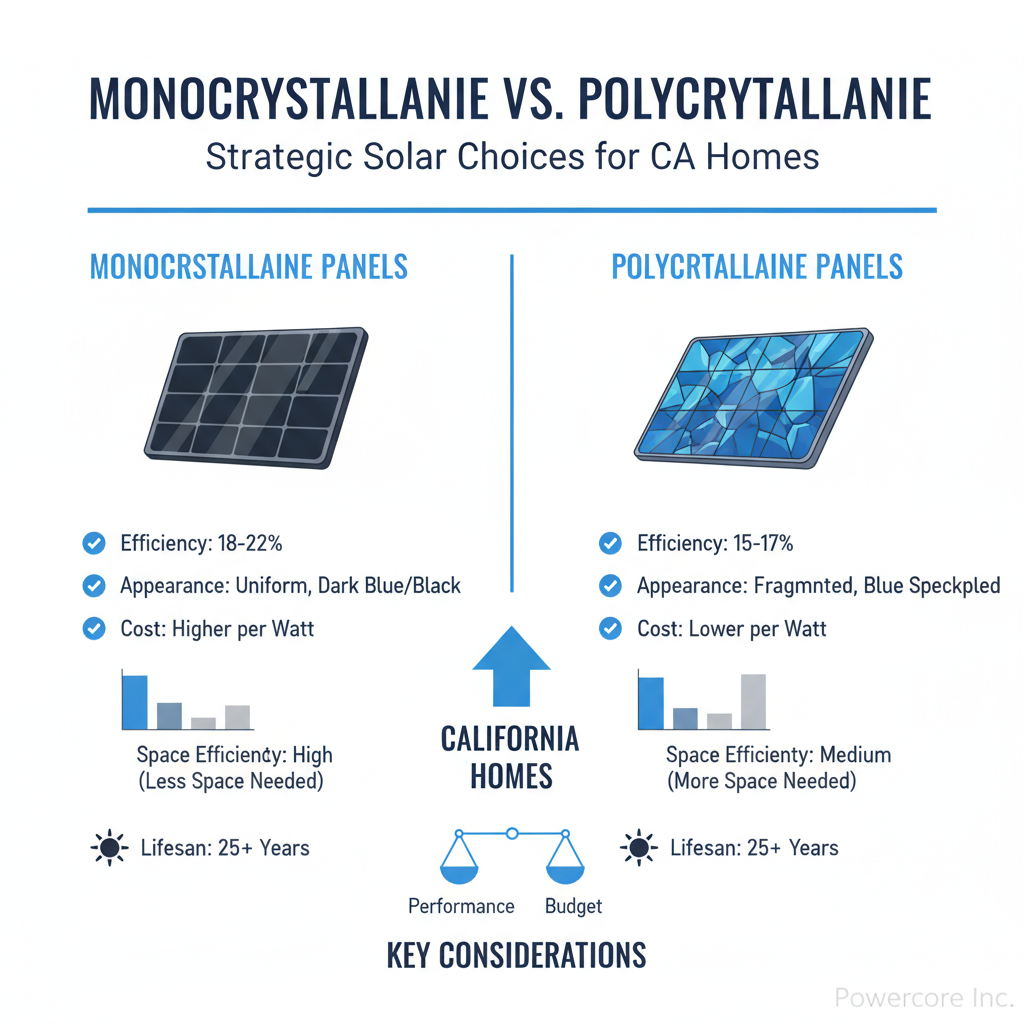
Monocrystalline panels are easily recognizable by their uniform, dark black appearance and rounded edges on the individual cells. They are considered the premium option in the residential solar market.
How Monocrystalline Panels Are Made
The manufacturing process for monocrystalline cells is intricate. It begins with a single, highly pure silicon crystal grown from a molten silicon ingot using the Czochralski process. This single crystal is then sliced into thin wafers, which become the solar cells. Because each cell is made from a single, unbroken crystal structure, electrons have more room to move, resulting in higher efficiency.
Advantages for California Homeowners
- Higher Efficiency: Monocrystalline panels boast the highest efficiency rates, typically ranging from 17% to over 22%. This means they convert more sunlight into electricity per square foot than polycrystalline panels. For California homeowners with limited roof space, especially in urban areas like San Francisco or San Diego where property values are high, this higher efficiency allows you to generate more power with fewer panels, optimizing your valuable roof area. This is particularly relevant when considering the optimal placement of solar panels.
- Sleek Aesthetics: Their uniform dark color and smooth appearance offer a more visually appealing integration with modern home designs. For many California homeowners, curb appeal is a significant factor, and monocrystalline panels often blend seamlessly with rooflines.
- Better Low-Light Performance: While all panels perform best in direct sunlight, monocrystalline panels generally exhibit slightly better performance in low-light conditions, such as cloudy days or early mornings/late afternoons. This can be an advantage in certain coastal or valley regions of California prone to fog or haze.
- Longevity: Often come with longer warranties (25+ years for performance) due to their robust and stable crystal structure, promising a reliable investment for decades.
Considerations for Monocrystalline Panels
- Higher Upfront Cost: The more complex manufacturing process makes monocrystalline panels more expensive per watt than polycrystalline panels. However, their higher efficiency can lead to lower overall system costs if fewer panels are needed to meet your energy demands.
- Temperature Sensitivity: While efficient, monocrystalline panels can be slightly more susceptible to performance degradation in extremely high temperatures, though modern advancements have largely mitigated this concern.
Polycrystalline Solar Panels: The Cost-Effective Solution
Polycrystalline panels are distinguished by their blueish hue and a mosaic-like pattern on the cells, indicative of multiple crystal structures. They represent a more budget-friendly entry point into solar energy.
How Polycrystalline Panels Are Made
Instead of a single crystal, polycrystalline cells are made by melting raw silicon and pouring it into a square mold. As the silicon cools, multiple silicon crystals form, creating the characteristic fragmented appearance. These silicon blocks are then sliced into wafers, which become the cells. This simpler manufacturing process reduces production costs.
Advantages for California Homeowners
- Lower Upfront Cost: Polycrystalline panels are typically less expensive per watt, making them an attractive option for homeowners with tighter budgets or those looking to maximize savings on their initial investment. This aligns with strategies for choosing budget-friendly solar panels without sacrificing quality.
- Good Heat Tolerance: Polycrystalline panels tend to perform slightly better in higher temperatures compared to monocrystalline panels, experiencing less efficiency drop-off. This can be an advantage in California's hotter inland regions like the Central Valley or parts of Southern California, where summer temperatures frequently soar.
- Sustainable Production: The manufacturing process for polycrystalline panels uses less silicon waste, making them a slightly more environmentally friendly option in terms of production resource consumption.
Considerations for Polycrystalline Panels
- Lower Efficiency: Polycrystalline panels generally have efficiency ratings between 15% and 17%. This means you'll need more panels, and thus more roof space, to achieve the same power output as a monocrystalline system. For homes with limited roof area, this can be a significant constraint.
- Less Uniform Appearance: The blueish color and visible crystal grains may not appeal to all homeowners, particularly those prioritizing sleek aesthetics for their home's exterior.
- More Roof Space Required: Due to lower efficiency, a polycrystalline system will require a larger footprint on your roof to generate the same amount of electricity as a monocrystalline system. This is a critical factor for many California properties where space is at a premium.
Key Comparison Factors for Your California Solar Investment
Choosing between monocrystalline and polycrystalline panels isn't just about efficiency numbers; it's about evaluating how each type fits into your overall energy strategy and California lifestyle. Here's a deeper dive into the factors that matter most for homeowners across the state:
Efficiency vs. Space: Optimizing Your California Rooftop
California's diverse housing stock means roof sizes vary dramatically, from compact urban dwellings to sprawling suburban estates. For homes with limited roof space, such as those in dense metropolitan areas like San Francisco, Los Angeles, or even established neighborhoods in Sacramento, the higher efficiency of monocrystalline panels is a significant advantage. Fewer panels are needed to achieve your desired energy production, leaving more roof area free for other considerations or simply maintaining an uncluttered aesthetic. If you have ample, unobstructed roof space, polycrystalline panels might offer a more cost-effective way to reach your energy goals, even if it means installing more of them. Powercore Inc specializes in tailoring solar solutions to optimize your specific roof configuration and energy needs.
Cost vs. ROI: Maximizing Your California Solar Savings
While monocrystalline panels have a higher upfront cost per panel, their superior efficiency can sometimes lead to a lower total system cost if fewer panels are required. Conversely, polycrystalline panels offer a lower entry point, which can be appealing for larger systems where space isn't an issue. When calculating your return on investment (ROI) in California, remember to factor in potential incentives like the federal Residential Clean Energy Credit (ITC), which offers a significant tax credit for solar installations. Additionally, consider the long-term savings on your utility bills, especially with California's Time-Of-Use (TOU) rates, and potential increases in your home's value. A detailed cost-benefit analysis by Powercore Inc can help you understand the true long-term value of each panel type for your specific situation.
Aesthetics: Blending with Your California Home Design
For many California homeowners, the visual impact of solar panels is an important consideration. Monocrystalline panels, with their uniform dark black appearance, tend to offer a sleek, modern look that often blends seamlessly with contemporary architecture and darker roof shingles. Polycrystalline panels, with their blueish hue and visible crystal patterns, have a more traditional solar aesthetic. If curb appeal is a top priority, especially for homes with prominent rooflines or specific architectural styles, monocrystalline might be the preferred choice. However, if functionality and cost-effectiveness outweigh aesthetic concerns, the appearance of polycrystalline panels is often perfectly acceptable.
Performance in California's Diverse Climate
California's climate is incredibly varied, from the cool, foggy coasts to the scorching inland deserts and snowy mountains. While both panel types perform well across the state, there are subtle differences. Polycrystalline panels are often cited as having slightly better temperature coefficients, meaning their efficiency degrades less in very high temperatures. This could be a minor advantage in extremely hot regions like the Coachella Valley or parts of the Central Valley during peak summer. Monocrystalline panels, on the other hand, tend to have a slight edge in low-light conditions, which might be beneficial in coastal areas prone to morning fog. Ultimately, modern panel technology has made both types highly resilient to California's weather, but these nuances can be part of a comprehensive assessment.
Durability and Lifespan: A Long-Term California Investment
Both monocrystalline and polycrystalline panels are built to last, with most manufacturers offering performance warranties of 25 years or more. This means your solar investment is designed for long-term power generation. The longevity of a solar system, however, extends beyond just the panels. It also depends on the quality of the installation, the durability of other components like inverters, and proper maintenance. Powercore Inc, with our deep expertise as a C-10 Electrical Contractor, ensures that your entire solar & battery storage system is installed to the highest standards, maximizing its operational lifespan and your return on investment.
Environmental Impact: Beyond Clean Energy
While both panel types contribute to a cleaner environment by generating renewable energy, their production processes have subtle differences. Polycrystalline manufacturing uses less silicon waste, making it a slightly more resource-efficient process. However, monocrystalline panels' higher efficiency means fewer panels are needed for the same output, potentially reducing the overall material footprint of a system. Both are excellent choices for reducing your carbon footprint and supporting California's green initiatives.
Beyond the Panels: Integrating Your California Energy System
The choice between monocrystalline and polycrystalline panels is just one piece of your comprehensive California energy strategy. A truly future-proof home integrates various technologies to maximize savings, enhance resilience, and contribute to grid stability.
Battery Storage: The California Advantage
Pairing your solar panels with battery storage is increasingly essential for California homeowners. With fluctuating Time-Of-Use (TOU) rates and the potential for Public Safety Power Shutoffs (PSPS), batteries allow you to store excess solar energy generated during the day and use it when electricity prices are highest or during grid outages. California offers compelling battery storage incentives that can significantly offset installation costs, making it a smart financial and practical decision.
EV Charging and Energy Independence
As electric vehicles become more prevalent, integrating EV charging stations with your solar system allows you to power your transportation with clean, self-generated electricity. This further reduces your reliance on the grid and fossil fuels, enhancing your overall energy independence. Powercore Inc can seamlessly integrate EV charging solutions into your solar and home electrical infrastructure.
Whole-Home Solutions from Powercore Inc
Powercore Inc doesn't just install solar panels; we provide holistic energy and home improvement solutions. Our dual licensure as a General B contractor means we understand the entire structure of your home, not just the electrical system. This enables us to offer integrated services from roofing (crucial for solar longevity) to HVAC climate control and even remodels, ensuring all aspects of your home work in harmony for optimal energy efficiency and comfort. This comprehensive approach is vital for maximizing your solar investment in the long run.
Making the Right Choice for Your California Home
There's no single "best" solar panel type; the ideal choice depends on your specific needs, priorities, and property characteristics. For instance, a homeowner in a densely populated area with limited roof space might prioritize the high efficiency and sleek aesthetics of monocrystalline panels, even with a higher upfront cost. Conversely, a homeowner in a more rural area with ample roof space and a focus on budget-friendliness might find polycrystalline panels to be the perfect fit.
The most crucial step in this decision-making process is to consult with a reputable and experienced solar contractor who understands California's unique energy landscape. Powercore Inc brings unparalleled expertise to every project. Our team performs a detailed assessment of your home's energy consumption, roof characteristics, shading analysis, and budget to recommend the optimal solar panel technology and system design. We'll walk you through the pros and cons of each option, considering factors like potential advanced cell technologies like PERC that can further enhance efficiency for both panel types.
Powercore Inc: Your Trusted California Solar Partner
At Powercore Inc, we pride ourselves on being more than just solar installers. As a California-licensed General B and C-10 Electrical Contractor (CSLB #1134334 & #1098175), we offer a breadth of services and depth of knowledge that ensures your solar project is handled with the utmost professionalism and care from start to finish. From initial consultation and design to permitting and flawless installation, our team manages every aspect of your solar journey. We serve homeowners and businesses across all of California, providing reliable, high-performance solar solutions tailored to the diverse needs of the state.
Whether you're prioritizing maximum efficiency, sleek aesthetics, or cost-effectiveness, Powercore Inc has the expertise to help you navigate the choices between monocrystalline and polycrystalline panels and design a solar system that delivers optimal performance and value for your California home. Our commitment to quality, safety, and customer satisfaction is unwavering, making us the go-to experts for residential solar installations throughout the state.
Ready to Power Your California Home with Solar?
Don't let the technical details of monocrystalline vs. polycrystalline panels overwhelm you. Let the experts at Powercore Inc simplify the process and design a customized solar solution that perfectly fits your California home and lifestyle. We're here to answer all your questions and provide a no-obligation consultation.
Contact Powercore Inc today at 916-699-8778 or visit our contact page to schedule your personalized solar assessment. Let us help you unlock the full potential of solar energy for your California property!