

Unlocking California's Energy Puzzle: Solar, Battery, and Time-of-Use Rates
California homeowners are increasingly seeking ways to gain control over their electricity bills and enhance energy independence. With the state's unique energy landscape, characterized by fluctuating utility rates and a strong push towards renewable energy, understanding how to strategically manage your home's power consumption is more critical than ever. At the heart of this strategy lies the intelligent integration of solar energy, battery storage, and a thorough comprehension of Time-of-Use (TOU) electricity rates.
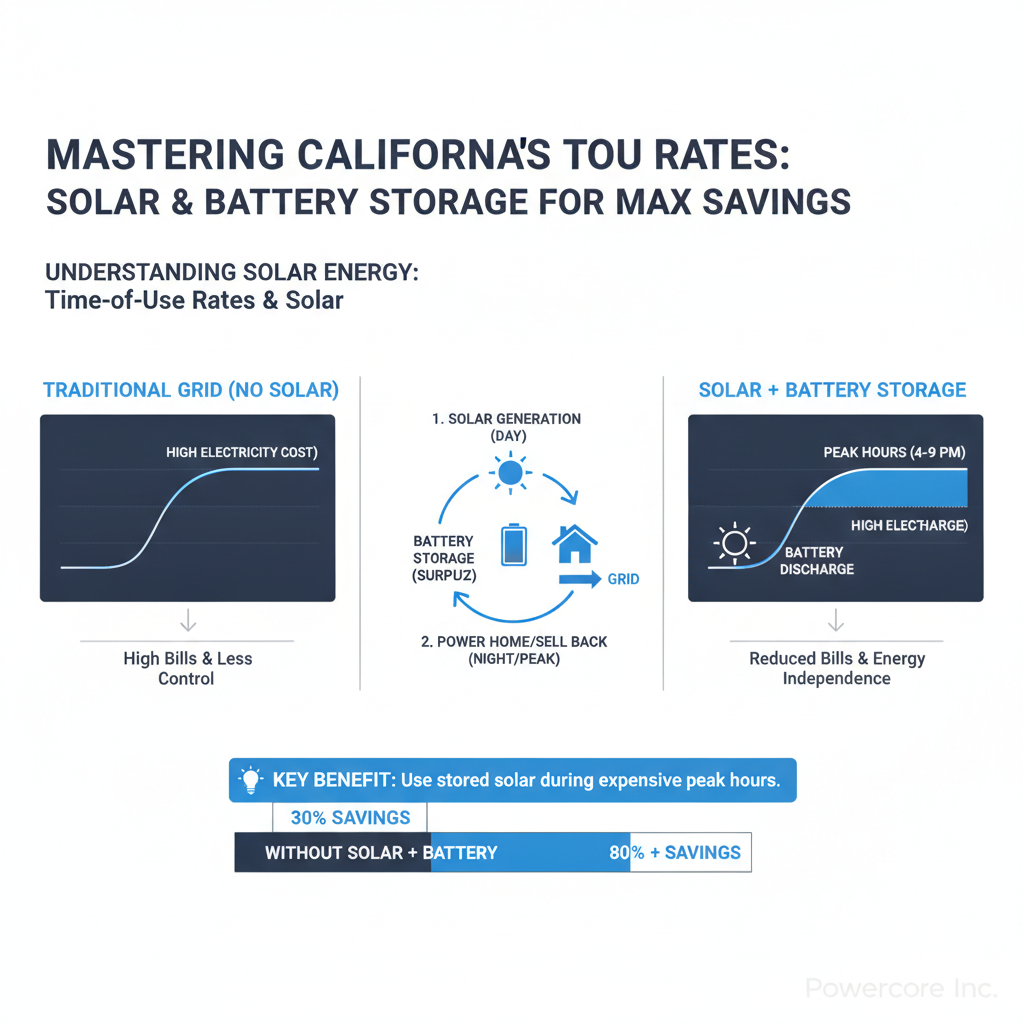
For many, the promise of solar power is clear: generate your own clean electricity and reduce reliance on the grid. However, the introduction of TOU rates by major California utilities like PG&E, SCE, and SDG&E adds a layer of complexity. These rates charge different prices for electricity depending on the time of day, day of the week, and even season. While solar panels are excellent at producing power during sunny daylight hours, they often face a mismatch with peak demand periods, which typically occur in the late afternoon and early evening when the sun is setting. This is where a robust solar + battery storage system becomes not just an enhancement, but a necessity for maximizing savings and truly optimizing your home's energy profile.
Powercore Inc, a dual-licensed General B & C-10 Electrical Contractor based in Roseville, CA, specializes in helping California residents navigate this intricate energy environment. We design and install integrated energy solutions that empower you to take full advantage of your solar investment, mitigate the challenges of TOU rates, and build a more resilient, energy-efficient home.
What Are Time-of-Use (TOU) Rates, and How Do They Work in California?
Time-of-Use rates are a billing structure where the cost of electricity varies based on when you use it. Utilities implement TOU rates to encourage consumers to shift their energy usage away from peak demand periods, thereby reducing strain on the grid and potentially delaying the need for costly infrastructure upgrades. In California, these rates typically divide the day into several periods:
- Off-Peak: These are the cheapest hours, usually late night to early morning, and sometimes mid-day. Demand is lowest during these times.
- Partial-Peak (or Mid-Peak): Rates are moderate, often occurring in the morning and early afternoon, and sometimes late evening.
- On-Peak (or Peak): These are the most expensive hours, typically in the late afternoon and early evening (e.g., 4 PM to 9 PM), when electricity demand is highest, and the grid is under the most stress.
The exact timing and duration of these periods, as well as the price differentials, vary significantly between utilities and specific rate plans. For instance, some plans might have 'super off-peak' hours with exceptionally low rates. Understanding your specific utility's TOU schedule is the first critical step in developing an effective energy strategy. You can find detailed information on these rates directly from the California Public Utilities Commission (CPUC) or your local utility provider's website.
The Challenge for Solar-Only Homes Under TOU
While traditional residential solar installations are excellent at producing clean energy during the sunniest parts of the day, they often face an economic mismatch with TOU rates. Here's why:
- Solar Production Peak vs. Grid Demand Peak: Solar panels generate the most electricity around midday. However, the most expensive TOU rates (on-peak) typically kick in later in the afternoon and early evening, precisely when solar production starts to decline or cease entirely.
- Exporting at Low Value, Importing at High Value: Without battery storage, excess solar energy produced during off-peak or partial-peak hours (when electricity is cheap) is exported back to the grid. You receive a credit for this power, but often at a lower rate than what you pay to import electricity during the expensive on-peak hours. This means you might be selling cheap and buying expensive, eroding your potential savings.
- Reliance on the Grid During Peak: As the sun sets, a solar-only home must pull electricity from the grid to power evening activities. During these on-peak hours, this imported electricity comes at the highest possible price, significantly impacting your monthly bill.
This dynamic means that even with solar panels, homeowners can still face substantial electricity bills if they don't strategically manage their energy consumption, particularly during the costly on-peak windows.
The Strategic Solution: Integrating Solar with Battery Storage
The addition of battery storage fundamentally transforms how your solar system interacts with TOU rates, turning potential challenges into significant advantages. A well-designed solar + battery system allows you to:
- Store Excess Solar Production: Instead of exporting valuable midday solar energy back to the grid for a low credit, your battery stores it.
- Self-Power During Peak Hours: When on-peak rates begin and solar production drops, your home seamlessly switches to drawing power from the stored energy in your battery, avoiding the purchase of expensive grid electricity.
- Maximize Self-Consumption: By using your own generated and stored energy, you dramatically increase your home's energy independence and reduce reliance on the utility grid during critical times.
- Optimize Energy Arbitrage: Essentially, you 'buy low' (generate solar when it's free or export for a credit) and 'sell high' (avoid buying expensive grid power during peak, or export from your battery if net billing allows and it's economically advantageous).
This strategic approach to energy management ensures that every kilowatt-hour your solar panels produce is utilized in the most economically beneficial way, leading to substantial savings on your electricity bill. Powercore Inc specializes in tailoring these integrated solutions to the unique energy demands and TOU rate structures faced by each California homeowner.
Navigating NEM 3.0 and TOU: Why Batteries Are Now Essential
California's Net Energy Metering (NEM) 3.0, officially known as the Net Billing Tariff, has significantly altered the economics of solar power for new installations. Under NEM 3.0, the export credit rates for excess solar energy sent back to the grid are generally much lower than under previous NEM versions, often reflecting the 'avoided cost' of wholesale electricity rather than retail rates. This change makes the strategic integration of battery storage even more critical for maximizing the financial benefits of solar.
Here’s why NEM 3.0 fundamentally shifts the value proposition towards solar + battery systems when considering TOU rates:
- Reduced Export Value: With lower export credits, sending excess solar energy back to the grid during off-peak hours is less financially rewarding.
- Increased Value of Self-Consumption: By storing solar energy in a battery and using it yourself during expensive on-peak TOU hours, you directly offset the highest-priced electricity you would otherwise have to buy from the grid. This 'avoided cost' becomes the primary driver of savings.
- Optimized Time Shifting: Batteries allow you to 'time-shift' your solar power. Generate during the day, store, and use during the evening peak – essentially turning your home into a miniature power plant that smartly manages its own supply and demand in sync with TOU pricing.
For any California homeowner considering a new solar installation, or even upgrading an existing one, a battery storage system is no longer just an optional add-on; it's a strategic imperative for truly unlocking the financial potential of solar under NEM 3.0 and the complexities of TOU rates. For a deeper dive into how solar panels affect your utility statement, you can refer to our article on understanding your electricity bill with solar panels.
Strategic Advantages of Solar + Battery for California Homeowners
Beyond simply reducing your electricity bill, an integrated solar and battery storage system offers a multitude of benefits tailored for the California lifestyle:
Maximizing Cost Savings Through TOU Arbitrage
The most immediate and tangible benefit is the ability to leverage TOU rates to your advantage. By storing inexpensive solar power and using it when grid electricity is most expensive, you effectively engage in 'energy arbitrage,' significantly lowering your monthly utility expenditures. This strategy allows you to minimize purchases from the grid during peak hours, often eliminating them entirely for many households.
Enhanced Energy Independence and Grid Resilience
With a battery, your home becomes less dependent on the grid. This means greater peace of mind during unexpected power outages, which are becoming more common in California due to wildfires, public safety power shutoffs (PSPS), and aging infrastructure. Your battery acts as a reliable home battery backup, providing critical power when the grid goes down. This also contributes to a more resilient local energy ecosystem.
Reducing Your Carbon Footprint
By maximizing the use of your self-generated solar energy, you further reduce your reliance on fossil-fuel-generated electricity from the grid, especially during peak hours when dirtier 'peaker' plants are often brought online. This contributes directly to a cleaner environment and supports California's ambitious renewable energy goals.
Potential for Future Grid Services
As smart grid technologies evolve, battery storage systems may offer opportunities to participate in virtual power plants or demand response programs, potentially earning additional credits or payments from your utility for allowing them to draw from or charge your battery during specific grid events. This further enhances the economic value of your investment.
Key Considerations for Your California Home
Implementing a successful solar + battery strategy for TOU rates requires careful planning and expert execution. Here are the critical factors Powercore Inc evaluates for every client:
Sizing Your System for Optimal TOU Savings
Proper sizing is paramount. It involves two main components:
- Solar Panel Capacity: Based on your historical electricity consumption, future energy needs (e.g., adding an EV charger, HVAC upgrades), and available roof space. Optimal panel orientation, as discussed in our guide on which direction to face solar panels, is also crucial.
- Battery Storage Capacity: Determined by your typical evening peak demand, the duration of on-peak hours, and how much critical load backup you desire during an outage. A common goal is to store enough energy to power your essential loads through the entire on-peak period without drawing from the grid.
Powercore Inc conducts a detailed energy audit and load analysis to ensure your system is perfectly sized to meet your specific needs and maximize TOU arbitrage opportunities.
Choosing the Right Battery Storage System
The market offers various battery technologies and brands. Key factors to consider include:
- Capacity (kWh): How much energy the battery can store.
- Power Output (kW): How much electricity the battery can deliver at one time.
- Chemistry: Lithium-ion batteries (e.g., LFP or NMC) are currently dominant due to their efficiency and longevity.
- Cycle Life and Warranty: How many charge/discharge cycles the battery is rated for and the manufacturer's warranty.
- Integration: Compatibility with your chosen solar inverter and home energy management system.
Our experts will guide you through the options, recommending the best battery solution that aligns with your budget, energy goals, and the unique conditions of your California property.
Understanding California Incentives and Tax Credits
Investing in solar and battery storage can be made more affordable through various incentives:
- Self-Generation Incentive Program (SGIP): California's leading battery storage incentive program offers rebates for installing battery storage. Eligibility and rebate amounts depend on various factors, including your utility, household income, and system size. These rebates are highly sought after and can significantly reduce upfront costs.
- Residential Clean Energy Credit (Federal Tax Credit): This federal incentive allows homeowners to claim a percentage of the cost of eligible solar and battery storage systems as a tax credit. As of current legislation, it provides a substantial reduction in the overall cost. You can find more details on the IRS website.
Powercore Inc stays up-to-date on all applicable state and federal incentives, helping you navigate the application processes to ensure you maximize your financial benefits.
Why Choose Powercore Inc: Your California Energy Partner
Navigating the complexities of California's TOU rates, NEM 3.0, and advanced solar + battery solutions requires a contractor with deep expertise, proven experience, and a commitment to customer satisfaction. Powercore Inc is that partner.
- Dual-Licensed Expertise: As a California CSLB #1134334 (General B) and #1098175 (C-10 Electrical) licensed contractor, we possess the comprehensive skill set to handle every aspect of your project, from initial design and structural considerations to electrical integration and final commissioning. This dual expertise ensures a seamless, code-compliant, and high-quality installation.
- Holistic Energy Solutions: We don't just install solar panels; we provide integrated energy solutions. Whether you're looking to add battery storage, integrate HVAC climate control, or plan a complete home remodel that includes solar, our team has the capability to deliver a cohesive, efficient, and future-proof system.
- California-Specific Knowledge: Operating across all of California, we have an intimate understanding of the state's diverse climate zones, utility regulations, permitting requirements, and incentive programs. This local expertise ensures your system is optimized for your specific location and maximizes all available benefits.
- Commitment to Excellence: At Powercore Inc, we pride ourselves on delivering exceptional craftsmanship and unparalleled customer service. From the initial consultation to post-installation support, our team is dedicated to making your transition to cleaner, more efficient energy as smooth and rewarding as possible. Learn more about Powercore.
Take Control of Your Energy Future with Powercore Inc
Don't let the complexities of Time-of-Use rates and evolving energy policies prevent you from realizing the full potential of solar power. By strategically integrating solar panels with battery storage, you can transform your home into an energy-independent powerhouse, dramatically reduce your electricity bills, and contribute to a sustainable future.
Powercore Inc is ready to be your trusted partner in this journey. Our team of experts will design a customized solar + battery solution perfectly tailored to your California home, ensuring you master TOU rates and unlock maximum savings. Take the first step towards a smarter, more resilient energy future. Contact Powercore Inc today for a personalized consultation. Call us directly at 916-699-8778 to discuss your project and discover how we can empower your home with advanced energy solutions.