

Introduction to California Solar Permits
California stands at the forefront of the solar revolution, leading the nation in renewable energy adoption. With its abundant sunshine and progressive environmental policies, it's no surprise that more homeowners and businesses across the Golden State are making the switch to solar power. However, beneath the promise of energy independence and significant savings lies a critical, often complex, hurdle: the California solar permits process.
For many, the idea of navigating local building codes, state regulations, and utility interconnection requirements can seem daunting. This is where expertise becomes invaluable. Powercore Inc, a dual-licensed General B & C-10 Electrical Contractor based in Roseville, CA, with extensive experience across all of California, understands these complexities intimately. Our mission is to demystify the permitting journey, ensuring your transition to solar is as seamless and efficient as possible.
This comprehensive guide will decode the intricacies of California solar permits, from initial application to final approval. We'll explore the 'why' behind these regulations, outline the essential steps, highlight California-specific nuances, and provide strategic insights to help you avoid common pitfalls. By understanding the permitting landscape, you can accelerate your path to energy independence, backed by the trusted expertise of Powercore Inc.
Why Solar Permits Are Essential in California
While permits might seem like bureaucratic red tape, they serve several crucial functions, especially in a state as seismically active and environmentally conscious as California:
Ensuring Safety and Structural Integrity
- Electrical Safety: Solar photovoltaic (PV) systems involve high-voltage electricity. Permits ensure that all electrical components are installed according to the National Electrical Code (NEC) and local amendments, preventing hazards like electrical fires or shocks.
- Structural Soundness: Solar panels add significant weight to a roof. Permits require structural evaluations to confirm that your roof can safely support the additional load, especially crucial in California where seismic activity is a concern.
- Fire Safety: California has stringent fire safety regulations, particularly in wildfire-prone areas. Permits address requirements for clear access pathways for firefighters, appropriate panel setbacks, and rapid shutdown capabilities to enhance safety.
Compliance with Building Codes and Zoning Ordinances
- Statewide Standards: California's Building Energy Efficiency Standards (Title 24) often mandate solar installations for new residential construction and significant remodels, requiring adherence to specific design and performance criteria.
- Local Zoning: Municipalities have zoning laws that dictate where structures can be built, their height, and aesthetic considerations. Permits ensure your solar installation complies with these local rules, preventing issues with neighbors or city planning departments.
Consumer Protection and Quality Assurance
- Licensed Contractors: Permits often require that the installation be performed by a licensed contractor, protecting homeowners from shoddy workmanship and ensuring accountability. Powercore Inc holds both a General B (CSLB #1134334) and C-10 Electrical (CSLB #1098175) license, guaranteeing professional, compliant installations.
- System Performance: Permitting processes often involve review of system design, ensuring that the proposed system meets efficiency standards and will perform as expected.
Grid Integration and Utility Requirements
Connecting your solar system to the utility grid requires careful planning and approval. Permits ensure that your system is safely and effectively integrated, allowing for net metering and other programs. This process, often called 'interconnection,' is distinct from building permits but runs concurrently.
The Key Players in California's Solar Permitting Process
Successfully navigating solar permits in California involves collaboration among several entities:
The Homeowner or Business Owner
As the property owner, you initiate the desire for solar. While your contractor will handle most of the paperwork, understanding the process empowers you to make informed decisions and track progress.
Your Solar Contractor: Powercore Inc
This is arguably the most crucial player. A qualified, experienced contractor like Powercore Inc will:
- Design your solar system.
- Prepare all necessary permit documentation (plans, schematics, engineering reports).
- Submit the application to the local Authority Having Jurisdiction (AHJ).
- Coordinate with utility companies for interconnection.
- Manage inspections and address any issues.
- Ensure compliance with all state and local regulations.
Our dual licensing as a General B and C-10 Electrical Contractor means we have the comprehensive expertise to manage both the structural and electrical aspects of your solar and battery storage installation, streamlining the process significantly.
The Local Building Department (AHJ)
This is typically your city or county building department. They are responsible for:
- Reviewing permit applications for compliance with local and state building codes.
- Issuing the permit.
- Conducting required inspections during and after installation.
Requirements and processing times can vary significantly between different AHJs across California.
The Utility Company
Companies like PG&E, SCE, and SDG&E are responsible for:
- Approving your system's interconnection to their grid.
- Setting up net metering.
- Providing Permission to Operate (PTO) after all inspections are complete.
State Agencies
While not directly involved in every permit application, state bodies like the California Contractors State License Board (CSLB) ensure contractors are licensed and bonded, and the California Public Utilities Commission (CPUC) oversees utility regulations and programs like Net Energy Metering (NEM).
General Steps for Obtaining a California Solar Permit
While local variations exist, the core process for securing a solar permit in California generally follows these steps:
Step 1: Initial Assessment and System Design
Powercore Inc begins with a thorough site evaluation, assessing your energy needs, roof condition, sun exposure, and electrical infrastructure. This informs the design of a custom solar system, including panel count, inverter type, and potential battery storage integration. Structural and electrical plans are developed at this stage.
Step 2: Permit Application Preparation
Our team compiles all necessary documentation. This typically includes detailed engineering drawings, electrical schematics (single-line diagrams), equipment specifications, structural calculations, and a site plan showing the solar array's placement and required setbacks. The AHJ's specific application forms are also completed.
Step 3: Submission to the Local AHJ
The complete permit package is submitted to your city or county building department. Many jurisdictions now offer online submission portals, while others still require physical submissions. This is also where permit fees are paid.
Step 4: Review Period and Revisions
The AHJ reviews the application for compliance with local and state codes. This period can range from a few days (especially with automated tools like SolarAPP+) to several weeks. If deficiencies are found, the AHJ will issue comments or requests for revisions. Powercore Inc's dedicated team will promptly address these, making necessary adjustments and resubmitting the plans.
Step 5: Permit Issuance
Once all requirements are met and plans are approved, the permit is issued. This is the green light to begin installation.
Step 6: Solar Installation
With the permit in hand, Powercore Inc's certified installers proceed with the physical installation of your solar array. This includes mounting the panels, wiring the electrical components, and integrating any battery storage or EV charging infrastructure.
For more details on the installation process, you might find our guide How to Install Roof Top Solar Panels: A Step-by-Step Guide helpful.
Step 7: Inspections
Typically, there are one or two inspections. A 'rough-in' inspection might occur before the system is fully enclosed, followed by a 'final' inspection once the installation is complete. The AHJ inspector verifies that the installation adheres to the approved plans and all applicable codes.
Step 8: Utility Interconnection and Permission to Operate (PTO)
After successful final inspection, Powercore Inc notifies your utility company. The utility will then review the documentation and, upon approval, grant Permission to Operate (PTO). This is the final step, allowing you to turn on your system and begin generating your own clean energy!
California-Specific Regulations Influencing Permitting
California's commitment to renewable energy has led to unique regulations that shape the solar permitting landscape:
SolarAPP+: Streamlining Residential Solar Permits
To expedite solar adoption, California has championed SolarAPP+ (Solar Automated Permit Processing), an online platform developed by the National Renewable Energy Laboratory (NREL). Many California cities and counties have adopted SolarAPP+, allowing for instant or same-day permit approval for qualifying residential rooftop solar and battery storage systems. This significantly reduces permit review times from weeks to minutes, provided the system meets specific criteria for simplicity and compliance.
Net Energy Metering (NEM) Frameworks
While not a direct permit requirement, NEM policies (such as NEM 2.0 and the newer NEM 3.0) dictate how solar owners are compensated for excess energy sent to the grid. These policies influence system design, particularly the economic viability of adding battery storage, which can, in turn, affect the permit application process for integrated systems.
Title 24: Building Energy Efficiency Standards
California's Title 24 mandates energy efficiency for new construction and certain alterations to existing buildings. Current versions often require new homes to include solar PV systems, embedding solar into the initial building permit process rather than as an add-on. This requires seamless coordination between general construction and electrical contractors, an area where Powercore Inc excels with our dual licensing.
Fire Safety Regulations
Given California's wildfire risks, the state has robust fire safety codes for solar installations. These include requirements for clear pathways on roofs for firefighters, specific setbacks from roof ridges and valleys, and rapid shutdown capabilities for PV systems. Permit applications must demonstrate compliance with these crucial safety measures.
Homeowner Association (HOA) Rules
California law (Civil Code Sections 714 and 714.1) largely protects a homeowner's right to install solar panels, even if an HOA has restrictive covenants. HOAs generally cannot prohibit solar installations outright or impose unreasonable restrictions that significantly increase costs or decrease efficiency. However, they can establish reasonable aesthetic guidelines. Your permit application should still consider HOA rules, and Powercore Inc can help navigate these discussions if needed.
Local Variations and Overlay Zones
Despite statewide mandates, local jurisdictions maintain control over specific zoning, historical preservation overlay zones, and additional requirements. What's permissible in Roseville might differ slightly from San Jose or San Diego. Powercore Inc's deep understanding of local nuances across California helps mitigate potential permit delays.
Common Permit Requirements and Documentation
To successfully obtain your solar permit, a comprehensive package of documents is typically required. Powercore Inc handles the meticulous preparation of these for you:
- Site Plan: A detailed drawing of your property, showing the location of the solar array, property lines, adjacent structures, utility connections, and access points.
- Electrical Schematics (Single-Line Diagrams): These illustrate the entire electrical path from solar panels to the main service panel, including inverters, disconnects, wiring, and grounding.
- Structural Plans/Calculations: An engineer's stamp may be required to certify that your roof's structure can safely support the added weight of the solar panels, especially for older homes or large systems.
- Equipment Specifications: Datasheets for all major components, including solar panels, inverters, batteries, and mounting hardware, verifying they are certified and meet safety standards.
- Application Forms: Completed forms specific to your local AHJ.
- Proof of Contractor Licensing and Insurance: Documentation proving that your installer (Powercore Inc) is fully licensed (CSLB #1134334 & #1098175) and insured.
Costs Associated with California Solar Permits
While the long-term savings from solar far outweigh initial costs, it's important to be aware of the expenses tied to the permitting process:
- Application Fees: These vary widely by jurisdiction, often calculated based on system size (per kW), project valuation, or as a flat fee. They cover the AHJ's administrative costs for reviewing plans and conducting inspections.
- Engineering Fees: If a custom structural engineering analysis is required due to roof age, design, or system size, this will add to the cost.
- Expedited Review Fees: Some jurisdictions offer an option to pay an additional fee for faster permit review, though SolarAPP+ often negates the need for this for eligible systems.
- Interconnection Fees: Utility companies may charge a small fee for processing your interconnection application.
These costs are typically incorporated into your overall solar installation quote from Powercore Inc, providing transparency and eliminating unexpected expenses. It's crucial to get a comprehensive quote that details all these fees upfront.
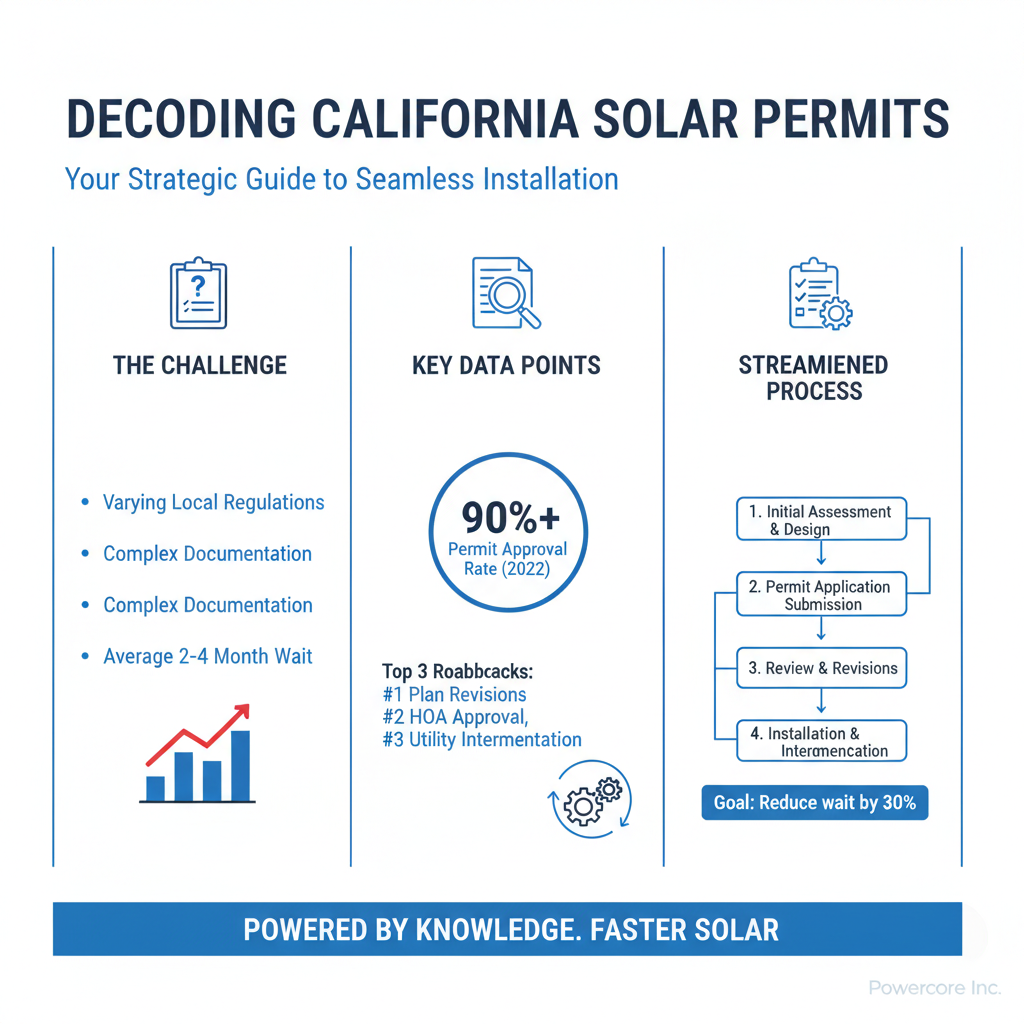
Timelines for California Solar Permits
The time it takes to secure a solar permit in California can vary significantly based on several factors:
- Jurisdiction: Cities and counties that have adopted SolarAPP+ can issue permits instantly or within days for eligible systems. Jurisdictions relying on manual review processes may take 2-6 weeks, or even longer if there's a backlog or complex issues.
- Completeness of Application: Incomplete or inaccurate applications are the leading cause of delays. Powercore Inc's thorough preparation minimizes this risk.
- System Complexity: Larger, more complex systems, especially those integrating battery storage or requiring significant structural modifications, often require more extensive review.
- Revisions: If the AHJ requests revisions, the review clock essentially restarts, adding days or weeks to the process.
- Inspection Scheduling: After the permit is issued, scheduling and passing inspections can add another 1-2 weeks before utility interconnection can be initiated.
On average, for a standard residential rooftop solar system without SolarAPP+, expect the permitting process from submission to final inspection to take approximately 4-8 weeks. With SolarAPP+, this can be drastically reduced to 1-3 weeks for applicable projects.
Navigating Potential Pitfalls and Delays
Even with the most streamlined processes, issues can arise. Powercore Inc helps you avoid these common pitfalls:
- Incomplete or Incorrect Applications: The most frequent cause of delays. Our attention to detail ensures your application is robust and accurate.
- Non-Compliance with Local Codes: Ignoring specific local zoning or fire safety rules can lead to rejections. Our team is well-versed in diverse California municipal codes.
- Structural Concerns: Unexpected structural issues with older roofs can necessitate additional engineering or reinforcement, adding time and cost.
- Utility Interconnection Issues: Sometimes, the utility company may have specific requirements or backlogs that can delay the final Permission to Operate.
- Unlicensed or Inexperienced Contractors: Choosing a contractor without proper licensing or a strong track record in California permits can lead to significant headaches, delays, and costly errors. Always verify licenses with the CSLB.
The Powercore Inc Advantage: Streamlining Your Solar Journey
At Powercore Inc, we understand that investing in solar is a significant decision, and the last thing you need is a protracted permitting process. Our expertise is your advantage:
- California-Specific Regulatory Mastery: With our base in Roseville and operations across all of California, we possess an unparalleled understanding of the state's diverse permitting requirements, from urban centers to rural communities.
- Dedicated Permitting Team: We have experienced professionals whose sole focus is navigating the permit landscape, ensuring your application is meticulously prepared and submitted correctly the first time.
- Dual Licensing for Seamless Projects: As a General B & C-10 Electrical Contractor, Powercore Inc offers a unique advantage. We can handle not only the electrical aspects of your residential solar installation but also any necessary structural modifications, roofing coordination, or remodels that might arise, simplifying communication and accelerating project completion.
- Proactive Problem Solving: We anticipate potential challenges and address them preemptively, minimizing revisions and delays.
- Transparent Communication: You'll be kept informed at every stage, understanding exactly where your project stands in the permitting queue.
Beyond Permits: What Happens After Approval?
Once your solar permit is secured, the excitement truly begins. Powercore Inc manages every subsequent step to bring your energy vision to life:
- Professional Installation: Our certified technicians install your solar panels, inverters, and any EV charging stations or battery systems with precision and adherence to the highest safety standards.
- Rigorous Inspections: We coordinate and facilitate all necessary inspections, ensuring your system meets local codes and passes with flying colors.
- Utility Interconnection & PTO: We handle the final paperwork with your utility company to secure Permission to Operate, officially activating your solar power.
- Ongoing Support: Our commitment extends beyond installation. We're here to answer questions, provide maintenance advice, and ensure your system performs optimally for decades to come.
Embrace the future of energy with confidence, knowing that Powercore Inc is your trusted partner from the very first permit application to the moment your home is powered by the California sun.
Conclusion: Your Path to Energy Independence with Powercore Inc
Navigating the permit process for solar installation in California doesn't have to be a barrier to achieving energy independence. While the regulations are in place for vital safety and compliance reasons, having an expert guide by your side makes all the difference. Powercore Inc stands as your reliable partner, equipped with the licenses, experience, and dedication to streamline every aspect of your solar journey, from the initial consultation to the final flip of the switch.
Don't let the complexities of California solar permits deter you from harnessing the power of the sun. With Powercore Inc, you gain access to unparalleled expertise, ensuring your project is compliant, efficient, and successfully completed. Ready to take the next step towards a sustainable and energy-independent future for your California home or business? Contact Powercore Inc today at 916-699-8778 to discuss your solar project and let us handle the permitting intricacies for you. Your brighter, cleaner energy future awaits.