

The Dawn of a New Solar Era for California Homes
California, a state synonymous with innovation and environmental leadership, stands on the cusp of a significant transformation in residential energy. As we accelerate towards 2026, the solar industry is buzzing with projections of unprecedented advancements in solar panel efficiency. For homeowners across the Golden State, this isn't just technical jargon; it represents a pivotal opportunity to redefine their energy independence, enhance property value, and contribute to a sustainable future.
At Powercore Inc, a dual-licensed General B & C-10 Electrical Contractor based in Roseville, CA, we believe in empowering homeowners with knowledge to make informed decisions. The landscape of solar energy is evolving rapidly, and understanding what solar panel efficiency 2026 means for your home is crucial. This comprehensive guide will explore the impending technological leaps, their tangible benefits for California residences, and how Powercore Inc is uniquely positioned to help you harness this next generation of clean energy.
Understanding Solar Panel Efficiency: The Basics and Beyond
Before we gaze into the future, let's establish a foundational understanding. Solar panel efficiency refers to the rate at which a solar panel converts sunlight into usable electricity. Expressed as a percentage, it indicates how much of the sun's energy hitting the panel is actually transformed into power for your home.
- Higher Efficiency = More Power: A more efficient panel can generate more electricity from the same amount of sunlight and space.
- Space Optimization: For homes with limited roof area, higher efficiency panels are invaluable, allowing you to maximize energy production within a smaller footprint.
- Faster ROI: Generating more power means greater savings on electricity bills and a quicker return on your initial investment.
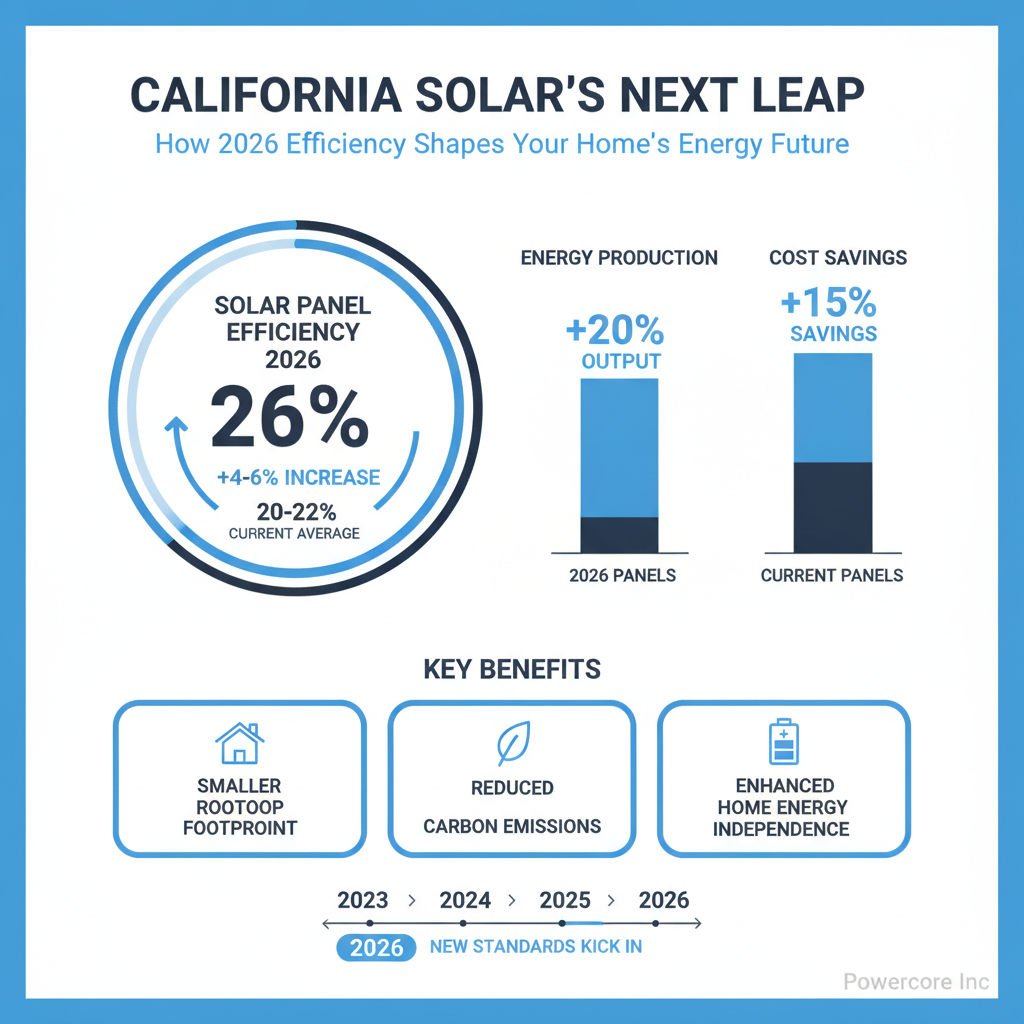
Today, standard residential solar panels typically boast efficiencies ranging from 17% to 20%. Premium panels can reach up to 22-23%. But what's coming by 2026 promises to push these boundaries significantly, fundamentally altering the economics and feasibility of solar for many California homeowners.
The Road to 2026: Unveiling Next-Generation Solar Technologies
The push for higher efficiency is driven by relentless innovation in materials science, engineering, and manufacturing. Several key technologies are on track to revolutionize the market by 2026, making current benchmarks seem modest:
Perovskite Solar Cells: A Game-Changer
Often hailed as the 'next big thing' in solar, perovskite materials offer incredible potential. These synthetic crystals are highly effective at absorbing light across a broad spectrum and converting it into electricity. Their advantages include:
- High Theoretical Efficiency: Researchers have already demonstrated perovskite cell efficiencies exceeding 25% in laboratory settings, with theoretical limits potentially much higher.
- Flexibility and Transparency: Perovskites can be processed into thin, flexible films, opening doors for integration into building materials, windows, and curved surfaces, beyond traditional rooftop panels.
- Low Manufacturing Cost: The production methods for perovskites are generally less energy-intensive and cheaper than traditional silicon, potentially driving down overall solar costs.
By 2026, we expect to see perovskite-silicon tandem cells entering the commercial market, combining the best features of both materials for unprecedented efficiency.
Tandem Cells and Multi-Junction Designs
The concept of stacking different solar cell materials, each optimized to capture a specific part of the solar spectrum, is gaining traction. Tandem cells, like those combining perovskite and silicon, can capture more energy by absorbing wavelengths that single-junction cells miss. This 'two-in-one' approach promises a substantial jump in overall panel efficiency, potentially reaching 28-30% in commercial applications by our target year.
Advances in Silicon-Based Technologies
While new materials emerge, traditional silicon isn't standing still. Innovations in silicon cell architecture continue to push boundaries:
- TOPCon (Tunnel Oxide Passivated Contact): An evolution of PERC technology, TOPCon cells improve passivation, reducing energy losses and boosting efficiency.
- HJT (Heterojunction Technology): Combining amorphous and crystalline silicon layers, HJT cells offer superior performance at higher temperatures and excellent bifacial capabilities (generating power from both sides).
- Bifacial Modules: These panels can capture sunlight from both their front and back sides, utilizing reflected light from rooftops or ground surfaces to increase total energy yield, especially beneficial in California's sunny environment.
These enhancements ensure that even without entirely new materials, silicon-based panels will continue to offer competitive and highly efficient solutions.
Quantum Dots and Concentrated Photovoltaics (CPV)
Further down the innovation pipeline, quantum dots – tiny semiconductor nanocrystals – are being explored for their ability to tune light absorption, potentially creating highly efficient and flexible solar films. Meanwhile, Concentrated Photovoltaics (CPV) systems, which use lenses or mirrors to focus sunlight onto small, high-efficiency cells, are becoming more refined, offering solutions for specific, high-irradiance applications.
Impact on California Homeowners: What 2026 Efficiency Means for You
For California residents, these technological advancements translate into tangible, exciting benefits:
Maximizing Output from Limited Space
California homes often contend with limited roof space, complex rooflines, or shading issues. Higher efficiency panels mean you can generate more power from a smaller array. This is critical for meeting your energy demands, especially if you're looking to electrify your home with an EV charging station or heat pump, without needing an expansive rooftop footprint.
Enhanced ROI and Faster Payback Periods
The core appeal of solar remains its financial return. More efficient panels generate more electricity, leading to greater savings on your monthly utility bills. This directly contributes to a quicker payback period for your solar investment. In California, where electricity rates continue to climb, maximizing self-generation becomes increasingly valuable.
Furthermore, these savings are amplified by ongoing incentives. For more details on how solar boosts your property's financial standing, explore Beyond the Bill: How California Solar Incentives Supercharge Your Home's Value.
Greater Energy Independence and Resilience
California faces unique challenges, from grid stability concerns to planned power outages. High-efficiency solar panels, when paired with robust battery storage systems, offer unprecedented energy independence. You'll generate more power to store, ensuring your home remains powered even when the grid goes down, reducing reliance on volatile utility rates.
Increased Home Value and Market Appeal
A home equipped with state-of-the-art, high-efficiency solar panels is a future-proof asset. As energy costs rise and environmental consciousness grows, a solar-powered home becomes significantly more attractive to potential buyers, commanding a higher resale value and distinguishing it in California's competitive real estate market.
Meeting California's Stringent Energy Goals
California leads the nation in aggressive clean energy mandates, including building codes like Title 24 that push for energy efficiency and solar integration in new construction. Higher efficiency panels make it easier for homes to meet and exceed these standards, aligning with the state's vision for a greener future and potentially unlocking additional benefits or compliance pathways.
Navigating the California Landscape: Regulations and Incentives
Understanding the technological shifts is only half the equation. California's unique regulatory and incentive environment plays a crucial role in maximizing your solar investment.
Net Energy Metering (NEM 3.0)
The recent transition to NEM 3.0 has shifted the financial dynamics of solar in California, emphasizing the value of battery storage and self-consumption. Under NEM 3.0, the export rate for excess solar electricity sent back to the grid is lower than under previous tariffs. This makes generating and storing as much of your own power as possible more critical than ever. High-efficiency panels are paramount here, as they allow you to maximize your self-generation, reducing your reliance on grid electricity and optimizing your savings.
State and Local Incentives: SGIP and Beyond
California offers robust programs to encourage solar adoption and, particularly, battery storage. The Self-Generation Incentive Program (SGIP) provides significant rebates for installing energy storage systems, helping homeowners affordably pair their high-efficiency solar with critical backup power. Powercore Inc can help you navigate these programs to maximize your financial benefits. Learn more about state incentives at California Battery Storage Incentives.
Federal Clean Energy Credit (ITC)
The federal Residential Clean Energy Credit, often referred to as the Investment Tax Credit (ITC), allows homeowners to claim a significant percentage (currently 30%) of the cost of their solar panel installation as a tax credit. This national incentive remains a powerful driver for solar adoption, making high-efficiency systems even more financially attractive. For the most current information, consult the IRS Residential Clean Energy Credit guidelines.
Beyond Panels: The Integrated Smart Home Ecosystem
The future of solar efficiency isn't just about the panels themselves; it's about how they integrate into a holistic, intelligent energy ecosystem within your home. By 2026, high-efficiency solar will be seamlessly connected with:
- Advanced Battery Storage: Essential for time-of-use (TOU) rate optimization and grid resilience, storing surplus power generated by your efficient panels.
- Smart Home Energy Management Systems: AI-powered platforms will learn your energy consumption patterns, automatically optimize solar generation and battery discharge, and even predict future energy needs.
- EV Charging Integration: Powering your electric vehicle directly from your high-efficiency solar array, turning your home into a personal, clean-energy fueling station.
- HVAC Optimization: Integrating solar power with high-efficiency HVAC systems, such as heat pumps, to ensure your home's climate control is as sustainable as possible.
This integrated approach allows homeowners to maximize the value of their high-efficiency solar, achieving true energy autonomy and significant long-term savings.
Choosing the Right Partner for Your Solar Future: Powercore Inc
Navigating the complexities of emerging solar technologies, California's unique regulations, and integrating a comprehensive home energy system requires expertise. This is where Powercore Inc stands out.
As a California dual-licensed General B (CSLB #1134334) and C-10 Electrical Contractor (CSLB #1098175), Powercore Inc offers unparalleled capabilities. Our general contractor license means we understand the entire home envelope – from roofing compatibility for new panel installations to structural considerations for battery storage. Our electrical contractor license ensures that all wiring, grid connections, and system integrations are performed to the highest standards of safety and efficiency.
We provide comprehensive solutions, including:
- Expert Consultation: Tailoring a solar and energy storage plan specifically for your home's needs and future goals, incorporating the latest in high-efficiency technology.
- Seamless Integration: Designing and installing systems that cohesively link your residential solar panels, battery storage, EV charging, and smart home controls.
- Future-Proofing Your Investment: Guiding you through the best choices for long-term performance and maximum ROI, considering upcoming efficiency advancements.
- Code Compliance & Incentives: Ensuring your system meets all California building codes and helping you access all available state and federal incentives.
With Powercore Inc, you're not just installing solar panels; you're investing in a sophisticated, resilient, and highly efficient energy future for your California home.
Preparing Your Home for 2026 and Beyond
The future of solar is bright, and proactive planning can ensure your California home is ready to embrace the next leap in efficiency:
- Assess Your Current Energy Needs: Understand your consumption patterns and anticipate future additions like EVs or electric appliances.
- Consider Energy Efficiency Upgrades: Before going solar, optimize your home's insulation, windows, and appliances to reduce overall energy demand.
- Plan for Integration: Think about how solar will integrate with battery storage, EV charging, and smart home systems from the outset.
- Consult with Trusted Experts: Engage with qualified professionals like Powercore Inc early in your planning process.
Conclusion: Powering California's Future with Powercore Inc
The projected advancements in solar panel efficiency 2026 are set to transform how California homeowners interact with their energy. Higher efficiency means more power, greater savings, enhanced resilience, and increased property value. As the solar landscape evolves, having a knowledgeable and experienced partner is paramount.
Powercore Inc is committed to bringing these cutting-edge solutions to your doorstep, ensuring your home is equipped with the most efficient, reliable, and future-ready solar energy system available. Don't just adapt to the future of energy – define it. Contact Powercore Inc today at 916-699-8778 or visit our contact page to schedule a consultation and take the next leap towards your home's energy independence.