

The Sun-Powered Dream in the Golden State
California, with its abundant sunshine and progressive energy policies, stands at the forefront of the solar revolution. For homeowners across the Golden State, installing solar panels is more than an environmental statement; it's a strategic financial investment, promising significant savings on electricity bills, increased home value, and energy independence. From the bustling urban centers of Los Angeles to the serene landscapes of Northern California, countless residences are harnessing the sun's power.
However, like any long-term investment, solar energy systems come with questions about their longevity and sustained performance. One of the most frequently asked, and often misunderstood, questions revolves around solar panel degradation rates. Homeowners naturally want to know: how long will my panels truly last, and how much power will they lose over time? This isn't just a technical detail; it's a critical factor in calculating your system's lifetime value and ensuring your investment continues to pay dividends for decades.
At Powercore Inc, a California dual-licensed General B and C-10 Electrical Contractor based in Roseville, CA, we believe in empowering homeowners with comprehensive knowledge. We’re here to demystify solar panel degradation, explain the factors that influence it, and, most importantly, equip you with proactive strategies to mitigate its effects, ensuring your California solar system delivers peak performance for its full lifespan.
Understanding Solar Panel Degradation: The Slow Decline
In simple terms, solar panel degradation refers to the gradual decrease in a solar panel's electricity-generating capacity over time. It's an inevitable physical process, much like how a car engine slowly loses efficiency or a battery's charge capacity diminishes with age. Solar panels are built to be incredibly durable, but constant exposure to the elements and the inherent physics of photovoltaic cells mean their output will not remain at 100% of its initial rating indefinitely.
The Science Behind the Slow Decline
Solar panels convert sunlight into electricity using photovoltaic (PV) cells, typically made from silicon. Over time, several microscopic changes occur within these cells and the panel's other components that contribute to degradation:
- Light-Induced Degradation (LID): This is an initial, often rapid, drop in performance that occurs within the first few hours or days of a panel's exposure to sunlight. It's a well-known phenomenon, and manufacturers typically account for it in their initial power ratings, meaning a 300W panel is rated after this initial dip.
- Potential-Induced Degradation (PID): High voltage differences between the PV cells and the grounded module frame can cause ions to migrate, reducing power output. Modern panels are often designed to be PID-resistant.
- Thermal Cycling: Repeated expansion and contraction of materials due to daily temperature fluctuations can lead to micro-cracks in the cells or delamination of the protective layers, compromising efficiency.
- UV Radiation: California's intense sunshine, while great for energy production, also exposes panels to strong ultraviolet (UV) radiation, which can degrade the encapsulant material (EVA) that protects the cells, leading to yellowing or clouding, and reducing light transmission.
- Moisture Ingress: Over time, seals can degrade, allowing moisture to penetrate the panel, which can lead to corrosion of electrical contacts and reduced performance.
Distinguishing Degradation from Performance Issues
It's important to differentiate between actual solar panel degradation and other factors that might temporarily reduce your system's output:
- Soiling/Dust: Accumulation of dust, dirt, pollen, or bird droppings, especially prevalent in certain parts of California, can significantly block sunlight. This is a temporary issue easily resolved with cleaning.
- Shading: New tree growth, antenna installations, or even nearby construction can cast shadows on panels, drastically cutting output.
- Equipment Malfunction: An inverter issue, a loose connection, or a faulty optimizer can reduce system performance, which is a repairable problem, not degradation of the panel itself.
- Seasonal Variations: Solar production naturally fluctuates with the seasons due to changes in sun angle, daylight hours, and temperature.
True degradation is a gradual, irreversible decline in the panel's inherent ability to convert sunlight, even under ideal conditions. Understanding this distinction is key to accurately assessing your system's health.
Key Factors Influencing Degradation Rates
While degradation is inevitable, its rate is not uniform. Several factors play a significant role in how quickly a solar panel's performance diminishes over time.
Inherent Material Properties & Manufacturing Quality
The quality of the materials used in the PV cells, encapsulants, backsheets, and frames, along with the precision of the manufacturing process, are paramount. Premium manufacturers often use higher-grade silicon, advanced encapsulation techniques, and robust frame designs that are more resistant to environmental stressors and internal degradation mechanisms. For instance, panels specifically engineered for PID resistance or with superior thermal management will naturally degrade slower.
Environmental Stressors in California
California's diverse climate presents unique challenges that can accelerate degradation:
- High Temperatures: While panels need sunlight, excessive heat actually reduces their efficiency. Prolonged exposure to high ambient temperatures, common in California's Central Valley and desert regions, can stress materials and accelerate thermal degradation.
- UV Exposure: California's intense sunshine means high UV radiation, which can break down polymeric materials like the EVA encapsulant and backsheet over time.
- Air Quality and Smog: Urban areas, particularly those prone to smog, can expose panels to airborne pollutants that contribute to soiling and may have long-term chemical effects on panel surfaces.
- Dust and Particulates: Arid regions and areas near agricultural activity or construction can experience significant dust accumulation, requiring more frequent cleaning to maintain optimal performance.
- Wildfires: While direct fire damage is catastrophic, smoke and ash can cause severe soiling and, in some cases, heat exposure that degrades panels.
- Coastal Conditions: Salt spray in coastal communities can be corrosive to metal frames and components if panels aren't specifically designed for marine environments.
Installation Quality & System Design
Even the best panels can underperform or degrade faster if not installed correctly. Proper ventilation beneath panels is crucial to prevent heat buildup. Correct wiring and grounding prevent issues like PID. A well-designed system, taking into account roof angles, shading analyses, and local environmental factors, ensures panels operate under optimal conditions, minimizing stress. Powercore Inc, with our General B and C-10 Electrical licenses, ensures every installation meets the highest standards of safety, efficiency, and longevity, tailored for California's specific conditions.
Maintenance & Monitoring Practices
Regular cleaning removes performance-sapping dust and debris. Proactive monitoring identifies potential issues like faulty components or unexpected drops in output early, allowing for timely intervention before minor problems become major ones that could accelerate degradation.
Typical Degradation Rates & Industry Standards
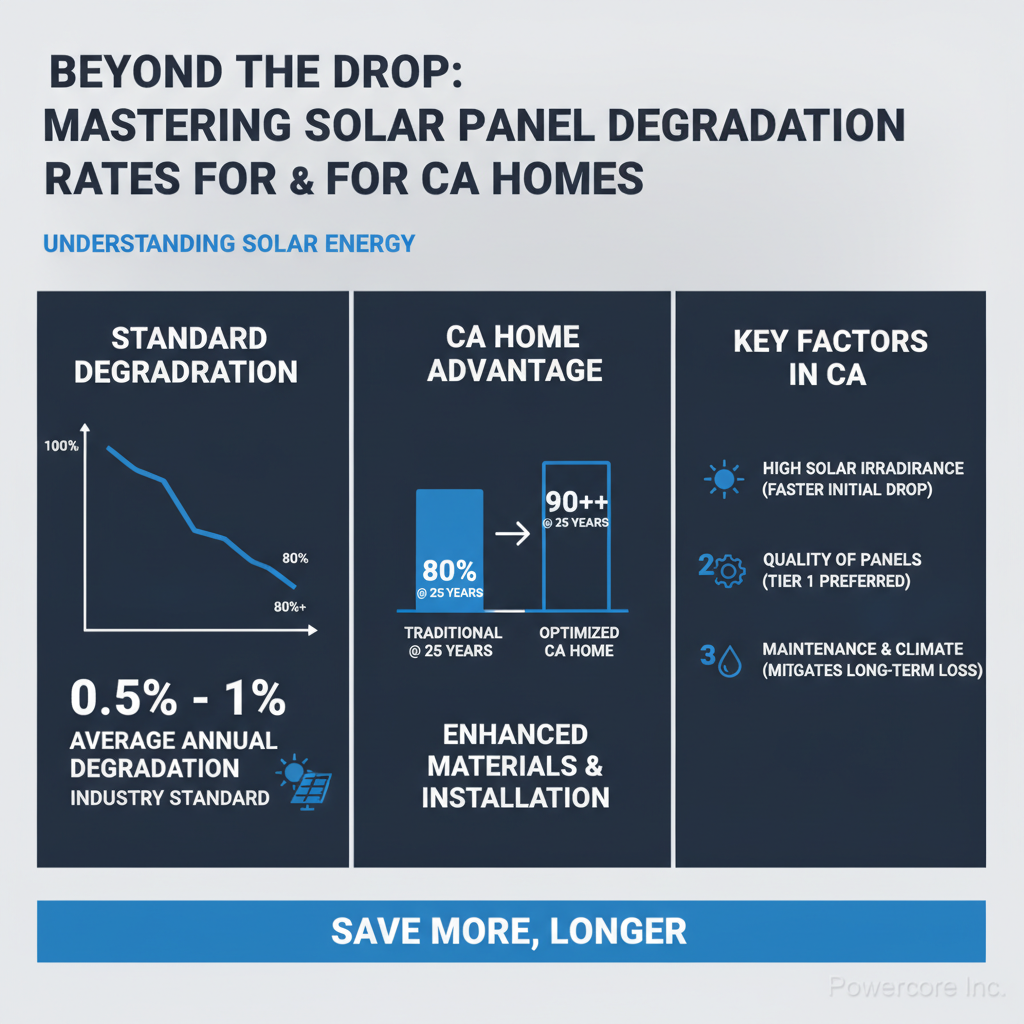
The good news is that modern solar panels are incredibly durable and come with robust warranties that reflect their expected lifespan and performance. The industry standard for solar panel degradation is remarkably low.
The "Linear Performance Warranty" Explained
Most reputable solar panel manufacturers offer a 25-year (and sometimes 30-year) linear performance warranty. This warranty typically guarantees that the panels will produce a certain percentage of their original rated power after a specified number of years. A common guarantee is:
- Year 1: No more than 2-3% degradation.
- Years 2-25: An annual degradation rate of 0.5% to 0.7%.
What this means in practice is that after 25 years, your solar panels are typically guaranteed to produce at least 80% to 87% of their original output. For example, a panel with a 0.5% annual degradation rate would still produce approximately 87.5% of its initial power after 25 years (100% - (25 years * 0.5% + 2.5% initial drop)). This long-term performance guarantee underpins the financial viability of solar investments.
How Different Panel Technologies Compare
- Monocrystalline Silicon Panels: These are currently the most common and efficient panels. They generally have very low degradation rates, often at the lower end of the 0.5% to 0.7% range, thanks to high-purity silicon and advanced manufacturing.
- Polycrystalline Silicon Panels: Slightly less efficient than monocrystalline, these older-generation panels may have marginally higher degradation rates, though still well within acceptable warranty limits.
- Thin-Film Panels: While offering flexibility and performing well in low light or high heat, some thin-film technologies historically had higher degradation rates. However, modern thin-film panels have significantly improved and can be very competitive.
The Role of Inverters and Optimizers in Mitigating Losses
It's not just the panels that impact long-term performance. The quality of your inverter system is equally crucial:
- String Inverters: These convert DC electricity from an entire string of panels into AC. If one panel degrades or is shaded, it can affect the output of the entire string. Their degradation rates are typically around 0.5% to 1% per year.
- Microinverters & Power Optimizers: These advanced technologies manage power at the individual panel level. This means if one panel degrades or is shaded, the performance of other panels in the system is not compromised. They also allow for panel-level monitoring, which is invaluable for identifying and addressing degradation or performance issues early. Their lifespan often matches or exceeds that of the panels, with warranties up to 25 years.
Calculating Your Long-Term Solar ROI in California
Understanding solar panel degradation rates is fundamental to accurately project your long-term return on investment (ROI). For California homeowners, where electricity rates are among the highest in the nation, even a slight decline in performance can impact savings over decades.
Beyond the Initial Savings: Lifetime Energy Production
When you invest in solar, you're buying decades of clean energy production. While the initial savings are attractive, the cumulative savings over 20-30 years are truly transformative. Degradation means your system will produce slightly less electricity each year, but this reduction is factored into professional ROI calculations. A well-designed 10 kW system, even with a 0.5% annual degradation, will still produce a substantial amount of power and savings throughout its warranty period and beyond.
The Impact of NEM (Net Energy Metering) Evolution on Long-Term Value
California's Net Energy Metering (NEM) policies have evolved, with NEM 3.0 introducing significant changes to how solar owners are compensated for excess energy sent back to the grid. While the new tariff structure places a greater emphasis on self-consumption and battery storage, understanding degradation remains crucial. A system that maintains higher output for longer will generate more power for direct use or battery charging, minimizing reliance on grid purchases and maximizing financial benefits under NEM 3.0. This makes mitigating degradation even more important for maximizing your investment under current California regulations.
Factoring in Maintenance and Potential Upgrades
When calculating ROI, it's wise to include anticipated maintenance costs (like cleaning or minor repairs) and potential future upgrades (e.g., battery storage addition) into your long-term projections. These proactive measures, though they incur costs, can significantly extend the effective life of your system and maximize its overall output, essentially mitigating the financial impact of degradation.
Proactive Strategies to Minimize Degradation and Maximize Lifespan
While degradation is inevitable, homeowners are not powerless. By making informed choices and adopting best practices, you can significantly slow the rate of degradation and ensure your solar investment in California performs optimally for decades.
Choosing the Right Panels for California's Climate
Not all solar panels are created equal. When selecting panels for your California home, consider:
- Manufacturer Reputation: Opt for panels from established manufacturers known for quality, reliability, and robust warranties.
- Temperature Coefficient: This metric indicates how much a panel's output decreases as its temperature rises. Lower temperature coefficients are better, especially in hot California regions.
- PID Resistance: Look for panels explicitly designed or certified as PID-resistant.
- Durability Certifications: Panels certified to withstand harsh conditions (e.g., high wind loads, salt mist corrosion for coastal areas) offer better long-term reliability.
- Encapsulant Quality: Advanced encapsulants are more resistant to UV degradation and moisture ingress.
Expert Installation by CSLB-Licensed Contractors
This is perhaps the most critical factor after panel selection. Proper installation directly impacts performance and longevity. A qualified contractor ensures:
- Optimal Tilt and Orientation: Maximizing sun exposure while considering local climate factors.
- Adequate Ventilation: Preventing heat buildup under panels, which can accelerate degradation.
- Secure Mounting: Protecting panels from wind and seismic events common in California.
- Correct Electrical Connections: Preventing issues like hot spots and ensuring proper grounding to avoid PID.
Powercore Inc holds both a General B (CSLB #1134334) and C-10 Electrical (CSLB #1098175) license in California, providing comprehensive, expert installation that adheres to the highest industry standards and local building codes. Our team understands the nuances of California's climate and energy landscape, ensuring your system is built to last.
Regular Cleaning and Maintenance
While not directly preventing degradation, regular cleaning ensures that your panels are always operating at their maximum potential, preventing performance losses that might be mistaken for accelerated degradation. In dusty regions of California, or after wildfire events, cleaning becomes even more critical. A professional cleaning every 6-12 months is often recommended.
Advanced Monitoring and Early Detection
Modern solar systems come with sophisticated monitoring platforms. These allow you to track your system's output in real-time, often down to the individual panel level (especially with microinverters or optimizers). Consistent monitoring helps you:
- Identify sudden drops: Which could indicate a faulty component rather than degradation.
- Track long-term trends: To verify that your system is degrading at the expected rate, not faster.
- Optimize performance: By identifying and addressing any issues promptly.
Understanding and Leveraging Warranties
Always review your solar panel product and performance warranties carefully. Know what they cover, for how long, and the process for making a claim. A strong warranty from a reputable manufacturer provides peace of mind and protection for your investment against unexpected or excessive degradation.
The Future of Solar Panel Longevity
The solar industry is continuously innovating, striving for even more durable and efficient panels. Researchers are exploring new materials and designs that promise even lower degradation rates and longer lifespans. Advancements in perovskite solar cells, tandem cell structures, and even self-cleaning coatings are on the horizon, hinting at a future where solar panels could maintain near-peak performance for 40-50 years or more.
Why Choose Powercore Inc for Your California Solar Investment
Navigating the complexities of solar energy, from understanding degradation rates to choosing the right technology and ensuring expert installation, requires a trusted partner. Powercore Inc is that partner for homeowners across all of California. Our dual licensing as a General B and C-10 Electrical Contractor means we offer unparalleled expertise in both construction and electrical systems, ensuring a seamless, high-quality installation from start to finish. We specialize in comprehensive energy solutions, including solar, battery storage, and EV charging, and integrate these with other home improvement services like HVAC, roofing, ADUs, remodels, siding, and decking.
We're not just installing panels; we're building long-term relationships and empowering California homes with sustainable, efficient, and resilient energy systems. Our commitment to quality, transparency, and customer satisfaction means you can invest in solar with confidence, knowing your system is optimized for longevity and maximum return on investment.
Conclusion: Powering Your California Future
Solar panel degradation is a natural process, but it's a manageable one. By understanding the factors involved, choosing high-quality components, and partnering with experienced professionals like Powercore Inc, you can significantly mitigate its impact and ensure your solar energy system delivers robust performance for decades. Your investment in solar is an investment in a cleaner, more sustainable, and financially independent future for your California home.
Ready to explore how a custom-designed solar solution can benefit your California home, with long-term performance and savings in mind? Contact the experts at Powercore Inc today for a personalized consultation. Call us at 916-699-8778 to start your journey towards energy independence with confidence and clarity.