

Introduction: Paving the Way for a Greener California
In an era defined by environmental consciousness and the urgent need for sustainable practices, homeowners across California are increasingly seeking ways to minimize their impact on the planet. The concept of a carbon footprint—the total greenhouse gas emissions caused by an individual, event, organization, or product—has moved from scientific discourse to everyday conversation. For many, reducing this footprint starts right at home.
California, a state synonymous with innovation and environmental leadership, offers a unique landscape for homeowners eager to embrace sustainable living. With abundant sunshine and forward-thinking policies, the Golden State is an ideal place to leverage renewable energy. Among the most impactful strategies for significant carbon footprint reduction is the adoption of solar power.
This comprehensive guide from Powercore Inc, your trusted California dual-licensed General B & C-10 Electrical Contractor, will explore how strategically integrating solar energy into your home not only dramatically cuts down your environmental impact but also offers substantial long-term benefits. We’ll delve into understanding your home’s carbon footprint, the undeniable power of solar, how to quantify its impact, and the holistic approaches you can take to build a truly sustainable future for your California property.
The Climate Imperative for California Homeowners
California faces unique environmental challenges, from wildfires to droughts, underscoring the critical need for every resident to contribute to climate solutions. Our state has set ambitious goals for reducing greenhouse gas emissions, aiming for net zero by 2045. As homeowners, our collective actions play a pivotal role in achieving these targets. Shifting away from fossil fuels, particularly in our energy consumption, is not just a regulatory push; it's a moral imperative and an investment in the health and future of our communities.
California's Commitment to Sustainability and Renewable Energy
California’s commitment to renewable energy is unparalleled. The state mandates that all new homes built since 2020 include solar panels, demonstrating a clear path towards a sustainable future. This forward-thinking approach, coupled with various incentives and programs, makes it easier and more economically viable than ever for existing homeowners to transition to solar. By choosing solar, you align your home with California's vision for a greener, more resilient energy landscape.
Understanding Your Home's Carbon Footprint
Before we can effectively reduce our carbon footprint, we must first understand what it is and how our homes contribute to it. It’s more than just driving a car; your home’s energy consumption is a major player in its overall environmental impact.
What Exactly is a Carbon Footprint?
A carbon footprint measures the total amount of greenhouse gases (GHGs), primarily carbon dioxide (CO2), emitted directly and indirectly by human activities. For a household, this includes emissions from:
- Electricity Consumption: The burning of fossil fuels (coal, natural gas) at power plants to generate the electricity you use. Even in California, where the grid is progressively cleaner, a significant portion of electricity still comes from non-renewable sources.
- Heating and Cooling: The use of natural gas furnaces, water heaters, and air conditioners. Natural gas combustion directly releases CO2 and other GHGs.
- Transportation: While not directly related to the home's structure, personal vehicle usage is a significant part of a household's overall footprint.
- Waste and Water: The energy used to treat and transport water, and the emissions from waste decomposition.
Focusing on electricity and heating/cooling offers the most immediate and substantial opportunities for reduction within the home itself.
How Homes Contribute to Global Emissions
Residential buildings are significant contributors to global greenhouse gas emissions. According to the U.S. Energy Information Administration (EIA), the residential sector accounts for a substantial portion of total energy consumption, much of which is still met by fossil fuels. In California, while the grid mix is cleaner than the national average, the sheer scale of energy demand means that every household's choice to go green has a magnified impact. Every kilowatt-hour of electricity generated from fossil fuels and every therm of natural gas burned contributes to atmospheric CO2 levels, accelerating climate change.
Solar Power: The Ultimate Decarbonization Tool
When it comes to making a tangible difference in your home's carbon footprint, solar power stands out as the most effective and accessible solution for California homeowners. It's a direct, clean energy source that fundamentally alters your relationship with the grid.
How Solar Eliminates Emissions at the Source
The beauty of solar energy lies in its simplicity and profound impact. Solar photovoltaic (PV) panels convert sunlight directly into electricity without burning any fuel or producing any greenhouse gas emissions during operation. This means that every kilowatt-hour of electricity your solar panels generate directly displaces a kilowatt-hour that would have otherwise come from the utility grid, potentially generated by fossil fuels.
- Clean Energy Production: Once installed, solar panels produce electricity silently and cleanly for decades.
- Reduced Reliance on Fossil Fuels: By generating your own power, you reduce the demand for electricity produced by coal, natural gas, and oil.
- Support for Grid Decarbonization: The more homes and businesses that adopt solar, the less pressure there is on utilities to build or maintain fossil fuel power plants, accelerating the transition to a fully renewable grid.
Addressing the Lifecycle Emissions of Solar Panels
It's fair to consider the carbon footprint associated with the manufacturing, transportation, and installation of solar panels. However, numerous studies have consistently shown that solar panels have a very favorable energy payback time and a low overall lifecycle carbon footprint.
- Energy Payback: Modern solar panels typically generate enough clean energy to offset the energy used in their manufacturing within 1 to 4 years. Considering that panels are warrantied to last 25 years or more, they produce net-positive clean energy for the vast majority of their lifespan.
- Recyclability: The solar industry is increasingly focused on recycling programs for end-of-life panels, further reducing their environmental impact.
- Continuous Improvement: Advances in manufacturing processes are continually reducing the energy and resource intensity of panel production.
When you weigh the minimal upfront emissions against decades of clean energy production, solar power emerges as a clear winner for carbon footprint reduction.
Quantifying Your Carbon Footprint Reduction with Solar
Understanding the theoretical benefits of solar is one thing; seeing the actual numbers of carbon footprint reduction is another. For California homeowners, the impact is significant and measurable.
Average Carbon Reductions for California Homes
The amount of carbon dioxide emissions reduced by a solar system depends on several factors, including the size of the system, the amount of sunlight it receives, and the carbon intensity of the local electricity grid it's offsetting. California's grid is becoming cleaner, but there's still a substantial benefit.
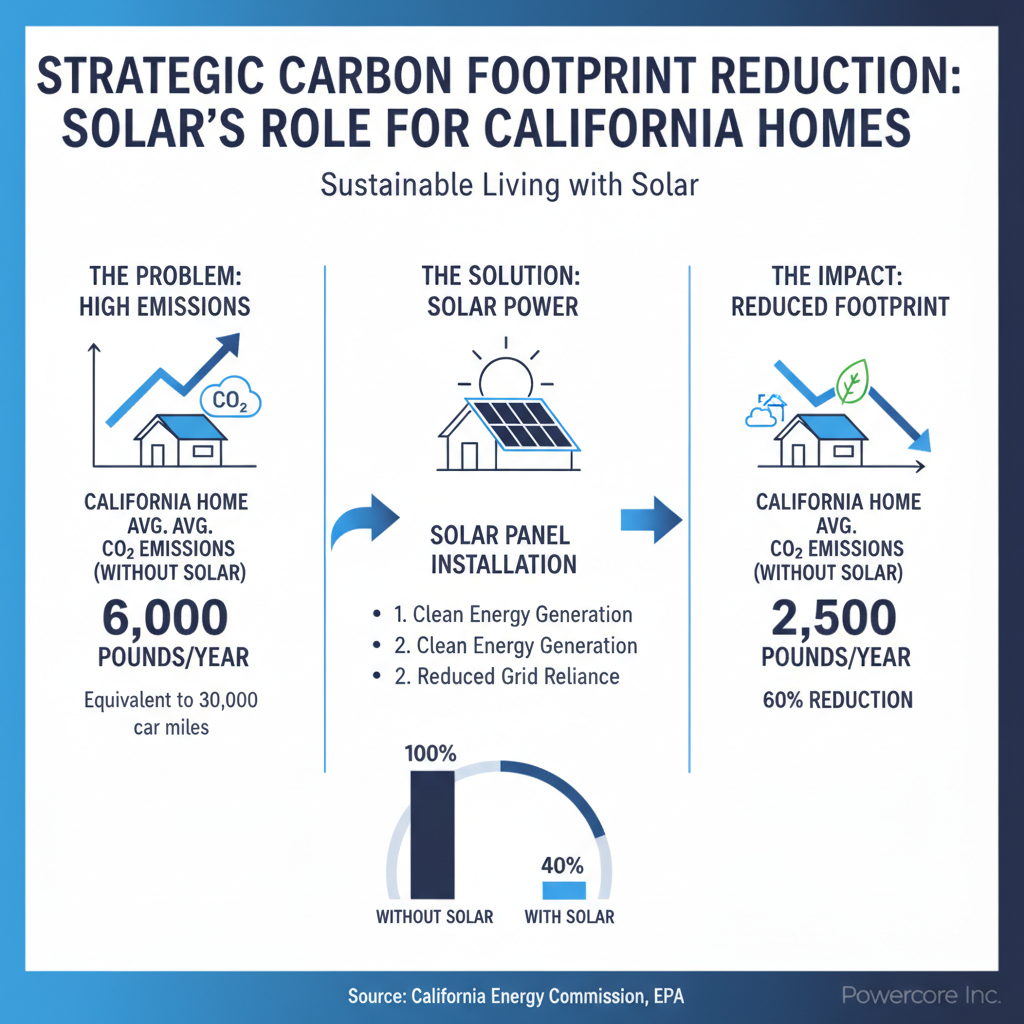
- Typical Home System: A standard 5-kilowatt (kW) solar system on a California home can produce approximately 7,500 to 8,500 kilowatt-hours (kWh) of electricity annually, depending on location and sun exposure.
- CO2 Offset: Based on the average carbon intensity of California's grid mix, a 5kW system can prevent the release of roughly 5 to 7 tons of CO2 into the atmosphere each year. To put that into perspective, that's equivalent to:
- Taking one to two cars off the road for a year.
- Planting hundreds of trees annually.
- Avoiding the emissions from burning thousands of pounds of coal.
Over a 25-year lifespan, a single residential solar system can prevent the emission of well over 100 tons of CO2. This is a profound contribution to climate action from a single household.
Calculating Your Home's Potential Impact
To estimate your home's specific carbon footprint reduction, Powercore Inc considers your average electricity consumption (from your utility bills) and the size of the solar system needed to meet that demand. We then use regional grid carbon intensity data to project your annual CO2 savings. Our experts can provide a personalized assessment, showcasing the tangible environmental benefits you’ll achieve.
Beyond Solar Panels: A Holistic Decarbonization Approach
While solar panels are the cornerstone of carbon footprint reduction, Powercore Inc understands that true sustainability often requires a multifaceted approach. As a comprehensive General B and C-10 Electrical Contractor, we offer a suite of services that complement solar, amplifying your home’s environmental benefits and energy independence across California.
Battery Storage: Ensuring 24/7 Clean Energy & Resilience
Solar panels produce electricity when the sun shines, but what about at night or during peak demand when the grid is dirtier? Integrating battery storage with your solar system is a strategic move for several reasons:
- Maximize Self-Consumption: Store excess solar energy generated during the day and use it in the evening, further reducing reliance on grid power and its associated emissions.
- Grid Independence: Lessen your dependence on the utility grid, especially during California's frequent Public Safety Power Shutoffs (PSPS) or other outages.
- Peak Shaving: Avoid drawing power from the grid during peak hours when electricity is most expensive and often generated by less efficient, higher-emission power plants.
Battery storage ensures that your commitment to clean energy extends around the clock, significantly enhancing your carbon footprint reduction with solar.
EV Charging: Fueling Clean Transportation at Home
Electric vehicles (EVs) are a critical component of California's decarbonization strategy. By installing an EV charging station at home, powered by your solar system, you extend your carbon footprint reduction efforts beyond your dwelling to your daily commute. Imagine driving on sunshine, knowing your transportation is virtually emission-free.
Energy-Efficient HVAC Systems: Cutting Heating & Cooling Emissions
Heating and cooling account for a large percentage of a home's energy use. Upgrading to modern, high-efficiency HVAC systems, particularly electric heat pumps, can dramatically reduce natural gas consumption and associated emissions. Heat pumps, which can both heat and cool, are highly efficient and can be powered by your solar energy, creating a truly decarbonized climate control solution.
Enhanced Insulation and Siding: Reducing Thermal Demand
Before generating your own energy, it's wise to ensure your home is as energy-efficient as possible. High-quality siding and superior insulation prevent heat loss in winter and heat gain in summer, reducing the workload on your HVAC system. This passive approach to energy efficiency means your solar system can be smaller, more cost-effective, and still meet your reduced energy demands, leading to an even lower overall carbon footprint.
ADUs and Remodels: Building Sustainably from the Ground Up
For those embarking on an ADU construction or a major home remodel, there’s an unparalleled opportunity to integrate sustainability from the design phase. Powercore Inc can help incorporate energy-efficient designs, materials, and systems from the outset, ensuring your new space or renovation is a model of environmental responsibility. This includes integrating solar, efficient windows, advanced insulation, and smart home technology for optimized energy use.
California's Leadership in Decarbonization: What Homeowners Need to Know
California continues to lead the nation in renewable energy adoption and climate policy. Understanding the regulatory landscape and available incentives is crucial for maximizing the benefits of your solar investment and carbon footprint reduction efforts.
State Mandates and Incentives for Solar Adoption
Beyond the federal Investment Tax Credit (ITC), which offers a significant percentage off the cost of your solar system, California has its own unique programs and regulations:
- Solar Mandate for New Construction: As mentioned, new residential construction in California must include solar PV systems, setting a high standard for energy efficiency.
- Net Energy Metering (NEM): This policy allows solar owners to send excess electricity back to the grid for credits, effectively using the grid as a battery. While NEM policies have evolved (e.g., NEM 3.0), they still provide financial incentives for solar adoption, making it easier to see a return on investment. Powercore Inc stays abreast of all California solar regulations to guide you through the process.
- Local Programs: Many cities and counties in California offer additional incentives or loan programs to encourage solar and energy efficiency upgrades.
Navigating these programs can be complex, but Powercore Inc's expertise ensures you take full advantage of every available incentive to make your transition to solar as cost-effective as possible.
Navigating NEM and Other Programs for Maximum Impact
The transition from NEM 2.0 to NEM 3.0 in California has shifted the financial landscape for solar owners. NEM 3.0 places a greater emphasis on self-consumption and battery storage to maximize savings, as export credit rates are now lower. This makes a holistic approach, combining solar with battery storage, even more critical for optimal carbon footprint reduction and financial returns.
Powercore Inc specializes in designing systems that are not only tailored to your energy needs but also optimized for California's specific regulatory environment. We ensure your solar + battery solution maximizes your environmental impact while providing robust energy independence and financial benefits.
Powercore Inc: Your Strategic Partner for a Greener California
Embarking on a journey to reduce your home's carbon footprint with solar is a significant decision. You need a partner with unparalleled expertise, a proven track record, and a deep understanding of California's unique energy landscape. Powercore Inc is that partner.
Why Powercore Inc Stands Out as California's Expert
As a California dual-licensed General B & C-10 Electrical Contractor (CSLB #1134334 and #1098175), Powercore Inc brings a level of comprehensive expertise that few can match. Our dual licensing means we are qualified to handle not just the electrical aspects of your solar installation but also any general construction needs, such as roofing, structural modifications, or even entire ADU projects that integrate seamlessly with your sustainable energy goals. This holistic capability ensures a streamlined, efficient, and high-quality installation process from start to finish across our extensive California service area.
Our team comprises seasoned professionals who are passionate about sustainable living and dedicated to providing tailored solutions. We don't just install solar panels; we design integrated energy systems that consider your entire home's energy consumption, future needs (like EV charging), and your specific goals for carbon footprint reduction.
Our Commitment to California's Sustainable Future
Powercore Inc is more than a contractor; we are an active contributor to California’s sustainable future. We believe that every solar installation, every battery storage system, and every energy-efficient upgrade brings us closer to a cleaner, more resilient state. Our commitment extends to providing exceptional customer service, transparent communication, and installations that stand the test of time, ensuring your investment in sustainability yields decades of benefits.
Conclusion: Powering a Sustainable Tomorrow, Today
Reducing your home's carbon footprint with solar is one of the most impactful decisions you can make for the environment, for your finances, and for the future of California. It's a strategic move that aligns personal values with tangible environmental action, leveraging the abundant sunshine and forward-thinking policies of our state.
By choosing solar, you're not just installing panels; you're investing in a cleaner energy grid, enhancing your home's resilience, and setting a powerful example for your community. When combined with other energy-efficient upgrades and technologies like battery storage and EV charging, your home becomes a beacon of sustainable living.
Are you ready to make a significant impact on your carbon footprint and embrace a greener lifestyle? Let Powercore Inc be your guide. As California's leading experts in solar, battery storage, and comprehensive home energy solutions, we're here to help you design and implement the perfect system for your home, anywhere in California. Contact us today for a personalized consultation and take the first step towards a sustainable future. Call us at 916-699-8778 or visit our website to learn more about how we can help you achieve your carbon footprint reduction goals.