

Introduction: Guarding Your Golden State Solar Investment
California homeowners have embraced solar power with unparalleled enthusiasm, transforming countless rooftops into clean energy generators. Your solar system represents a significant investment, promising substantial energy savings, a reduced carbon footprint, and enhanced property value. However, like any sophisticated technology, solar panels and their accompanying components are not entirely 'set-it-and-forget-it.' Over time, various factors can contribute to what’s known as solar performance degradation – a gradual reduction in your system's energy output. This degradation often goes unnoticed by the casual observer, silently eroding your savings and diminishing your return on investment.
At Powercore Inc, a dual-licensed General B & C-10 Electrical Contractor based in Roseville, CA, we understand the critical importance of maintaining your solar investment. Our expertise extends beyond initial installation to ensuring your system performs optimally for its entire lifespan, especially in California's diverse and sometimes challenging environments. This comprehensive guide will delve into the often-overlooked aspects of solar performance degradation, providing California homeowners with strategic diagnostic insights to identify and prevent these issues, safeguarding your energy independence and financial gains.
Understanding Solar Performance Degradation: What It Is and Why It Matters
Solar performance degradation refers to the natural and sometimes accelerated decline in a solar panel's ability to convert sunlight into electricity over time. While a slight annual degradation (typically 0.5% to 1% per year) is expected and accounted for in manufacturer warranties, anything beyond this rate can signify underlying issues that require attention. Failing to address these problems can lead to significant financial losses due to reduced energy production and higher utility bills, directly impacting your system's long-term viability and return on investment (ROI).
Common & Not-So-Common Causes of Degradation
Beyond the expected wear and tear, several factors can contribute to accelerated degradation. Some are visible, others are hidden, requiring a strategic diagnostic approach to uncover:
- Soiling and Debris Accumulation: Dust, pollen, bird droppings, leaves, and other environmental debris can block sunlight from reaching the solar cells. While a common issue, its impact can be surprisingly significant, especially in California's dusty valleys or coastal regions.
- Shading: Even partial shading from growing trees, new construction, or even dirt on a single cell can drastically reduce the output of an entire string of panels. Dynamic shading, which changes throughout the day or season, is particularly insidious.
- Micro-Cracks: Hairline fractures in the silicon cells, often invisible to the naked eye, can occur during manufacturing, transportation, installation, or due to thermal cycling (expansion and contraction). These micro-cracks can lead to 'dead spots' and reduced power output.
- Potential Induced Degradation (PID): A phenomenon where high voltage differences between the solar cells and the grounded module frame, particularly in humid environments, can cause a loss of power output. Older panels or those without PID-resistant technology are more susceptible.
- Inverter Issues: The inverter is the brain of your solar system, converting DC electricity from your panels into usable AC power. Malfunctions, efficiency losses, or complete failure of the inverter can severely impact or halt energy production.
- Wiring and Connection Problems: Loose connections, corroded wiring, or damaged conduits can create resistance, leading to power loss, inefficiencies, and even safety hazards.
- Module Mismatch: If panels within a string have different performance characteristics (e.g., due to manufacturing variations, damage, or degradation rates), the weaker panel can drag down the performance of the stronger ones.
- Environmental Stress: California's intense UV radiation, high temperatures, and temperature fluctuations can accelerate material degradation, affecting the panel's encapsulant, backsheet, and even the solar cells themselves over time.
- Animal Damage: Pests like rodents and birds can nest under panels, chewing through wires or accumulating debris that causes hot spots and fire risks.
The California Context: Unique Challenges for Solar Longevity
Operating a solar system in California comes with its own set of environmental and regulatory considerations that can influence system degradation:
- Dust and Air Quality: Central Valley and desert regions experience significant dust accumulation, especially during dry seasons, while wildfire smoke can leave a persistent film across the state. These factors lead to increased soiling rates.
- High Temperatures: While sunny, California's intense summer heat can reduce panel efficiency. Solar panels operate less efficiently as their temperature rises, and prolonged exposure to high temperatures can accelerate material degradation.
- Wildfire Risk: Beyond smoke, the risk of wildfires can necessitate system shutdowns or even damage, requiring thorough post-event inspections.
- Grid Demands & NEM Changes: With evolving net metering policies (like NEM 3.0), maximizing self-consumption and ensuring peak system performance becomes even more critical for financial returns. Any degradation directly impacts your ability to offset rising utility costs.
- Seismic Activity: While rare, seismic events can potentially cause micro-cracks or structural shifts, necessitating careful inspection.
Understanding these unique challenges is the first step toward implementing a strategic diagnostic and maintenance plan for your California solar system.
Strategic Diagnostics: The Powercore Inc Approach to Preventing Degradation
Preventing solar performance degradation requires a proactive and strategic approach that goes beyond occasional cleaning. It involves a combination of regular monitoring, advanced diagnostic techniques, and expert intervention. Powercore Inc, as a leading C-10 Electrical Contractor, offers comprehensive diagnostic services designed to identify and rectify issues before they significantly impact your system's output and your wallet.
1. Performance Monitoring and Data Analysis
Modern solar systems often come with monitoring platforms that track energy production in real-time. This is your first line of defense. Regularly reviewing your system's output data allows you to:
- Identify Anomalies: A sudden drop in production, or a consistent underperformance compared to expected output based on weather conditions, is a clear red flag.
- Track Degradation Rate: By comparing annual production figures, you can monitor your system's actual degradation rate against the manufacturer's specified rate.
- Pinpoint Time-Specific Issues: Data can reveal if performance dips at certain times of day (suggesting shading) or during specific seasons.
While monitoring provides the 'what,' advanced diagnostics help uncover the 'why.'
2. Visual Inspections: The Expert Eye
A trained eye can spot many issues that might be missed by a homeowner. Powercore Inc technicians conduct thorough visual inspections, looking for:
- Physical Damage: Cracks in glass, delamination (separation of layers), discoloration (yellowing or browning), burn marks, or signs of animal damage (chewed wires, nests).
- Mounting Integrity: Loose panels, rust on mounting hardware, or signs of roof wear.
- Wiring and Conduit Health: Fraying wires, exposed conductors, damaged conduits, or improper wire management.
- Shading Sources: New tree growth, antenna installations, or adjacent construction that might be casting shadows.
3. Thermal Imaging: Uncovering Hidden Hot Spots
Thermal imaging using infrared cameras is an invaluable diagnostic tool. It allows technicians to 'see' heat signatures on solar panels. Overheating or 'hot spots' can indicate several underlying problems:
- Cell Malfunctions: Damaged or defective cells can generate excessive heat.
- Micro-Cracks: Areas around micro-cracks often heat up due to increased electrical resistance.
- Bypass Diode Failure: Diodes protect panels from hot spots; a faulty diode can lead to isolated overheating.
- Soiling or Shading: Severely soiled or shaded sections can also appear hotter as they struggle to produce power, dissipating energy as heat.
Thermal imaging is non-invasive and highly effective at identifying problematic areas that require further investigation, often long before they become visible to the naked eye or cause a significant drop in overall system output.
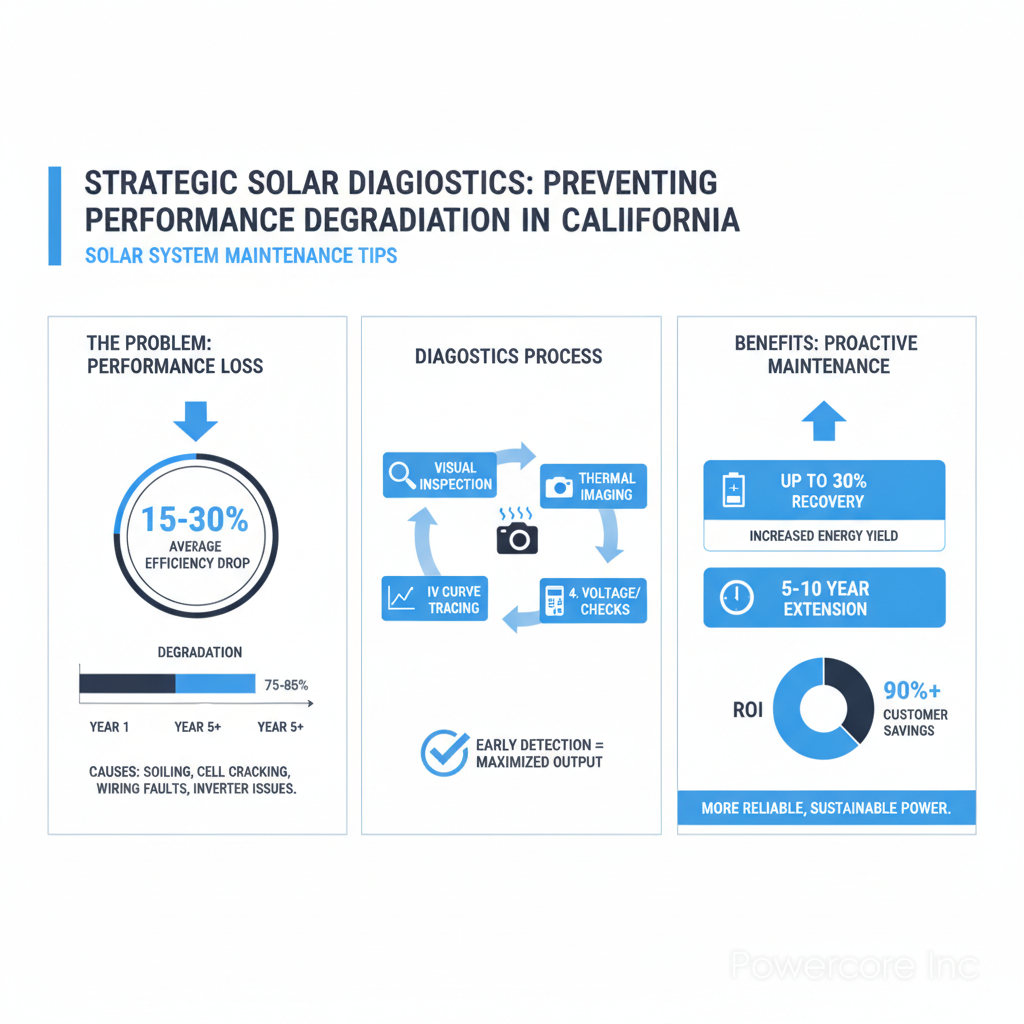
4. IV Curve Tracing: The Panel's Fingerprint
An IV (Current-Voltage) curve tracer measures the electrical characteristics of individual solar panels or strings. This sophisticated diagnostic method provides a 'fingerprint' of the panel's performance, revealing its maximum power point, open-circuit voltage, and short-circuit current. By comparing these measurements to the manufacturer's specifications or previous readings, Powercore Inc experts can diagnose:
- Degradation Rate: Precise measurement of how much power a panel is losing.
- Module Mismatch: Identifying underperforming panels within a string.
- Internal Cell Damage: Subtle issues that affect the panel's electrical behavior.
- PID Effects: Quantifying the power loss due to potential induced degradation.
IV curve tracing is particularly useful for identifying issues that aren't visible and provide definitive data on a panel's actual condition.
5. Electroluminescence (EL) Testing: Seeing Inside the Cells
EL testing is perhaps the most advanced and revealing diagnostic technique. It involves running a small current through a solar panel in the dark, causing the silicon cells to emit infrared light. A specialized camera captures this emission, revealing the internal structure of the cells. EL images can precisely identify:
- Micro-Cracks: Even the smallest, invisible cracks become apparent.
- Broken Fingers: Damage to the metallic contacts on the cell surface.
- Defective Cells: Cells that are not emitting light or have irregular patterns.
- Solder Joint Defects: Issues with the connections between cells.
- PID Effects: Areas affected by potential induced degradation appear darker.
While often used in manufacturing quality control, EL testing is increasingly vital for diagnosing severe or persistent performance issues in deployed systems, offering an unparalleled view into the health of individual solar cells.
6. Inverter and Electrical System Health Checks
The inverter is a critical component, and its health directly impacts system performance. Powercore Inc technicians conduct thorough checks including:
- Firmware Updates: Ensuring the inverter software is up-to-date for optimal efficiency and security.
- Voltage and Current Measurements: Verifying that input and output levels are within manufacturer specifications.
- Connection Integrity: Checking all DC and AC connections for tightness, corrosion, and proper insulation.
- Grounding and Arc Fault Detection: Ensuring safety features are functioning correctly, which can also indicate wiring issues.
- Battery Storage Integration: For systems with battery backup, ensuring seamless communication and charging/discharging cycles.
The Impact of Neglecting Degradation on Your California Home
Ignoring signs of solar performance degradation can have several detrimental effects, particularly for California homeowners reliant on their solar investment:
- Financial Losses: Reduced energy production means higher reliance on grid power, leading to increased utility bills and a slower return on your initial solar investment. With evolving NEM policies, maximizing self-consumption is paramount, making every watt of lost production more expensive.
- Reduced System Lifespan: Unaddressed issues like hot spots, micro-cracks, or inverter malfunctions can accelerate wear and tear on components, potentially leading to premature system failure and costly replacements.
- Environmental Impact: A underperforming solar system isn't offsetting as much carbon as it could, diminishing your contribution to California's clean energy goals.
- Property Value: While solar generally boosts property value, a poorly performing or neglected system can become a liability during resale, or at least fail to provide the expected premium.
- Warranty Voidance: Some manufacturer warranties require regular maintenance or professional inspection to remain valid. Neglecting your system could jeopardize your coverage.
Proactive Maintenance Schedule for California Solar Systems
To prevent significant performance degradation, Powercore Inc recommends a proactive maintenance schedule for California homeowners:
- Monthly: Review your system's online monitoring data for any unusual drops in production. Note any new potential shading sources.
- Quarterly/Bi-Annually: Conduct visual inspections from the ground (if safe) for obvious debris, damage, or animal activity. Consider professional cleaning, especially after dusty periods or wildfires.
- Annually (Professional Check-up): Schedule a comprehensive diagnostic inspection with a licensed professional like Powercore Inc. This should include:
- Detailed visual inspection of panels, racking, and wiring.
- Performance testing (e.g., using string current/voltage measurements).
- Inverter health check and firmware update.
- Assessment of potential shading changes.
- Minor debris removal.
- Every 3-5 Years (Advanced Diagnostics): Consider more in-depth diagnostics like thermal imaging or IV curve tracing, especially if your monitoring data indicates persistent underperformance or if your system is approaching its 10-year mark.
Why Choose Powercore Inc for Your Solar Diagnostics?
When it comes to protecting your solar investment, expertise and reliability are paramount. Powercore Inc is a California dual-licensed General B & C-10 Electrical Contractor (CSLB #1134334 and #1098175), bringing unparalleled experience to every solar project. Our team of certified electricians and solar specialists is equipped with the advanced diagnostic tools and in-depth knowledge necessary to identify even the most subtle signs of performance degradation.
We don't just fix problems; we provide strategic solutions that ensure your solar system delivers peak performance for decades. From routine maintenance to complex troubleshooting and repairs, Powercore Inc is your trusted partner for maximizing your solar ROI across all of California.
Conclusion: Strategic Longevity for Your California Solar Investment
Your solar system is a powerful asset, but its full potential can only be realized through diligent care and strategic diagnostics. Understanding and proactively addressing solar performance degradation is key to ensuring your California home continues to benefit from clean, affordable energy for years to come. Don't let hidden issues silently diminish your investment. With advanced diagnostic techniques and the expert care of Powercore Inc, you can confidently maintain your system's efficiency, extend its lifespan, and continue to enjoy maximum savings.
Ready to ensure your solar system is performing at its absolute best? Contact Powercore Inc today for a comprehensive solar diagnostic assessment. Protect your investment and maximize your energy savings throughout California. Call us at 916-699-8778 or visit gopowercoreinc.com to schedule your service.