

Mastering California’s Energy Puzzle with Solar Battery Arbitrage
California, a beacon of innovation and sustainability, also grapples with one of the nation's most complex and often highest electricity costs. For homeowners across the Golden State, navigating fluctuating energy prices and understanding intricate utility billing can feel like a daunting challenge. This is particularly true with the widespread adoption of Time-of-Use (TOU) rate plans, where the cost of electricity changes dramatically throughout the day.
Imagine a world where you don't just react to these price shifts but proactively leverage them to your advantage. This is the promise of Time-of-Use (TOU) arbitrage with solar batteries – a sophisticated yet increasingly accessible strategy that empowers California homeowners to take control of their energy expenses, enhance grid independence, and contribute to a more sustainable future. At Powercore Inc, a dual-licensed General B & C-10 Electrical Contractor based in Roseville, CA, we specialize in helping homeowners across the entire state unlock these exact savings, transforming their homes into smart, resilient energy hubs.
In this comprehensive guide, we'll delve deep into the mechanics of TOU arbitrage, explore its profound benefits for California residents, and walk you through the considerations for integrating this powerful solution into your home. Get ready to turn your home into an active participant in California's energy market, optimizing your consumption and maximizing your savings.
Understanding California’s Time-of-Use (TOU) Rates
To truly appreciate the power of TOU arbitrage, it’s essential to first understand the landscape of California’s electricity pricing. Unlike traditional flat-rate billing, TOU plans, mandated for most new solar installations under Net Energy Metering (NEM) 3.0 and increasingly common for all utility customers, divide the day into different pricing periods. These periods are typically categorized as:
- Off-Peak: When electricity demand is lowest (e.g., late night, early morning, midday on weekdays). Prices are the cheapest.
- Partial-Peak: Transitional periods with moderate demand (e.g., late morning, early evening). Prices are higher than off-peak.
- On-Peak: When electricity demand is highest (e.g., late afternoon to early evening, typically 4 PM to 9 PM). Prices are the most expensive, sometimes several times higher than off-peak rates.
Utilities like Pacific Gas and Electric (PG&E), Southern California Edison (SCE), and San Diego Gas & Electric (SDG&E) implement TOU rates for several critical reasons:
- Grid Stability: By incentivizing customers to shift energy use away from peak demand times, utilities can reduce strain on the grid, preventing blackouts and brownouts.
- Infrastructure Investment: Managing peak demand can defer the need for costly new power plants or grid upgrades.
- Encouraging Renewable Energy Integration: TOU rates can be structured to encourage consumption during periods of high solar generation (midday), aligning with California’s clean energy goals.
While TOU rates aim to balance the grid, they can lead to significantly higher electricity bills for homeowners who aren't mindful of their energy usage patterns. A simple act like running your washing machine during peak hours can cost you substantially more than doing it off-peak. This is where solar battery storage becomes not just a convenience, but a strategic financial tool.
The Power of Solar Battery Storage: Beyond Backup
For years, solar panels have been a cornerstone of sustainable living in California. They capture the sun’s abundant energy and convert it into clean electricity for your home. However, the sun doesn't always shine when your energy needs are highest, and traditional grid-tied solar systems primarily feed excess power back to the grid, often at a lower credit rate than what you pay for consumption.
This is where solar battery storage enters the picture, transforming a passive solar system into an intelligent energy management hub. A solar battery system works by:
- Storing Excess Solar: When your solar panels generate more electricity than your home is currently using (e.g., during midday when you're at work), instead of exporting it all to the grid, the excess power is directed to your battery for storage.
- Charging from the Grid (Strategically): During off-peak hours when grid electricity is cheapest, your battery can be programmed to draw power from the grid and store it. This is a crucial component of TOU arbitrage.
- Discharging When Needed: When your home’s demand is high, or during expensive on-peak hours, the battery discharges its stored energy to power your home, reducing or eliminating your reliance on expensive grid electricity.
While backup power during outages is a compelling benefit of battery storage, its capabilities extend far beyond simply keeping the lights on. For California homeowners, the true financial advantage often lies in its ability to actively participate in energy markets through strategies like Time-of-Use arbitrage.
Time-of-Use Arbitrage Explained: Your Smart Energy Strategy
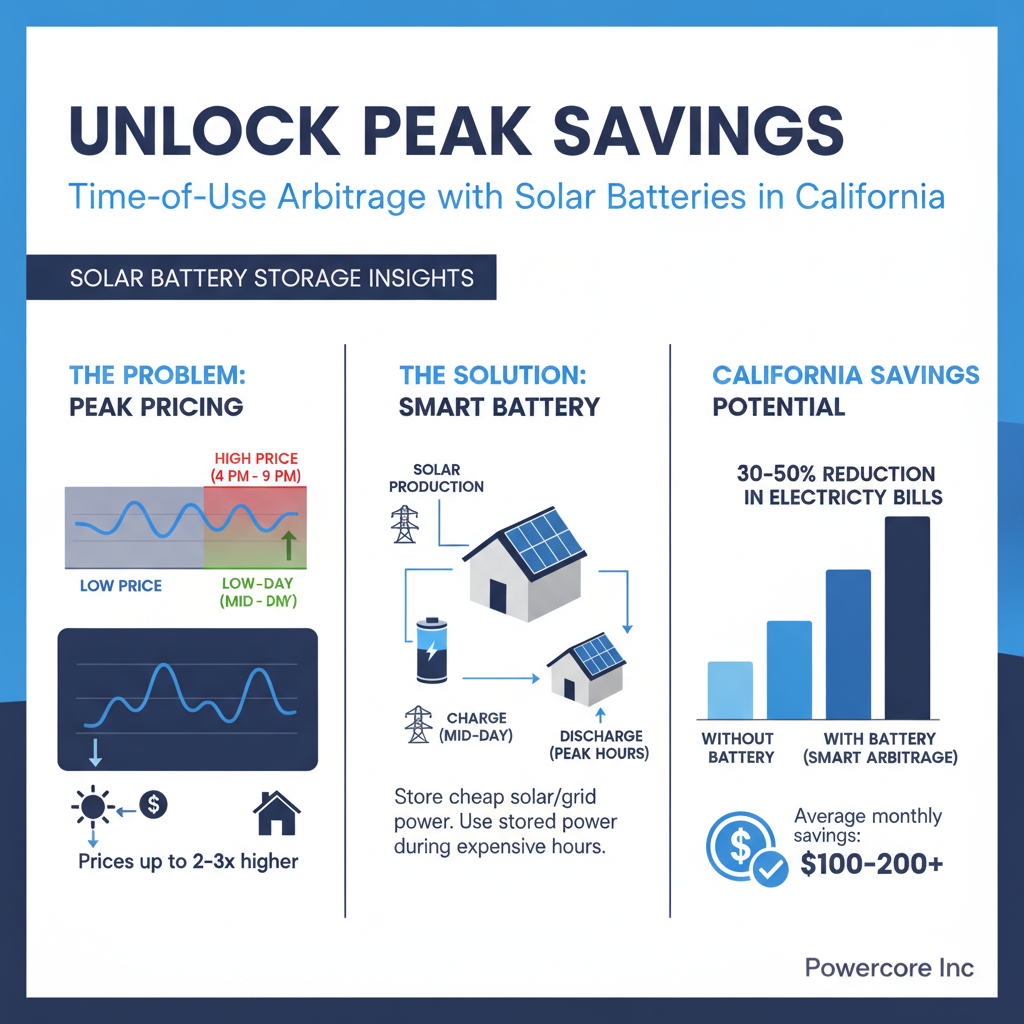
At its core, Time-of-Use arbitrage is an economic strategy that involves buying a commodity when its price is low and selling or using it when its price is high, thereby profiting from the price difference. In the context of home energy, your solar battery acts as your personal energy bank, allowing you to "buy" (store) cheap energy and "sell" (use) it to avoid buying expensive energy.
How TOU Arbitrage Works in Practice:
- Off-Peak Charging: During late night or early morning hours, when your utility’s electricity rates are at their lowest (off-peak), your battery system is programmed to either charge using your solar panels (if available) or, crucially, draw power directly from the grid. This is your opportunity to store energy at wholesale-like prices.
- Midday Solar Maximization: Throughout the day, especially during sunny midday hours, your solar panels generate electricity. This power first serves your home's immediate needs, and any surplus is directed to fully charge your battery, further reducing reliance on the grid.
- On-Peak Discharging: As the late afternoon approaches and utility rates transition to expensive on-peak periods (e.g., 4 PM to 9 PM for many California utilities), your smart battery system automatically switches to discharge mode. Instead of drawing costly electricity from the grid, your home is powered by the cheap energy stored in your battery. This significantly reduces your utility bill by avoiding the highest rates.
Consider this analogy: You wouldn't buy groceries at premium prices if you knew you could get the same items for a fraction of the cost later in the day. Your solar battery performs this exact function for your electricity. By strategically shifting your energy consumption from expensive peak hours to cheaper off-peak hours, you effectively hedge against fluctuating utility rates, creating a predictable and significantly lower energy bill.
Modern battery systems are equipped with intelligent energy management software that learns your home’s consumption patterns, anticipates solar production, and monitors real-time utility rates. This allows for automated, optimized arbitrage, ensuring your battery is always working to maximize your savings without you needing to manually adjust settings.
Beyond Arbitrage: The Multifaceted Benefits of Battery Storage
While Time-of-Use arbitrage offers compelling financial advantages, solar battery storage systems provide a host of other benefits that make them a wise investment for California homeowners.
Uninterrupted Power During Outages
California is unfortunately no stranger to power outages, whether due to wildfires, extreme weather, or planned Public Safety Power Shutoffs (PSPS). A solar battery system, when properly configured with a critical load panel, ensures that essential appliances and circuits (refrigerators, lights, internet, medical devices) remain operational during grid disruptions, offering peace of mind and enhanced home resilience.
Maximizing Solar Self-Consumption
Under California’s Net Energy Metering (NEM) 3.0, the value of exporting excess solar power back to the grid has significantly decreased for many homeowners. Batteries allow you to store your self-generated solar energy for later use, dramatically increasing your self-consumption rate. This means you're using more of the power you generate, rather than selling it back at a lower credit and buying it back at a higher retail rate.
Reduced Grid Dependence and Energy Independence
By generating, storing, and strategically using your own power, you become less reliant on the utility grid. This not only translates to lower bills but also provides a greater sense of energy independence and control over your home's power supply.
Environmental Impact and Sustainability
Utilizing stored solar energy, especially during peak hours when the grid often relies on dirtier peaker plants, reduces your carbon footprint. By stabilizing demand and integrating more renewables, you directly contribute to California’s ambitious clean energy goals.
Access to Valuable Incentives
Investing in solar battery storage can unlock significant financial incentives. The federal Investment Tax Credit (ITC) allows homeowners to claim a percentage of the cost of their solar-plus-storage system as a tax credit. Additionally, California has historically offered programs like the Self-Generation Incentive Program (SGIP), which provides rebates for battery storage. While programs evolve, Powercore Inc stays abreast of the latest incentives to help you maximize your investment.
Is Time-of-Use Arbitrage Right for Your California Home? Factors to Consider
While the benefits are clear, determining if a solar battery system for TOU arbitrage is the right fit for your specific California home requires a personalized assessment. Here are key factors Powercore Inc considers during our expert consultation:
Your Utility's TOU Rate Structure
The potential for savings through arbitrage is directly tied to the difference between your utility’s on-peak and off-peak rates. Homes in areas with a significant price spread (e.g., SDG&E’s often higher peak rates) will see greater financial benefit. Our team can analyze your specific utility bill and rate plan to project potential savings.
Daily Energy Consumption Patterns
Do you consistently use a lot of electricity during peak hours (e.g., running AC after work, cooking dinner, charging EVs)? If your consumption naturally aligns with expensive periods, a battery system for arbitrage will offer substantial relief.
Existing Solar System Size and Production
If you already have a solar array, its size and typical production are crucial. A larger system generates more excess power that can be stored. For new solar installations, we design systems that are appropriately sized to meet your energy needs and charge your battery effectively.
Battery Capacity and Power Needs
The size of the battery (measured in kWh for capacity and kW for power output) must match your household's energy demand during peak hours and your desired duration of discharge. Undersizing a battery can limit arbitrage potential, while oversizing can lead to unnecessary upfront costs. We ensure a balanced and efficient design.
Upfront Investment vs. Long-Term Savings
Like any significant home improvement, there's an initial investment. However, with the right system design, available incentives, and projected energy savings, solar battery storage for TOU arbitrage typically offers a compelling return on investment, especially in California’s dynamic energy market. Powercore Inc provides transparent cost analyses and financing options.
Increased Home Value
Beyond direct energy savings, homes equipped with solar-plus-storage systems are increasingly attractive to buyers, often commanding higher resale values. This added resilience and lower operating cost are significant selling points in the California real estate market.
Choosing the Right Battery System for Arbitrage
Selecting the optimal battery storage system for Time-of-Use arbitrage involves more than just picking a brand. It requires understanding key specifications and how they align with your energy goals. Powercore Inc works with leading manufacturers to offer a range of reliable, high-performance battery solutions tailored for California homes.
Key Battery Metrics for Arbitrage:
- Usable Capacity (kWh): This indicates how much energy the battery can store and deliver. For TOU arbitrage, you need enough capacity to cover your peak-hour consumption.
- Power Output (kW): This measures how much electricity the battery can deliver at any given moment. Ensure it can meet your home's instantaneous peak demand.
- Round-Trip Efficiency: Represents the percentage of energy put into the battery that can be retrieved. Higher efficiency means less energy loss during charging and discharging, directly impacting savings.
- Lifespan and Warranty: Look for batteries with long cycle lives (how many times they can be charged and discharged) and comprehensive warranties, typically 10 years or more.
- Integrated Inverter & Smart Controls: Many modern battery systems come with integrated inverters and sophisticated energy management software that are essential for automated TOU arbitrage.
- Scalability: Consider if the system can be expanded later if your energy needs grow (e.g., adding an EV or an ADU).
Common battery technologies, primarily Lithium-Ion Phosphate (LFP) and Nickel Manganese Cobalt (NMC), both offer excellent performance for home storage. LFP batteries are often praised for their longevity and safety, while NMC can offer higher energy density. Powercore Inc's experts can guide you through the nuances of each, ensuring you get a system perfectly suited for maximizing your arbitrage potential.
Navigating California’s Regulations and Incentives with Powercore Inc
California’s energy landscape is constantly evolving, with new policies and incentives emerging to support renewable energy and grid modernization. Successfully implementing a solar battery system for TOU arbitrage requires not only technical expertise but also a deep understanding of the regulatory environment.
Net Energy Metering (NEM) 3.0
For new solar installations in California, NEM 3.0 fundamentally changes how solar credits are calculated. Under NEM 3.0, the value of exporting excess solar power to the grid is significantly lower than under previous policies, especially during peak evening hours when demand (and prices) are highest. This makes battery storage, and specifically TOU arbitrage, an even more critical component for maximizing the financial benefits of solar. Batteries allow you to store your solar production and use it during those high-cost peak hours, effectively bypassing the lower export credits.
Federal Investment Tax Credit (ITC)
The federal ITC provides a substantial tax credit (currently 30%) for homeowners who install solar energy systems, including qualified battery storage. This credit can significantly reduce the upfront cost of your solar-plus-storage system, making TOU arbitrage even more economically viable.
Self-Generation Incentive Program (SGIP)
While subject to change and funding availability, California's SGIP has historically offered rebates for energy storage systems, particularly for customers in high fire-threat areas or those who have experienced multiple Public Safety Power Shutoffs (PSPS). Powercore Inc helps clients identify and apply for all applicable local, state, and federal incentives to ensure the most cost-effective installation.
Permitting and Compliance
Installing a solar battery system involves adherence to local building codes, electrical codes, and utility interconnection requirements. As a California dual-licensed General B and C-10 Electrical Contractor (CSLB #1134334 and #1098175), Powercore Inc possesses the necessary expertise and licenses to navigate the entire permitting process seamlessly. We ensure your system is designed, installed, and interconnected safely and in full compliance with all regulations, providing you with peace of mind.
The Powercore Inc Advantage: Your Partner in Smart Energy
Embarking on a journey to optimize your home’s energy with Time-of-Use arbitrage and solar battery storage is a significant step, and choosing the right partner is paramount. Powercore Inc brings unparalleled expertise, comprehensive services, and a commitment to customer satisfaction to every project across California.
Comprehensive Energy Assessment and Custom Design
Our process begins with a thorough analysis of your home's energy consumption, current utility rates, and future energy goals. We don’t offer one-size-fits-all solutions. Instead, our expert team designs a bespoke solar-plus-storage system perfectly tailored to your unique needs, maximizing your TOU arbitrage potential and overall savings.
Seamless Installation by Certified Experts
With our General B and C-10 Electrical Contractor licenses, Powercore Inc handles every aspect of your installation – from roofing integration for solar panels to complex electrical wiring for battery systems. Our certified technicians adhere to the highest standards of safety and quality, ensuring a smooth, efficient, and reliable installation that stands the test of time.
End-to-End Project Management
From initial consultation and design to permitting, installation, and final system activation, Powercore Inc manages the entire project. We handle all paperwork, coordinate with utility companies, and ensure all inspections are passed, taking the stress out of your hands.
Ongoing Support and Monitoring
Our commitment doesn't end with installation. We provide comprehensive support, including system monitoring capabilities that allow you to track your energy production, consumption, and savings in real-time. Our team is always available to answer questions and ensure your system continues to perform optimally.
Conclusion: Empower Your California Home with Smart Energy Storage
As California continues to lead the nation in renewable energy adoption, navigating its complex energy markets and maximizing savings has become a strategic imperative for homeowners. Time-of-Use arbitrage with solar battery storage offers a powerful, intelligent solution, transforming your home from a passive consumer into an active, optimized energy participant.
By investing in a smart battery system, you gain the ability to:
- Significantly reduce your electricity bills by avoiding expensive peak rates.
- Enhance your home’s resilience with reliable backup power during outages.
- Maximize the value of your solar investment, especially under NEM 3.0.
- Contribute to a cleaner, more sustainable energy future for California.
Don't let fluctuating energy prices dictate your budget or compromise your comfort. Partner with Powercore Inc, your trusted California dual-licensed General B & C-10 Electrical Contractor, to design and install a customized solar battery storage system that empowers your home. Our expertise ensures you harness the full financial and environmental benefits of Time-of-Use arbitrage, delivering lasting value and peace of mind.
Ready to unlock peak savings and take control of your energy future? Contact Powercore Inc today for a free consultation. Call us at 916-699-8778 or visit our website to learn more about how we can transform your California home.