

Introduction: Powering California Homes with Confidence
As California continues its ambitious journey towards a greener, more resilient energy future, solar battery storage has become an indispensable component for homeowners. Beyond simply generating clean electricity, energy storage systems offer unparalleled benefits: from maximizing savings under new Time-of-Use (TOU) rates and California battery storage incentives, to providing critical backup power during grid outages, especially prevalent during wildfire seasons.
However, investing in a solar battery system is a significant decision, and like any major home improvement, its long-term value hinges on one often-overlooked but absolutely critical element: the warranty. For California homeowners, navigating the complexities of solar battery warranties can feel daunting. With various manufacturers, different terms, and a myriad of technical jargon, how do you ensure your investment is truly protected for years to come?
This comprehensive guide from Powercore Inc, your trusted dual-licensed General B & C-10 Electrical Contractor across California, is designed to demystify solar battery warranties. We'll break down the essential components, highlight key considerations specific to California's unique environment, and empower you to make an informed decision that secures your energy independence and peace of mind for the long haul.
Why Solar Battery Warranties Are Critical in California
California's energy landscape is dynamic, and a robust battery warranty is more important here than perhaps anywhere else. Here's why:
- NEM 3.0 and Maximized Savings: With the evolution of Net Energy Metering (NEM 3.0), solar battery storage is no longer just a luxury; it’s a strategic necessity to maximize the financial returns of your residential solar system. A reliable battery, backed by a solid warranty, ensures you can consistently store surplus solar energy and discharge it during peak, high-cost hours.
- Grid Resilience and Blackout Protection: California faces increasing challenges from extreme weather events, including wildfires, which can lead to Public Safety Power Shutoffs (PSPS). A battery system provides essential backup power, keeping your lights on and critical appliances running when the grid goes down. Your warranty ensures this crucial functionality persists.
- Investment Protection: Solar battery systems represent a substantial financial investment. While federal incentives like the Residential Clean Energy Credit (ITC) significantly reduce upfront costs, a warranty safeguards that investment against premature failure or performance degradation, ensuring you reap the benefits for its intended lifespan.
- California's Unique Climate: From the scorching summers of the Central Valley to the coastal humidity, California's diverse climate can impact battery performance and longevity. A good warranty accounts for these environmental stressors and guarantees performance under typical operating conditions.
Deconstructing the Solar Battery Warranty: Key Components
When reviewing a solar battery warranty, you'll encounter several important terms. Understanding each component is vital for a thorough battery warranty comparison:
1. Performance (Capacity Retention) Warranty
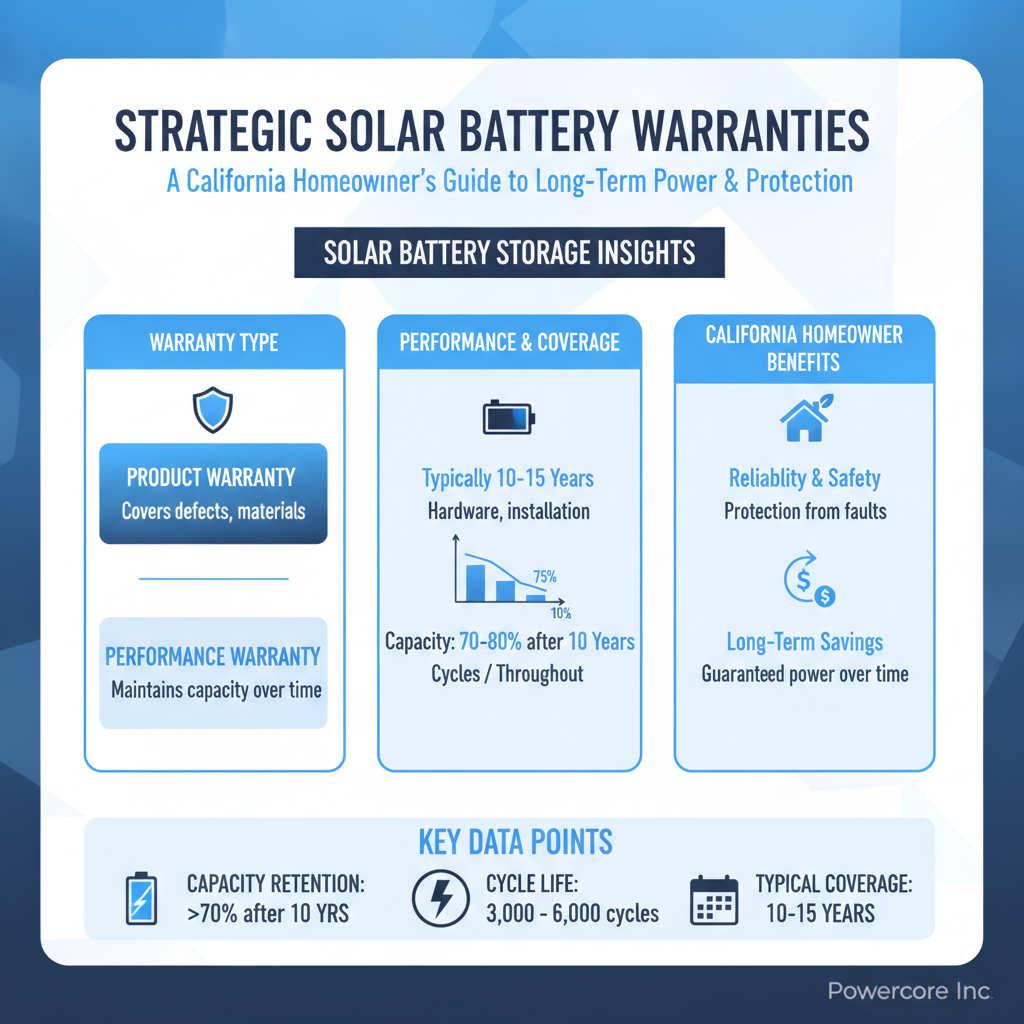
This is arguably the most critical aspect of a solar battery warranty. Batteries naturally degrade over time, losing some of their ability to hold a charge. The performance warranty guarantees that your battery will retain a certain percentage of its original capacity after a specified period or number of cycles. For example, a common guarantee might be 70% of original capacity after 10 years or 6,000 cycles.
- What to look for: A high percentage of retained capacity (e.g., 70-80%) over a long duration (10+ years) is ideal.
- Why it matters: Your battery's effectiveness in providing backup power and optimizing energy usage directly correlates with its usable capacity.
2. Cycle Life Warranty
A "cycle" refers to one full charge and discharge of the battery. The cycle life warranty specifies the maximum number of cycles the battery is guaranteed to perform while retaining its performance warranty. For example, a battery might be warranted for 10 years OR 6,000 cycles, whichever comes first.
- What to look for: A higher number of guaranteed cycles (e.g., 6,000 to 10,000+) indicates a more robust and long-lasting battery.
- Why it matters: If you frequently charge and discharge your battery (e.g., daily cycling for TOU arbitrage), you'll reach the cycle limit faster than someone using it primarily for backup.
3. Throughput (Energy Throughput) Warranty
Some warranties express performance in terms of total energy throughput, measured in kilowatt-hours (kWh). This guarantees the total amount of energy (in kWh) the battery can deliver over its warranty period. For instance, a warranty might state 30 MWh (megawatt-hours) of throughput over 10 years.
- What to look for: A higher total kWh throughput indicates a battery designed for heavy, consistent use.
- Why it matters: This metric can be easier to understand than cycle life for some homeowners, as it relates directly to the energy you'll consume from the battery.
4. Product/Equipment Warranty
This covers defects in materials or workmanship of the battery unit itself. It typically covers manufacturing flaws that might cause the battery to fail prematurely, separate from normal degradation. These warranties usually last 10 years, aligning with the performance warranty.
- What to look for: Comprehensive coverage for all physical components of the battery system.
- Why it matters: Ensures you're protected against manufacturing defects that could lead to complete system failure.
5. Labor Warranty (Installation & Replacement)
While the manufacturer's warranty covers the battery, the installer's warranty covers the labor for installation and any necessary replacement work. Powercore Inc, as a licensed contractor, provides robust labor warranties, ensuring peace of mind beyond the product itself.
- What to look for: Clear terms regarding labor coverage for both initial installation and any future warranty-related servicing.
- Why it matters: A manufacturer might replace a faulty battery, but you could still be on the hook for labor costs if your installer doesn't offer a strong labor warranty.
6. Transferability
Some warranties are transferable to a new homeowner if you sell your property. This can be a significant selling point and add value to your home.
- What to look for: Explicit language confirming warranty transferability and any associated fees or processes.
- Why it matters: Enhances your home's resale value and the attractiveness of your solar + storage system.
7. Exclusions and Limitations
All warranties have exclusions. Common ones include damage from improper installation (hence the importance of choosing a reputable contractor like Powercore Inc), unauthorized repairs, natural disasters (beyond normal wear), or operating the battery outside specified environmental conditions (e.g., extreme temperatures).
- What to look for: Read the fine print carefully. Understand what could potentially void your warranty.
- Why it matters: Being aware of exclusions helps you properly maintain your system and avoid actions that could nullify your coverage.
Understanding Battery Degradation and Warranty Limits
Battery degradation is a natural process. Just like your smartphone battery holds less charge over time, so too will your solar battery. Warranties are designed to protect you against excessive or premature degradation, not to promise indefinite peak performance.
- Factors Affecting Degradation:
- Temperature: High temperatures accelerate degradation. California's hot summers can be a factor, making proper installation and ventilation crucial.
- Depth of Discharge (DoD): Consistently discharging a battery to 0% (deep cycling) can shorten its lifespan. Most modern batteries are designed to handle this well, but it's worth noting.
- Usage Patterns: Very frequent cycling or prolonged periods at full or empty charge can impact longevity.
- How Warranties Account for Degradation: The performance warranty's capacity retention clause directly addresses this. It acknowledges degradation but guarantees a minimum usable capacity.
Strategic Battery Warranty Comparison for California Homes
When comparing different solar battery options for your California home, don't just look at the upfront cost. A thorough battery warranty comparison is essential for long-term value. While specific brand names and their exact warranty terms vary and evolve, here's a general overview of what you'll typically find in the market and what Powercore Inc recommends our clients consider:
Most reputable solar battery manufacturers offer warranties that are generally similar in length but differ in the specifics of their coverage:
- Typical Warranty Duration: Most leading solar battery warranties extend for 10 years. Some premium products might offer 12 or even 15 years, but 10 years is the industry standard.
- Capacity Retention Guarantees: You'll commonly see guarantees of 70% to 80% capacity retention after 10 years. For instance, a 10 kWh battery might be guaranteed to hold at least 7 kWh after a decade.
- Cycle Life vs. Throughput: Some manufacturers emphasize cycle life (e.g., 6,000 to 10,000 cycles), while others focus on total energy throughput (e.g., 20 MWh to 40 MWh). For California homeowners engaging in daily cycling for TOU optimization or frequent backup use, a high cycle life or throughput guarantee is paramount.
- Full Replacement vs. Pro-Rata: Understand if the warranty offers a full replacement of a faulty battery or a pro-rata refund (meaning you get a partial credit based on how much of the warranty period has elapsed). Full replacement is always more desirable.
When evaluating, consider your expected usage. If you anticipate heavy daily cycling to navigate California's Time-of-Use rates, prioritize higher cycle life or throughput numbers. If your primary concern is backup power during infrequent outages, a solid capacity retention over 10 years might be sufficient, even with fewer cycles.
California-Specific Warranty Considerations: What to Ask
Beyond the general terms, California's unique environment and energy policies necessitate a deeper look into specific warranty nuances:
Extreme Temperatures
California experiences significant temperature swings. Batteries operate optimally within a specific temperature range. Excessive heat, particularly in inland areas like Roseville, Sacramento, and the Central Valley, can accelerate degradation. Inquire about:
- Temperature Operating Range: Does the warranty specify a temperature range, and how does it compare to your region's climate?
- Thermal Management: What cooling or heating mechanisms does the battery have, and how do they impact its longevity and warranty?
Grid Instability and Frequent Cycling
The increasing frequency of PSPS events and the financial incentives to cycle batteries daily under NEM 3.0 mean your battery might experience more cycles than in other regions. Ensure the cycle life or throughput warranty adequately covers this intensive usage without prematurely expiring.
Compliance with Local Regulations
Ensure that meeting local safety and electrical codes (which Powercore Inc always adheres to as a CSLB-licensed contractor) does not inadvertently void any manufacturer warranty clauses. For example, specific installation clearances or ventilation requirements.
Incentive Compatibility
Programs like California's Self-Generation Incentive Program (SGIP) have specific requirements for eligible battery systems. Confirm that your chosen battery and its usage patterns, as covered by the warranty, align with SGIP requirements to avoid issues with your incentive eligibility.
Red Flags and Fine Print to Watch For
Not all warranties are created equal. Be vigilant for:
- Vague Language: Terms like "expected lifespan" instead of clear guarantees are red flags.
- Complex Claim Processes: Research the manufacturer's reputation for honoring claims. Powercore Inc only works with manufacturers known for reliable products and customer support.
- Exclusions for Common Issues: Ensure the warranty doesn't exclude common causes of battery degradation or failure that are typical for California's environment.
- "System Warranty" vs. "Component Warranty": Some warranties might cover the entire system (battery, inverter, software) while others cover only the battery unit itself. Understand the scope.
- Financial Stability of Manufacturer: A warranty is only as good as the company backing it. Choose established manufacturers.
Maximizing Your Battery's Lifespan and Warranty Protection
Even with an excellent warranty, proactive measures can extend your battery's life and ensure your coverage remains valid:
- Professional Installation: This is paramount. Improper installation is a leading cause of battery issues and can void warranties. Always choose a reputable, licensed contractor like Powercore Inc, with our dual General B and C-10 Electrical licenses, ensuring expert and compliant installation across California.
- Optimal Placement: Ensure your battery is installed in a location that adheres to manufacturer specifications regarding temperature and ventilation.
- Smart Energy Management: Utilize your battery's energy management system (EMS) to optimize charging and discharging, minimizing unnecessary stress on the cells.
- Regular Monitoring: Keep an eye on your system's performance via its monitoring app. Early detection of issues can prevent larger problems.
- Scheduled Maintenance: While batteries are generally low-maintenance, occasional checks by qualified technicians can identify potential issues.
Powercore Inc: Your Trusted Partner for Strategic Solar Battery Solutions
Choosing the right solar battery and understanding its warranty is a critical step in securing your home's energy future. As a California dual-licensed General B & C-10 Electrical Contractor, Powercore Inc brings unparalleled expertise to every project. We don't just install systems; we provide strategic, long-term energy solutions tailored to California homeowners.
Our team understands the nuances of various battery technologies and their warranties, helping you navigate the options to select a system that aligns with your energy goals, budget, and local climate conditions. We ensure seamless installation, adherence to all California codes, and provide robust labor warranties, giving you complete peace of mind.
From comprehensive solar and battery storage installations to maximizing your system's efficiency and lifespan, Powercore Inc is committed to delivering excellence.
Conclusion: Invest in Confidence with a Smart Warranty Choice
A solar battery is a cornerstone of modern, resilient California homes. While the immediate benefits of energy independence and cost savings are clear, the long-term value is intrinsically tied to the strength and clarity of its warranty. By understanding the key components of a battery warranty comparison – from capacity retention and cycle life to product and labor coverage – you empower yourself to make a truly strategic investment.
Don't let complex jargon deter you. Partner with an expert like Powercore Inc to ensure your solar battery storage system is not only perfectly sized and installed for your California home but also backed by a warranty that delivers genuine, lasting protection. Secure your energy future with confidence.
Ready to explore the best solar battery storage solutions and warranties for your California home? Contact Powercore Inc today for a personalized consultation. Call us at 916-699-8778 or visit our contact page to get started.