

The Power of Protection: Why Solar Battery Warranties Matter in California
As California continues its ambitious journey towards a cleaner energy future, solar battery storage has become an indispensable component of residential solar systems. With the evolving energy landscape, including changes like NEM 3.0, homeowners across the Golden State are increasingly turning to battery storage to maximize their solar investment, achieve greater energy independence, and ensure reliable power during outages. However, the long-term value of a battery storage system isn't just about its upfront cost or its immediate performance; it's profoundly tied to the strength and clarity of its warranty.
A solar battery is a significant investment, promising years of energy savings and peace of mind. But like any sophisticated technology, batteries degrade over time. This is where a comprehensive warranty becomes your ultimate safeguard. Without a thorough understanding of what your battery warranty covers – and doesn't cover – you could face unexpected costs and diminishing returns on your clean energy investment. For California homeowners, deciphering the fine print of these warranties is not just prudent; it's strategic.
At Powercore Inc, a dual-licensed General B & C-10 Electrical Contractor based in Roseville, CA, we understand that making an informed decision about your home's energy future is paramount. Our expertise spans solar, battery storage, and a range of other home enhancements across all of California. We believe in empowering our clients with the knowledge needed to choose not just the best technology, but also the best protection for that technology.
Deciphering the DNA of a Solar Battery Warranty
Solar battery warranties are multifaceted, often comprising several distinct components that collectively define the scope of your protection. Understanding each part is crucial for a meaningful solar battery warranty comparison.
Product Warranty: Guarding Against Defects
This is the most straightforward part of any warranty, covering manufacturing defects in the battery unit itself. It ensures that the battery you receive is free from faults in material and workmanship at the time of purchase and for a specified period. This typically includes issues like faulty components, casing integrity, or internal electrical failures not caused by external factors or misuse.
- Typical Duration: Most product warranties for solar batteries range from 5 to 10 years.
- What it Covers: Defects that prevent the battery from operating as intended due to manufacturing flaws.
- What it Doesn't Cover: Normal wear and tear, damage from improper installation (unless installed by the manufacturer or an authorized dealer like Powercore Inc), misuse, environmental damage, or unauthorized modifications.
Performance/Capacity Warranty: The Heart of Your Investment
This is arguably the most critical aspect of a solar battery warranty, as it directly addresses the battery's ability to store and deliver energy over time. All batteries degrade, meaning their ability to hold a charge diminishes with age and use. The performance warranty guarantees that your battery will retain a certain percentage of its original energy storage capacity after a specified number of years or charge/discharge cycles.
- Common Guarantee: Typically, manufacturers guarantee 60-70% of the original capacity after 10 years or a certain number of cycles.
- Why it's Important: It protects you against premature degradation, ensuring you get the expected energy output for the majority of the battery's advertised lifespan. Without this, your battery could become significantly less effective well before its expected end-of-life, leaving you with reduced savings and resilience.
Workmanship/Installation Warranty: The Powercore Advantage
While often provided by the installer rather than the battery manufacturer, the workmanship warranty is equally vital. It covers the quality of the installation itself, ensuring the battery is installed correctly, safely, and according to manufacturer specifications and local codes. Improper installation can not only void your product and performance warranties but also pose safety risks and hinder system efficiency.
- Powercore Inc's Commitment: As a licensed C-10 Electrical Contractor and General B Contractor, Powercore Inc provides robust workmanship warranties, ensuring that your solar battery system is installed with the highest standards of safety, compliance, and performance. Our dual licensing means we handle both the electrical and general construction aspects, providing a seamless and fully warranted installation.
- Crucial Consideration: Always verify your installer's licensing and reputation. A poor installation can negate the best battery warranty.
Key Metrics for a Strategic Solar Battery Warranty Comparison
When evaluating different battery warranties, several key metrics will help you cut through the marketing jargon and compare offerings objectively. Focusing on these details will empower you to make an investment that truly lasts.
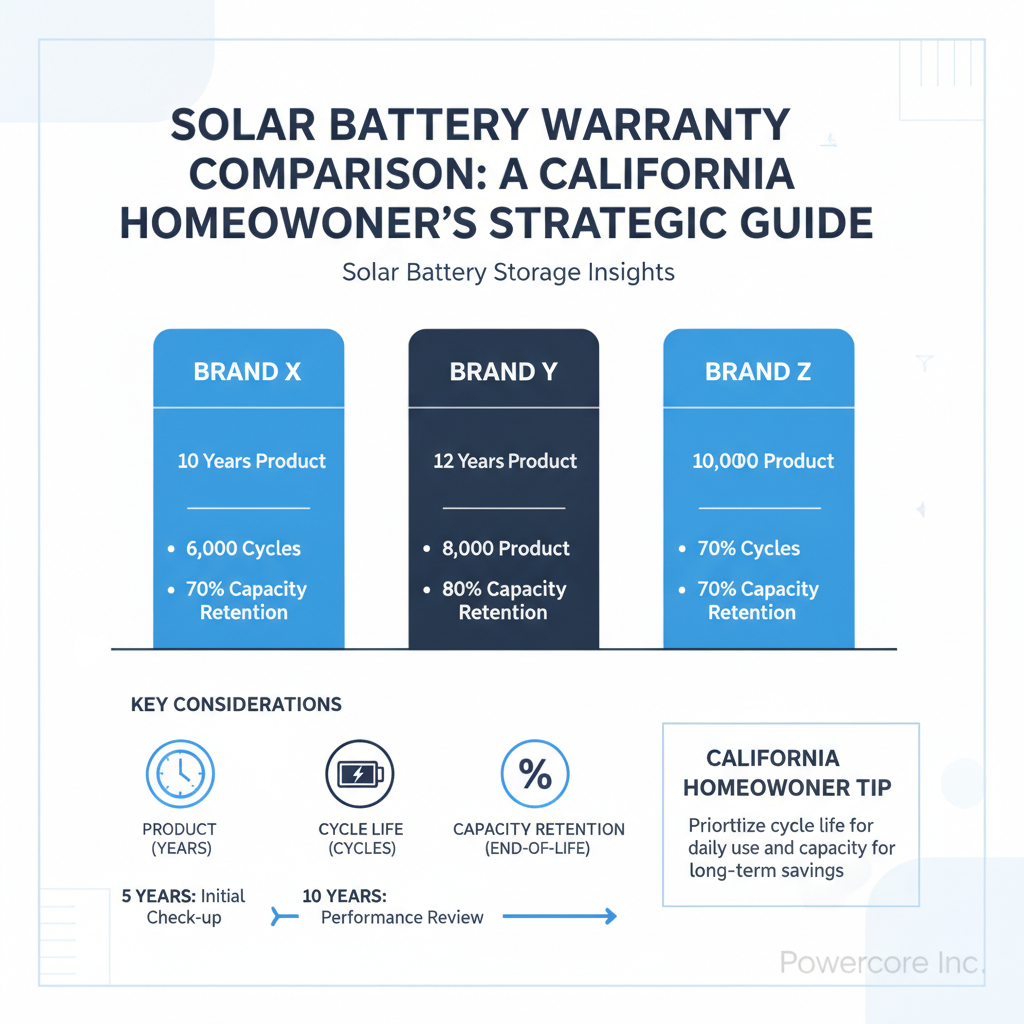
Cycle Life: The Number of Power Cycles
A cycle refers to one complete charge and discharge of the battery. Battery warranties often specify a guaranteed number of cycles. For example, a warranty might promise 'X' cycles over 'Y' years. It's important to understand how manufacturers define a cycle, particularly regarding Depth of Discharge (DoD).
- Understanding DoD: Most manufacturers base cycle life on a specific DoD (e.g., 80% or 100%). A battery discharged to 80% (meaning 20% charge remaining) and then fully recharged counts as one 80% DoD cycle. Deeper discharges typically reduce the total number of cycles a battery can achieve over its lifetime.
- Practical Implications: If your household frequently drains the battery deeply, a higher guaranteed cycle count becomes more valuable. Conversely, if you only use a small portion of your battery's capacity daily, the total years might be a more relevant metric.
Total Energy Throughput (kWh Delivered): The Most Comprehensive Metric
This metric represents the total amount of energy (in kilowatt-hours or kWh) the battery is guaranteed to deliver over its warranty period. It's often expressed as a cumulative sum, for instance, '10 years or 30,000 kWh, whichever comes first.' This is arguably the most holistic warranty metric because it factors in both capacity and usage patterns.
- Why it's Superior: Unlike cycle life alone, throughput directly measures the usable energy you'll get from the battery. A battery with a higher throughput warranty, even if its cycle count is similar to another, might offer more real-world value, especially if your daily usage patterns involve varying depths of discharge.
- Calculation Example: If a 10 kWh battery is guaranteed for 30,000 kWh throughput, it means it can deliver 30,000 kWh before the warranty expires. If you use 5 kWh per day, this implies a 6,000-day (approx. 16.4-year) lifespan, assuming no degradation. However, degradation is factored in, so the 30,000 kWh accounts for declining capacity over time.
Capacity Retention: What Remains at the End?
This is the percentage of the battery's original usable capacity that is guaranteed to remain after a specified period or number of cycles. For example, '70% capacity retention after 10 years or 6,000 cycles.' This tells you how much usable energy you can expect from your battery towards the end of its warranty period.
- Long-Term Value: A higher capacity retention guarantee means your battery will remain more effective for longer, delaying the need for replacement and ensuring continued savings and resilience.
Warranty Period: The Duration of Protection
Most reputable solar battery manufacturers offer a warranty period of 10 years. Some may offer slightly less, while others might extend to 12 or 15 years, often with specific conditions.
- Concurrent Conditions: Always remember that the warranty is typically 'X years OR Y cycles OR Z kWh, whichever comes first.' It's not uncommon for heavy users to hit the cycle or throughput limit before the years expire.
Navigating the Fine Print: What to Look For Beyond the Headline Numbers
Beyond the core metrics, the terms and conditions of a solar battery warranty hold critical details that can significantly impact your experience if you ever need to make a claim. A savvy California homeowner will scrutinize these aspects.
Pro-Rata vs. Full Replacement Coverage
This distinction is incredibly important for your financial protection:
- Full Replacement: If the battery fails or degrades beyond the warranted capacity within the warranty period, the manufacturer replaces the unit entirely, often covering the cost of the new battery, shipping, and sometimes even labor. This is the most desirable form of coverage.
- Pro-Rata Warranty: The manufacturer covers a percentage of the replacement cost, typically based on how much of the warranty period has passed or how many cycles/kWh have been used. For example, if your battery fails halfway through a 10-year pro-rata warranty, you might only receive 50% coverage for a new unit, leaving you to pay the remaining balance. This can lead to significant out-of-pocket expenses.
Labor and Shipping Costs: Who Pays for the Swap?
A replacement battery is useless without installation. Some warranties cover the labor costs associated with removing the faulty unit and installing the new one, as well as the shipping costs for the replacement. Others do not, leaving you responsible for potentially hundreds or even thousands of dollars in installation fees.
- Ask the Right Questions: Always clarify if labor and shipping are included in the warranty claim process. Powercore Inc ensures transparency in these discussions, so you know exactly what to expect.
Warranty Transferability: For Future Homeowners
If you plan to sell your home within the battery's warranty period, the ability to transfer the warranty to the new homeowner can be a significant selling point. Some warranties are transferable, while others are not, or require a fee and specific paperwork.
- Boost Your Property Value: A transferable warranty adds value and peace of mind for potential buyers, making your home more attractive in California's competitive real estate market.
Exclusions and Conditions: The Small Print That Matters
All warranties have exclusions. Common exclusions include:
- Damage due to improper installation (again, highlighting the need for a certified installer like Powercore Inc).
- Acts of nature (lightning, floods, earthquakes).
- Misuse, abuse, or unauthorized modifications.
- Operation outside specified environmental conditions (temperature ranges).
- Failure to follow manufacturer's maintenance guidelines (e.g., software updates).
Understanding these can prevent a denied claim down the line.
The Claim Process: How Easy Is It?
A robust warranty is only as good as the ease with which you can make a claim. Ask your installer about their experience with warranty claims for the specific battery brand. A complex, bureaucratic process can be frustrating and time-consuming.
California-Specific Considerations for Your Battery Warranty
California's unique energy market and environmental factors add layers of importance to understanding your solar battery warranty.
NEM 3.0 and the Amplified Role of Batteries
With the implementation of Net Energy Metering (NEM) 3.0, the financial incentives for simply exporting excess solar power back to the grid have significantly decreased for many California homeowners. This shift has made battery storage not just an option but a strategic necessity for maximizing solar savings and achieving energy independence. Consequently, the long-term reliability and warranted performance of your battery are more critical than ever, directly impacting your return on investment.
A solid performance warranty ensures that your battery continues to provide the expected value under NEM 3.0, allowing you to store cheap daytime solar energy for use during expensive evening peak hours. For more insights on maximizing your solar investment, you might find our article on How Much Energy Does the Average Solar Panel Produce? insightful, as panel output directly influences battery charging.
SGIP and Other California Battery Storage Incentives
California offers powerful incentives like the Self-Generation Incentive Program (SGIP) to encourage battery storage adoption. While these programs provide upfront financial assistance, they often have specific requirements for eligible equipment and installation. Ensuring your chosen battery and its installation meet these standards is vital for maintaining both incentive eligibility and warranty validity.
For more details on available support, explore our page on California Battery Storage Incentives. Additionally, homeowners may qualify for the federal Residential Clean Energy Credit, which can cover a percentage of your solar and battery storage system costs.
Environmental Factors and Installation Locale
California's diverse climates, from coastal humidity to inland heat, can impact battery performance and longevity. Most battery warranties specify acceptable operating temperature ranges. Ensuring your battery is installed in a location that adheres to these specifications is crucial to prevent voiding your warranty. Powercore Inc's expert installers are intimately familiar with California's climate challenges and best practices for optimal battery placement.
Beyond the Paper: Maximizing Your Battery Warranty's Value
A great warranty is a foundation, but proactive steps ensure you get the most out of it.
The Critical Role of Professional Installation
This cannot be stressed enough. Many warranty claims are denied due to improper installation. A certified, experienced installer like Powercore Inc (CSLB #1134334 & #1098175) ensures your battery is installed correctly, safely, and in compliance with all manufacturer guidelines and California's stringent electrical codes. This protects not only your warranty but also your home and family.
System Sizing and Usage Patterns
An undersized battery might be cycled more frequently and deeply, potentially accelerating degradation and hitting cycle/throughput limits sooner. A properly sized system, tailored to your household's energy needs by an expert like Powercore Inc, helps optimize battery usage, extending its effective life and maximizing warranty coverage.
Monitoring and Maintenance
Regular monitoring through your battery's smart app allows you to track performance and identify potential issues early. Many manufacturers also recommend periodic software updates. Staying on top of these small tasks can ensure your battery operates within optimal parameters, upholding your warranty.
Document Everything
Keep meticulous records of your purchase, installation, and any communication with the manufacturer or installer. This documentation is invaluable if you ever need to file a warranty claim.
Red Flags and Questions to Ask Your Solar Contractor
Before committing to a solar battery system, engage in a thorough discussion with your potential installer. Here are some red flags and essential questions:
- Red Flags:
- Vague warranty terms or a reluctance to provide full warranty documentation upfront.
- Significantly shorter warranty periods or lower capacity retention guarantees compared to industry standards.
- An installer who seems unfamiliar with specific battery warranty details or the claim process.
- High upfront costs but unclear long-term support.
- Key Questions to Ask:
- "What are the exact terms of the product and performance warranties for this battery, including cycle life, throughput, and capacity retention?"
- "Is this a full replacement or pro-rata warranty?"
- "Does the warranty cover labor and shipping costs for a replacement?"
- "Is the warranty transferable if I sell my home? What's the process?"
- "What are the specific exclusions that could void the warranty?"
- "What is your company's process for handling a warranty claim from start to finish?"
- "Are your installers certified by the battery manufacturer?"
Powercore Inc: Your Trusted Partner for Strategic Solar and Battery Solutions in California
Choosing a solar battery storage system is a decision for decades, not just years. A robust, clearly understood warranty is the bedrock of that long-term investment. At Powercore Inc, we pride ourselves on transparency, expertise, and a commitment to quality that extends far beyond installation. As a premier California solar and electrical contractor (CSLB #1134334 & #1098175), we guide homeowners through every step, from selecting the right battery system for your specific needs to ensuring its flawless installation and providing ongoing support.
We understand the nuances of the California energy market and the critical importance of a warranty that truly protects your interests. Whether you're considering Residential Solar & Storage or exploring advanced Solar & Battery Storage options, Powercore Inc delivers solutions designed for enduring performance and peace of mind across all of California.
Secure Your Energy Future with Confidence
Don't let the complexities of battery warranties deter you from embracing the incredible benefits of home energy storage. With the right knowledge and a trusted partner, you can make an informed decision that safeguards your investment for years to come. Powercore Inc is here to illuminate your path to energy independence, ensuring your solar battery system is not only powerful and efficient but also backed by the strongest possible protection.
Ready to explore solar battery solutions with a warranty you can trust? Contact Powercore Inc today for a consultation. Call us at 916-699-8778 or visit our contact page to schedule an appointment. Let us help you secure your energy future with confidence.