

Introduction: Maximizing Your California Solar Battery ROI
In the Golden State, where energy costs continue to climb and grid reliability faces increasing challenges, homeowners are increasingly turning to solar power combined with battery storage as a powerful solution. But beyond the obvious benefits of clean energy and backup power, a critical question emerges for every forward-thinking Californian: What is the true solar battery ROI (Return on Investment)?
For many, the initial investment in a solar-plus-storage system can seem substantial. However, understanding and strategically optimizing your ROI transforms this decision from a simple purchase into a savvy financial move. It’s not just about reducing your electricity bill; it’s about leveraging advanced energy management, tapping into lucrative incentives, and future-proofing your home against rising costs and grid instability. Powercore Inc, a California dual-licensed General B & C-10 Electrical Contractor, understands that maximizing this return requires more than just installation – it demands a deep understanding of California's unique energy landscape and a strategic approach to system design and utilization.
This comprehensive guide will go beyond basic calculations, delving into the multifaceted factors that drive your solar battery ROI in California. We'll explore how smart strategies can unlock peak value, turning your energy storage system into a dynamic asset that pays dividends for years to come.
Understanding Solar Battery Storage ROI in California
What is ROI in the Context of Energy Storage?
At its core, Return on Investment (ROI) measures the profitability of an investment. For solar battery storage, it's the financial benefit you gain relative to the cost of your system. This isn't always a straightforward calculation, as the benefits extend beyond mere monetary savings and include aspects like energy independence, grid resilience, and even environmental impact.
Traditionally, ROI for solar systems focused on bill savings and incentives. With the addition of battery storage, the calculation becomes more dynamic, incorporating factors like:
- Time-of-Use (TOU) Rate Optimization: Storing cheaper off-peak electricity for use during expensive on-peak hours.
- Demand Charge Reduction: For some homeowners (and especially commercial properties), batteries can reduce high demand charges.
- Backup Power Value: The economic and comfort value of uninterrupted power during outages.
- Grid Services & Virtual Power Plants (VPPs): Earning revenue by sharing stored energy with the grid.
- Increased Home Value: Homes with solar and storage often command higher resale values.
California's Unique Energy Landscape: Why ROI Matters More Here
California stands at the forefront of renewable energy adoption, but also grapples with complex energy challenges that make battery storage particularly valuable:
- High & Volatile Electricity Rates: California has some of the highest electricity rates in the nation, with significant fluctuations based on time of day and season. This creates a prime environment for TOU optimization with battery storage.
- Net Energy Metering (NEM) 3.0: The latest iteration of California's net metering policy, NEM 3.0, has drastically reduced the credit homeowners receive for sending excess solar energy back to the grid. This shift makes self-consumption and battery storage crucial for maximizing the value of your solar production. Instead of exporting cheap solar, you store it for later use when grid power is expensive.
- Grid Instability & PSPS Events: Wildfires and aging infrastructure lead to Public Safety Power Shutoffs (PSPS) and general grid instability. Battery storage offers critical resilience, providing seamless backup power and protecting against financial losses from outages.
- Ambitious Clean Energy Goals: California's commitment to 100% clean electricity by 2045 drives ongoing incentives and programs that favor battery storage.
These factors collectively amplify the financial and practical benefits of battery storage, making a strategic understanding of residential solar and storage solutions and their ROI more vital than ever for California homeowners.
Key Pillars Driving Your Battery Storage ROI
To truly maximize your solar battery ROI, it’s essential to understand the specific mechanisms through which these systems generate value. It's a combination of direct savings, indirect benefits, and potential revenue streams.
Time-of-Use (TOU) Rate Optimization
California's utility companies primarily operate on Time-of-Use (TOU) rate structures. This means electricity costs vary significantly throughout the day, with peak rates often occurring in the late afternoon and early evening when demand is highest and solar production is waning. This is where battery storage shines:
- Arbitrage Power: Your solar panels generate electricity during the day when rates are often lower (or you're offsetting usage). With a battery, you can store this inexpensive solar energy instead of sending it to the grid for reduced NEM 3.0 credits.
- Peak Shaving: During expensive peak hours (e.g., 4 PM - 9 PM), your home automatically draws power from your battery instead of the grid, avoiding the highest charges. This strategy is a cornerstone of modern solar battery ROI.
For homeowners with EV charging stations, this optimization is even more critical, as charging an electric vehicle during peak hours can significantly inflate electricity bills without battery support.
Grid Resilience and Blackout Protection
While difficult to quantify in a simple dollar figure, the value of uninterrupted power during grid outages is immense. Consider the costs associated with a blackout:
- Food Spoilage: Loss of refrigerated and frozen goods.
- Disrupted Work/Life: Inability to work from home, loss of internet, impacts on comfort and safety.
- Medical Equipment Needs: Critical for those relying on life-sustaining medical devices.
- HVAC System Shutdown: Discomfort and potential health risks during extreme temperatures without your HVAC climate control.
Battery storage provides seamless, automatic backup power, ensuring your essential appliances and systems remain operational. This peace of mind and protection against financial losses and discomfort adds significant, albeit intangible, value to your ROI calculation.
Virtual Power Plant (VPP) Participation
California is a pioneer in the Virtual Power Plant (VPP) revolution. VPPs aggregate distributed energy resources, like residential solar batteries, into a collective network that can provide services to the grid. By participating in a VPP, homeowners can effectively rent out their battery's capacity to the utility during times of high demand or grid stress, earning monetary compensation. This transforms your battery from a purely self-serving asset into a revenue-generating component of the broader energy infrastructure.
This innovative approach not only boosts your personal solar battery ROI but also contributes to the state's overall grid stability and renewable energy goals. To learn more about this exciting development, read our article: California's Virtual Power Plant Revolution: Empowering Homeowners with Solar & Storage.
Federal Tax Credits and State Incentives
Significant financial incentives exist to reduce the upfront cost of solar battery storage systems, directly improving your ROI:
- Federal Residential Clean Energy Credit (ITC): The Investment Tax Credit (ITC) allows homeowners to claim a credit for a percentage of the cost of their solar and battery storage system. Currently, this credit is 30% for systems placed in service before 2033. This is a dollar-for-dollar reduction in your federal income tax liability. For the most current information, refer to the IRS Residential Clean Energy Credit page.
- Self-Generation Incentive Program (SGIP): California's SGIP offers rebates for qualifying energy storage systems. This program has specific funding allocations and eligibility criteria, often prioritizing low-income households or those in high-fire-risk areas. These rebates can significantly offset installation costs.
Navigating these incentives can be complex, but Powercore Inc helps homeowners identify and apply for all eligible California battery storage incentives, ensuring you maximize every available financial advantage.
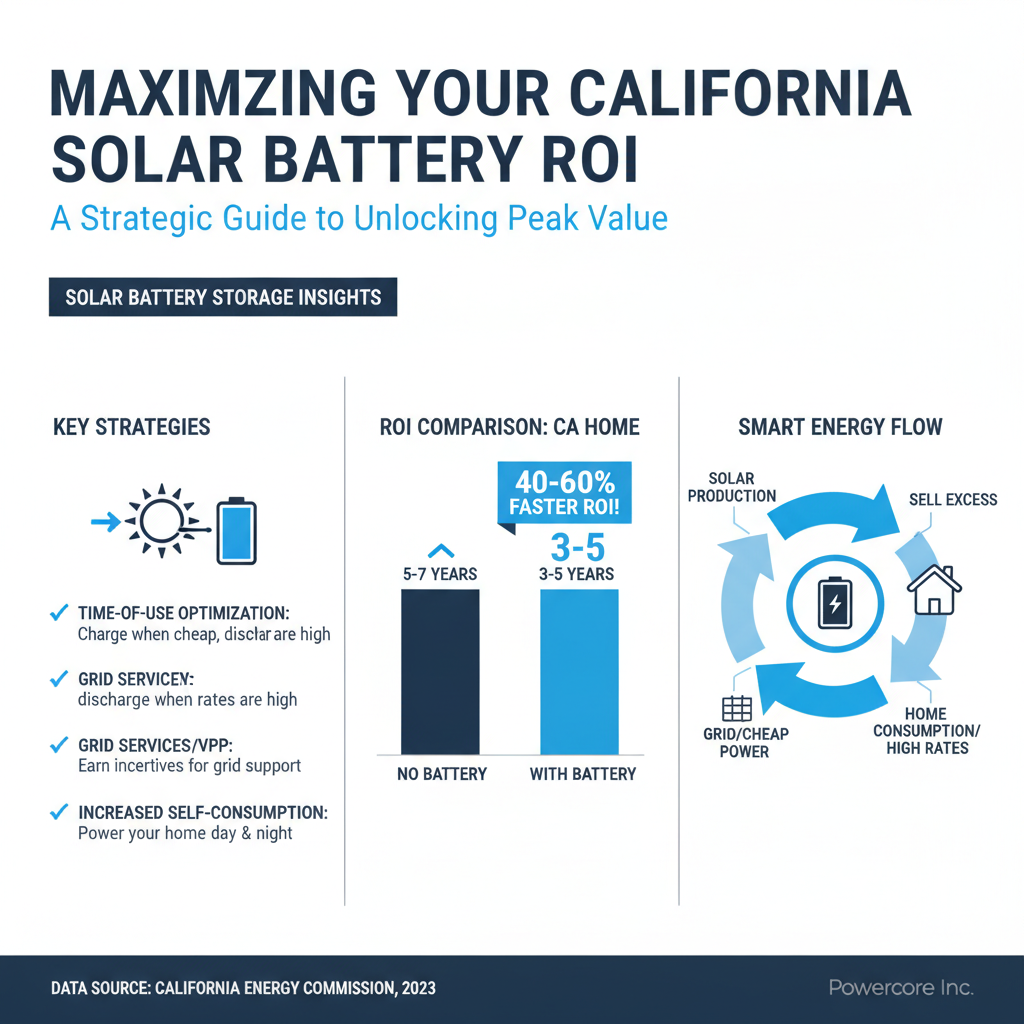
Calculating Your Real-World Solar Battery ROI
While the concept of ROI is simple, its calculation for solar battery storage requires a nuanced approach, factoring in both direct costs and the various value streams mentioned above.
Initial Investment: Understanding All Costs
The total upfront cost of your solar battery storage system includes:
- Equipment Costs: The battery unit(s), inverter, and associated electrical components.
- Installation Labor: Professional installation by licensed electricians, like those at Powercore Inc, ensuring safety and compliance.
- Permitting & Interconnection Fees: Costs associated with obtaining necessary permits and connecting your system to the utility grid.
- System Design & Engineering: Customized design tailored to your home's energy needs and California's specific regulations.
It's crucial to get a comprehensive quote that outlines all these components. Don't just compare battery prices; compare total system costs from reputable, licensed contractors.
Quantifying Operational Savings
This is where the direct financial benefits become tangible:
- Monthly Electricity Bill Reductions: Calculate the difference in your bill before and after battery installation, specifically from TOU optimization. For instance, if you're avoiding 5 hours of $0.50/kWh peak rates by using stored energy, that's a direct saving.
- Avoided Demand Charges: If your utility charges based on peak demand, a battery can flatten your consumption curve, leading to significant savings.
- Revenue from VPP Participation: Estimate potential earnings based on local program rates and your battery's capacity and dispatch frequency.
These savings are ongoing and compound over the lifespan of your battery, significantly contributing to your long-term ROI.
The Value of Resilience and Future-Proofing
While not a direct monetary saving, the value of resilience is critical, especially in California:
- Avoided Costs during Outages: Estimate the cost of spoiled food, lost productivity, or temporary accommodation if you experience frequent or long-duration outages.
- Peace of Mind: The intangible benefit of knowing your home is secure and powered, regardless of grid conditions.
- Increased Property Value: Studies show homes with solar and storage sell for a premium, providing a long-term asset value.
Battery Lifespan and Degradation
Most modern solar batteries come with warranties for 10-15 years, guaranteeing a certain percentage of their original capacity. Factoring in degradation means understanding that while your battery will perform optimally for many years, its capacity will slightly diminish over time. This should be considered in long-term ROI projections, though advancements in battery technology are continually extending lifespans and improving performance.
When selecting a battery, consider options discussed in resources like 7 Best Home Battery Solutions for Eco-Conscious Homeowners to ensure you're choosing a durable, high-performance system.
Beyond Simple Payback: Total Lifecycle Value
While simple payback period (how long it takes for savings to equal initial cost) is a useful metric, a holistic ROI calculation considers the total lifecycle value, including the cumulative savings over the battery's lifespan, potential revenue streams, and the avoided costs of grid reliance and outages. Powercore Inc assists homeowners in performing these detailed analyses to ensure a clear understanding of their investment's long-term financial benefits.
Strategies for Maximizing Your ROI
Once you understand the components of ROI, the next step is to implement strategies that optimize each factor, ensuring your solar battery storage system delivers maximum value.
Right-Sizing Your System for Optimal Performance
One of the most critical steps in maximizing ROI is correctly sizing your battery system. An undersized battery won't provide enough backup or TOU optimization, while an oversized one represents unnecessary upfront cost without proportionate returns. A professional energy audit by Powercore Inc will analyze your household's unique energy consumption patterns, peak usage times, and backup power needs to recommend the ideal battery capacity and solar array size. This ensures you invest in a system that perfectly matches your requirements, minimizing waste and maximizing efficiency.
Advanced Energy Management and Smart Controls
Modern battery storage systems are not just passive containers of energy; they are intelligent devices capable of sophisticated energy management. Leveraging smart controls, AI-driven algorithms, and seamless integration with your home's energy ecosystem is key:
- Automated TOU Optimization: Systems can learn your usage patterns and local utility rates, automatically charging when electricity is cheap and discharging when it's expensive.
- Weather Forecasting Integration: Some systems can anticipate cloudy days or potential outages, adjusting charging/discharging schedules accordingly to ensure you have sufficient stored energy.
- Load Prioritization: During an outage, smart systems can prioritize power to essential circuits (refrigerator, medical equipment) over non-essential ones.
Effective setup and utilization of your solar battery storage's monitoring app is crucial for understanding its performance and ensuring optimal settings for your ROI.
Integration with Your Home Energy Ecosystem
Thinking holistically about your home's energy use can further enhance battery ROI. Integrating your battery with other major energy consumers or producers in your home creates a more efficient and responsive system:
- EV Charging: Power your electric vehicle with stored solar energy, significantly reducing your transportation costs and minimizing reliance on grid power during peak hours.
- Smart HVAC: Coordinate your HVAC climate control with your battery system to run high-demand heating or cooling cycles when solar is abundant or stored energy is cheapest.
- Home Automation: Link smart appliances to your energy management system to shift loads and optimize consumption.
Proactive Maintenance and Monitoring
Like any sophisticated system, solar batteries benefit from regular monitoring and occasional maintenance. Keeping an eye on your system's performance via its monitoring app ensures it's operating efficiently and alerts you to any potential issues. While batteries are generally low-maintenance, ensuring proper ventilation and environmental conditions can extend their lifespan and maintain optimal performance, thereby protecting your long-term ROI.
Partnering with an Expert: Powercore Inc
The most crucial strategy for maximizing your solar battery ROI is partnering with an experienced and reputable contractor. Powercore Inc brings a unique advantage as a dual-licensed General B & C-10 Electrical Contractor (CSLB #1134334 & #1098175) based in Roseville, CA, serving all of California. Our expertise ensures:
- Customized Design: Systems tailored to your specific energy needs and budget.
- Flawless Installation: Adherence to the highest safety and code standards.
- Incentive Navigation: Expert guidance on maximizing federal and state incentives.
- Long-Term Support: We stand by our work, providing reliable service and support for your investment.
Choosing Powercore Inc means choosing a partner committed to unlocking the full potential and peak value of your solar battery investment.
The Future of Battery Storage and Your ROI in California
The landscape of energy storage in California is dynamic and evolving rapidly. Looking ahead, several trends are poised to further enhance the ROI for homeowners with battery systems:
- Technological Advancements: Continuous innovation in battery chemistry and manufacturing promises lower costs, higher energy density, and longer lifespans, making future systems even more efficient and affordable.
- Evolving Grid Services: As California's grid becomes more decentralized, opportunities for homeowners to participate in advanced grid services (beyond current VPPs) and earn additional revenue will likely expand.
- Further Regulatory Support: The state's ambitious clean energy goals will likely lead to ongoing and potentially new incentive programs, reinforcing the financial viability of energy storage.
Investing in solar battery storage today positions you at the forefront of this energy revolution, ensuring long-term savings, energy independence, and a resilient home energy future.
Why Choose Powercore Inc for Your Battery Storage Investment?
At Powercore Inc, we don't just install systems; we build comprehensive energy solutions designed for California's unique demands. As a trusted, dual-licensed contractor, we offer unparalleled expertise in solar and battery storage, HVAC, roofing, and a full suite of home improvement services. Our integrated approach means we can address all aspects of your home's energy efficiency and resilience, ensuring a seamless, high-performance system.
We are committed to helping homeowners throughout California navigate the complexities of energy independence, maximizing their solar battery ROI through meticulous design, expert installation, and comprehensive support. With Powercore Inc, you gain a partner dedicated to your long-term energy savings and peace of mind.
Conclusion: Unlocking Your Peak Energy Value
Investing in solar battery storage in California is more than an upgrade; it's a strategic financial decision that offers substantial and multifaceted returns. By understanding the drivers of ROI—from Time-of-Use optimization and grid resilience to federal tax credits and Virtual Power Plant participation—homeowners can unlock significant savings and achieve true energy independence.
Don't leave your solar battery ROI to chance. Partner with Powercore Inc, your California experts, to design and install a system that delivers peak value for decades to come. Ready to maximize your energy investment? Contact Powercore Inc today for a personalized consultation. Call us at 916-699-8778 or visit our contact page to get started on your path to optimized energy savings and resilience.