

Introduction: Navigating California's Energy Landscape with Smart Storage
California stands at the forefront of renewable energy, but this leadership also comes with unique challenges: grid instability, the increasing frequency of Public Safety Power Shutoffs (PSPS), and evolving solar policies like NEM 3.0. These factors underscore a critical need for homeowners to not just generate solar power, but to effectively store it. Solar battery storage has transitioned from a luxury to a near necessity, offering unparalleled energy independence, resilience, and potential cost savings.
As you consider adding battery storage to your California home, you'll inevitably encounter a crucial decision: choosing between different lithium-ion battery chemistries. Specifically, the debate often centers on Lithium Iron Phosphate (LFP) and Nickel Manganese Cobalt (NMC) batteries. Both offer distinct advantages and disadvantages, making the selection process complex for the uninitiated.
At Powercore Inc, a dual-licensed General B & C-10 Electrical Contractor based in Roseville, CA, we understand the intricacies of California's energy demands and the technology designed to meet them. This comprehensive guide will delve deep into the LFP vs NMC solar battery comparison, empowering you with the knowledge to make an informed decision that aligns with your home's energy goals, budget, and long-term sustainability vision. We’ll explore everything from safety and lifespan to efficiency and environmental impact, tailored specifically for the California homeowner.
Why Solar Battery Storage is Essential in California
For California homeowners, solar panels alone are no longer enough to fully capitalize on renewable energy or ensure complete energy security. Here’s why battery storage has become indispensable:
-
NEM 3.0 Adaptation: The California Public Utilities Commission (CPUC) implemented Net Energy Metering (NEM) 3.0, significantly altering how solar homeowners are compensated for excess energy sent back to the grid. Under NEM 3.0, storing your solar energy for self-consumption during peak hours or for use when the sun isn't shining becomes far more economically beneficial than exporting it to the grid at reduced rates. Batteries allow you to maximize your self-consumption and optimize savings.
-
PSPS Resilience: California's wildfire season often leads to PSPS events, where utility companies proactively shut off power to prevent ignitions. Solar panels without battery storage also shut down during these outages for safety reasons. A solar battery system ensures your home remains powered, providing critical backup during grid interruptions, keeping your lights on, refrigerator cold, and essential electronics running.
-
Peak Shaving and Time-of-Use (TOU) Savings: California utilities often employ TOU rates, charging more for electricity during peak demand hours (typically late afternoon/early evening). With a battery, you can charge it during off-peak hours (or with solar during the day) and discharge it during expensive peak hours, significantly reducing your electricity bill.
-
Energy Independence: Beyond financial savings and backup power, battery storage offers a profound sense of energy independence. You become less reliant on the grid, gaining greater control over your home's power supply and contributing to a more resilient, decentralized energy system.
Lithium-Ion Battery Fundamentals: A Brief Overview
Before diving into the specifics of LFP and NMC, it's helpful to understand the basic principles of lithium-ion batteries. These rechargeable batteries power everything from smartphones to electric vehicles and, increasingly, our homes. They work by moving lithium ions between a positive electrode (cathode) and a negative electrode (anode) through an electrolyte. The material used in the cathode largely determines the battery's characteristics, leading to different chemistries like LFP and NMC, each optimized for specific performance metrics.
Deep Dive: Lithium Iron Phosphate (LFP) Batteries
Lithium Iron Phosphate batteries, often abbreviated as LFP or LiFePO4, have gained significant traction in the solar storage market due to their robust characteristics.
Composition and History (LFP)
LFP batteries use lithium iron phosphate as the cathode material. This chemistry was first discovered in the mid-1990s and has since evolved to become a preferred choice for applications requiring high safety and long lifespan. Unlike some other lithium-ion chemistries, LFP does not use nickel or cobalt, which are metals associated with higher costs and more volatile supply chains.
Key Advantages of LFP for California Homes
-
Superior Safety: This is arguably the most significant advantage of LFP. Lithium iron phosphate has excellent thermal and chemical stability, making LFP batteries far less prone to thermal runaway (overheating and catching fire) compared to other lithium-ion chemistries. This enhanced safety provides significant peace of mind for homeowners, especially in fire-prone regions of California.
-
Exceptional Cycle Life: LFP batteries typically boast a significantly longer cycle life than NMC batteries. A cycle refers to one full charge and discharge. Many LFP batteries are rated for 6,000 to 10,000 cycles or more, which translates to 15-20+ years of daily use. For California homeowners looking to maximize their NEM 3.0 savings through daily cycling, this longevity is a major economic benefit, ensuring a better return on investment over the system's lifetime.
-
Cost-Effectiveness (Long-Term): While initial costs can vary, LFP batteries often offer a lower cost per kilowatt-hour (kWh) over their lifespan due to their superior durability and cycle life. Their simpler material composition also contributes to more stable and often lower manufacturing costs.
-
Environmental Profile: The absence of cobalt and nickel makes LFP a more environmentally friendly option. These materials are associated with ethical mining concerns and have a higher environmental footprint. LFP's components are more abundant and less toxic, contributing to a more sustainable energy solution.
-
Stable Performance: LFP batteries maintain a very stable voltage output throughout most of their discharge cycle, ensuring consistent power delivery to your home.
Key Disadvantages of LFP
-
Lower Energy Density: LFP batteries are generally larger and heavier than NMC batteries for the same energy capacity. This means they require more physical space for installation, which can be a consideration for homeowners with limited utility room or garage space. However, many modern LFP systems are designed with aesthetics and compact footprints in mind.
-
Performance in Extreme Cold: While most of California doesn't experience extreme cold consistently, LFP batteries can see a slight reduction in performance and charging efficiency in very low temperatures. Most residential systems are installed in garages or sheltered areas where temperatures are moderate enough to avoid significant impact.
Deep Dive: Nickel Manganese Cobalt (NMC) Batteries
Nickel Manganese Cobalt batteries are another prevalent lithium-ion chemistry, widely known for their application in electric vehicles (EVs) and many early residential battery storage systems.
Composition and History (NMC)
NMC batteries use a blend of nickel, manganese, and cobalt in their cathode. The specific ratio of these metals can vary, influencing the battery's performance characteristics. This chemistry emerged as a high-performance solution, offering a balance of energy density and power capability.
Key Advantages of NMC for California Homes
-
Higher Energy Density: NMC batteries pack more energy into a smaller, lighter package. This makes them ideal for applications where space and weight are critical, such as EVs, and can be an advantage for homeowners with very limited installation space.
-
Higher Power Output: NMC batteries can often deliver higher bursts of power, which can be beneficial for homes with high instantaneous energy demands, although this is less of a differentiating factor for typical residential solar storage.
-
Better Cold Weather Performance: NMC batteries tend to perform slightly better in colder temperatures compared to LFP, making them marginally more versatile in diverse climates, though again, this is less critical for most California installations.
Key Disadvantages of NMC
-
Lower Safety Profile: While significant advancements have been made in NMC battery safety, they are inherently more susceptible to thermal runaway compared to LFP due to their material composition. They have a narrower thermal operating window, requiring more sophisticated battery management systems (BMS) to ensure safety. For California, where safety regulations are stringent, this is a crucial consideration.
-
Shorter Cycle Life: Generally, NMC batteries have a shorter cycle life than LFP, typically ranging from 2,000 to 4,000 cycles. While this is still a substantial lifespan, it means they may need replacement sooner than LFP batteries, impacting the long-term cost-effectiveness and ROI for daily cycling applications under NEM 3.0.
-
Higher Cost: The use of cobalt, a relatively rare and expensive metal, often makes NMC batteries more costly to produce. These higher material costs can translate to a higher upfront investment for homeowners.
-
Environmental and Ethical Concerns: The mining of cobalt, in particular, has been linked to significant environmental damage and human rights issues in certain regions. For environmentally conscious California homeowners, this can be a significant ethical consideration.
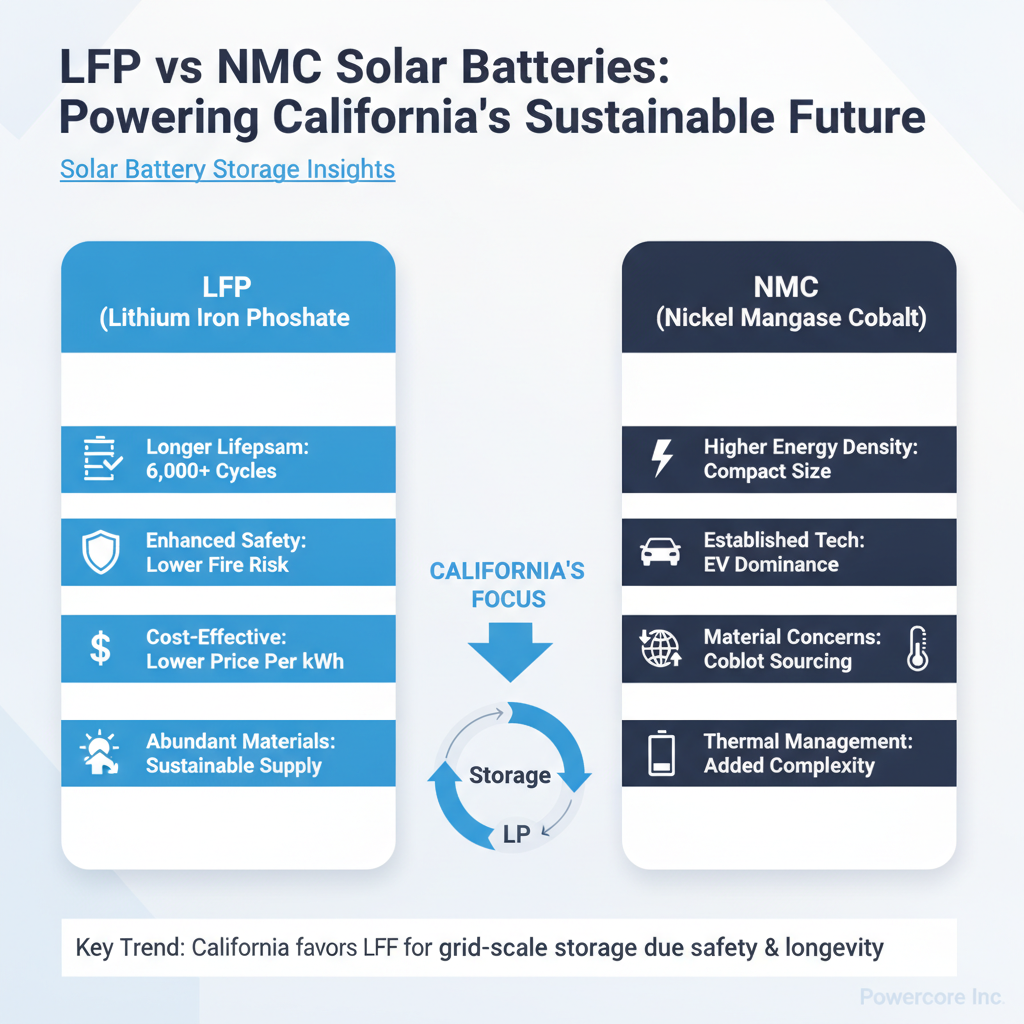
LFP vs NMC: A Head-to-Head Comparison for California Homes
To help you weigh the options, let's put LFP and NMC head-to-head on the most critical factors for California homeowners:
Safety
-
LFP: Clear Winner. Exceptionally stable, highly resistant to thermal runaway. Often considered the safest lithium-ion chemistry for residential use.
-
NMC: While modern NMC batteries have advanced safety features, they are inherently less stable than LFP and require more robust cooling and management systems to mitigate risks.
Lifespan and Cycle Life
-
LFP: Clear Winner. Offers significantly more charge/discharge cycles (6,000-10,000+), translating to a longer operational life and better long-term value, especially crucial for daily cycling under NEM 3.0.
-
NMC: Good cycle life (2,000-4,000), but generally shorter than LFP, potentially leading to earlier replacement.
Cost (Initial vs. Long-Term)
-
LFP: Often competitive or lower in initial cost, and significantly more cost-effective over its extended lifespan due to higher cycle count.
-
NMC: Generally higher initial cost due to material scarcity (cobalt). While declining, the long-term cost per kWh can be higher due to shorter cycle life.
Energy Density and Footprint
-
LFP: Lower energy density, meaning a larger physical footprint for the same capacity. This is a consideration if space is extremely limited.
-
NMC: Clear Winner. Higher energy density, resulting in smaller, lighter battery units. Ideal for constrained spaces.
Efficiency
-
LFP: High round-trip efficiency (typically 90-95%), meaning very little energy is lost during the charge/discharge process.
-
NMC: Comparable round-trip efficiency (also typically 90-95%). No significant difference here for most residential applications.
Environmental Impact
-
LFP: Clear Winner. Uses more abundant, less toxic materials (iron, phosphate), and avoids cobalt, reducing environmental and ethical concerns.
-
NMC: Relies on cobalt and nickel, which have higher environmental and ethical footprints.
Factors Influencing Your Choice in California
While the technical specifications are important, your personal circumstances and priorities as a California homeowner should ultimately guide your decision:
Budget and ROI
Consider not just the upfront cost but the total cost of ownership. An LFP battery, with its longer lifespan, often provides a superior return on investment over 15-20 years, especially when factoring in daily cycling under NEM 3.0 and the potential for federal incentives like the Investment Tax Credit (ITC).
Space Availability
Do you have ample space in your garage, utility room, or outdoors for a larger LFP system, or is a compact NMC unit more suitable for your property's layout?
Energy Needs and Usage Patterns
If your primary goal is daily cycling to maximize NEM 3.0 benefits and achieve long-term energy independence, LFP's superior cycle life makes it an excellent choice. If you anticipate less frequent cycling but need a powerful burst for specific appliances, NMC might be considered, though LFP systems are robust enough for most residential peak loads.
Safety Priorities
For many California homeowners, particularly in areas susceptible to wildfires, the enhanced safety profile of LFP batteries is a compelling advantage. Peace of mind knowing your battery is less prone to thermal issues is invaluable.
Environmental and Ethical Values
If minimizing your environmental footprint and supporting ethical supply chains are important to you, LFP batteries, with their absence of cobalt and reliance on more abundant materials, align better with these values.
California Regulations and Incentives for Battery Storage
Navigating the landscape of regulations and incentives can be complex, but Powercore Inc is here to help you understand how they apply to your battery storage project:
-
Self-Generation Incentive Program (SGIP): While largely allocated, SGIP has been a significant incentive for battery storage in California, particularly for low-income households or those in high fire-threat areas. Check for current availability and eligibility, as programs can evolve.
-
Federal Solar Investment Tax Credit (ITC): Both LFP and NMC batteries, when installed as part of a new solar system or retrofitted to an existing one, are eligible for the federal ITC, offering a significant percentage (currently 30%) off the total system cost. This applies to the battery's cost if charged by solar at least 75% of the time.
-
Local Permits and Safety Standards: Installing a battery storage system in California requires adherence to strict local building codes and electrical safety standards. Your system must be installed by licensed professionals to ensure compliance and safety. Powercore Inc, with our CSLB #1134334 (General B) and #1098175 (C-10 Electrical) licenses, ensures all installations meet or exceed California's rigorous standards.
Powercore Inc: Your California Solar & Storage Experts
Choosing the right solar battery storage solution is a significant decision for your California home, impacting your energy independence, financial savings, and peace of mind for years to come. At Powercore Inc, we don't just sell batteries; we provide comprehensive, tailored energy solutions designed to meet the unique needs of California homeowners across the entire state.
Our dual licensing as a General B and C-10 Electrical Contractor means we possess the expertise to handle every aspect of your project, from intricate electrical work to integrating your battery storage with other home improvements like HVAC, EV charging stations, or even ADUs and remodels. We understand the nuances of California's energy market, including NEM 3.0 and PSPS preparedness, and can recommend the ideal LFP or NMC battery system that maximizes your benefits.
We pride ourselves on our professional yet approachable tone, guiding you through the technical details with clarity and transparency. Whether you prioritize ultimate safety and long-term value (LFP) or a compact footprint with high power output (NMC), Powercore Inc will design and install a system that empowers your home for a sustainable future.
Making the Right Choice for Your Home
In summary, both LFP and NMC batteries offer compelling advantages for solar battery storage. For most California homeowners prioritizing safety, long-term durability, and maximum ROI through daily cycling under NEM 3.0, LFP often presents itself as the superior choice due to its exceptional cycle life, robust safety profile, and favorable environmental characteristics. However, if space constraints are paramount and a slightly higher energy density is critical, NMC could be considered.
The best battery for your home isn't just about LFP vs NMC; it's about understanding your specific energy consumption, backup power needs, budget, and long-term goals. A personalized consultation with an experienced professional is the most effective way to navigate these options.
Conclusion & Call to Action
As California continues its ambitious journey towards a carbon-neutral future, empowering your home with smart solar battery storage is a strategic investment in your energy independence and financial well-being. Don't let the technical complexities deter you from securing your home's energy future.
Ready to explore which solar battery chemistry is the perfect fit for your California home? Contact Powercore Inc today for a no-obligation consultation. Our expert team will assess your unique needs, explain your options clearly, and design a custom solar and battery storage solution that ensures your home is resilient, efficient, and ready for whatever California's energy landscape brings. Call us now at 916-699-8778 to take the first step towards true energy independence.