

California's Grid Revolution: What Are Virtual Power Plants (VPPs)?
The Golden State, a pioneer in renewable energy, faces a unique challenge: how to effectively integrate its abundant solar and wind power into a reliable, resilient grid. Enter Virtual Power Plants (VPPs) – a groundbreaking solution that is fundamentally reshaping how we generate, distribute, and consume electricity. Far from a futuristic concept, VPPs are actively being implemented across California, transforming ordinary homes into vital components of a smarter, more sustainable energy future.
At Powercore Inc, we believe understanding VPPs is not just for industry experts; it's crucial for every California homeowner looking to maximize their energy independence, contribute to grid stability, and unlock new financial opportunities.
The Core Concept: Aggregating Distributed Energy Resources
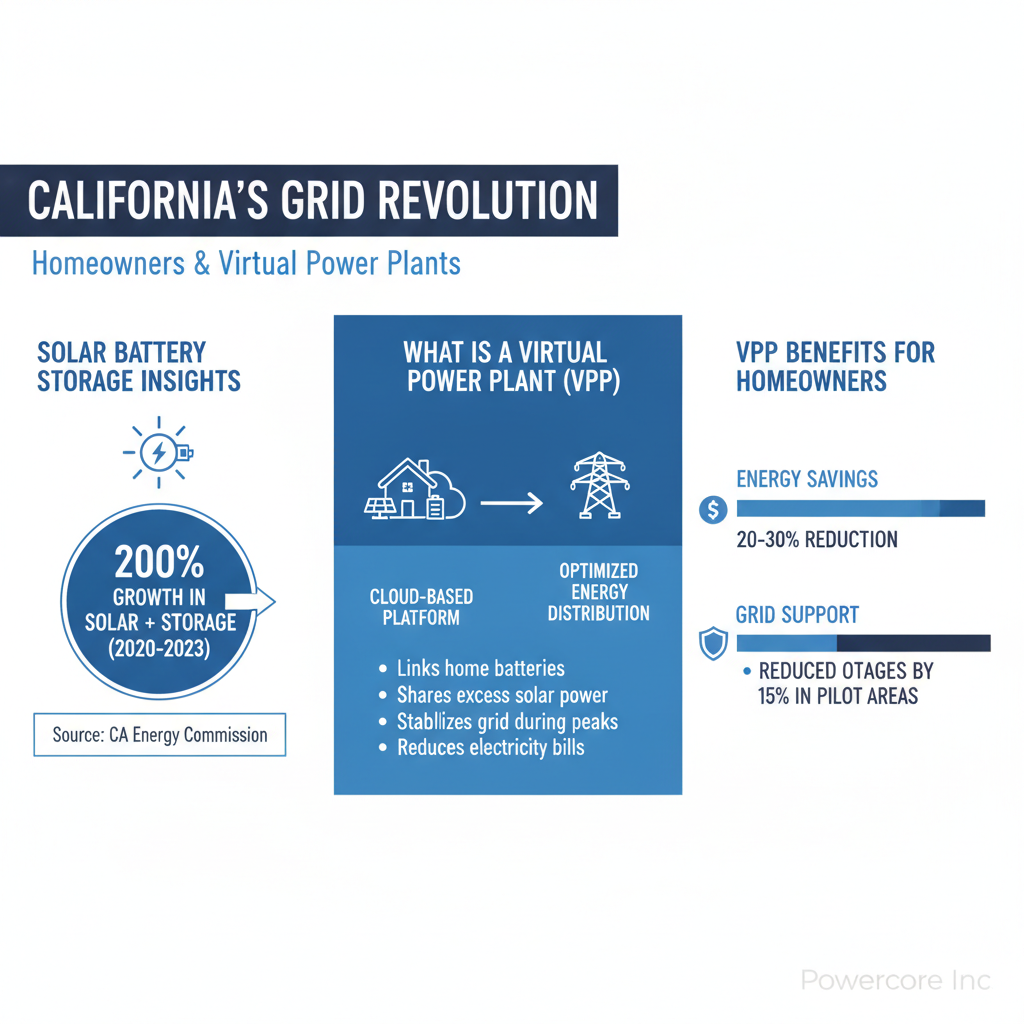
Imagine a vast network of smaller, independent energy resources – solar panels on rooftops, home battery storage systems, smart thermostats, and even electric vehicle (EV) chargers – all working in concert. This collective, managed by advanced software, is precisely what a Virtual Power Plant is. Instead of relying solely on large, centralized power plants, VPPs harness the cumulative power of thousands of distributed energy resources (DERs) to provide grid services, much like a traditional power plant would.
- Solar PV Systems: Generating clean electricity directly at the point of consumption.
- Battery Storage: Storing excess solar power for later use, enabling energy resilience and grid support.
- Smart Thermostats: Adjusting HVAC loads dynamically to reduce demand during peak times or grid stress.
- Electric Vehicle (EV) Chargers: Managing charging times to optimize grid load and potentially discharge power back to the home or grid (Vehicle-to-Home/Grid).
- Smart Appliances: Other internet-connected devices that can modulate their energy consumption based on grid signals.
The beauty of a VPP lies in its ability to aggregate these diverse assets into a single, controllable entity. When the grid needs power (e.g., during a heatwave), a VPP can dispatch stored energy from batteries. When there's too much power (e.g., abundant midday solar), it can direct batteries and EVs to charge, absorbing the excess. This dynamic flexibility is invaluable for a grid increasingly reliant on intermittent renewable sources, ensuring stability and preventing outages.
VPPs vs. Traditional Power Plants: A Paradigm Shift
Traditional power grids are built on a centralized model: large power plants generate electricity, which is then transmitted over long distances to consumers. This model, while effective for decades, struggles with the inherent variability of renewables and the growing demand for local resilience and sustainability.
Virtual Power Plants represent a decentralized paradigm shift, offering distinct advantages:
- Centralized vs. Distributed: Traditional plants are massive, singular entities with high upfront costs and long construction times. VPPs are networks of smaller, geographically dispersed units, built upon existing or new residential and commercial installations.
- One-Way vs. Bidirectional Flow: Traditional grids largely push power one way, from plant to consumer. VPPs enable bidirectional energy flow, allowing homes to both consume and contribute power, creating a more interactive and responsive grid.
- Inflexible vs. Flexible: Ramping up or down traditional fossil fuel plants can be slow, costly, and environmentally impactful. VPPs offer rapid, granular responses to grid needs, dispatching power or reducing demand in minutes.
- Monolithic vs. Resilient: A single point of failure in a traditional plant can have widespread impact. VPPs, by their distributed nature, enhance overall grid resilience, creating a more robust system that can better withstand localized disruptions.
- Polluting vs. Clean: Many traditional power plants rely on fossil fuels, contributing to emissions. VPPs primarily leverage clean, renewable energy sources, accelerating California's transition to a carbon-free future.
For California, a state committed to 100% clean energy and facing significant grid challenges, this shift is not just an option – it's a necessity. VPPs provide the agility, intelligence, and sustainability required to manage a complex, renewable-rich energy ecosystem.
California's Unique Energy Challenges & The VPP Solution
California stands at the forefront of renewable energy adoption, yet this leadership brings its own set of grid management complexities. Virtual Power Plants are emerging as a critical tool to address these specific Golden State challenges.
Renewable Integration & Grid Instability
The intermittent nature of solar and wind power poses significant challenges. Solar production peaks in the midday, often exceeding demand, leading to the infamous "Duck Curve" phenomenon where excess power needs to be curtailed or stored. In the evenings, as solar production drops but demand remains high, the grid faces a steep ramp-up challenge.
VPPs offer a dynamic solution:
- Load Shifting: Home batteries within VPPs can absorb excess midday solar, preventing curtailment and storing it for later use.
- Peak Shaving: During evening peaks, these batteries can discharge stored energy, reducing the strain on the grid and mitigating the Duck Curve's impact.
- Frequency Regulation: VPPs can rapidly adjust power output to maintain grid frequency, a crucial aspect of grid stability.
Peak Demand & Grid Resilience (Wildfires, Heatwaves)
California experiences extreme weather events, particularly heatwaves that drive unprecedented peak electricity demand for air conditioning. Additionally, the threat of wildfires often necessitates Public Safety Power Shutoffs (PSPS), leaving communities without power. VPPs significantly enhance grid resilience:
- Mitigating Peak Loads: By aggregating residential battery storage, VPPs can provide substantial power during critical peak demand periods, reducing the need for costly and often fossil-fuel-based peaker plants.
- Localized Backup Power: Homes participating in a VPP with battery storage gain a level of energy independence, providing backup power during local outages, including PSPS events. While not a complete off-grid solution, it offers critical power for essential loads.
- Faster Recovery: A decentralized network of energy resources can help communities recover faster from grid disruptions by providing localized power and reducing the burden on centralized infrastructure.
Policy & Incentives Driving VPP Adoption (SGIP, NEM 3.0 Context)
California's regulatory landscape is actively encouraging VPP development:
- Self-Generation Incentive Program (SGIP): While evolving, SGIP has been a cornerstone in promoting residential and commercial battery storage, making it more affordable for homeowners to install the foundational technology for VPP participation. Powercore Inc has extensive experience navigating SGIP and other incentive programs to maximize client savings.
- Net Energy Metering (NEM) 3.0: The shift to NEM 3.0 has significantly altered the economics of solar in California, making battery storage almost essential for maximizing solar self-consumption and value. VPPs offer a new revenue stream for homeowners under NEM 3.0, allowing them to monetize their stored energy by providing services to the grid.
- Community Microgrids & DER Aggregation: State policies are increasingly supporting the development of community microgrids and the aggregation of DERs, creating the framework for VPPs to flourish.
These policies, combined with the state's ambitious clean energy goals, create a fertile ground for Virtual Power Plants to become a dominant force in California's energy future.
Your Home's Role in California's Virtual Power Plants
For California homeowners, the idea of their residence becoming an active participant in the energy grid might sound complex, but the reality is surprisingly straightforward. With the right technology and an expert partner like Powercore Inc, your home can play a crucial role in stabilizing the grid and earning you rewards.
The Power of Solar + Battery Storage
At the heart of residential VPP participation is the integration of solar panels with a home battery storage system. Solar generates clean electricity, and the battery stores any excess. This combination provides the flexibility necessary for VPPs:
- Clean Generation: Your solar panels produce renewable energy, reducing your reliance on grid power and lowering your carbon footprint.
- On-Demand Energy: Your battery acts as a personal energy bank, storing surplus solar for use during peak hours, at night, or during grid outages.
- Grid Contribution: When your VPP operator signals a need, your battery can discharge a portion of its stored energy back to the grid, earning you compensation.
This symbiotic relationship between solar generation and battery storage creates a powerful, dispatchable energy asset right in your backyard.
Smart Inverters & Home Energy Management Systems (HEMS)
The intelligence behind your home's VPP participation comes from advanced technology:
- Smart Inverters: These are not just converting DC solar power to AC for your home; they are intelligent devices that can communicate with the grid and VPP operators, managing power flow and responding to grid signals in real-time.
- Home Energy Management Systems (HEMS): HEMS platforms provide you with visibility and control over your energy consumption. More importantly, they allow VPP operators to send signals to your battery or smart appliances, optimizing their behavior to support the grid while respecting your predefined preferences.
These systems work seamlessly in the background, ensuring your home's energy assets are contributing to the VPP without disrupting your daily life.
What Happens During a VPP Event? (Charge/Discharge)
A "VPP event" is simply when the VPP operator calls upon its aggregated resources to perform a grid service. This might happen during:
- Peak Demand: On a scorching California afternoon when air conditioners are running full blast, the VPP might signal your battery to discharge power to the grid, easing strain and preventing blackouts.
- Excess Renewable Generation: During a windy morning with abundant solar, the VPP might signal your battery to charge up, absorbing surplus energy that would otherwise be wasted.
- Grid Instability: If there's a sudden drop in grid frequency, your battery could rapidly inject power to stabilize the system.
Crucially, these events are typically automated and managed by the VPP software. Your system will respond based on the program's algorithms and your pre-set preferences, ensuring your home's energy needs are always prioritized. You retain control over your battery's reserve levels for backup power, and you're compensated for the energy you contribute to the VPP.
The Tangible Benefits of Participating in a VPP
Joining a Virtual Power Plant isn't just about being a good environmental steward; it offers concrete, measurable advantages for California homeowners.
Financial Incentives & Grid Services Payments
This is often the most compelling benefit for homeowners. By allowing your battery to provide services to the grid, you can unlock new revenue streams:
- Performance-Based Payments: Many VPP programs offer payments based on how much energy your battery contributes to the grid or how reliably it responds to dispatch signals.
- Peak Demand Reduction Payments: By reducing your household's demand during critical peak hours, you can earn incentives from your utility or VPP operator.
- Wholesale Market Access: Some advanced VPPs can participate directly in wholesale electricity markets, allowing homeowners to earn a share of the revenue generated by selling energy and ancillary services.
These payments can significantly offset the cost of your solar and battery system, accelerating your return on investment and transforming your energy assets into income-generating resources.
Enhanced Energy Resilience & Self-Sufficiency
Beyond financial gains, VPP participation bolsters your home's energy security:
- Backup Power During Outages: Your battery provides seamless backup power during grid outages, ensuring essential appliances remain operational, a critical advantage in regions prone to wildfires and PSPS events.
- Reduced Reliance on the Grid: By storing and using your own solar energy more effectively, you reduce your dependence on grid electricity, particularly during expensive peak hours.
- Greater Control: You gain a higher degree of control over your home's energy usage, optimizing it for both savings and grid support.
Environmental Impact: Accelerating California's Green Future
Your participation in a VPP directly contributes to California's clean energy goals:
- Reduced Emissions: By providing clean, dispatchable power, VPPs reduce the need for fossil fuel peaker plants, lowering greenhouse gas emissions.
- Efficient Renewable Integration: VPPs enable the grid to integrate more solar and wind power effectively by providing the flexibility needed to balance supply and demand.
- Sustainable Energy Ecosystem: You become an active part of a decentralized, sustainable energy ecosystem, helping to build a greener future for California.
Future-Proofing Your Home's Energy System
As energy markets evolve and grid technologies advance, a VPP-ready solar + storage system installed by experts like Powercore Inc ensures your home remains at the cutting edge. You're investing in a system that can adapt to new opportunities, regulations, and technologies, maximizing its long-term value and benefits.
Navigating California's VPP Landscape: What to Look For
The VPP ecosystem in California is dynamic and growing. Choosing the right program and ensuring your system is compatible are key steps for homeowners.
Key VPP Operators & Programs in CA
Various entities are launching and expanding VPP initiatives across California:
- Utility-Led Programs: California's major Investor-Owned Utilities (IOUs) – PG&E, SCE, and SDG&E – are actively developing and piloting VPP programs. These programs often focus on specific grid needs within their service territories and may offer direct incentives or bill credits.
- Third-Party Aggregators: Companies specializing in energy management and VPP operations are emerging. These aggregators contract with homeowners, manage their DERs, and participate in wholesale markets or utility programs on their behalf, often sharing the revenue.
- Community Choice Aggregators (CCAs): Many CCAs, which procure electricity for local communities, are also exploring VPP models to enhance local energy resilience and meet their renewable energy targets.
Each program will have its own eligibility criteria, compensation structure, and terms of service. It's vital to research and understand the options available in your specific location.
Understanding Program Requirements & Compensation Models
Before committing, carefully review the details of any VPP program:
- Battery Size & Type: Most programs require a minimum battery capacity to ensure meaningful grid contribution.
- Inverter Compatibility: Your solar inverter and battery inverter must be compatible with the VPP operator's communication and control systems.
- Commitment Period: Understand the length of the program commitment and any exit clauses.
- Compensation Structure: Is it a fixed payment, performance-based incentive, or a share of market revenues? How frequently are payments made?
- Control & Override: Clarify how much control you retain over your battery and if you can override VPP dispatches for personal use (e.g., ensuring backup power during a storm).
The Importance of a VPP-Ready System (Solar, Battery, Smart Tech)
To maximize your VPP benefits, your home's energy system must be designed with VPP participation in mind. This includes:
- Right-Sized Solar: Optimized to meet your daily needs and charge your battery efficiently.
- Appropriate Battery Storage: Sufficient capacity to provide both household backup and grid services.
- Smart Inverter Technology: Enabling seamless communication and control with the VPP platform.
- Integrated Home Energy Management: Allowing for intelligent orchestration of energy flows.
This is where expert guidance is invaluable. Powercore Inc specializes in designing and installing comprehensive solar + storage solutions that are not only efficient for your home but also future-proofed for VPP integration.
Partnering with Powercore Inc: Your VPP Journey Starts Here
Successfully integrating your home into California's Virtual Power Plants requires more than just installing solar panels; it demands a strategic approach to system design, expert installation, and ongoing support. As a California dual-licensed General B & C-10 Electrical Contractor (CSLB #1134334 & #1098175), Powercore Inc is uniquely positioned to guide you through every step of this exciting journey.
Designing a VPP-Optimized Solar + Storage System
At Powercore Inc, we don't offer one-size-fits-all solutions. Our team of experts takes a holistic view of your home's energy needs, your consumption patterns, and your aspirations for VPP participation. We consider factors like:
- Solar Production Potential: Maximizing your rooftop's solar generation to ensure ample energy for your home and battery.
- Battery Sizing & Chemistry: Recommending the ideal battery capacity and technology to meet your backup power needs and VPP participation goals.
- Smart Inverter & HEMS Selection: Choosing cutting-edge equipment that offers seamless VPP integration and robust communication capabilities.
- Future Expansion: Designing systems with the flexibility to adapt to evolving VPP programs and technological advancements.
Whether you're looking for solar, battery storage, EV charging, or a complete home energy overhaul, our expertise ensures your system is perfectly tailored for maximum efficiency and VPP readiness.
Seamless Installation and Integration
Our dual licensing as a General B and C-10 Electrical Contractor means we handle all aspects of your project in-house, from electrical wiring and panel upgrades to solar panel mounting and battery installation. This integrated approach ensures a smooth, efficient, and code-compliant installation, minimizing disruption to your home.
We work with leading manufacturers of VPP-compatible equipment, ensuring that your system is not only reliable but also ready to connect to the VPP of your choice. Our meticulous attention to detail guarantees that your solar, battery, and smart home technologies communicate flawlessly, setting the stage for optimal VPP performance.
Ongoing Support and Optimization
Your relationship with Powercore Inc doesn't end with installation. We're committed to ensuring your system performs optimally for years to come. We provide:
- System Monitoring: Helping you understand your energy production and consumption.
- VPP Program Guidance: Offering insights and updates on California's evolving VPP landscape.
- Maintenance & Service: Ensuring your solar and battery systems remain in top condition.
With Powercore Inc, you gain a trusted partner dedicated to helping you harness the full potential of your home's energy assets and contribute meaningfully to California's resilient energy future.
The Road Ahead: Challenges and the Future of California VPPs
While Virtual Power Plants hold immense promise for California, their widespread adoption and optimization still involve navigating certain challenges and embracing future innovations.
Policy Evolution & Regulatory Frameworks
The regulatory landscape for VPPs is still maturing. Key areas of ongoing development include:
- Standardization: Developing common protocols and standards for VPP communication and operation across different utilities and aggregators.
- Market Design: Refining wholesale and retail electricity markets to better value and compensate VPP services.
- Consumer Protections: Ensuring transparency, fairness, and robust data privacy for homeowners participating in VPPs.
As California continues its ambitious clean energy transition, policymakers will play a crucial role in creating a stable and supportive environment for VPP growth.
Technological Advancements (AI, Predictive Analytics)
The future of VPPs will be increasingly driven by advanced technologies:
- Artificial Intelligence (AI) & Machine Learning: Enhancing VPP software to make more accurate predictions about energy demand, supply, and grid conditions, leading to more optimized dispatch decisions.
- Predictive Analytics: Leveraging weather forecasts, historical data, and real-time grid conditions to anticipate needs and proactively manage DERs.
- Blockchain for Energy Trading: Exploring decentralized platforms for peer-to-peer energy trading and VPP settlement, potentially increasing efficiency and transparency.
These innovations will make VPPs even smarter, more responsive, and more valuable to the grid and participating homeowners.
Expanding VPP Reach Across the Golden State
Currently, VPPs are concentrated in certain regions or pilot programs. The future will see a significant expansion of their reach, integrating more diverse DERs and encompassing more communities:
- Commercial & Industrial Integration: Beyond residential, commercial buildings with solar, batteries, and smart HVAC systems offer vast VPP potential.
- Enhanced EV Integration: As Vehicle-to-Grid (V2G) technology becomes more prevalent, EVs will play an even larger role in VPPs, acting as mobile energy storage units.
- Broader Participation: Simplified enrollment processes and clearer financial benefits will encourage a wider range of homeowners and businesses to join VPPs.
California is poised to lead the nation in VPP deployment, creating a more resilient, sustainable, and democratized energy system for all its residents.
Conclusion: Powering California's Future, One Home at a Time
Virtual Power Plants are not just a technological marvel; they represent a fundamental shift in how we approach energy in California. They empower homeowners to move beyond being mere consumers, transforming them into active participants in building a more resilient, sustainable, and financially rewarding energy future for the entire state.
By investing in a solar + battery storage system and joining a VPP, you're not only securing your own energy independence but also contributing to the stability of the grid, reducing reliance on fossil fuels, and helping California achieve its ambitious clean energy goals.
Ready to unlock your home's potential as a Virtual Power Plant? Partner with Powercore Inc, your trusted California dual-licensed General B & C-10 Electrical Contractor. Our expertise in solar, battery storage, and comprehensive home energy solutions ensures a seamless transition to a VPP-ready home. Contact us today for a personalized consultation and take the first step towards empowering your home and California's grid. Call us at 916-699-8778 to learn more!