

Introduction: Powering California's Future with Strategic Battery Choices
As California continues its ambitious journey towards a cleaner, more resilient energy future, home battery storage has emerged as an indispensable component of modern solar energy systems. The Golden State's unique energy landscape, marked by evolving regulations like NEM 3.0, increasing grid volatility, and a strong push for sustainability, makes strategic energy decisions more critical than ever. For homeowners considering a robust solar setup, one of the most pivotal choices lies in the heart of their system: the battery chemistry.
Specifically, the debate often centers around two dominant technologies: Lithium Iron Phosphate (LFP) and Nickel Manganese Cobalt (NMC). Both offer compelling advantages, but their distinct characteristics in terms of safety, lifespan, performance, and environmental impact can significantly influence your long-term energy independence and return on investment. At Powercore Inc, a dual-licensed General B & C-10 Electrical Contractor based in Roseville, CA, we empower California homeowners with the knowledge to make informed decisions for their unique needs.
This comprehensive guide dives deep into the LFP vs. NMC battery discussion, providing California-specific insights to help you navigate the complexities and choose the optimal energy storage solution for your smart solar home. From understanding the core technologies to evaluating practical implications for your property, we'll equip you with the expertise to confidently step into California's electrified future.
The Growing Imperative for Home Battery Storage in California
California's energy environment has transformed dramatically, making home battery storage less of a luxury and more of a necessity for solar owners. Several factors underscore this shift:
Navigating NEM 3.0 and Time-of-Use Rates
The advent of NEM 3.0 has significantly altered the financial landscape for new solar installations, reducing the export credit for excess energy sent back to the grid. This makes self-consumption and strategic energy management paramount. Battery storage allows homeowners to store surplus solar energy generated during the day and use it during evening peak hours when electricity rates are highest under Time-of-Use (TOU) tariffs. This arbitrage strategy maximizes savings and enhances your solar investment's value.
Grid Resilience and Power Outage Protection
California residents are increasingly familiar with Public Safety Power Shutoffs (PSPS) due to wildfire risks, as well as general grid instability. A reliable home battery backup system provides peace of mind, ensuring your essential appliances and critical loads remain powered during outages. This resilience is a key driver for many Californians investing in integrated solar and battery storage solutions.
Energy Independence and Sustainability Goals
Beyond financial and reliability benefits, battery storage contributes to greater energy independence, reducing reliance on the grid. For eco-conscious homeowners, it aligns perfectly with sustainability goals by optimizing renewable energy use and minimizing carbon footprint. Powercore Inc specializes in designing and installing customized residential solar & storage systems that meet these evolving demands.
LFP vs. NMC: Understanding the Core Chemistries
Both LFP and NMC batteries are types of lithium-ion batteries, meaning they utilize lithium ions for charge and discharge. However, the cathode material—the positive electrode—is where they diverge, leading to significant differences in their characteristics.
Lithium Iron Phosphate (LFP): The Safety and Longevity Champion
LFP batteries use lithium iron phosphate (LiFePO₄) as their cathode material. This chemistry has gained immense popularity in stationary energy storage (like home batteries) and electric vehicles (EVs) due to its exceptional safety profile and long cycle life.
-
Chemical Stability: LFP is inherently more stable than other lithium-ion chemistries. The strong bond between phosphate and iron atoms makes it less prone to thermal runaway (overheating and potential combustion) even under extreme conditions like overcharging or physical damage.
-
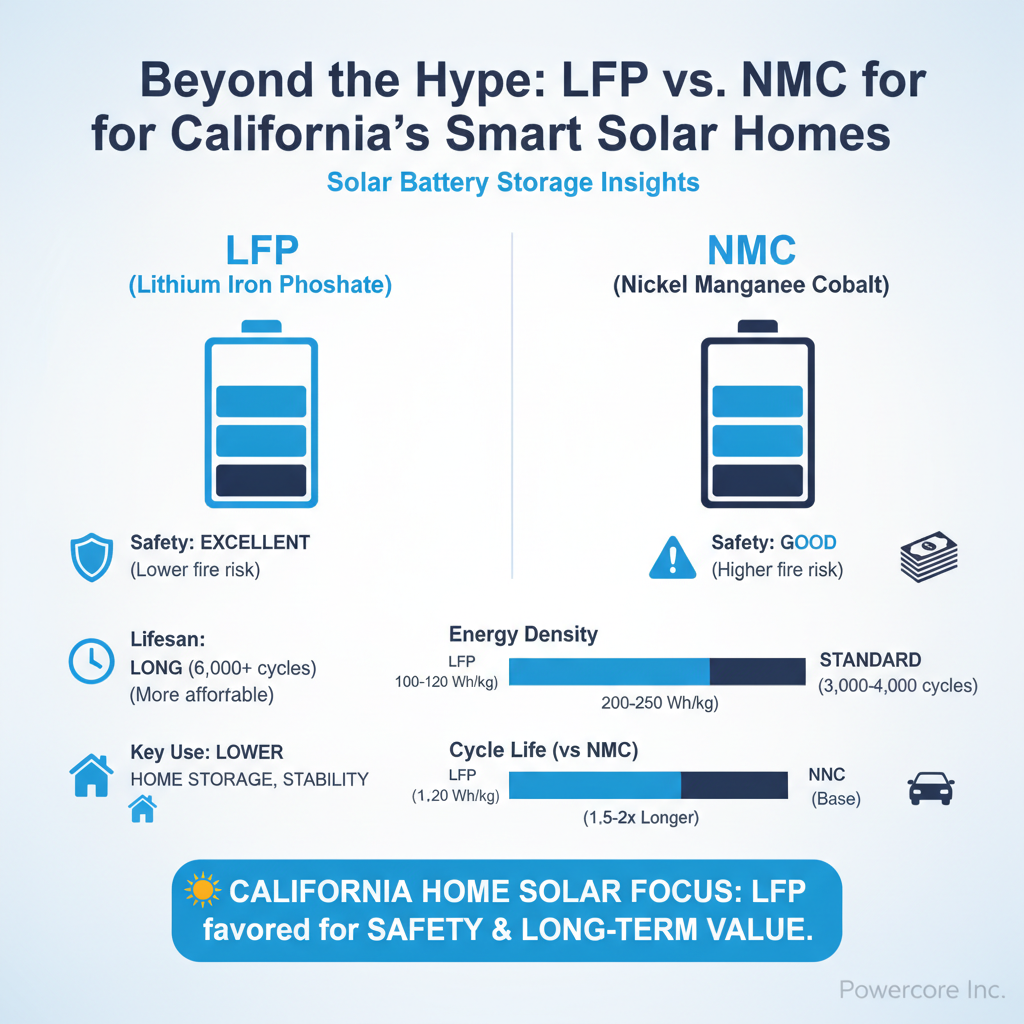
Long Cycle Life: LFP batteries typically offer a significantly higher number of charge/discharge cycles compared to NMC, often exceeding 6,000-10,000 cycles under ideal conditions. This translates to a longer operational lifespan for your home battery system.
-
Performance & Durability: They perform well across a wide temperature range and are more tolerant of full discharge cycles, which is beneficial for daily cycling in solar applications. They maintain high efficiency throughout their lifespan.
-
Environmental Profile: LFP does not use cobalt, a critical and often controversially sourced mineral, making it a more environmentally and ethically appealing choice for many consumers.
-
Energy Density: While LFP's volumetric and gravimetric energy density is generally lower than NMC (meaning it's larger and heavier for the same energy capacity), this is often less of a concern for stationary home storage where space might be available.
Nickel Manganese Cobalt (NMC): The Power and Density Performer
NMC batteries utilize a cathode composed of nickel, manganese, and cobalt. This chemistry is a workhorse in high-performance applications, most notably in a vast majority of electric vehicles where compact size and high power output are paramount.
-
High Energy Density: NMC batteries boast higher energy density, meaning they can store more energy in a smaller and lighter package. This is a significant advantage where space is at a premium, such as in compact urban homes or specific installation scenarios.
-
Strong Performance: They offer excellent power delivery, making them suitable for applications requiring rapid charging and discharging.
-
Cycle Life: While not as long-lived as LFP, modern NMC batteries still offer substantial cycle lives, typically ranging from 2,000 to 4,000 cycles, which can still provide many years of reliable service for residential use.
-
Temperature Sensitivity: NMC can be more sensitive to extreme temperatures, potentially impacting performance and lifespan if not properly managed by the battery's thermal management system.
-
Safety Considerations: Historically, NMC has had a higher propensity for thermal runaway than LFP due to its chemical composition. However, significant advancements in battery management systems (BMS) and cell design have greatly improved the safety profile of contemporary NMC batteries, especially those from reputable manufacturers adhering to stringent safety standards required for home applications.
Head-to-Head: LFP vs. NMC for California Homeowners
Choosing between LFP and NMC often comes down to prioritizing certain attributes based on your specific needs, budget, and property characteristics. Here's a direct comparison of key factors relevant to California homeowners:
Safety and Peace of Mind
In California, where fire safety is a paramount concern, the inherent chemical stability of LFP batteries often gives them an edge. Their reduced risk of thermal runaway provides an additional layer of safety and peace of mind for homeowners. While NMC battery safety has improved dramatically, LFP remains the industry benchmark for thermal stability.
Lifespan and Long-Term Value
LFP's superior cycle life means your battery system will likely last longer, potentially offering a better return on investment over its lifetime. For a system expected to cycle daily to manage TOU rates or leverage California battery storage incentives, a higher cycle count translates directly into more years of optimal performance before degradation becomes significant. NMC batteries, while having a shorter cycle life, still offer substantial longevity, especially with careful usage and advanced BMS.
Performance and Efficiency
Both chemistries are highly efficient. LFP batteries can often be discharged to a greater depth (closer to 0%) without significant long-term damage, allowing for more usable energy. NMC batteries excel in situations requiring very high power output for short bursts, though for typical home use, both provide ample power.
Cost: Upfront and Over Time
Historically, LFP batteries have had a lower manufacturing cost per kWh, translating to potentially lower upfront prices for homeowners. However, global supply chains and manufacturing efficiencies are constantly evolving, and the cost difference between LFP and NMC can fluctuate. When evaluating cost, it's crucial to consider the total cost of ownership, factoring in the longer lifespan of LFP batteries, which might result in a lower cost per cycle over the system's lifetime.
Space and Installation Considerations
Due to its lower energy density, an LFP battery system will generally be larger and heavier than an NMC system of equivalent capacity. For homes with limited installation space, an NMC battery's smaller footprint might be a significant advantage. Powercore Inc's expert installers can help assess your available space and recommend the best fit for your property.
Environmental Impact
The absence of cobalt in LFP batteries is a considerable environmental and ethical advantage, addressing concerns about mining practices and supply chain sustainability. While efforts are underway to make NMC production more sustainable and improve recycling, LFP currently leads in this aspect.
Making the Strategic Choice for Your California Home
The ideal battery chemistry for your California home depends on a careful assessment of your priorities. Here’s how to weigh the factors:
Prioritizing Safety and Longevity
If absolute safety, maximum lifespan, and the ability to cycle your battery heavily for years are your top concerns, LFP is likely the superior choice. Its robust chemistry and extended cycle life make it an excellent investment for long-term daily cycling, especially under NEM 3.0.
When Space is a Premium
For homeowners with limited space for battery installation, the higher energy density of NMC batteries could be a deciding factor. If a compact footprint is essential, NMC might offer a more discreet and practical solution without compromising significant energy capacity.
Balancing Upfront Cost with Long-Term Value
While LFP often has a lower upfront cost per kWh, both chemistries represent a substantial investment. Consider the total cost of ownership over the expected lifespan. An LFP battery with 8,000 cycles might offer a lower cost per cycle than an NMC battery with 4,000 cycles, even if the initial purchase price is similar or slightly higher for the LFP.
Leveraging California Incentives
Both LFP and NMC batteries generally qualify for various incentives designed to encourage battery storage adoption. The federal Residential Clean Energy Credit offers a significant tax credit (currently 30%) for eligible solar and battery storage installations. While the California Self-Generation Incentive Program (SGIP) has specific requirements, many LFP and NMC systems from approved manufacturers are eligible, further reducing your net cost. Powercore Inc can help you navigate these incentives to maximize your savings.
Future-Proofing Your Investment
The energy landscape is constantly evolving. Choosing a reliable, durable battery system ensures your home remains resilient and adaptable for decades to come. Both LFP and NMC are proven technologies, but understanding their fundamental differences allows you to align your choice with your personal vision for your home's energy future.
Why Powercore Inc is Your Trusted California Partner
Navigating the nuances of battery chemistries, system design, and California's specific regulations requires expert guidance. Powercore Inc stands as a premier California General B & C-10 Electrical Contractor, bringing unparalleled expertise to your solar and battery storage project.
-
Dual-Licensed Expertise: Our unique dual licensing ensures that every aspect of your project, from general construction to complex electrical installations, is handled by certified professionals. This streamlines the process, guarantees compliance, and delivers superior results.
-
Customized Solutions: We don't believe in one-size-fits-all. Powercore Inc assesses your specific energy consumption patterns, budget, property characteristics, and personal preferences to design a solar and battery storage system that perfectly aligns with your goals, whether that means prioritizing LFP's longevity or NMC's compact design.
-
Seamless Installation & Permitting: From initial consultation to final inspection, our team manages every step, ensuring a smooth, efficient, and code-compliant installation across California. We handle all permitting and utility interconnection paperwork, making your transition to energy independence hassle-free.
-
Beyond Installation: We offer comprehensive support, including insights into various battery options and how they integrate with your overall energy system, ensuring you understand your investment for years to come.
Conclusion: Empowering Your Energy Future with Confidence
The choice between Lithium Iron Phosphate (LFP) and Nickel Manganese Cobalt (NMC) batteries is a strategic decision that will shape your home's energy resilience, savings, and environmental impact for years to come. Both chemistries offer robust solutions for California homeowners, but understanding their distinct advantages in safety, lifespan, energy density, and cost is crucial for making the right investment.
At Powercore Inc, we are committed to empowering you with the knowledge and the highest quality installation services. Our team of expert General B and C-10 Electrical Contractors is ready to guide you through every step, ensuring your solar and battery storage system is perfectly tailored to California's unique demands and your personal energy goals. Make an informed decision that future-proofs your home and unlocks true energy independence.
Ready to explore which battery chemistry is best for your California home? Contact Powercore Inc today for a personalized consultation. Call us at 916-699-8778 or visit our contact page to schedule an appointment. Let us help you build a smarter, more resilient energy future.