

Introduction: Mastering Your Energy Future with California Demand Response Programs
In a state synonymous with innovation and environmental consciousness, California homeowners are constantly seeking smarter ways to manage energy. With fluctuating electricity prices, the growing demand on our grid, and a collective drive towards sustainability, the concept of a 'smart home' has evolved beyond mere convenience to become a strategic asset. At the forefront of this evolution are California Demand Response Programs — powerful tools designed to empower you, the homeowner, to actively participate in strengthening the grid while significantly reducing your utility bills.
As California's trusted dual-licensed General B and C-10 Electrical Contractor, Powercore Inc, based in Roseville and serving the entire state, understands the intricate dance between energy consumption, grid stability, and homeowner savings. We believe that truly smart energy management isn't just about installing efficient systems; it's about integrating them intelligently to respond to the dynamic needs of both your home and the broader energy infrastructure. This comprehensive guide will explore how demand response programs work in California, how modern smart home technologies — from solar and battery storage to EV charging — can maximize your participation, and why partnering with an expert like Powercore Inc is crucial for unlocking these peak savings.
What Are California Demand Response Programs?
At its core, demand response (DR) is a voluntary program that incentivizes electricity customers to reduce or shift their energy usage during critical periods of high demand. Think of it as a collaborative effort: when the grid is strained, perhaps during a scorching summer afternoon or an unexpected power plant outage, utilities ask customers to temporarily lighten their load. In return, participants receive financial incentives, bill credits, or other rewards.
Why Demand Response Matters for California
- Grid Stability: California's grid faces unique challenges, including extreme weather events and a growing population. DR programs help prevent blackouts and brownouts by balancing supply and demand in real-time.
- Reduced Peak Costs: Generating electricity during peak times is expensive and often relies on less efficient, more polluting 'peaker plants.' By reducing demand, DR lowers wholesale electricity costs for everyone.
- Environmental Benefits: Less reliance on peaker plants means fewer greenhouse gas emissions and a cleaner energy footprint for the state.
- Empowerment: DR puts control back into the hands of homeowners, allowing them to make conscious choices about their energy use and be rewarded for it.
Types of Demand Response Programs
While specific programs vary by utility (PG&E, SCE, SDG&E), most fall into a few general categories:
- Critical Peak Pricing (CPP): Customers pay higher rates during specific, predetermined critical peak hours, incentivizing them to reduce usage.
- Peak Time Rebates (PTR): Customers receive a rebate or credit for every kilowatt-hour (kWh) they reduce below their typical usage during designated peak events.
- Capacity Bidding Programs: Larger customers or aggregators commit to reducing a certain amount of load and are paid for that capacity, whether they're called upon or not.
- Automated Demand Response (ADR): This is where smart homes truly shine. ADR systems automatically adjust connected devices (like thermostats or EV chargers) in response to a DR signal, minimizing manual effort for the homeowner.
The California Public Utilities Commission (CPUC) plays a vital role in regulating and overseeing these programs, ensuring they benefit both consumers and the state's energy goals.
The Smart Advantage: Integrating DR with Your Home Technology
While manual participation in DR programs is possible, the true power — and convenience — comes from integrating these programs with your smart home ecosystem. Modern technologies allow for automated, seamless participation, maximizing your savings without sacrificing comfort or convenience.
Key Technologies for Maximizing DR Participation
Smart Thermostats and HVAC Control
Your HVAC system is often the largest energy consumer in your home. Smart thermostats, when enrolled in DR programs, can automatically pre-cool your home before a peak event and then subtly adjust the temperature during the event. This allows you to stay comfortable while reducing your energy demand during critical hours. Powercore Inc specializes in advanced HVAC climate control systems that seamlessly integrate with these energy-saving strategies.
Home Battery Storage Systems
This is perhaps the most impactful technology for DR participation. A home battery storage system allows you to store electricity generated by your residential solar panels or drawn from the grid during off-peak hours. When a DR event occurs, your home can then draw power from your battery instead of the grid, significantly reducing your peak demand and earning you substantial incentives. Furthermore, California offers compelling battery storage incentives that make this investment even more attractive, especially when combined with DR programs.
Solar Energy Systems and Smart Inverters
While solar panels generate power during the day, their output may not always align perfectly with peak demand hours, especially in the evening. Pairing solar with battery storage enables you to capture that daytime energy and deploy it strategically during DR events. Smart inverters, often part of modern solar installations, can also be programmed to respond to grid signals, optimizing your energy flow during critical periods. For more insights on optimizing solar and battery use, read our article: Mastering California's ToU Rates: Your Strategic Solar & Battery Guide.
EV Charging Stations
Electric vehicles represent a significant, yet flexible, load on the home's electrical system. Smart EV charging stations can be programmed to automatically pause charging during DR events or shift charging to off-peak hours when electricity is cheaper and demand is lower. This not only supports grid stability but also saves you money on your vehicle's energy costs. For guidance on setting up your EV charging, check out our resource: How to Choose and Install an Electric Car Charging Point for Home.
Smart Appliances and Plugs
Even smaller appliances can contribute. Smart dishwashers, washing machines, and dryers can be set to run only during off-peak or non-DR event hours. For non-smart devices, smart plugs can provide similar control, allowing you to remotely manage their power consumption. Discover how to tackle energy waste with our guide: 5 Steps to Use Smart Plug Strips to Stop Vampire Loads.
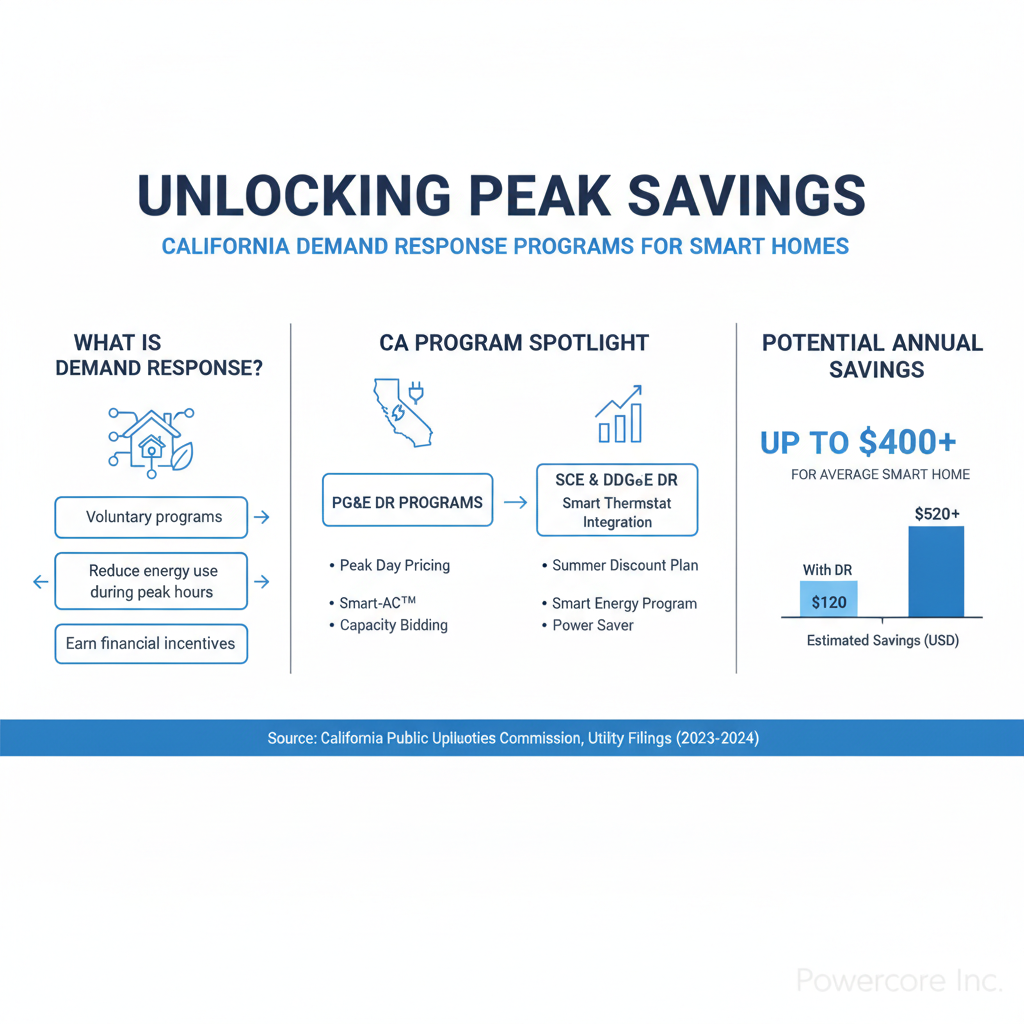
Navigating California's Demand Response Landscape: Utility Programs and How to Enroll
California's major utilities — Pacific Gas and Electric (PG&E), Southern California Edison (SCE), and San Diego Gas & Electric (SDG&E) — each offer various demand response programs tailored for residential customers. While the names and specifics may differ, the underlying goal remains the same: incentivize energy reduction during critical times.
Common Utility DR Programs
- PG&E's SmartAC Program: Allows PG&E to cycle your central AC compressor on and off for short intervals during peak demand events, typically on hot summer afternoons. You receive an incentive for participating.
- SCE's Power Share Program: Similar to PG&E's, Power Share works with smart thermostats to make small adjustments to your AC settings during high-demand periods, with participants earning bill credits.
- SDG&E's AC Rush Hour Rewards: This program also integrates with smart thermostats to manage AC usage during critical hours, offering financial rewards for reducing consumption.
- Emergency Load Reduction Programs (ELRP): These are often broader programs that provide incentives for reducing load during emergency grid conditions, sometimes through third-party aggregators.
Many of these programs are designed to integrate directly with popular smart thermostat brands and home energy management systems, making enrollment and participation straightforward. Powercore Inc can help you understand which programs are available in your specific service area and how best to integrate your home's systems to qualify and maximize benefits.
Enrollment and Optimization Tips
- Check Your Utility's Website: Start by visiting your specific utility's website to see the most current residential DR programs available in your area.
- Assess Your Home's Readiness: Do you have a smart thermostat? Are you considering solar and battery storage? These are key enablers for optimal DR participation.
- Connect Your Devices: Link your smart thermostat, EV charger, and home battery system to the utility's DR program or a compatible smart home energy management platform.
- Monitor and Adjust: While automated, it's good practice to periodically review your energy usage and DR participation to ensure you're maximizing savings and comfort.
- Consult an Expert: For comprehensive integration and optimization, especially if you're installing new solar, battery, or EV charging systems, a licensed contractor like Powercore Inc is invaluable.
The Financial and Environmental Benefits of Smart DR Participation
Engaging with California demand response programs, especially with a smart home setup, offers a multifaceted return on investment that extends beyond immediate bill reductions.
Significant Cost Savings
- Reduced Peak Charges: By shifting energy use away from high-priced peak hours, you directly cut down your electricity bill. Many California homes are on Time-of-Use (ToU) rates, making DR participation even more impactful.
- Incentive Payments & Bill Credits: Utilities offer direct financial incentives or bill credits for participating in DR events, providing an additional revenue stream for your energy-conscious efforts.
- Long-Term Value: Investments in smart home technology, solar, and battery storage are amplified by DR programs, leading to faster payback periods and greater overall savings over the lifetime of your systems.
Enhanced Grid Reliability and Resilience
Your participation directly contributes to a more stable and resilient energy grid for all Californians. By reducing demand during critical periods, you help:
- Prevent rolling blackouts and brownouts.
- Reduce the need for expensive and often carbon-intensive peaker power plants.
- Support the integration of more renewable energy sources into the grid.
Reduced Carbon Footprint
By optimizing your energy consumption and reducing reliance on fossil-fuel-generated electricity during peak times, you are actively contributing to a cleaner environment. Demand response is a key component of California's ambitious climate goals, helping the state transition to a more sustainable energy future.
Increased Home Value
A smart, energy-efficient home equipped with integrated solar, battery storage, and DR capabilities is a highly attractive asset in today's real estate market. These features not only offer immediate savings but also future-proof your home against rising energy costs and evolving environmental standards, enhancing its overall value and appeal.
Choosing Powercore Inc: Your Partner in Smart Energy Management
Navigating the complexities of California's energy landscape — from demand response programs and Time-of-Use rates to the installation of solar, battery storage, and EV charging — requires expertise and precision. That's where Powercore Inc stands as your ideal partner.
As a California dual-licensed General B and C-10 Electrical Contractor (CSLB #1134334 and #1098175), Powercore Inc brings unparalleled experience and comprehensive capabilities to every project. We're not just installers; we're integrators. Our team understands how each component of your home's energy system — be it solar, battery, HVAC, or EV charging — interacts to create a truly optimized and efficient smart home. We serve all of California, ensuring that homeowners across the state have access to expert guidance and high-quality installations.
We provide a holistic approach to energy solutions, ensuring your systems are not only installed to the highest standards but are also configured to maximize your participation in demand response programs and other incentives. From initial consultation and design to seamless installation and ongoing support, Powercore Inc is committed to helping you unlock peak savings and achieve true energy independence.
Conclusion: Powering a Smarter, More Resilient California Home
California demand response programs represent more than just a way to save money on your utility bill; they're an invitation to actively shape a more stable, sustainable, and energy-efficient future for our state. By strategically integrating these programs with your smart home technologies — particularly solar, battery storage, and EV charging — you can transform your home into a dynamic participant in California's energy ecosystem, reaping significant financial and environmental rewards.
Don't let the complexity deter you. With the right knowledge and an expert partner like Powercore Inc, you can confidently navigate the demand response landscape, optimize your energy use, and unlock substantial peak savings. Our commitment to excellence and our comprehensive expertise ensure that your smart home is not just smart, but strategically empowered.
Ready to transform your home's energy future and start unlocking peak savings with California Demand Response Programs? Contact Powercore Inc today at 916-699-8778 for a consultation. Let us help you design and implement an integrated energy solution that works for you and for California.