

Introduction: Unlocking Your Home's Energy Potential in California
California, a beacon of innovation and environmental stewardship, faces unique energy challenges. From scorching summer heatwaves to the increasing integration of renewable energy sources, managing the state's power grid requires a delicate balance. For homeowners, this often translates into fluctuating energy bills and concerns about grid reliability. But what if your home could actively contribute to grid stability and significantly reduce your energy costs at the same time?
Enter California Demand Response Programs. These innovative initiatives empower residents to become active participants in the state's energy future, offering financial incentives for temporarily reducing or shifting electricity usage during periods of high demand. Far from being a mere inconvenience, participating in these programs, especially when integrated with smart home technology, presents a powerful opportunity to save money, enhance grid resilience, and reduce your carbon footprint.
At Powercore Inc, a leading California dual-licensed General B & C-10 Electrical Contractor based in Roseville, we understand the complexities of the state's energy landscape. Our mission is to equip California homeowners with the knowledge and tools to navigate these programs effectively, transforming their homes into intelligent, energy-saving powerhouses. This comprehensive guide will demystify demand response, explore the specific programs available across California, and reveal how modern smart home solutions can maximize your benefits.
What Are Demand Response Programs? The Basics for California Homeowners
At its core, demand response (DR) is a voluntary program designed to balance electricity supply and demand, particularly during peak periods. Think of it as a coordinated effort where utilities ask customers to temporarily reduce or shift their electricity consumption in exchange for financial incentives or bill credits. This helps prevent blackouts, reduces the need for expensive and often polluting "peaker" power plants, and stabilizes the grid.
Why California Needs Demand Response
California's energy needs are dynamic and growing. The state's commitment to renewable energy, while commendable, introduces variability (e.g., solar generation drops in the evening). Combine this with extreme weather events, population growth, and the increasing adoption of electric vehicles, and you have a recipe for grid strain. Demand response acts as a flexible resource, allowing the grid operator (CAISO – California Independent System Operator) and local utilities to manage these fluctuations without resorting to emergency measures like Public Safety Power Shutoffs (PSPS) or rolling blackouts.
Types of Demand Response Events
While specific program names vary by utility, DR events generally fall into a few categories:
- Critical Peak Pricing (CPP): During designated "critical peak" hours (often hot summer afternoons), electricity prices skyrocket. Participating customers are incentivized to reduce usage during these times to avoid high costs.
- Peak Day Pricing (PDP): Similar to CPP, but typically involves a higher number of event days per year, with specific high-cost periods.
- Capacity Bidding Programs: Larger commercial or industrial customers might bid to reduce their load by a certain amount, receiving payment if they deliver. While less common for residential, some aggregators might pool residential customers for this.
- Automated Demand Response (ADR): Programs that leverage smart thermostats or other connected devices to automatically adjust energy usage during events, often with an override option for the homeowner.
- Flex Alerts: Public calls from CAISO for voluntary energy conservation, usually during extreme heat or grid emergencies. While not a direct financial incentive program, they highlight the need for DR.
Understanding these event types is the first step toward strategically participating and maximizing your benefits.
Key California Demand Response Programs for Homeowners: Utility-Specific Insights
California's three major investor-owned utilities – Pacific Gas and Electric (PG&E), Southern California Edison (SCE), and San Diego Gas & Electric (SDG&E) – each offer a variety of demand response programs tailored to residential customers. While principles are similar, names, incentives, and rules can differ. It's essential to identify your utility and explore their current offerings.
PG&E Demand Response Programs
- SmartRate™: Offers lower rates on most days but significantly higher rates on 9-15 "SmartDays" (typically weekdays 2-7 PM, May-October). Participants receive a bill credit guarantee for their first year.
- Peak Day Pricing (PDP): Similar to SmartRate, PDP has higher rates on approximately 9-15 "Peak Days," encouraging demand management during these critical periods.
- Third-Party Providers: PG&E partners with aggregators (e.g., OhmConnect, Leap) offering cash incentives for reducing energy during specific "OhmHours" or "Flex Alerts," often integrating with smart home devices.
Southern California Edison (SCE) Demand Response Programs
- Critical Peak Pricing (CPP): Customers on this rate face higher prices during critical peak events (15-20 days per year, 4-9 PM), balanced by lower baseline rates.
- Summer Discount Plan (SDP): Offers a monthly bill credit for allowing SCE to cycle your air conditioner on and off during high demand. You retain override ability.
- Smart Energy Program (SEP): Provides an incentive for customers with eligible smart thermostats to allow temporary temperature adjustments during peak demand, with opt-out control.
San Diego Gas & Electric (SDG&E) Demand Response Programs
- Critical Peak Pricing (CPP): SDG&E's CPP rates feature higher prices during peak hours (2-7 PM weekdays) and critical peak event days (up to 18 days per year, 2-7 PM). Lower prices apply during off-peak.
- Reduce Your Use Alerts: Public alerts encouraging voluntary conservation during high demand. Customers on time-of-use or CPP rates benefit by responding.
Eligibility and Enrollment
General eligibility often depends on your utility, having a smart meter, your existing rate plan, and eligible smart home devices for automated programs. Powercore Inc can help assess your home's readiness and guide you toward the most beneficial programs.
How Smart Home Technology Elevates Your California Demand Response Participation
While manual adjustments to your energy usage during a demand response event are certainly effective, the true power and convenience of maximizing your savings come from integrating smart home technology. These intelligent systems don't just make participation easier; they make it significantly more effective, often without requiring conscious effort from the homeowner.
The "Smart" Advantage: Automation and Optimization
Imagine receiving a Flex Alert or a notification for an upcoming CPP event, and your home automatically begins to pre-cool itself, your EV charging pauses, and your battery storage system prepares to discharge. This is the promise of smart home integration with demand response. Automation eliminates the need for constant monitoring and manual adjustments, ensuring you capitalize on every savings opportunity.
Key Smart Home Technologies for Demand Response Success
- Smart Thermostats: Devices like Nest, Ecobee, and Honeywell Home are often the cornerstone of residential DR. They can learn your preferences, optimize heating/cooling schedules, and, critically, receive signals from your utility or DR provider to automatically adjust temperatures during events. You can pre-cool your home before a peak event, then allow the thermostat to slightly raise the temperature during the event without significant discomfort, saving substantially.
- Smart EV Chargers: With California's push for electric vehicles, managing charging times is crucial. Smart EV chargers can be programmed to charge your vehicle during off-peak hours when electricity is cheapest and demand is low. Many utility programs offer specific incentives for smart charging, further integrating EVs into the DR ecosystem.
- Smart Appliances: Newer washing machines, dryers, and dishwashers often come with "delay start" functions or smart connectivity that allows them to run during off-peak hours. While the individual savings might be small, collectively, they contribute to a significant load shift during DR events.
- Home Battery Storage Systems: This is arguably the most impactful smart home technology for demand response, especially when paired with solar. A home battery (like those Powercore Inc expertly installs) can be programmed to charge during off-peak hours (when electricity is cheap or solar generation is abundant) and then discharge its stored energy to power your home during peak demand or DR events. This means you avoid pulling expensive grid power when it's most costly and when the grid is most stressed. This strategy is particularly powerful under California's NEM 3.0, where self-consumption and strategic energy usage are key to maximizing solar ROI.
- Solar PV Systems: While solar panels generate electricity rather than directly reducing demand from the grid during an event (they simply reduce the amount you pull from the grid), integrating solar with battery storage creates a powerful synergy. During a DR event, your solar panels can charge your battery, which then powers your home, further minimizing your reliance on grid power during high-cost periods.
- Integrated Energy Management Systems (EMS): These advanced systems act as the brain of your smart energy home. They connect all your smart devices – solar, battery, EV charger, HVAC, and appliances – allowing them to communicate and coordinate. An EMS can prioritize energy usage, monitor real-time rates, and automatically optimize your home's energy flow to maximize DR participation and savings without any manual intervention from you.
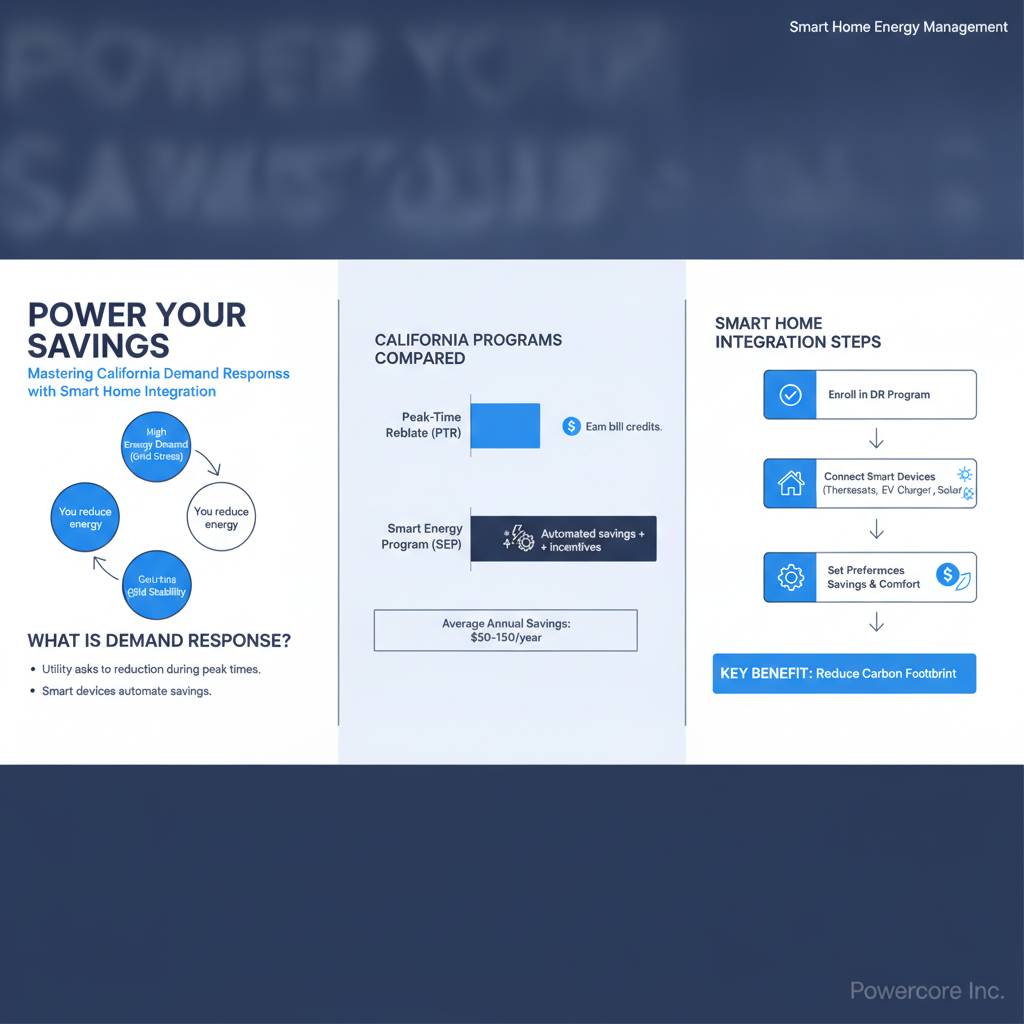
The synergy between demand response programs and smart home technology is clear. It transforms your home from a passive energy consumer into an active, intelligent participant in California's energy grid, offering unparalleled opportunities for savings and resilience. Powercore Inc specializes in designing and installing these integrated solutions, ensuring your home is not just smart, but strategically optimized for California's unique energy environment.
Maximizing Your Savings & Impact: Strategies for Strategic Demand Response Participation
Simply enrolling in a demand response program is a good start, but truly maximizing your financial benefits and positive impact on the grid requires a strategic approach. Here’s how California homeowners can get the most out of these programs:
- Understand Your Utility’s Specific Programs: Don't assume all DR programs are the same. Dive into the details of what PG&E, SCE, or SDG&E offers. Understand the event triggers, notification methods, incentive structures (bill credits vs. lower baseline rates), and any associated penalties for non-compliance.
- Integrate Solar + Battery Storage: This is the ultimate strategy for California homeowners, especially under NEM 3.0. A solar PV system generates clean energy, and a robust battery storage system allows you to capture and store that energy. During DR events, your battery can power your home, allowing you to effectively "opt out" of pulling expensive grid power without sacrificing comfort. Powercore Inc excels in designing and installing bespoke solar and battery storage solutions that seamlessly integrate with your home's energy needs and DR goals.
- Automate with Smart Home Technology: As discussed, smart thermostats, EV chargers, and integrated energy management systems are game-changers. By setting up automated responses, you ensure consistent participation and savings without the hassle of manual adjustments. Many programs offer incentives for installing these devices.
- Monitor Your Energy Usage: Knowledge is power. Utilize your utility's online portal or third-party energy monitoring apps to track your real-time and historical energy consumption. Identifying your personal "peak usage" habits can help you make more informed decisions about when and how to reduce your load during DR events.
- Be Proactive and Prepared for Alerts: Sign up for text or email alerts from your utility or DR provider. When an event is announced, take a few moments to review your schedule for the day and make a plan. Simple actions like pre-cooling your home, charging your EV before peak hours, or running large appliances earlier can make a significant difference.
- Consider a Whole-Home Energy Audit: An expert assessment from Powercore Inc can identify areas where your home is inefficient, such as outdated HVAC systems, poor insulation, or leaky windows. Addressing these foundational issues will naturally reduce your baseline energy consumption, making DR participation even more effective and comfortable.
By combining these strategies, you're not just participating; you're actively managing your home's energy profile to achieve maximum savings and contribute meaningfully to California's grid stability.
The Broader Benefits: Beyond Your Energy Bill
While the financial incentives are a compelling reason to participate in California demand response programs, the advantages extend far beyond your wallet. Your active involvement contributes to a more sustainable, reliable, and resilient energy future for the entire state.
- Enhanced Grid Stability and Reliability: Every time a homeowner reduces their energy consumption during a peak demand event, it lessens the strain on the grid. This collective effort helps prevent overloads, reduces the risk of rolling blackouts (like those experienced during past California heatwaves), and ensures a more stable power supply for everyone.
- Reduced Reliance on "Peaker" Power Plants: To meet sudden spikes in demand, utilities often fire up older, less efficient, and typically fossil-fuel-dependent "peaker" plants. These plants are costly to operate and contribute significantly to air pollution. Demand response helps mitigate the need for these plants, supporting cleaner air and a healthier environment.
- Lower Carbon Emissions: By reducing peak demand, especially when that demand would otherwise be met by fossil fuel generation, demand response directly contributes to lower overall carbon emissions. It aligns perfectly with California's ambitious climate goals and your personal commitment to sustainability.
- Support for Renewable Energy Integration: As California continues to integrate more solar and wind power, managing their inherent intermittency becomes critical. Demand response provides a flexible resource that can quickly adjust to changes in renewable generation, helping to smooth out energy supply and demand curves.
- Community Resilience: A stable grid benefits everyone. By participating in DR, you're not just saving money for yourself; you're contributing to a more robust energy infrastructure that can better withstand challenges, benefiting your neighbors and the broader community.
Participating in demand response is a tangible way for California homeowners to be part of the solution, demonstrating that individual actions can have a profound collective impact on the state's energy resilience and environmental health.
Navigating the Future: Demand Response, NEM 3.0, and California's Evolving Energy Landscape
California's energy policies are constantly evolving, and recent changes, particularly the implementation of NEM 3.0 (Net Energy Metering 3.0), have significantly reshaped the value proposition of rooftop solar. However, these changes also underscore the increasing importance and synergy of demand response programs, especially when integrated with advanced energy solutions.
Demand Response and NEM 3.0: A Powerful Synergy
Under NEM 3.0, the financial benefits of simply exporting excess solar power back to the grid have been reduced. This makes self-consumption and strategic energy management paramount. This is precisely where demand response, coupled with battery storage, becomes a game-changer:
- Maximizing Self-Consumption: By using your stored solar energy during peak hours (when grid electricity is expensive and DR events might occur), you reduce your reliance on the grid and maximize the value of your solar investment.
- Avoiding High Export Charges: Smart battery systems can be programmed to avoid exporting power during low-value times and instead store it for high-value peak periods or DR events.
- Enhanced ROI for Solar + Storage: Demand response participation, combined with NEM 3.0 optimization, creates a multi-layered savings strategy, significantly improving the return on investment for solar and battery storage systems.
The future of residential energy in California clearly points towards homes that are not just energy-efficient, but actively intelligent – capable of responding to grid needs and optimizing energy flow for maximum financial and environmental benefit.
The Evolution of Demand Response
As grid technology advances and more homes adopt smart devices, demand response programs are becoming increasingly sophisticated. We can expect to see:
- More Granular Incentives: Programs may offer even more precise incentives based on location, grid conditions, and individual usage patterns.
- Wider Device Integration: More smart home devices, from smart plugs to pool pumps, will likely be integrated into automated DR programs.
- Virtual Power Plants (VPPs): Aggregations of residential solar and battery systems acting as a single, dispatchable resource for the grid, further increasing their value and the potential for homeowner earnings.
Staying ahead of these trends requires expertise, and that's where a trusted partner like Powercore Inc comes in.
Why Choose Powercore Inc for Your Smart Home Energy Solutions in California
Navigating California's intricate energy programs and integrating advanced smart home technology requires a partner with deep expertise and comprehensive capabilities. Powercore Inc is that partner for homeowners across California.
As a California dual-licensed General B (CSLB #1134334) and C-10 Electrical Contractor (CSLB #1098175), we offer a unique, holistic approach to home energy management. We don't just install components; we provide integrated solutions that consider your entire home's energy ecosystem, from your roof to your electrical panel.
Our comprehensive services include:
- Solar & Battery Storage: Expert design and installation of high-performance solar PV systems and cutting-edge battery storage, optimized for NEM 3.0 and demand response.
- EV Charging: Seamless installation of smart EV charging stations, integrating your electric vehicle into your home's energy strategy.
- HVAC Systems: Upgrading to energy-efficient HVAC reduces baseline consumption, making DR participation more effective.
- Roofing & Siding: Ensuring your home's envelope is energy-efficient and resilient, a crucial foundation for any smart energy strategy.
- ADUs & Remodels: Integrating smart energy management from the ground up in new constructions or major renovations.
From Roseville to San Diego, Powercore Inc serves all of California. We pride ourselves on delivering exceptional craftsmanship, cutting-edge technology, and unparalleled customer service. When you choose Powercore Inc, you're choosing a partner committed to making your home more efficient, resilient, and ready for California's energy future.
Conclusion: Empower Your Home, Empower Your Savings
California demand response programs offer a tangible path for homeowners to take control of their energy future, providing significant financial incentives while simultaneously contributing to a more stable, cleaner, and resilient state grid. By understanding these programs and strategically integrating smart home technology – particularly solar and battery storage solutions – you can transform your home into an active participant in California's energy landscape, maximizing your savings and minimizing your environmental footprint.
Don't let the complexities of energy management deter you. Powercore Inc is here to guide you every step of the way, from assessing your home's unique needs to designing and installing a bespoke smart energy system that optimizes your demand response participation. Our expert team ensures you unlock every available saving and contribute to a sustainable California.
Ready to transform your home into an energy-saving powerhouse? Contact Powercore Inc today for a personalized consultation. Call us at 916-699-8778 or visit gopowercoreinc.com to learn more about how we can help you master California demand response programs and build a smarter, more resilient home.