

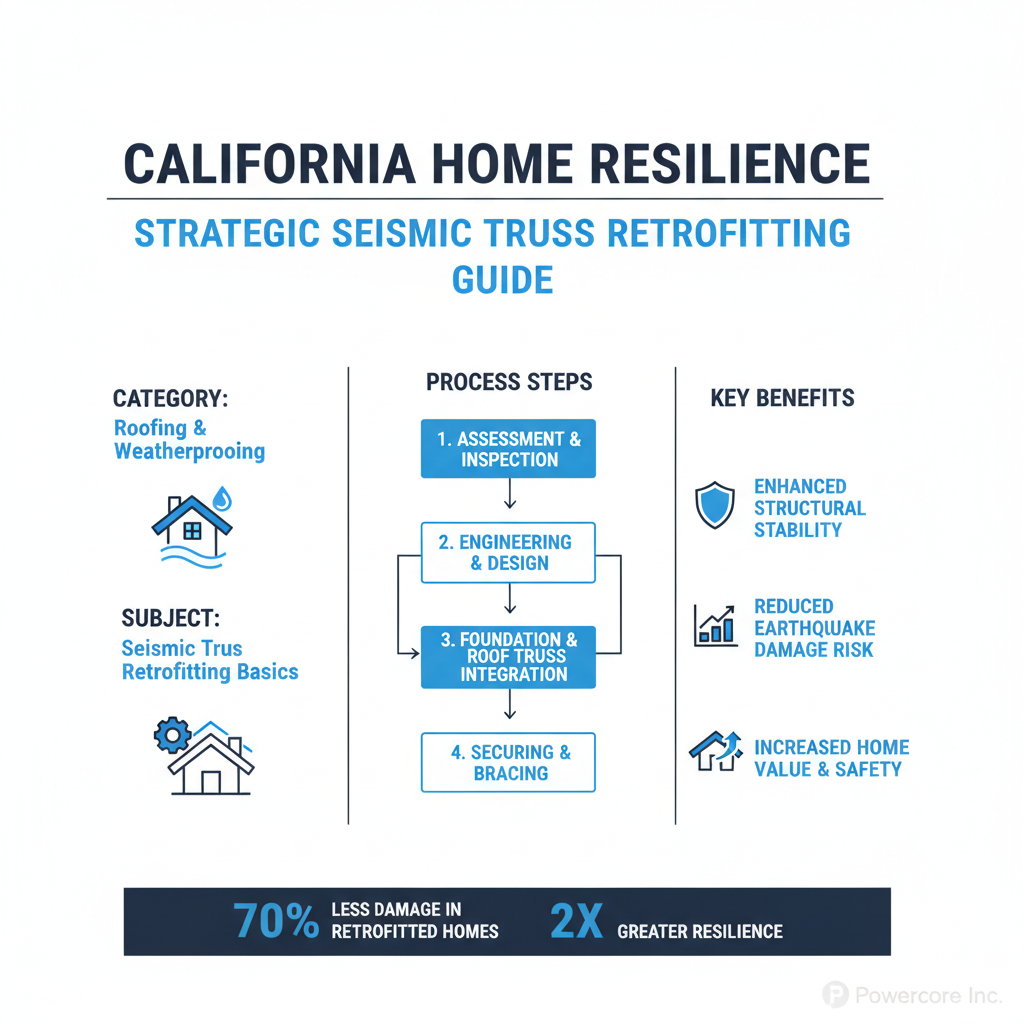
California Home Resilience: Strategic Seismic Truss Retrofitting Guide
California, a state renowned for its breathtaking landscapes and vibrant innovation, also sits atop one of the world's most seismically active regions. For homeowners, this reality necessitates a proactive approach to structural integrity, especially when it comes to the often-overlooked yet critical components of a home: the roof trusses. While you might focus on the visible exterior of your roof, the underlying truss system forms the skeleton that provides crucial support and stability. Understanding and implementing strategic seismic truss retrofitting isn't just about meeting code; it's about safeguarding your family, your investment, and your peace of mind.
At Powercore Inc, a dual-licensed General B & C-10 Electrical Contractor based in Roseville, CA, we understand the unique challenges and opportunities that come with owning property in California. With extensive experience across roofing, remodels, ADUs, and comprehensive structural enhancements, we bring a holistic perspective to home resilience. This guide delves into the basics of seismic truss retrofitting, exploring why it's essential for California homes, what the process entails, and how it contributes to the long-term safety and value of your property.
Understanding California's Seismic Landscape
California experiences thousands of earthquakes annually, though most are minor. However, the potential for significant seismic events, particularly along major fault lines like the San Andreas, Hayward, and San Jacinto faults, is a constant consideration. These events can exert immense forces on buildings, causing lateral (side-to-side) and vertical (up-and-down) stresses that can lead to severe structural damage, even collapse.
Older homes, particularly those built before modern seismic codes were fully adopted, are often most vulnerable. Their original construction methods may not have accounted for the intense shaking and differential movement that a major earthquake can induce. While foundation retrofitting often gets the spotlight, the integrity of your home's roof and its supporting truss system is equally vital. A compromised roof structure can lead to immediate hazards and exacerbate damage to the rest of the home.
What is Seismic Truss Retrofitting?
Seismic truss retrofitting involves strengthening the structural components of your roof's truss system to better withstand earthquake forces. Trusses are essentially frameworks of interconnected triangles, typically made of wood, that support the roof's weight and transfer it down to the exterior walls and foundation. In an earthquake, these connections can fail, leading to roof displacement, sagging, or collapse.
The Role of Trusses in Your Home's Structure
Think of your roof trusses as the backbone of your home's top level. They are engineered to distribute the load of the roofing materials, snow, and wind across the entire structure. A well-designed and robust truss system ensures the stability of your roof and, by extension, the integrity of your entire home. They form a critical part of the building's 'diaphragm,' which is how the roof acts as a horizontal beam, distributing seismic forces to the vertical shear walls.
Why Trusses Need Seismic Reinforcement
In a seismic event, the roof structure, including the trusses, can be subjected to significant inertial forces. If the connections between individual truss members, or between the trusses and the wall top plates, are insufficient, the roof can rack, twist, or even lift off its supports. Common vulnerabilities include:
- Weak Connections: Older construction often relied on simple nail plates or minimal fasteners that can fail under shear or tension.
- Lack of Lateral Bracing: Without adequate bracing, trusses can buckle or collapse sideways.
- Inadequate Anchorage: The roof diaphragm might not be securely anchored to the supporting walls, allowing the roof to slide off or separate.
Retrofitting addresses these weaknesses, turning a potentially vulnerable roof into a resilient component of your earthquake-resistant home.
Key Components and Techniques of Truss Retrofitting
Seismic truss retrofitting is not a one-size-fits-all solution; it’s a tailored approach based on your home's specific construction, age, and vulnerabilities identified by a structural engineer. However, several common techniques and components are frequently employed:
Reinforcing Connections and Joints
This is often the most fundamental aspect. It involves strengthening the points where individual truss members meet and where trusses connect to the top plates of the walls. Techniques include:
- Metal Connectors: Adding steel straps, hurricane ties, or hold-downs at critical junctures dramatically increases resistance to uplift and lateral forces.
- Additional Fasteners: Supplementing existing nail plates with structural screws or bolts.
- Plywood Gussets: For older, stick-framed roofs, plywood or OSB gussets can be added to reinforce joints, acting as larger, stronger connection plates.
Shear Walls and Bracing
While shear walls primarily refer to the vertical elements designed to resist lateral forces, their connection to the roof diaphragm is crucial. For the roof structure itself, bracing is vital:
- Diagonal Bracing: Adding diagonal lumber or steel straps within the truss system or connecting trusses to stiffen the overall roof plane.
- Strongback Bracing: Attaching continuous lumber perpendicular to the trusses at specific intervals to help distribute loads and prevent individual truss buckling.
Foundation Anchorage (Complementary Work)
Though not directly part of truss retrofitting, it's essential to understand that the entire building acts as a system. If your foundation isn't adequately anchored, even a perfectly retrofitted roof won't prevent overall structural failure. Powercore Inc, as a General B contractor, can assess and address these interconnected structural needs, ensuring a comprehensive approach to your home's resilience. This often involves bolting the sill plate to the foundation and reinforcing cripple walls.
Diaphragm Reinforcement
The roof sheathing (the plywood or OSB panels that form the roof's surface) acts as a horizontal diaphragm, transferring seismic forces to the shear walls below. Reinforcement techniques include:
- Re-nailing Sheathing: Adding more nails to the existing sheathing, especially at the edges, to create a stronger connection to the trusses and rafters.
- Adding Plywood Overlays: In some cases, an additional layer of plywood can be installed over existing sheathing to significantly enhance diaphragm strength.
- Sub-Diaphragm Installation: For roofs with skip sheathing or spaced sheathing, a new plywood sub-diaphragm may be installed before new roofing materials.
Benefits of Strategic Seismic Truss Retrofitting
Investing in seismic truss retrofitting offers a multitude of benefits that extend far beyond simple code compliance.
Enhanced Safety & Damage Mitigation
The primary benefit is, unequivocally, increased safety for your home's occupants. By strengthening the roof structure, you significantly reduce the risk of partial or complete roof collapse during an earthquake. This directly protects lives and prevents severe injuries, providing invaluable peace of mind for you and your family.
Furthermore, a robust roof structure mitigates overall property damage. A roof that remains intact is less likely to cause cascading failures in walls, ceilings, and other structural elements, potentially saving hundreds of thousands in repair costs after a major event.
Increased Property Value & Marketability
In a state like California, where earthquake risk is a known factor, a home with documented seismic retrofits is a more attractive and valuable asset. Potential buyers are increasingly aware of structural integrity, and a retrofitted home signals a responsible and forward-thinking homeowner. This can translate to a quicker sale and a higher asking price, making it a smart remodels and new construction investment.
Code Compliance & Peace of Mind
While many existing homes aren't legally required to undergo seismic retrofitting unless significant renovations occur, adhering to modern seismic standards is a wise decision. For new construction, such as ADUs and Guest Homes, these standards are mandatory. Proactively retrofitting ensures your home meets or exceeds current safety benchmarks, offering you peace of mind that your property is as resilient as possible.
Protecting Your Investment
Your home is likely your largest financial asset. Seismic retrofitting acts as an insurance policy against catastrophic loss. Beyond the physical structure, it protects the value of all the improvements you've made, from interior remodels to solar panel installations. Ensuring the structural integrity of your roof means protecting the entire ecosystem of your home.
The Retrofitting Process: What to Expect
Undertaking a seismic truss retrofitting project might seem daunting, but with an experienced contractor like Powercore Inc, the process is streamlined and efficient.
Initial Assessment and Engineering
The first step involves a thorough inspection of your home by a qualified structural engineer and an experienced contractor. They will assess your existing roof structure, identify vulnerabilities, and design a custom retrofitting plan. This plan will detail the specific reinforcements needed, materials to be used, and the methodology for installation.
Permit Acquisition
Seismic retrofitting is a significant structural alteration and almost always requires permits from your local building department. Powercore Inc assists homeowners through this often-complex process, ensuring all plans comply with local and state building codes. We also emphasize the importance of working with licensed contractors, like those holding a California CSLB #1134334 (General B) and #1098175 (C-10 Electrical) license, to ensure work is performed safely and to code. You can verify contractor licenses at the CA Contractors State License Board (CSLB) website.
The Installation Phase
Once permits are secured, the physical work begins. This involves carefully accessing the truss system, which may require temporary removal of some roofing materials or interior ceiling access. Our skilled teams then install the specified metal connectors, bracing, and sheathing reinforcements as per the engineered plans. This phase is executed with precision to minimize disruption and ensure structural integrity.
Post-Retrofit Inspection
Upon completion of the retrofitting work, a final inspection by the city or county building department is conducted. This verifies that all work has been performed according to the approved plans and meets all applicable building codes, ensuring your home is officially compliant and strengthened.
Costs of Seismic Truss Retrofitting in California
The cost of seismic truss retrofitting in California can vary significantly due to several factors. It's an investment, but one that offers substantial returns in safety and property value.
Factors Influencing Cost
- Home Size and Complexity: Larger homes with more complex rooflines will naturally require more materials and labor.
- Existing Structural Conditions: Homes with significant pre-existing damage or unique structural challenges may require more extensive and costly interventions.
- Accessibility: Ease of access to the truss system (e.g., attic space, need for temporary roof removal) can impact labor costs.
- Materials Used: The specific types and quantities of metal connectors, lumber, and sheathing required will influence the overall material cost.
- Engineering & Permit Fees: These are standard components of any major structural project.
- Geographic Location: While Powercore Inc serves all of California, local labor rates and specific regional code interpretations can sometimes cause minor variations.
General Cost Ranges
For a typical single-family home in California, comprehensive seismic truss retrofitting can range from $10,000 to $50,000 or more. This estimate can fluctuate based on the factors listed above. It's crucial to obtain a detailed, itemized quote from a licensed contractor after a thorough initial assessment. While this may seem like a significant outlay, it pales in comparison to the potential costs of repair or rebuilding after a major earthquake, not to mention the invaluable cost of human safety.
Potential for Incentives
While direct incentives specifically for truss retrofitting are less common than for foundation retrofits (like the Earthquake Brace + Bolt program), strengthening your home's overall resilience can sometimes qualify for broader home improvement loans or property tax benefits. It's always worth discussing potential options with your financial advisor or checking local and state programs.
Choosing the Right Contractor in California
The success and efficacy of your seismic truss retrofitting project depend heavily on the expertise of your chosen contractor. This is not a job for amateurs; it requires specialized knowledge of structural engineering, seismic forces, and California building codes.
Importance of Licensed and Experienced Contractors
Always choose a contractor with the appropriate licensing and a proven track record in structural work. Powercore Inc holds both a California CSLB #1134334 (General B) and #1098175 (C-10 Electrical) license, signifying our comprehensive capabilities across diverse construction projects. A General B license allows us to undertake projects involving more than two unrelated building trades, making us ideal for integrated structural and roofing work. Our C-10 Electrical license further highlights our commitment to comprehensive home solutions, ensuring we can handle any electrical aspects related to access or other systems impacted by the retrofit.
Questions to Ask
- Are you licensed and insured in California for this type of structural work?
- Can you provide references from previous seismic retrofit projects?
- Do you work with a licensed structural engineer for project design and approval?
- What is your process for obtaining permits and inspections?
- What is the projected timeline and payment schedule?
- Do you offer a warranty on your workmanship?
Importance of an Integrated Approach
Powercore Inc prides itself on offering an integrated approach to home improvement and resilience. When considering seismic retrofitting, it’s an ideal time to assess other areas of your home's exterior and structure. For example, if roof work is involved for access, it might be a strategic moment to consider siding and exterior upgrades or to inspect your overall roofing and weatherproofing for optimal performance.
Beyond Trusses: A Holistic Approach to Home Resilience
While seismic truss retrofitting is a critical step, true home resilience in California extends to many other areas. At Powercore Inc, we offer a full spectrum of services designed to future-proof your property:
- Solar & Battery Storage: Ensuring energy independence during power outages, which often accompany major seismic events.
- HVAC Climate Control: Maintaining comfortable indoor environments, even when external conditions are challenging.
- Remodels & New Construction: Building or enhancing homes with resilience at the forefront, including considerations for foundation, framing, and overall structural integrity.
- EV Charging: Preparing your home for future transportation needs while ensuring electrical safety.
Every service we provide is underpinned by our commitment to quality, safety, and long-term value for California homeowners. We understand that a home is more than just a structure; it’s a sanctuary and a significant investment that deserves the utmost protection.
Conclusion
Strategic seismic truss retrofitting is an indispensable investment for any homeowner in California. It's a proactive measure that protects against the inevitable forces of nature, ensuring the safety of your loved ones and the preservation of your property's value. Don't wait for the next major earthquake to consider the integrity of your home's roof structure.
With Powercore Inc, you gain a trusted partner with the expertise, licensing, and comprehensive service offerings to make your California home more resilient. From initial assessment to final inspection, we guide you through every step, ensuring a professional and effective retrofit. Protect your home and secure your future by taking action today.
Ready to assess your home's seismic resilience? Contact Powercore Inc, your California experts, for a consultation. Call us today at 916-699-8778 or visit our Contact Us page to learn more about how we can help safeguard your investment.