

Strategic Climate Control: VRF Multi-Zone Systems for CA Homes
California, with its diverse microclimates stretching from the cool coastal fog to the scorching inland valleys, presents a unique challenge for homeowners seeking optimal indoor comfort and energy efficiency. Traditional HVAC systems, often designed with a one-size-fits-all approach, frequently fall short of meeting the varied demands of different rooms, individual preferences, and the state's stringent energy standards. But what if there was a climate control solution that offered unparalleled precision, personalized comfort, and significant energy savings, all while seamlessly integrating into your modern California home?
Enter Variable Refrigerant Flow (VRF) multi-zone systems. Long favored in commercial applications for their superior performance and adaptability, VRF technology is now revolutionizing residential climate control. For California homeowners looking to future-proof their properties, enhance living comfort, and dramatically reduce energy consumption, VRF represents a strategic upgrade. At Powercore Inc, your dual-licensed General B and C-10 Electrical Contractor based in Roseville, CA, we understand the nuances of California's energy landscape and are dedicated to bringing cutting-edge solutions like VRF to homes across the state.
In this comprehensive guide, we'll delve deep into the world of VRF multi-zone systems, explaining how they work, outlining their game-changing benefits for California properties, and comparing them strategically against conventional HVAC. Discover why a VRF system might be the smartest investment for your home's long-term comfort, value, and sustainability.
What Exactly is a VRF Multi-Zone System?
At its core, a VRF system is an advanced HVAC technology that provides simultaneous heating and cooling to multiple zones or rooms within a building. Unlike conventional systems that cycle on and off at full capacity, VRF systems are designed to precisely control the amount of refrigerant flowing to each indoor unit. This allows for incredibly accurate temperature control and unmatched energy efficiency.
Beyond Traditional HVAC: The VRF Principle
Imagine your home's lighting. A traditional HVAC system is like an old-fashioned light switch – either fully on or fully off. A VRF system, by contrast, is like a dimmer switch, allowing you to fine-tune the light level (or in this case, the heating or cooling output) to exactly what's needed. This is achieved through:
- Variable Speed Compressors: The heart of a VRF system is its inverter-driven variable-speed compressor in the outdoor unit. Instead of operating at a fixed speed, it can modulate its output to match the precise heating or cooling demand of the building. This eliminates energy-wasting on/off cycles and ensures continuous, comfortable temperatures.
- Refrigerant Flow Control: VRF systems distribute refrigerant (not air) from a single outdoor unit to multiple indoor units via a network of small diameter pipes. Each indoor unit has its own electronic expansion valve, which precisely controls the amount of refrigerant entering that specific zone, allowing for individual temperature settings.
This intelligent modulation means the system only consumes the exact amount of energy required to maintain the desired comfort levels in each zone, leading to significant energy savings.
Key Components of a VRF System
A typical residential VRF multi-zone system comprises several essential components working in harmony:
- Outdoor Condensing Unit: This single unit houses the variable-speed compressor, condenser coil, and fan. Its compact design and quiet operation make it ideal for California homes where outdoor space and noise considerations are important.
- Indoor Units: These are the devices that deliver conditioned air to each zone. VRF offers an extensive array of indoor unit types, including:
- Ductless Mini-Splits: Wall-mounted, ceiling-cassette, or floor-standing units that require no ductwork, perfect for additions or spaces where ducts are impractical.
- Ducted Units: Concealed units that connect to traditional ductwork, ideal for maintaining a seamless aesthetic.
- Console Units: Resembling small radiators, these sit at floor level.
- Refrigerant Piping: A network of copper pipes connects the outdoor unit to all indoor units. Depending on the system type (two-pipe or three-pipe), these systems can provide simultaneous heating and cooling to different zones, further enhancing comfort and efficiency.
- Control System: Advanced controllers allow homeowners to manage individual zones from dedicated thermostats or a centralized control panel. Many systems also integrate with smart home platforms, offering remote access and scheduling capabilities via smartphone apps.
Why VRF is a Game-Changer for California Homes
For California homeowners, embracing a VRF multi-zone system isn't just an upgrade; it's a strategic move towards a more comfortable, energy-efficient, and sustainable lifestyle. Here's why VRF technology is particularly well-suited for the Golden State:
Unmatched Energy Efficiency & Savings
California boasts some of the highest electricity rates in the nation, making energy efficiency a top priority for homeowners. VRF systems excel in this area:
- Precise Load Matching: By only delivering the exact amount of heating or cooling needed for each zone, VRF systems virtually eliminate the energy waste common in traditional on/off systems.
- High SEER/EER/HSPF Ratings: VRF systems consistently achieve superior Seasonal Energy Efficiency Ratio (SEER), Energy Efficiency Ratio (EER), and Heating Seasonal Performance Factor (HSPF) ratings, translating directly into lower utility bills.
- Reduced Duct Losses: With fewer or smaller ducts (especially with ductless indoor units), VRF minimizes energy loss through ductwork, a common inefficiency in older homes.
- Synergy with Solar: For homes already equipped with residential solar panels, the increased efficiency of a VRF system can further reduce reliance on grid electricity, potentially leading to even greater savings and a smaller carbon footprint.
Investing in a VRF system is a tangible step towards meeting California's ambitious energy goals and enjoying substantial cost savings over the system's lifespan.
Personalized Comfort with True Multi-Zone Control
California homes often have diverse heating and cooling needs. A sun-drenched living room might require cooling, while a shaded bedroom simultaneously needs a touch of warmth. VRF systems are built for this complexity:
- Independent Zone Control: Each indoor unit can be set to its own temperature, allowing occupants to customize their comfort without affecting other areas of the home. This is ideal for multi-generational families, homes with home offices, or simply different preferences among family members.
- Eliminates Hot & Cold Spots: By precisely managing refrigerant flow, VRF systems maintain consistent temperatures throughout each zone, eliminating the frustrating hot and cold spots often found with single-thermostat systems.
- Simultaneous Heating and Cooling: Advanced VRF heat recovery systems can even heat one zone while cooling another, perfect for those transitional California days or homes with diverse internal heat loads.
Quiet Operation for Enhanced Living
Peace and quiet are highly valued in any home. VRF systems deliver on this front:
- Low Noise Levels: Outdoor units operate much quieter than traditional central AC units due to their variable-speed compressors. Indoor units are designed for whisper-quiet operation, often barely audible.
- Discreet Placement: Many indoor unit options, like concealed ducted units or slim wall-mounted models, are designed to blend seamlessly into your home's aesthetic without drawing attention.
Space-Saving & Flexible Design
California properties often come with space constraints, making VRF's compact design a significant advantage:
- Single Outdoor Unit: A single outdoor unit can serve numerous indoor units, reducing the visual impact and freeing up valuable outdoor space compared to multiple traditional AC condensers.
- Versatile Indoor Units: The wide range of indoor unit styles provides flexibility for any architectural design or room layout. This is especially beneficial for ADUs & Guest Homes or major home remodels where space optimization is critical.
- Reduced Ductwork: While ducted options exist, VRF can also be implemented with minimal or no ductwork, simplifying installation and reducing energy loss associated with extensive duct runs.
Scalability for ADUs, Remodels, and Expansions
California homeowners often undertake renovations or additions. VRF systems offer impressive scalability:
- Modular Design: As your needs evolve, it's often possible to add more indoor units to an existing VRF system, making it ideal for future home expansions or new ADU construction without overhauling your entire HVAC infrastructure.
- Future-Proofing: Investing in VRF means you're adopting a system that can adapt to changes in your home's layout and occupancy, ensuring long-term comfort and efficiency.
VRF vs. Traditional HVAC Systems: A Strategic Comparison
When considering an investment in a new climate control system for your California home, it's essential to weigh VRF against more traditional options like central air conditioning or conventional heat pumps. Here's a strategic comparison:
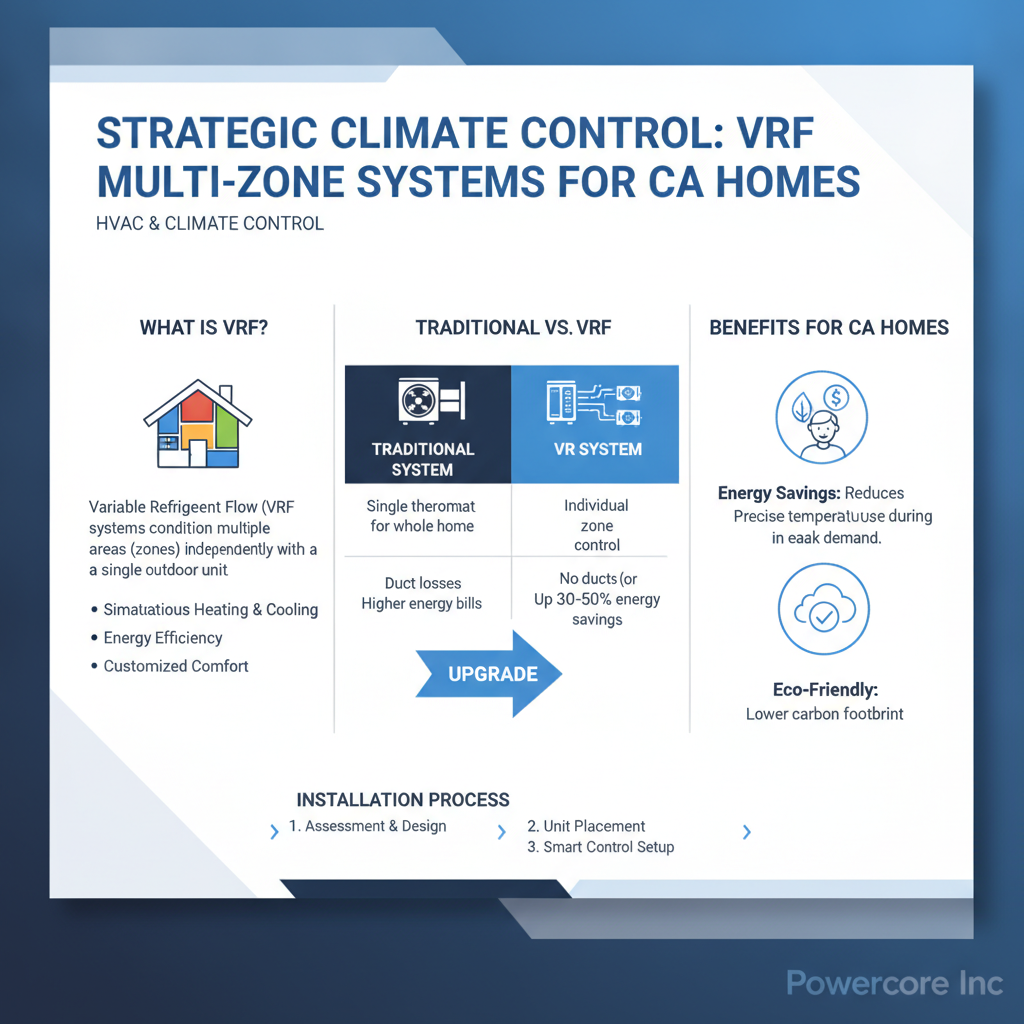
Initial Investment vs. Long-Term ROI
- Initial Cost: VRF systems typically have a higher upfront installation cost than conventional central HVAC systems. This is due to their advanced technology, more complex installation, and specialized components.
- Long-Term ROI: However, the long-term energy savings of a VRF system can be substantial. With lower operating costs, especially in California's high-utility environment, VRF can offer a quicker payback period and a more favorable total cost of ownership over its 15-20 year lifespan. Furthermore, a high-efficiency VRF system can increase your home's resale value, appealing to eco-conscious buyers.
Performance, Control, and Reliability
- Temperature Stability: VRF systems offer superior temperature stability. Their continuous, variable operation prevents the temperature swings often experienced with traditional systems that cycle on and off.
- Dehumidification: VRF systems are highly effective at dehumidifying the air, contributing to greater comfort and improved indoor air quality, which is particularly beneficial in humid California climates.
- Advanced Controls: VRF provides granular control over individual zones, something traditional systems with a single thermostat cannot match. This leads to personalized comfort and prevents energy waste in unoccupied rooms.
- Reliability: Designed for continuous, modulated operation, VRF systems often experience less wear and tear than traditional units that frequently cycle on and off at full blast, potentially leading to a longer lifespan.
Environmental Impact & Sustainability
- Reduced Carbon Footprint: By significantly reducing energy consumption, VRF systems contribute to a smaller carbon footprint, aligning perfectly with California's strong commitment to environmental protection and clean energy initiatives.
- Refrigerant Use: Modern VRF systems often utilize environmentally friendly refrigerants with lower global warming potential (GWP), further enhancing their ecological benefits.
Is a VRF Multi-Zone System Right for Your California Home?
While VRF systems offer compelling advantages, they are not a one-size-fits-all solution. Consider if a VRF system is the right strategic fit for your California home based on these scenarios:
Ideal for New Construction & Extensive Renovations
If you're building a new home or undertaking a significant remodel, integrating a VRF system from the outset is highly advantageous. It allows for optimal design and installation, maximizing efficiency and performance without the constraints of existing infrastructure. Powercore Inc's expertise in both general construction and electrical work makes us an ideal partner for such comprehensive projects.
Replacing Aging, Inefficient Systems
Is your current HVAC system outdated, constantly breaking down, or causing exorbitant energy bills? Upgrading to a VRF system can transform your home's climate control, offering a dramatic improvement in efficiency, comfort, and reliability. It's a strategic investment that pays dividends in comfort and savings.
Homeowners Prioritizing Smart Technology & Sustainability
For environmentally conscious homeowners who value cutting-edge technology and want to reduce their carbon footprint, VRF is a clear choice. Its smart controls and exceptional energy efficiency align perfectly with a sustainable lifestyle and can often integrate seamlessly with other smart home systems, creating a truly intelligent living environment.
Partnering with Powercore Inc for Your VRF Solution
Choosing the right HVAC system is a significant decision, and selecting the right contractor is even more crucial. Powercore Inc stands as California's trusted expert for advanced climate control solutions, including the sophisticated installation and maintenance of VRF multi-zone systems.
California's Dual-Licensed HVAC & Electrical Experts
As a California dual-licensed General B (CSLB #1134334) and C-10 Electrical Contractor (CSLB #1098175), Powercore Inc brings a unique and invaluable advantage to your VRF project. The installation of a high-tech VRF system often involves complex electrical work, from power supply upgrades to integrating advanced control systems. Our combined expertise ensures that every aspect of your HVAC & Climate Control installation is handled in-house, seamlessly, and to the highest standards of safety and efficiency. This eliminates the need for multiple contractors, streamlining your project and guaranteeing compliance with all California building and electrical codes.
Comprehensive Project Management, Statewide Service
From the initial consultation and custom design to professional installation and ongoing support, Powercore Inc provides end-to-end project management. We take the time to understand your specific needs, assess your home's unique characteristics, and recommend the ideal VRF solution tailored for maximum comfort and energy savings. Our commitment to excellence extends across all of California, bringing our expertise to homeowners throughout the state.
Beyond HVAC: A Full Spectrum of Home Improvements
At Powercore Inc, we believe in a holistic approach to home improvement. An energy-efficient VRF system works best within an optimized home envelope. We also offer services like Siding & Exterior upgrades, Roofing & Weatherproofing, and Solar & Battery Storage, all of which contribute to your home's overall energy performance and comfort. This integrated approach ensures that your home functions as a complete, high-performance system.
Take Control of Your California Home's Climate Today
The future of home climate control is here, offering unparalleled comfort, efficiency, and flexibility. A VRF multi-zone system is not just an expense; it's a strategic investment in the long-term value, sustainability, and comfort of your California home. Ready to explore how VRF technology can transform your living environment?
Contact Powercore Inc today for a personalized consultation. Our expert team is ready to answer your questions and guide you through the process of designing and installing the perfect VRF solution for your California property. Call us at 916-699-8778 or visit our contact page to schedule your appointment. Experience the Powercore Inc difference – where expertise meets innovation for your ultimate home comfort.