

Introduction: The Critical Importance of Contractor Insurance
Embarking on a home improvement project in California, whether it's a major remodel, a new ADU, solar installation, or a simple deck upgrade, is an exciting venture. You envision the transformation, the added value, and the enhanced comfort your property will gain. However, amidst the blueprints and material selections, there's a critical element that often gets overlooked: your contractor's insurance. This isn't just bureaucratic red tape; it's the unseen shield that protects your home, your finances, and your peace of mind.
In California, the stakes are particularly high. With stringent regulations, a dynamic housing market, and the sheer scale of investment involved in property enhancements, hiring a properly insured and licensed contractor is not merely a recommendation—it’s a non-negotiable safeguard. An uninsured or underinsured contractor can expose you, the homeowner, to catastrophic financial liabilities, project delays, and legal nightmares.
At Powercore Inc, a California dual-licensed General B & C-10 Electrical Contractor based in Roseville, CA, we understand that trust is built on transparency and compliance. We believe every homeowner deserves to understand the full scope of protection that proper California contractor insurance requirements provide. This comprehensive guide will equip you with the knowledge to navigate these crucial requirements, ensuring your next project is not only successful but also secure.
Why Contractor Insurance Matters: More Than You Think
Many homeowners focus solely on cost and timelines when evaluating contractors. While these are important, overlooking adequate insurance coverage is a dangerous oversight. Here's why it's paramount:
Protecting Your Financial Investment
- Property Damage: Accidents happen. A dropped tool, an electrical mishap, a burst pipe during construction—these can cause significant damage to your existing property or the new work. Without proper insurance, you could be left to cover expensive repairs out of pocket.
- Theft and Vandalism: Construction sites can be targets. If materials are stolen or your property is vandalized during the project, a contractor’s insurance (specifically Builder's Risk, if applicable) can cover the losses, preventing you from bearing the cost.
- Substandard Work & Project Abandonment: While insurance primarily covers accidents, a contractor's bond (a type of financial guarantee) offers recourse if a contractor fails to complete the work as agreed or doesn't pay subcontractors/suppliers, protecting you from financial loss.
Shielding You From Legal Liabilities
- Worker Injuries: In California, if an employee of your contractor is injured on your property and the contractor lacks Workers' Compensation insurance, you, the homeowner, could be held liable for their medical expenses, lost wages, and even pain and suffering. This is a profound and often overlooked risk.
- Third-Party Bodily Injury: What if a visitor or passerby is injured due to construction-related hazards on your property? Commercial General Liability (CGL) insurance protects the contractor and, by extension, you from claims arising from such incidents.
- Lawsuits and Legal Costs: Defending against claims, even if unfounded, can be incredibly expensive. Proper insurance ensures legal costs are covered, preventing personal financial strain.
Ensuring Project Continuity and Peace of Mind
When a contractor is properly insured, it signals professionalism and responsibility. It means they've invested in protecting their business, their employees, and their clients. This translates directly to greater reliability and fewer headaches for you, the homeowner. You can proceed with your solar installation, ADU construction, or interior remodel knowing that unforeseen circumstances won't derail your project or drain your bank account.
Key Types of Contractor Insurance in California
Understanding the different types of insurance is crucial for verifying adequate coverage. Here are the primary forms you should look for:
Workers' Compensation Insurance: The Critical Employee Safety Net
What it covers: This insurance provides medical treatment, disability benefits, and vocational rehabilitation for employees who get injured or become ill as a direct result of their job. It's a no-fault system, meaning benefits are paid regardless of who was at fault.
California-specifics: In California, all employers with one or more employees are legally required to carry Workers' Compensation insurance. If a contractor hires even one person, they must have it. If they claim to have no employees and operate as a sole proprietor, verify this carefully, as the CSLB (Contractors State License Board) requires sole proprietors to declare this when applying for a license. An injured worker without this coverage can sue the homeowner directly.
Commercial General Liability (CGL) Insurance: Your Property's Defender
What it covers: CGL insurance protects against claims of bodily injury or property damage to third parties (which includes you, the homeowner, and your property) arising from the contractor's operations. This is the insurance that would cover, for example, if a worker accidentally drills through a water pipe, causing damage to your home, or if a piece of equipment falls and damages your landscaping.
California-specifics: While not strictly mandated for all contractors by the CSLB (though a minimum is required for those with employees or those wanting to disclose coverage on their license record), carrying robust CGL insurance is an industry standard and a sign of a responsible contractor. The CSLB recommends that homeowners always require a contractor to carry at least $1 million in CGL coverage. Importantly, ensure that you are listed as an "Additional Insured" on the policy, which extends some of the policy's protections to you.
Contractor's Bond: Financial Security for Consumers
What it covers: A contractor's bond (specifically, the California Contractor's Bond) is a guarantee that the contractor will follow state laws and perform their work according to the contract. It provides a limited amount of financial recourse for consumers who suffer damages due to a contractor's fraudulent or negligent actions, or failure to complete a project or pay for materials/subcontractors.
California-specifics: All licensed contractors in California are required to have a contractor's bond, currently set at $15,000. While this amount might seem small for large projects, it’s a fundamental requirement that demonstrates the contractor's commitment to compliance and offers a basic layer of consumer protection. There are also additional bonds, like a "Bond of Qualifying Individual," and sometimes project-specific performance bonds.
Other Relevant Insurance Types
- Builder's Risk Insurance: This project-specific policy covers damage to the structure and materials during construction. While often carried by the homeowner or general contractor on large projects, it's good to clarify who holds this coverage.
- Commercial Auto Insurance: Covers vehicles used for business purposes, including accidents involving company trucks or equipment.
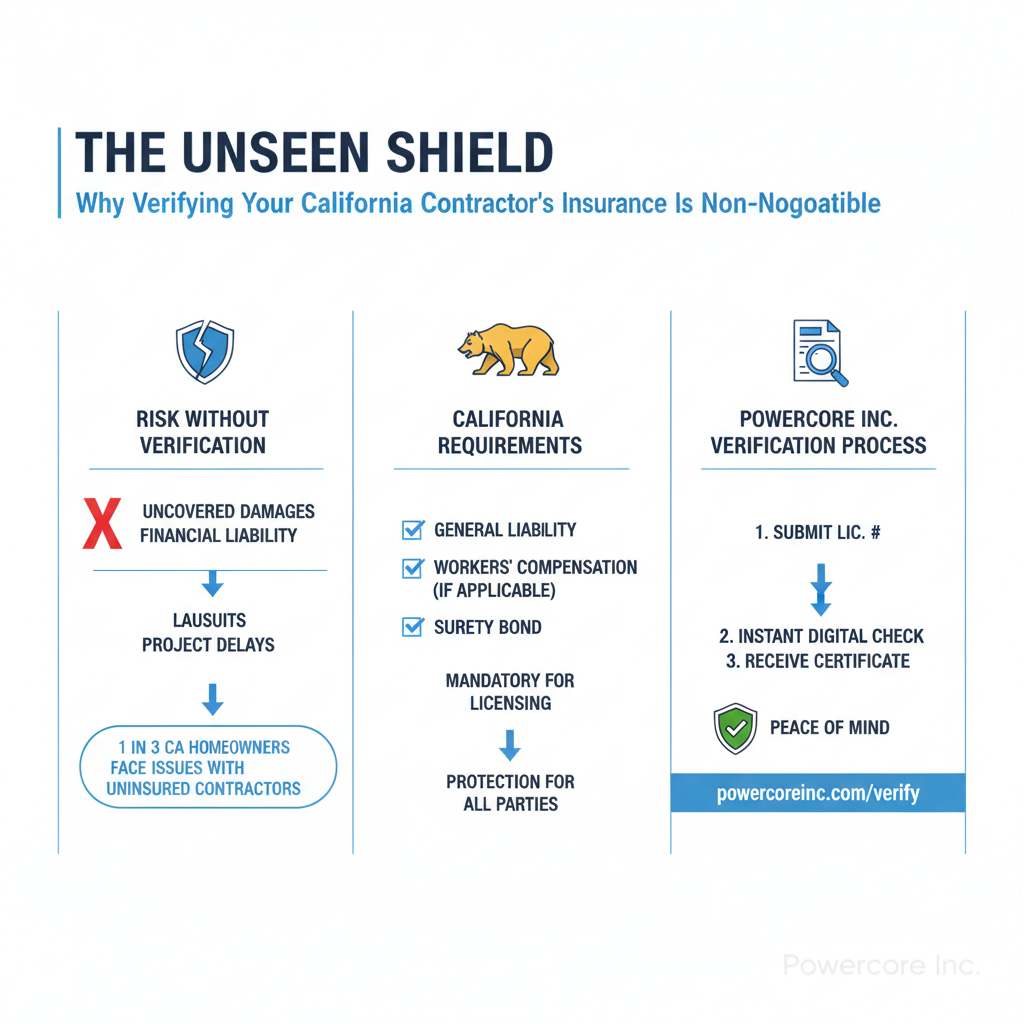
California's Stringent Requirements and What They Mean for You
California's Contractors State License Board (CSLB) is one of the most proactive licensing boards in the nation. Their regulations are designed to protect consumers, but it's ultimately up to you to verify compliance.
The CSLB License, Bond, and Insurance Mandate
Every contractor performing work valued at $500 or more (labor and materials) must be licensed by the CSLB. As part of this licensing, they must:
- Maintain a Contractor's Bond: Currently $15,000.
- Have Workers' Compensation Insurance: If they have employees. This is publicly verifiable on the CSLB website.
- Disclose CGL Insurance: While not always mandated for sole proprietors without employees, if a contractor declares CGL coverage on their license, it must meet specific minimums. For contractors with employees, carrying CGL is highly recommended and often a prerequisite for many clients.
Consequences of Non-Compliance for Homeowners
Hiring an unlicensed or uninsured contractor in California carries severe risks:
- Personal Liability: As discussed, you could be responsible for worker injuries or third-party damages.
- No Recourse for Shoddy Work: If an unlicensed contractor performs poor work, you have little to no legal recourse through the CSLB, potentially leaving you with expensive repairs.
- Voided Homeowner's Insurance: Your own homeowner's insurance policy might deny claims related to work performed by an unlicensed or uninsured contractor.
- Fines and Penalties: In some cases, homeowners who knowingly hire unlicensed contractors can face fines.
How to Verify a California Contractor's Insurance
Verifying a contractor's insurance isn't difficult, but it requires diligence. Don't just take their word for it. Here's a step-by-step process:
1. Check the CSLB Website
The CSLB website (cslb.ca.gov) is your first and most powerful tool. Use their "Check a License" feature to:
- Verify License Status: Ensure the license is active and for the correct classification (e.g., General B for general construction, C-10 for electrical). Powercore Inc holds both #1134334 (General B) and #1098175 (C-10 Electrical), demonstrating comprehensive capabilities.
- Confirm Bond Status: The website will show if the required contractor's bond is active.
- Review Workers' Compensation: It will clearly state if the contractor has Workers' Comp insurance (and the policy details) or if they are exempt (declaring no employees).
2. Request Certificates of Insurance (COIs)
A Certificate of Insurance (COI) is a document issued by the insurance company that summarizes the contractor's coverage. Request COIs for:
- Commercial General Liability (CGL)
- Workers' Compensation
What to look for on a COI:
- Effective Dates: Ensure the policies are current and will remain active through the duration of your project.
- Coverage Limits: Verify the limits meet or exceed your expectations (e.g., at least $1 million for CGL).
- Named Insured: Confirm the contractor's business name matches exactly.
- "Additional Insured" Endorsement: For CGL, ask the contractor to have their insurer list you (the homeowner) as an "Additional Insured." This is a critical step that extends some of the contractor's liability coverage to you for claims arising from their work.
3. Call the Insurer Directly
The most reliable way to verify a COI's authenticity and current status is to call the insurance company listed on the certificate. Provide the policy number and ask them to confirm coverage, limits, and if you are listed as an additional insured. This prevents fraudulent certificates.
4. Watch for Red Flags
- Contractor hesitates to provide COIs.
- COIs look altered or unprofessional.
- Insurance policy dates are expired or about to expire before your project ends.
- Claims they "don't need" certain insurance.
- Offers a significantly lower bid than others, potentially by cutting corners on insurance.
Powercore Inc: Your Trusted, Fully Insured California Partner
When you choose a contractor for your solar panel installation, battery storage system, HVAC upgrade, new roof, ADU construction, remodel, EV charging station, siding replacement, decking project, or interior remodeling across California, you're making a significant investment. You deserve a partner who not only delivers exceptional craftsmanship but also operates with the highest standards of professionalism and compliance.
Powercore Inc embodies this commitment. As a California dual-licensed General B (#1134334) and C-10 Electrical (#1098175) Contractor, we are fully licensed, bonded, and insured, exceeding California's stringent requirements. We proudly provide transparent documentation of our Workers' Compensation and Commercial General Liability insurance, and we are happy to list our clients as "Additional Insured" on our CGL policies.
Our extensive range of services, coupled with our unwavering dedication to safety and compliance, means you can trust Powercore Inc to handle your project across California—from Roseville to San Diego, San Francisco to Palm Springs—with complete peace of mind. We understand the unique challenges and regulations of California construction, and our comprehensive insurance coverage is a testament to our responsibility and our promise to protect your home and investment at every stage.
The Hidden Dangers of Uninsured Contractors: A Cautionary Tale
While the allure of a lower price from an uninsured contractor might be tempting, the potential risks far outweigh any initial savings. Consider these scenarios:
- The "Friend of a Friend" Scenario: A casual arrangement with someone who "does work on the side" without proper licensing or insurance might seem friendly, but it's a direct path to personal liability if an accident occurs.
- The Project Gone Wrong: Imagine your new ADU frame collapses due to faulty work, or a newly installed solar array malfunctions, causing a fire. Without CGL, you're left to sue the individual, hoping they have assets to cover the immense damage.
- The Worker Injury Nightmare: A worker falls from your roof during a siding installation, breaking a leg. If the contractor lacks Workers' Comp, that individual can directly sue you, the property owner, for medical bills, lost wages, and potentially a lifetime of care. This isn't theoretical; it happens in California.
These aren't scare tactics; they are real possibilities that underscore the absolute necessity of verifying every aspect of your contractor's credentials, especially their insurance.
Your Role as a Homeowner: Due Diligence is Key
Ultimately, the responsibility to protect your property and finances rests with you. By understanding California contractor insurance requirements and actively verifying your chosen contractor's coverage, you're not just being cautious; you're being a smart, responsible homeowner. Don't let the excitement of a new project overshadow the critical need for due diligence.
Take the time to:
- Ask for multiple references and check them.
- Obtain detailed written contracts.
- Never pay in full upfront.
- And crucially, verify all licenses, bonds, and insurance certificates thoroughly.
Conclusion: Build with Confidence, Build with Powercore Inc
Hiring a contractor is a partnership built on trust. In California, that trust must be underpinned by a solid foundation of proper licensing, bonding, and comprehensive insurance. The unseen shield of contractor insurance is not a luxury; it's an essential layer of protection for your home, your family, and your financial future.
When you're ready to embark on your next home transformation—be it solar, HVAC, an ADU, or a full remodel—choose a partner who prioritizes your security as much as the quality of their work. Choose Powercore Inc. We're committed to delivering excellence across all our services, backed by full compliance and robust insurance coverage. For a consultation on your next project, and to experience the peace of mind that comes with working with a fully licensed and insured expert, contact Powercore Inc today at 916-699-8778. Let us help you build your dream with confidence and complete protection.