

Introduction: Guarding Your California Investment with Smart Contractor Choices
Embarking on a home improvement project in California, whether it's a major remodel, a solar installation, a new HVAC system, or an ADU build, represents a significant investment of time, money, and trust. While envisioning the beautiful outcome is exciting, smart homeowners understand that the foundation of any successful project lies in selecting the right professionals. Beyond skill and reputation, one of the most critical, yet often overlooked, aspects of contractor selection is ensuring they carry proper insurance. In California's dynamic regulatory environment, the phrase "contractor insurance requirements" isn't just bureaucratic jargon; it's your frontline defense against unforeseen risks.
At Powercore Inc, a dual-licensed General B & C-10 Electrical Contractor based in Roseville, CA, we understand the complexities of construction and the peace of mind that comes with complete compliance. Serving all of California, we believe in empowering homeowners with the knowledge to make informed decisions. This comprehensive guide will delve into why verifying contractor insurance is not just a good idea, but a non-negotiable step for safeguarding your home, your finances, and your family.
Why Contractor Insurance Matters to YOU: Your Shield Against Project Risks
For many homeowners, the thought of insurance only comes up when something goes wrong. However, for a major home project, understanding and verifying your contractor's insurance policies should be a proactive measure. Here’s why it's paramount for your protection:
Mitigating Financial Risk and Unexpected Costs
Construction projects, by their very nature, involve inherent risks. Accidents can happen – a worker might be injured on your property, materials could be damaged, or an unforeseen error could cause damage to your existing structure. Without adequate insurance, these incidents could leave you, the homeowner, directly liable for medical bills, property repairs, or even legal fees. A properly insured contractor transfers this risk away from you, protecting your financial well-being.
Ensuring Legal Compliance and Peace of Mind
California has stringent regulations for licensed contractors, including specific insurance requirements. Hiring an uninsured contractor, even unknowingly, can expose you to legal ramifications. More importantly, knowing that your chosen contractor is fully insured provides invaluable peace of mind. It signifies a professional who takes their responsibilities seriously and is prepared for potential eventualities, allowing you to focus on the exciting aspects of your project rather than worrying about catastrophic liabilities.
Navigating California's Contractor Insurance Landscape: Key Policies You Need to Understand
California's Contractors State License Board (CSLB) sets specific mandates for contractors. While the exact requirements can vary based on the contractor's business structure and scope of work, several types of insurance are fundamental. Let's break down the essential coverages:
General Liability (GL) Insurance: Your Primary Defense
General Liability (GL) insurance is arguably the most critical policy for any contractor. It protects against claims of bodily injury or property damage caused by the contractor's work, employees, or operations. This is the insurance that would typically cover:
- Damage to your home or neighboring properties (e.g., a dropped tool damages your hardwood floor, a falling ladder breaks a window).
- Injuries sustained by a third party (anyone not employed by the contractor, such as a neighbor or passerby) on the job site.
- Accidents that occur during the course of the project.
In California, while there isn't a specific minimum dollar amount for GL insurance mandated by the CSLB for all contractors to obtain a license, it is considered standard practice and often required by clients and municipalities. Most reputable contractors carry policies ranging from $1 million to $2 million per occurrence, with higher aggregate limits. Always ask for proof of adequate coverage for the scope of your project.
Workers' Compensation (WC) Insurance: Protecting the Workforce and You
If a contractor has even one employee, California law mandates they carry Workers' Compensation insurance. This policy covers medical treatment, rehabilitation, and lost wages for employees who get injured or become ill as a direct result of their work. This is crucial for homeowners because:
- Protects You from Liability: If an uninsured worker is injured on your property, you could be held personally responsible for their medical bills and lost wages. This can be a financially devastating scenario.
- Ensures Fair Treatment: It ensures that the contractor's employees receive proper care if an accident occurs, reflecting ethical business practices.
The CSLB explicitly requires licensed contractors with employees to provide proof of Workers' Compensation insurance. Contractors who claim to have no employees (sole proprietors) are exempt from this specific CSLB requirement but must sign a declaration to that effect. However, even a sole proprietor might bring in temporary help or subcontractors, which complicates liability. Always clarify the employment status of everyone working on your property.
Contractor License Bonds: A Guarantee of Performance
While technically not insurance, contractor bonds are a critical component of California's contractor licensing requirements and serve a similar protective function. Every active licensed contractor in California is required to maintain a contractor's license bond, currently set at $15,000. This bond is designed to protect consumers from financial loss if a contractor fails to complete a project or violates CSLB regulations.
Key differences from insurance:
- Purpose: Insurance protects against unforeseen events and liability. A bond guarantees the contractor's adherence to regulations and contract terms.
- Payer: For insurance, the insurer pays the claim. For a bond, if a claim is paid out, the contractor is ultimately responsible for reimbursing the surety company.
Always verify a contractor's bond status through the CSLB website.
Other Potentially Essential Coverages
Depending on the scope and nature of your project, other types of insurance might be relevant:
- Commercial Auto Insurance: Covers vehicles used for business purposes. Essential if the contractor's vehicles cause damage on or off your property.
- Builder's Risk Insurance: Project-specific insurance that covers the structure under construction, materials on-site, and equipment from damage due to fire, theft, vandalism, or natural disasters. Often required for large-scale new builds or extensive remodels.
- Professional Liability (Errors & Omissions) Insurance: Primarily for design professionals (architects, engineers) but can extend to design-build contractors. Covers claims arising from professional negligence or errors in design.
The Perils of Uninsured Contractors: Why Taking Risks Isn't Worth It
The temptation to choose an uninsured or under-insured contractor might arise from a lower bid. However, this apparent saving is a false economy that can lead to catastrophic financial and legal consequences for you, the homeowner.
Direct Personal Liability for Damages
If a contractor causes damage to your property or a neighbor's property and lacks sufficient General Liability insurance, the burden of repair costs could fall squarely on your shoulders. Your homeowner's insurance might cover some aspects, but it may not cover negligence by a contractor, or your premiums could skyrocket after a claim.
Bearing the Financial Burden of Worker Injuries
This is perhaps the most significant risk. If an uninsured worker is injured on your property, California law allows them to sue you directly as the property owner. You could be responsible for medical bills, lost wages, and even long-term disability payments, which can amount to hundreds of thousands or even millions of dollars. This risk alone should make verifying Workers' Compensation insurance a top priority.
Legal Repercussions and Project Delays
Hiring an unlicensed or uninsured contractor can lead to fines, stop-work orders from local authorities, and invalidate any warranties or guarantees. If legal disputes arise, you may have limited recourse against a contractor who has no assets or insurance to cover damages, leading to lengthy, costly legal battles and significant project delays.
How to Strategically Verify Contractor Insurance in California
Being a smart consumer means doing your due diligence. Here's a step-by-step guide to verifying a contractor's insurance:
1. Request Certificates of Insurance (COI)
Always ask for current Certificates of Insurance (COIs) directly from the contractor. These documents provide proof of coverage, policy numbers, effective dates, and limits. Ensure the COI is current and hasn't expired.
2. Contact the Insurance Provider Directly
Don't just take the COI at face value. Contact the insurance agent or carrier listed on the certificate to verify its authenticity and confirm the policy is active and covers the specific type of work being done. Ask them to add you as an "additional insured" on the General Liability policy. This ensures you'll be notified if the policy is canceled and may offer you direct protection under their policy.
3. Verify CSLB License and Insurance Status Online
The California Contractors State License Board (CSLB) website (www.cslb.ca.gov) is an invaluable resource. You can search for a contractor by license number or name to verify:
- License Status: Ensure it's active and in good standing.
- License Bond: Confirm the $15,000 bond is current.
- Workers' Compensation: If the contractor has employees, the CSLB will show proof of active WC insurance. If they claim exemption, it will be noted.
4. Ensure Current and Sufficient Coverage
Look beyond just the presence of insurance. Check the effective dates to ensure policies are current and the coverage limits are adequate for your project's size and potential risks. A small policy for a large, complex project might not offer enough protection.
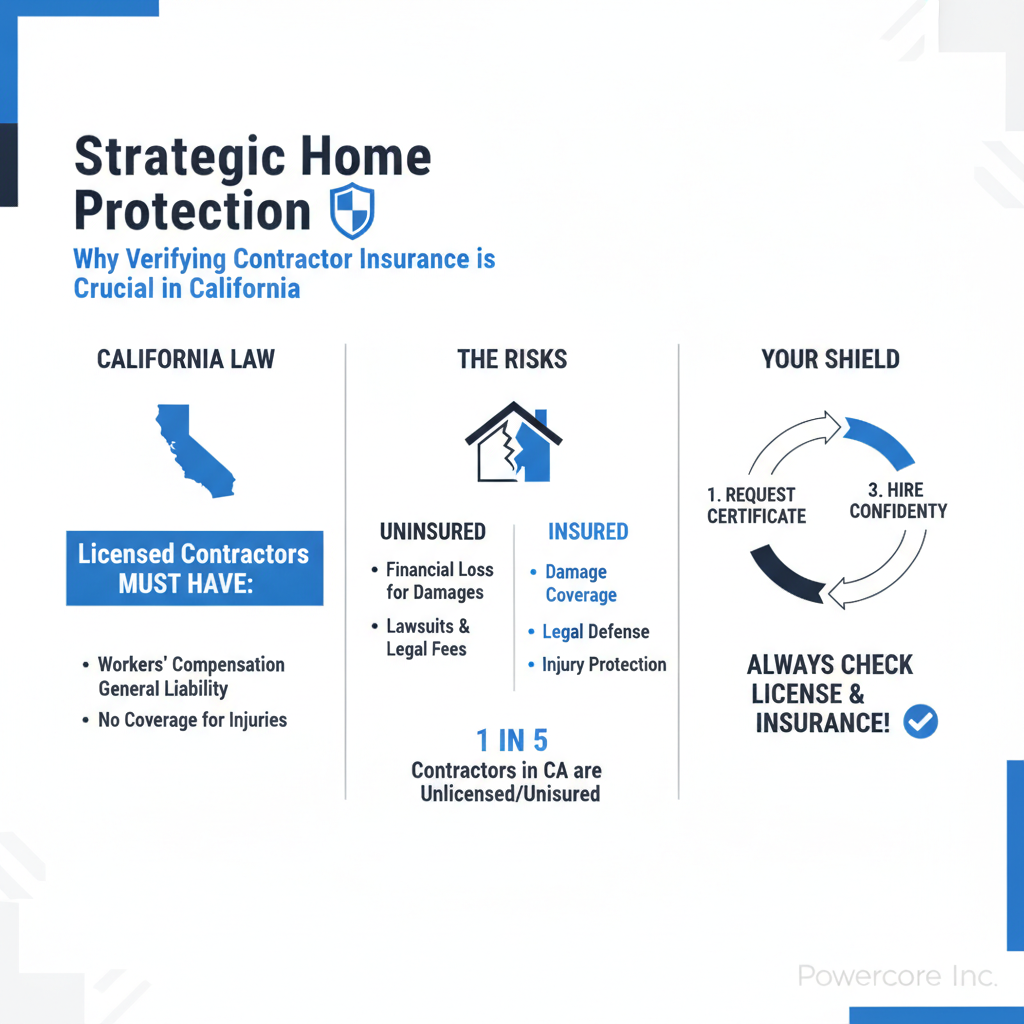
Powercore Inc: Your Partner in Fully Insured & Licensed Excellence Across California
When you choose a partner like Powercore Inc for your California home project, you're not just getting expert craftsmanship; you're securing peace of mind through a fully compliant and comprehensively insured contractor. As a dual-licensed General B (#1134334) and C-10 Electrical Contractor (#1098175), we uphold the highest standards of safety, professionalism, and legal compliance.
Our commitment extends to meticulously maintaining all required insurance policies, including robust General Liability and Workers' Compensation coverage, to protect our clients and our dedicated team. Whether you're considering solar installation, battery storage, HVAC upgrades, a full home remodel, an ADU build, EV charging, roofing, siding, decking, or interior renovations, Powercore Inc ensures that your investment is safeguarded every step of the way. We proudly serve homeowners throughout California, bringing expertise and accountability to every project.
Beyond Insurance: Additional Due Diligence for Homeowners
While insurance is foundational, it's part of a larger strategy for selecting the right contractor. Always consider these additional steps:
Thorough CSLB License Verification
Beyond insurance, check for any disciplinary actions or complaints against the contractor's license on the CSLB website. An active license in good standing is non-negotiable.
Gather References and Check Reviews
Speak to past clients about their experiences, and review online testimonials on platforms like Google, Yelp, and industry-specific sites. A reputable contractor will have a track record of satisfied customers.
Demand Clear, Comprehensive Contracts
A detailed contract protects both parties. It should outline the scope of work, timeline, payment schedule, materials to be used, change order procedures, and warranty information. Never start a project without a signed contract.
Conclusion: Build with Confidence, Choose Powercore Inc
Understanding and verifying contractor insurance requirements is an essential step for any California homeowner embarking on a renovation or construction project. It's not merely a formality but a critical layer of protection for your property, your finances, and your family's safety. By strategically vetting your contractors for adequate General Liability, Workers' Compensation, and license bonds, you empower yourself to mitigate risks and ensure a smoother, more secure project.
Don't leave your most valuable asset to chance. Choose a partner who prioritizes your protection and peace of mind. Powercore Inc is dedicated to delivering exceptional service and ensuring full compliance, providing expert solutions for solar, battery storage, HVAC, roofing, ADUs, remodels, EV charging, siding, decking, and interior remodeling across California. For a project built on trust, transparency, and comprehensive protection, contact Powercore Inc today at 916-699-8778 to discuss your next home improvement vision.