

Introduction: The Foundation of California Construction Success
Embarking on a construction or remodeling project in California is an exciting endeavor, promising enhanced living spaces, increased property value, and improved functionality. However, before the first nail is hammered or the first wire is laid, there's a critical foundational step that often determines a project's ultimate success or failure: navigating California construction permits. Far from being mere bureaucratic hurdles, permits are a strategic necessity, ensuring safety, compliance, and long-term value for your investment.
For homeowners and businesses across the Golden State, understanding the permit landscape is paramount. From the bustling urban centers to serene rural communities, each jurisdiction has its own set of rules and requirements, making the process seem daunting. This comprehensive guide from Powercore Inc. aims to demystify California's construction permit process, offering a strategic blueprint to ensure your project not only meets legal standards but also achieves its full potential.
Why Construction Permits Are a Strategic Advantage, Not Just a Requirement
Many view construction permits as an inconvenient necessity, a step that delays projects and adds costs. However, a strategic perspective reveals that securing the proper permits is, in fact, an investment in your project's integrity, safety, and future value. Here's why:
Ensuring Safety and Code Compliance
- Protecting Occupants: Building codes are designed to protect the health and safety of a building's occupants. Permitted projects undergo rigorous reviews and inspections to ensure structural integrity, electrical safety, plumbing efficiency, and fire safety.
- Meeting California's Standards: California has some of the most stringent building codes in the nation, particularly concerning seismic activity and energy efficiency (Title 24). Permits ensure your project adheres to these critical standards, which are constantly updated to reflect new technologies and safety advancements.
Preserving and Enhancing Property Value
- Legitimizing Your Investment: Permitted renovations and additions are recognized as legitimate improvements, adding verifiable value to your property. When it comes time to sell, proper documentation of permitted work provides peace of mind to buyers and ensures a smoother transaction.
- Avoiding Costly Redos: Unpermitted work can lead to significant issues during property sale, often requiring costly remediation, demolition, and re-construction to bring the property up to code – sometimes at the owner's expense.
Legal Protection and Insurability
- Liability Shield: Proper permits and inspections reduce your liability in case of future structural failures or accidents related to the construction work.
- Insurance Coverage: Most homeowner's insurance policies will not cover damages or losses resulting from unpermitted construction. Securing permits ensures your investment remains insurable against unforeseen events.
Quality Assurance and Contractor Accountability
- Expert Oversight: The permit process involves multiple inspections by city or county officials at various stages of construction. These inspections serve as an independent verification that the work is being performed correctly and according to approved plans.
- Holding Contractors Accountable: When a project is permitted, it ensures that your contractor (like Powercore Inc, a dual-licensed General B & C-10 Electrical Contractor) is working to specific, approved plans and adhering to industry standards. This adds a layer of protection for you, the client.
Projects That (Almost Always) Require California Construction Permits
While specific requirements can vary by municipality, many common home and commercial projects in California necessitate a permit. Understanding which projects fall under this umbrella is the first step in strategic planning:
Major Remodels, Additions, and New Construction
- Structural Changes: Any alteration to load-bearing walls, foundations, rooflines, or seismic bracing.
- Square Footage Additions: Expanding the footprint of your home, whether vertically or horizontally.
- New Buildings: This includes ADUs (Accessory Dwelling Units), garages, sheds over a certain size, and commercial structures. ADUs, in particular, have seen streamlined state regulations, but still require comprehensive permitting.
- Significant Interior Remodeling: Moving walls, reconfiguring layouts that impact plumbing or electrical systems, or changing the occupancy of a space.
Electrical, Plumbing, and Mechanical Upgrades
- Electrical System Modifications: Upgrading your main electrical panel, adding new circuits, or installing dedicated circuits for major appliances like an EV charging station. Even minor electrical work often requires a permit to ensure safety and compliance with the National Electrical Code (NEC). For those considering EV chargers, understanding the associated electrical work permits is key. You can learn more about related costs in Understanding Tesla House Charger Costs: An In-Depth Tutorial.
- Plumbing System Changes: Rerouting water lines, adding new fixtures, or installing a water heater.
- HVAC Systems: Installation or major replacement of furnaces, air conditioners, or ductwork (HVAC climate control systems).
Exterior and Site Improvements
- Roofing: Full roof replacements often require permits, especially if there are changes to the roof's structure or if multiple layers are being added. Minor repairs typically do not. (Roofing & Weatherproofing projects).
- Decks and Patios: New decks, especially those elevated or attached to the house, typically require permits. Size and height thresholds vary by jurisdiction.
- Siding and Exterior Walls: Extensive replacement of siding, especially if it involves structural changes or specific fire-resistant materials in wildfire-prone areas. (Siding & Exterior).
- Swimming Pools and Spas: Installation of new pools, spas, or significant modifications to existing ones, including fencing.
- Solar Panel Installation: Installing solar panels and battery storage systems requires permits from both the local building department and often the utility company to ensure electrical safety and grid interconnection. (Residential Solar & Storage and Commercial Solar & Microgrids).
When in doubt, it's always best to consult with your local building department or a licensed contractor like Powercore Inc.
The California Permit Application Process: A Step-by-Step Guide
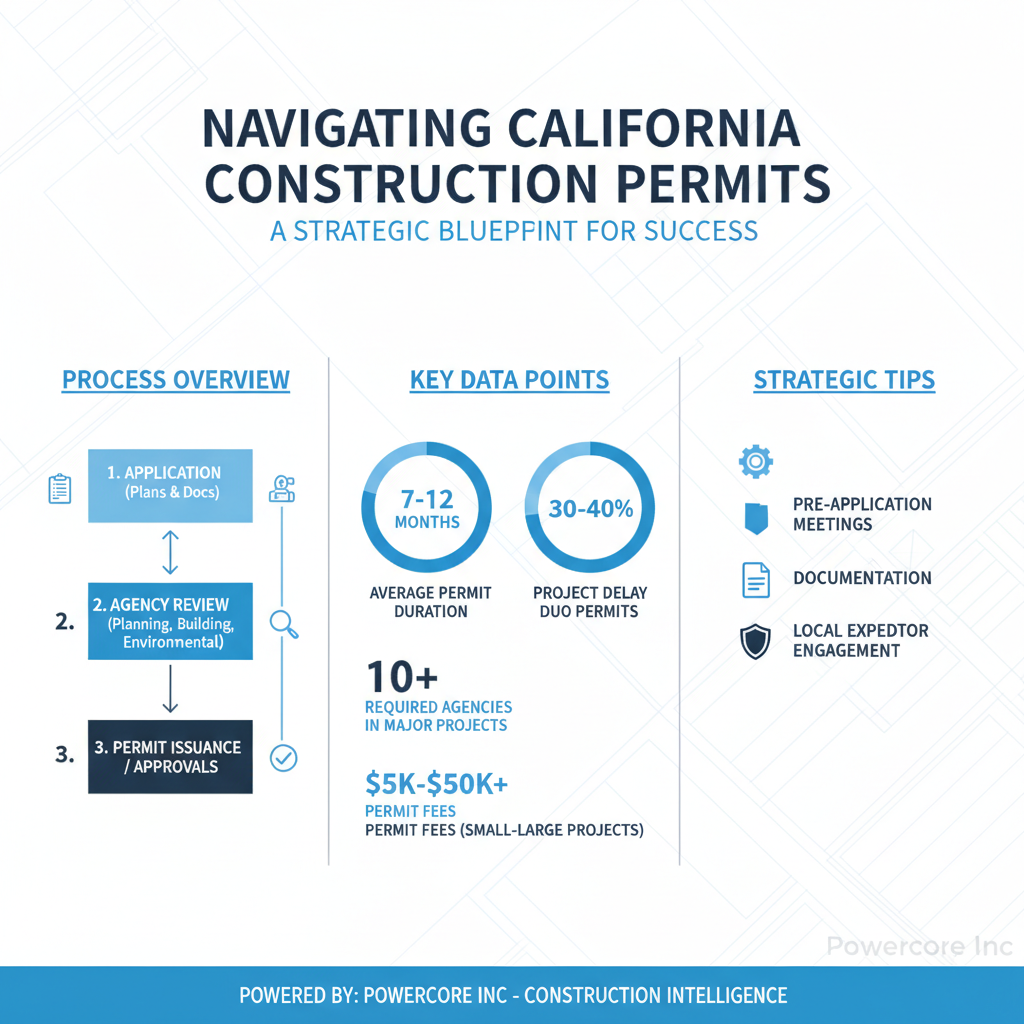
While specifics vary, the general flow of obtaining a construction permit in California follows a predictable path:
Step 1: Initial Research and Project Scope Definition
Before drawing any plans, understand what you want to achieve. Research your local city or county's building department website. Many offer guides, checklists, and even pre-application meetings. Define the scope of your project clearly: what are you building, modifying, or installing?
Step 2: Developing Plans and Documentation
For most significant projects, you'll need detailed architectural, structural, and/or engineering plans. These plans must clearly illustrate the proposed work, demonstrate compliance with building codes, and often include site plans, floor plans, elevations, sections, and structural details. Energy calculations (Title 24) are frequently required for new construction or major remodels.
Step 3: Application Submission
Fill out the necessary permit application forms provided by your local building department. These forms will typically require project details, contractor information (license numbers are essential!), property owner information, and an estimated project cost. Submit your completed application along with the required plans and any supporting documents (e.g., HOA approval, environmental reviews).
Step 4: Plan Review and Revisions
Once submitted, your plans will be reviewed by various department officials (building, planning, fire, public works, etc.) to ensure compliance with all applicable codes and zoning ordinances. This process can take anywhere from a few weeks to several months, depending on the complexity of the project and the workload of the department. It's common to receive comments or requests for revisions, which you'll need to address and resubmit.
Step 5: Permit Issuance
Once all reviews are complete and any required revisions are approved, you'll be notified that your permit is ready for issuance. You'll typically pay the final permit fees at this stage. Once paid, the permit document will be issued, which must be posted prominently at the job site.
Step 6: Inspections During Construction
Throughout the construction process, various inspections will be required at specific milestones (e.g., foundation, framing, electrical rough-in, plumbing rough-in, insulation, final). It is the responsibility of the permit holder (or their contractor) to schedule these inspections. Work cannot proceed beyond a certain point until the corresponding inspection has been approved.
Step 7: Final Approval and Occupancy
After all required inspections have passed, a final inspection will be conducted. Upon successful completion, the project will receive final approval, often documented by a Certificate of Occupancy for new structures or a final sign-off for remodels. This signifies that the work has been completed in accordance with the approved plans and all applicable codes.
Common Hurdles and How to Overcome Them in California
While the process is structured, several factors can complicate obtaining construction permits in California:
Local Jurisdiction Variations
California is diverse, and so are its building departments. What's required in Roseville might differ from what's needed in Los Angeles or San Francisco. Researching specific city or county requirements early on is crucial.
Permit Fees and Cost Estimation
Permit fees can range from a few hundred to several thousands of dollars, depending on project size, complexity, and location. These fees cover the cost of plan review and inspections. Budgeting for these costs from the outset is vital.
Timeline Expectations
The permit process is rarely quick. Plan review times can be lengthy, especially for complex projects or in busy jurisdictions. Factor these timelines into your overall project schedule.
Navigating Bureaucracy
Dealing with multiple departments, understanding technical jargon, and responding to revision requests can be overwhelming. This is where a knowledgeable contractor like Powercore Inc. becomes invaluable, serving as your advocate and guide through the bureaucratic maze.
Common Reasons for Permit Delays or Rejection
- Incomplete or inaccurate plans.
- Failure to meet zoning or setback requirements.
- Non-compliance with specific building codes (e.g., Title 24 energy standards, seismic requirements).
- Missing supporting documentation (e.g., HOA approval, environmental reports).
The Cost of Non-Compliance: Risks of Unpermitted Work in California
The temptation to bypass the permit process might seem appealing for minor projects to save time or money, but the risks in California far outweigh any perceived benefits. Unpermitted work can lead to severe consequences:
Stop Work Orders and Fines
If discovered, unpermitted construction will almost certainly result in a stop-work order. Fines can be substantial, often multiplying the original permit fees, and you will still be required to obtain the proper permits, potentially with additional penalties.
Difficulty Selling Your Property
During a property transaction, buyers and their lenders will often require proof that all significant alterations were legally permitted. Unpermitted work can complicate or even derail a sale, requiring you to obtain retroactive permits, which can be more expensive and time-consuming than initial permitting.
Insurance Issues and Liability
As mentioned, insurance companies may deny claims for damages related to unpermitted construction. Furthermore, if an injury occurs due to unpermitted work, you could face significant personal liability.
Safety Hazards
Without proper oversight, unpermitted work risks structural instability, electrical fires, gas leaks, or other hazards that endanger occupants and neighbors. In California, with its seismic activity, this is a particularly grave concern.
Remediation Costs
If your unpermitted work is deemed unsafe or not to code, you may be required to expose or even tear down completed construction to allow for inspection and correction, incurring significant additional costs.
Choosing the Right Partner for Your Permitted Project in California
Successfully navigating California's construction permit landscape is significantly smoother with the right partner. This is where a licensed, experienced, and knowledgeable contractor like Powercore Inc. becomes an indispensable asset.
The Powercore Advantage: Dual Licensing and Statewide Expertise
- California CSLB #1134334 (General B) and #1098175 (C-10 Electrical): Powercore Inc.'s dual licensing underscores our comprehensive capabilities. A General B license allows us to oversee entire construction projects, from foundations to finishes, while our C-10 Electrical license certifies our expertise in all aspects of electrical work – a critical component of most modern construction and remodeling projects, including EV charging installations and solar and battery storage systems.
- Understanding California Regulations: Our team is intimately familiar with the intricacies of California's building codes, zoning laws, and specific jurisdictional requirements across the state. We proactively address permit challenges, ensuring your project meets all necessary standards. We are also well-versed in the requirements of the CA Contractors State License Board (CSLB), ensuring full compliance and peace of mind.
- Full-Service Project Management: From initial design and plan development to permit acquisition, construction, and final inspection, Powercore Inc. manages the entire process. This holistic approach minimizes stress for you and ensures a seamless transition through each project phase. Whether it's an ADU addition, a major home remodel, a new roof, or a complex solar installation, we handle the permit legwork.
- Efficiency and Quality: With Powercore Inc., you gain a partner committed to not only securing your permits efficiently but also executing your project with the highest standards of quality and craftsmanship. Our focus on compliance ensures your investment is built to last and provides lasting value.
California-Specific Permit Considerations
Beyond the general process, California presents unique regulatory landscapes that impact permitting:
- Seismic Activity and Building Codes: California's building codes are continuously updated to address seismic safety. Permits ensure your project incorporates the latest structural requirements for earthquake resilience.
- Wildfire Zones and Defensible Space: In high-fire-risk areas, permits will include strict requirements for fire-resistant materials, defensible space around structures, and access for emergency services.
- Energy Efficiency Standards (Title 24): California's Title 24 Part 6, the Energy Code, mandates energy-efficient design and construction for new buildings and major renovations. Permits ensure compliance through energy calculations and inspections.
- ADU-Specific Regulations: California has enacted state-level streamlining laws for Accessory Dwelling Units to ease the housing crisis. While these laws reduce some local barriers, ADUs still require permits, plans, and adherence to specific setback, height, and size limitations.
- Environmental Reviews: Larger projects or those in sensitive areas may trigger environmental review processes under the California Environmental Quality Act (CEQA), requiring additional studies and permits.
Conclusion: Build with Confidence with Powercore Inc.
Navigating the world of California construction permits doesn't have to be a source of stress. By understanding the strategic importance of permits, familiarizing yourself with the process, and partnering with an experienced, dual-licensed contractor like Powercore Inc., you can ensure your project is built safely, legally, and to the highest standards.
Don't let the permit process deter you from realizing your construction dreams. Instead, view it as a critical step in protecting your investment and ensuring the long-term success of your home or business enhancement. From Roseville to San Diego, our team at Powercore Inc. is ready to guide you through every stage, ensuring compliance and delivering exceptional results across all of California.
Ready to start your next project with confidence? Contact Powercore Inc. today for a consultation. Call us directly at 916-699-8778 to discuss your plans and learn how our expertise can streamline your California construction permit process.