

Navigating California Home Projects: The Power of Licensing
Embarking on a home improvement project in California, whether it's a major remodel, a new ADU addition, or upgrading to solar and battery storage, is a significant investment. As a discerning homeowner, you likely focus on design, materials, and cost. However, there's a foundational element that often gets overlooked but is absolutely critical to your project's success and your peace of mind: contractor licensing.
In a state as dynamic and regulated as California, working with a properly licensed contractor isn't just a recommendation; it's a legal imperative and your strongest safeguard against shoddy workmanship, financial fraud, and unforeseen complications. At Powercore Inc, a dual-licensed General B and C-10 Electrical Contractor based in Roseville and serving all of California, we understand that understanding these licenses can feel complex. That's why we’ve compiled this comprehensive guide to demystify California contractor licensing, explain its profound importance, and empower you to make informed decisions for your next project.
Why California's Contractor Licensing Is Your Project Blueprint
California has some of the most stringent contractor licensing requirements in the nation, and for good reason. The state's diverse geography, population density, and commitment to consumer protection necessitate a robust regulatory framework. Here's why understanding and insisting on licensed professionals is your non-negotiable first step:
Protecting Your Investment and Property Value
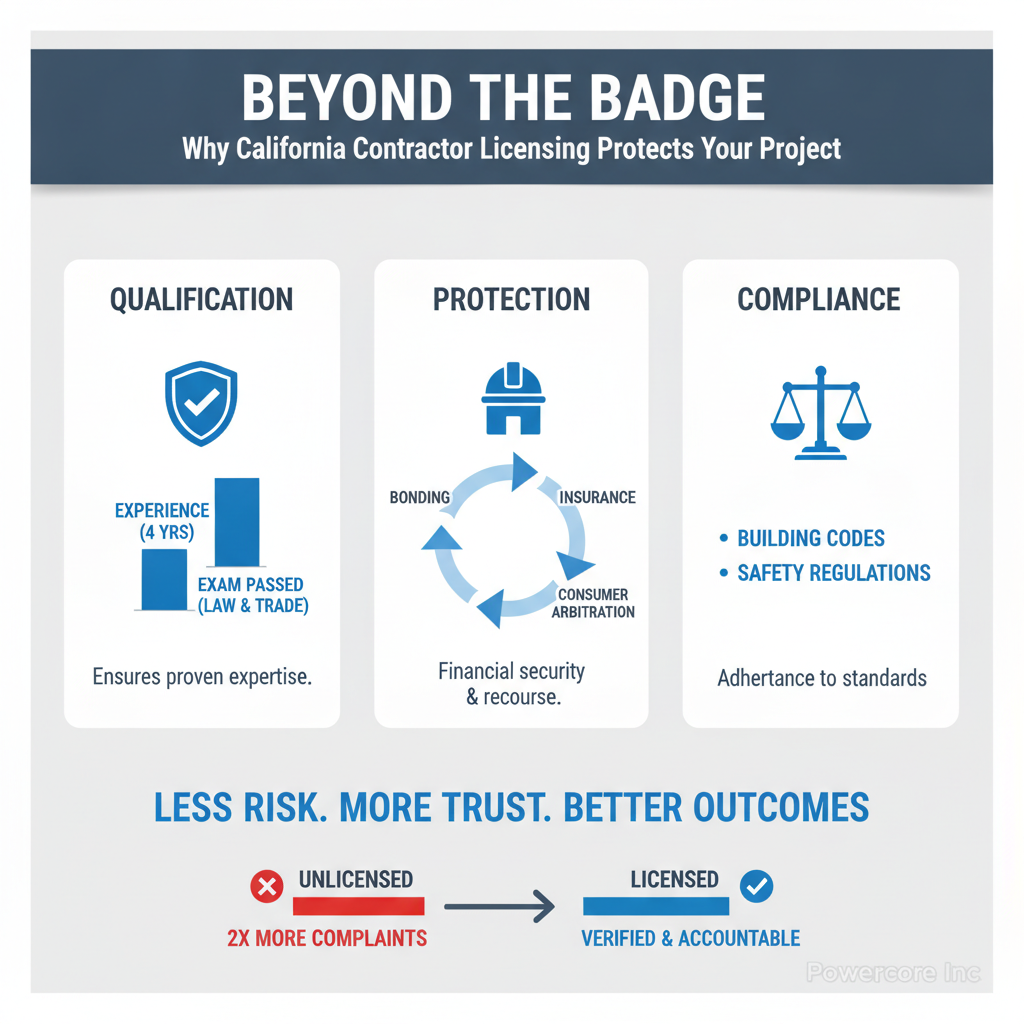
- Quality Assurance: Licensed contractors have demonstrated a baseline level of competence and experience. They are held to industry standards, ensuring that work is performed correctly and safely. Unlicensed work often leads to costly repairs down the line, diminishing your home’s value rather than enhancing it.
- Structural Integrity: For major projects like additions, remodels, or new construction, ensuring structural integrity is paramount. Licensed general contractors (Class B) possess the expertise to manage complex structural elements, adhering to California's strict building codes.
- Warranty and Guarantees: Reputable licensed contractors typically offer warranties on their work, providing recourse if issues arise after completion. Unlicensed individuals offer no such protection.
Ensuring Safety and Legal Compliance
- Building Codes: California's building codes are extensive and constantly updated, particularly concerning seismic activity, energy efficiency, and fire safety. Licensed contractors are knowledgeable about these codes and ensure your project complies, preventing potential fines, stop-work orders, or future safety hazards.
- Electrical and HVAC Safety: Specialized tasks like installing EV charging stations, complex HVAC climate control systems, or solar arrays require specific electrical and mechanical expertise. A C-10 Electrical contractor like Powercore Inc ensures all wiring, connections, and system integrations meet stringent safety standards, protecting your home from fire or electrical hazards.
- Permitting Requirements: Most significant home projects in California require permits from local authorities. Permitting bodies often mandate that work be performed by licensed contractors to ensure adherence to safety and building codes, and to facilitate proper inspections. Without proper permits and licensed work, future sale of your home could be jeopardized.
Financial and Legal Safeguards for Homeowners
- Bonding and Insurance: Licensed contractors are legally required to be bonded and carry liability insurance. The contractor's bond offers a layer of financial protection for the homeowner if the contractor fails to complete the work or pay for materials/subcontractors. General liability insurance protects you from financial responsibility if property damage or injury occurs during the project. Unlicensed contractors rarely carry adequate insurance, leaving you vulnerable to significant personal liability.
- Worker's Compensation: If a contractor has employees, they must carry worker's compensation insurance. If an uninsured worker is injured on your property, you, the homeowner, could be held responsible for their medical bills and lost wages.
- Dispute Resolution: Should a dispute arise, the California Contractors State License Board (CSLB) offers mediation and arbitration services for licensed contractors. With an unlicensed individual, your recourse options are severely limited, often requiring expensive legal action.
The Golden State's Licensing Framework: An Overview
The California Contractors State License Board (CSLB) is the regulatory body responsible for licensing and regulating contractors in the state. Its primary mission is to protect consumers by ensuring contractors are qualified, competent, and adhere to ethical business practices.
General Categories of California Contractor Licenses
California categorizes contractor licenses into three main classes:
-
Class A – General Engineering Contractor: This license is for contractors whose principal contracting business is in connection with fixed works requiring specialized engineering knowledge and skill. Examples include irrigation, drainage, earthmoving, bridges, roads, and utilities. These are typically large-scale public or commercial infrastructure projects.
-
Class B – General Building Contractor: This is arguably the most common and versatile license type for residential and commercial construction. A Class B contractor can take on projects that involve framing or at least two unrelated building trades. This includes constructing or remodeling structures where the work is within the property lines. Powercore Inc proudly holds a General B license, enabling us to manage diverse and complex projects from start to finish, including full home remodels, ADU construction, and comprehensive new builds.
-
Class C – Specialty Contractor: These licenses are for contractors whose principal contracting business involves the use of specialized building trades or crafts. There are over 40 different Class C license classifications, each covering a specific trade. Examples include C-10 Electrical, C-20 HVAC, C-39 Roofing, C-33 Painting, and more.
Diving Deeper: Understanding the Key License Types for Your Home Project
When planning your project, understanding which license types are relevant is crucial:
Class B General Building Contractor: The Project Orchestrator
A Class B license holder is the ideal choice for projects that involve multiple trades or significant structural changes. This includes:
- Building new homes or accessory dwelling units (ADUs).
- Major home remodels that involve tearing down walls, adding square footage, or reconfiguring layouts.
- Projects that combine services like roofing, siding, and interior work under one umbrella.
A Class B contractor acts as the general manager, coordinating all subcontractors (who must also be appropriately licensed for their specific trades), ensuring project timelines, budgets, and quality standards are met. This streamlined approach minimizes stress for homeowners, as they have a single point of contact responsible for the entire project.
Class C Specialty Contractor: The Expert Craftsman
For projects focused on a single trade, a Class C specialty contractor is essential. Powercore Inc notably holds a C-10 Electrical Contractor license, which is vital for a wide range of modern home improvements:
- Solar & Battery Storage Installation: Proper electrical system design, integration, and safety are paramount for solar panels and energy storage systems like the Tesla Powerwall. A C-10 license ensures your system is installed to code, operates efficiently, and safely connects to your home's grid.
- EV Charging Station Installation: Installing a Level 2 or Level 3 EV charger requires significant electrical work, often including dedicated circuits and panel upgrades. Our C-10 license guarantees safe and compliant installation.
- HVAC Climate Control Systems: While HVAC (C-20) is a separate license, electrical work is integral to HVAC installation and repair. A C-10 ensures the electrical components of your heating and cooling systems are expertly handled.
- Panel Upgrades and Wiring: Any significant electrical modification, from replacing an old electrical panel to rewiring a section of your home, falls under the purview of a C-10 contractor.
Other common Class C licenses relevant to homeowners include:
- C-20 Warm-Air Heating, Ventilating and Air-Conditioning Contractor (HVAC): For all your heating and cooling system installations and repairs.
- C-39 Roofing Contractor: For roof repair, replacement, and new installations.
- C-33 Painting and Decorating Contractor: For interior and exterior painting projects.
- C-54 Tile Contractor: For flooring, backsplashes, and bathroom tile work.
The Power of Dual Licensing: Powercore Inc's Advantage
Powercore Inc's distinction as a dual-licensed General B and C-10 Electrical Contractor (CSLB #1134334 and #1098175) offers a significant advantage to our clients. This means we are uniquely qualified to:
- Handle extensive general building projects, from initial design to final touches.
- Expertly integrate complex electrical systems into any project, be it residential solar, a new ADU with full electrical infrastructure, or an EV charging solution.
- Provide seamless coordination between structural and electrical work, eliminating the need for multiple contractors and ensuring cohesive project execution.
This comprehensive licensing ensures that for many projects, especially those involving both structural changes and significant electrical work (like a kitchen remodel with new appliance circuits or an ADU with its own power system), you have one highly qualified team managing all critical aspects.
The Perils of Unlicensed Work in California
It might be tempting to hire an unlicensed individual offering a lower price. However, the risks far outweigh any potential savings. The CSLB actively pursues unlicensed contractors, and homeowners who knowingly hire them can also face significant legal and financial repercussions.
Legal and Financial Risks for Homeowners
- No Legal Recourse: If an unlicensed contractor performs shoddy work, abandons the job, or charges excessively, you have very limited legal avenues for recovery. The CSLB cannot assist with disputes involving unlicensed individuals.
- Voided Insurance: Homeowner's insurance policies may not cover damages resulting from work performed by unlicensed contractors, leaving you personally liable for repairs.
- Personal Liability for Injuries: As mentioned, if an uninsured worker is injured on your property, you could be responsible for their medical bills and lost wages.
- Substandard Work & Safety Hazards: Unlicensed individuals often lack the knowledge of current building codes, safety standards, and proper construction techniques. This can lead to dangerous electrical systems, unstable structures, and long-term issues that are expensive to rectify.
- Mechanic's Liens: If an unlicensed contractor fails to pay their suppliers or laborers, those parties can place a mechanic's lien on your property, even if you’ve already paid the contractor in full.
- Difficulty Selling Your Home: Unpermitted or unlicensed work can be a major red flag during a home inspection when you decide to sell, potentially delaying or even derailing a sale until issues are rectified at your expense.
Beyond the License Number: What Else to Look For
While an active CSLB license is the absolute minimum requirement, a truly professional contractor offers more. Here’s what else to seek out:
Bonding and Insurance: Your Safety Net
Always verify that your contractor carries:
- Contractor's Bond: This bond, typically for $15,000 in California, protects you if the contractor fails to complete the job or meet other contractual obligations.
- General Liability Insurance: This protects you from claims of property damage or bodily injury caused by the contractor or their employees during the project. Ask for a certificate of insurance directly from their insurance provider.
- Worker's Compensation Insurance: If the contractor has employees, this is legally required and protects you from liability if a worker is injured on your property.
References and Portfolio: Proof of Expertise
A reputable contractor will be happy to provide:
- Client References: Speak to past clients about their experience, communication, project management, and satisfaction with the final outcome.
- Project Portfolio: Review examples of their past work, especially projects similar to yours. This demonstrates their skill, aesthetic capabilities, and attention to detail. Powercore Inc's portfolio showcases our commitment to excellence across a wide array of services, including solar installations, ADU builds, and complex interior remodels.
Transparent Contracts and Communication
- Detailed Written Contract: Insist on a clear, comprehensive contract that outlines the scope of work, materials, timeline, payment schedule, change order procedures, and warranty information. Avoid vague verbal agreements.
- Open Communication: A good contractor communicates regularly, keeps you informed of progress, addresses concerns promptly, and manages expectations realistically.
Verifying a Contractor's License: Your Essential Checklist
Before you sign any contract or make any payment, always perform these critical verification steps:
-
Visit the CSLB Website: Go to the official California Contractors State License Board website. Use their "Check a License" tool.
-
Enter License Number or Business Name: Input the contractor's license number (e.g., #1134334 for Powercore Inc) or their exact business name.
-
Verify Status: Ensure the license is active and not expired, suspended, or revoked.
-
Check License Classifications: Confirm the contractor holds the appropriate license for your specific project (e.g., General B for a remodel, C-10 for electrical work).
-
Review Disciplinary Actions: The CSLB website will also show any past disciplinary actions, citations, or legal judgments against the contractor. While a minor past issue might be explainable, a pattern of serious violations is a major red flag.
-
Confirm Bonding: The CSLB record will indicate if the contractor's bond is active.
-
Request Proof of Insurance: While the CSLB doesn't typically list general liability or worker's comp, always ask the contractor for current certificates of insurance directly from their insurance providers.
This due diligence takes only a few minutes but provides invaluable protection for your investment and peace of mind.
Powercore Inc: Your Trusted Dual-Licensed California Contractor
At Powercore Inc, we pride ourselves on upholding the highest standards of professionalism, transparency, and quality. As a California dual-licensed General B (#1134334) and C-10 Electrical (#1098175) Contractor, we bring unparalleled expertise and compliance to every project across the state.
Whether you're envisioning a complete home transformation, adding an ADU for family or rental income, embracing energy independence with residential solar and battery storage, or upgrading your home's infrastructure with EV charging or a new HVAC system, our team is equipped to deliver exceptional results. We navigate the complexities of California's regulations and permits, ensuring your project is not just beautiful and functional, but also fully compliant and built to last.
From the initial consultation to the final walkthrough, Powercore Inc is committed to clear communication, meticulous craftsmanship, and complete client satisfaction. We believe that an informed client is an empowered client, and we are dedicated to being your trusted partner in realizing your home improvement dreams.
Ready to Start Your California Project The Right Way?
Don't leave your most valuable asset to chance. Choose a licensed, experienced, and reputable contractor who prioritizes your protection and peace of mind. For a free consultation and to experience the Powercore Inc difference, contact us today. Our expert team is ready to discuss your vision and provide a comprehensive, compliant, and quality solution.
Call Powercore Inc at 916-699-8778 or visit our contact page to schedule your consultation. Let's build your California dream project, safely and expertly, together.