

Navigating California Contractor Licenses for Peace of Mind
Embarking on a home improvement project in California, whether it's a major remodel, a new ADU, or the installation of a cutting-edge solar and battery system, is a significant investment. Beyond the aesthetics and functionality, one of the most critical aspects homeowners often overlook is the contractor's licensing. In a state as regulated as California, understanding contractor licenses isn't just about legal compliance; it's about protecting your investment, ensuring safety, and guaranteeing the quality of work.
At Powercore Inc, we know firsthand the complexities of California's licensing requirements. As a dual-licensed General B & C-10 Electrical Contractor (CSLB #1134334 & #1098175), we embody the highest standards of professionalism and expertise. This comprehensive guide will demystify California's contractor licensing landscape, helping you make informed decisions that safeguard your home and ensure your project's success.
Why a Contractor License Is Your First Line of Defense
Imagine hiring someone to build a new deck or install a complex electrical system, only to discover they lack the necessary skills, cut corners, or, worse, disappear halfway through the job. This nightmare scenario is precisely what contractor licensing aims to prevent. A license signifies that a contractor has met specific criteria set by the state, including:
- Demonstrated Competence: Passing rigorous exams that test their knowledge of their trade and business practices.
- Financial Responsibility: Holding a contractor bond to protect clients from financial losses.
- Legal Compliance: Adhering to state laws and regulations, including workers' compensation insurance requirements.
Hiring an unlicensed contractor, while seemingly cheaper upfront, exposes you to immense risks. These can include shoddy workmanship, lack of insurance (leaving you liable for accidents), no recourse for incomplete or faulty work, and potential legal penalties for violating building codes. In California, even a homeowner can face fines for hiring an unlicensed individual for work exceeding a certain value.
The Risks of Unlicensed Work in California
- No Legal Recourse: If things go wrong, you have little to no legal standing against an unlicensed contractor.
- No Insurance Protection: If a worker is injured on your property, you could be held personally liable for medical bills and lost wages.
- Substandard Work: Unlicensed individuals often lack the training and expertise to ensure safe, code-compliant, and durable results.
- Permit Problems: Licensed contractors understand permit requirements. Unlicensed work often proceeds without permits, leading to fines, forced demolition, and difficulty selling your home.
- Project Abandonment: Without a professional reputation or bond to uphold, an unlicensed contractor may abandon your project with no consequences.
The California Contractors State License Board (CSLB): Your Consumer Protector
At the heart of California's contractor licensing system is the Contractors State License Board (CSLB). This state agency is responsible for licensing and regulating contractors in California. Its primary mission is to protect consumers by ensuring that contractors are qualified, competent, and adhere to state laws. The CSLB offers a wealth of resources for homeowners, including a license lookup tool where you can verify a contractor's license status, history, and disciplinary actions.
The CSLB sets the standards, administers the exams, and enforces the rules that govern California's contracting industry. When you work with a CSLB- licensed contractor, you're tapping into a system designed to provide a layer of security and accountability that is simply unavailable with unlicensed individuals. You can learn more about their mission and resources at the official CSLB website.
Decoding California's Primary Contractor License Classifications
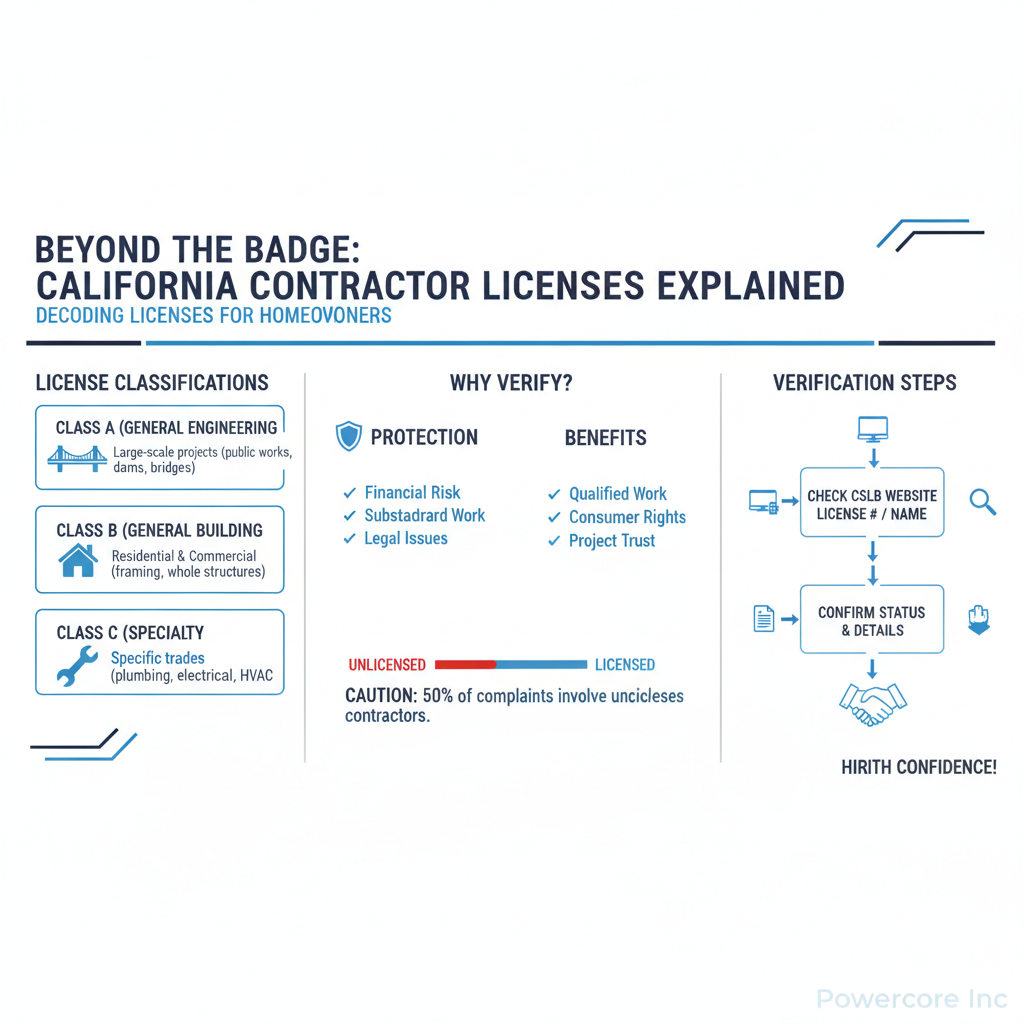
California's contractor licenses are categorized into different classes, reflecting the scope and nature of the work a contractor is legally allowed to perform. Understanding these distinctions is crucial, especially when your project involves multiple trades.
Class B: General Building Contractor – The Master Builder
A Class B license, or General Building Contractor, is one of the most comprehensive licenses in California. This license qualifies a contractor to build or remodel structures that require at least two unrelated building trades or crafts. Think of it as the license for projects that involve a broad range of skills, from framing and plumbing to drywall and roofing.
Key characteristics of a Class B license holder:
- Broad Scope: Can oversee and execute projects that touch nearly every aspect of a structure, including additions, whole-home renovations, and new construction.
- Project Management: Often acts as the primary coordinator, managing various specialty subcontractors (like electricians, plumbers, etc.) required for a complex project.
- Foundation to Finish: From pouring foundations to installing finishing touches, a General B contractor is equipped to handle the entire building process.
If you're planning a major undertaking like a new Accessory Dwelling Unit (ADU) or a significant home remodel, a Class B license is essential. It ensures the contractor has a holistic understanding of construction processes and can integrate various trades seamlessly.
Class C: Specialty Contractor – The Trade Expert
Class C licenses are specific to particular trades or crafts. There are hundreds of different C-class licenses, each designated by a number (e.g., C-10 for Electrical, C-39 for Roofing). A contractor holding a C-class license is an expert in their specific field and is licensed to perform work only within that specialty. They may subcontract work outside their specific classification.
C-10: Electrical Contractor – The Power Specialist
Among the most critical specialty licenses is the C-10 Electrical Contractor license. This license is required for any project involving the installation, alteration, or repair of electrical wiring, fixtures, appliances, and any other electrical apparatus. This includes everything from installing a new light fixture to wiring an entire building or integrating complex energy systems.
A C-10 licensed electrical contractor possesses:
- Specialized Knowledge: Deep understanding of the National Electrical Code (NEC), California Electrical Code, and local regulations.
- Safety Expertise: Trained in safe electrical practices to prevent hazards like fires, shocks, and system overloads.
- System Integration: Capable of installing and connecting advanced electrical systems like solar panels and battery storage, EV charging stations, and smart home technology.
For projects such as EV charging station installation or comprehensive residential solar systems, a C-10 license is non-negotiable. It ensures the electrical work is not only functional but also safe, efficient, and compliant with all applicable codes. Powercore Inc. is a C-10 licensed electrical contractor, ensuring all electrical work on your property meets the highest standards. Want to learn more about EV charging? Read our article on Home EV Charging Station Installation. Interested in battery storage? Check out our guide on Best Solar Battery Choices.
The Powercore Inc Advantage: Why Dual Licensing (B & C-10) Matters for Your Project
This is where Powercore Inc truly stands apart. As a California dual-licensed General B and C-10 Electrical Contractor, we offer a distinct advantage that translates into smoother, more efficient, and ultimately more successful projects for homeowners across California. Many projects today don't fit neatly into a single category; they often require both general construction oversight and specialized electrical expertise.
Consider these common scenarios where our dual licensing becomes invaluable:
- ADU Construction: Building a new Accessory Dwelling Unit involves framing, roofing, plumbing (Class B general construction), but also extensive electrical work for lighting, outlets, HVAC systems, and potentially integrating solar or EV charging (Class C-10 electrical). A dual-licensed contractor can manage the entire project from start to finish, ensuring seamless coordination between all trades.
- Whole-Home Remodels: A major interior remodeling project will almost certainly involve structural changes, new flooring, and perhaps new walls (Class B). Simultaneously, it will require electrical panel upgrades, new circuit installations for modern appliances, and smart home technology integration (Class C-10). Powercore Inc handles both aspects under one roof, eliminating the need to juggle multiple contractors.
- Solar & Battery Storage Integration: While solar installation itself is specialized electrical work (C-10), what if your roof needs repair or replacement before the panels go on? Or if your home needs structural modifications to support the new system? Our General B license allows us to address these broader construction needs, such as roofing and weatherproofing, ensuring a holistic solution without delays or additional contractor searches.
- HVAC System Upgrades: Installing a new, energy-efficient HVAC climate control system often requires modifications to ductwork (B-license scope) and significant electrical upgrades or dedicated circuits (C-10 electrical). Powercore Inc can manage both the mechanical and electrical aspects efficiently.
By choosing Powercore Inc, you benefit from:
- Streamlined Project Management: A single point of contact for all aspects of your project, from structural changes to electrical systems.
- Enhanced Efficiency: Reduced coordination efforts and fewer delays, as there's no need to wait for different contractors to align their schedules.
- Consistent Quality & Accountability: Our integrated approach ensures uniform standards of quality and safety across all trades involved, with one company fully accountable for the entire project.
- Cost Savings: Often, hiring one company for multi-trade projects can lead to better pricing and avoid markups from multiple subcontractors.
This dual-licensed expertise is especially vital in California, where building codes and energy efficiency standards are among the strictest in the nation. Our team is equipped to navigate these complexities, delivering projects that are not just beautiful and functional, but also fully compliant and future- ready.
How to Verify a California Contractor's License
Verifying a contractor's license is a simple yet crucial step in protecting yourself. Here’s how you can do it:
- Visit the CSLB Website: Go to www.cslb.ca.gov. Look for the “Check a Contractor License” tool.
- Enter Information: You can search by license number, contractor name, or business name. Ideally, you should have the contractor's license number.
-
Review the Results: The CSLB license lookup tool will show
you:
- License Status: Ensure it's active. Beware of licenses that are expired, suspended, or inactive.
- License Classifications: Confirm the contractor holds the correct license for the type of work you need done (e.g., General B for remodels, C-10 for electrical).
- Bonding Information: Verify that the contractor has a current contractor's bond.
- Workers' Compensation Insurance: For contractors with employees, this is mandatory. If they claim no employees, verify they are truly a sole proprietor or that you understand the liability.
- Disciplinary Actions: Check for any public disciplinary actions or complaints against the contractor.
Never assume a contractor is licensed just because they tell you they are. Always perform this quick verification yourself. It's your right and your best defense against potential problems.
Beyond Licensing: Essential Qualities of a Reliable Contractor
While a proper license is foundational, it's just the starting point. A truly reliable contractor brings much more to the table. When evaluating potential partners for your California home project, consider these additional factors:
Comprehensive Insurance and Bonding
- General Liability Insurance: This protects you and the contractor in case of property damage or injury occurring during the project. Always ask for a certificate of insurance directly from the insurer.
- Workers' Compensation Insurance: If the contractor has employees, this is non-negotiable. It covers medical expenses and lost wages for workers injured on your property, preventing you from being held liable.
- Contractor's Bond: While part of licensing, understanding its scope is important. It provides a limited amount of financial protection for consumers if the contractor fails to complete the job or doesn't pay for materials or subcontractors.
Clear and Detailed Contracts
A professional contractor will provide a written contract that clearly outlines the scope of work, materials, timeline, payment schedule, change order procedures, and warranty information. Avoid contractors who push for verbal agreements or vague terms. The contract is your safeguard and should be read carefully and understood before signing.
Strong References and a Proven Track Record
Ask for references from past clients and, if possible, view their previous work. A reputable contractor will be proud to showcase their portfolio and connect you with satisfied customers. Online reviews and testimonials can also provide valuable insights into their reliability and quality of work.
Transparent Communication
Effective communication is key to a successful project. A good contractor will keep you informed about progress, potential challenges, and any necessary changes. They should be accessible and responsive to your questions and concerns throughout the project duration.
Local Knowledge and Experience
While Powercore Inc serves all of California, local experience within your specific region can be beneficial, especially concerning local permitting processes, environmental factors, and community nuances. A contractor with experience navigating California's diverse regional requirements can prevent unforeseen delays and costs.
Real-World Impact: When Licensing Makes All the Difference
Let’s revisit some common California home improvement projects and highlight why the correct licensing is not just a formality, but a necessity:
- Adding an ADU: This is a complex undertaking involving site preparation, foundation, framing, plumbing, roofing, and extensive electrical work. A General B license is critical for overall project management, while a C-10 is essential for safe and code-compliant electrical systems.
- Installing a Solar & Battery System: Beyond just mounting panels, this requires integrating with your home's electrical panel, ensuring grid compliance, and safe battery storage. A C-10 Electrical Contractor license is absolutely mandatory for this specialized work, safeguarding your home from electrical hazards and ensuring optimal system performance.
- Kitchen or Bathroom Remodel: Even seemingly contained remodels often involve moving walls, reconfiguring plumbing, and updating electrical outlets and lighting. A General B license is ideal for managing the various trades, and if significant electrical changes are needed, a C-10 ensures those are handled expertly.
- EV Charging Station Installation: This isn't a DIY job. It requires precise electrical calculations, potentially panel upgrades, and adherence to strict safety codes. Only a C-10 Electrical Contractor can ensure your EV charger is installed safely, efficiently, and up to code.
In each of these scenarios, the absence of proper licensing can lead to severe consequences, from voided warranties and failed inspections to dangerous electrical fires or structural failures. Choosing a licensed professional is an investment in peace of mind and the long-term value of your home.
Powercore Inc: Your Trusted Dual-Licensed Partner in California
For homeowners across California, choosing a contractor doesn't have to be a gamble. Powercore Inc is proud to operate as a dual-licensed General B & C-10 Electrical Contractor. This means we are uniquely qualified to handle a vast array of projects, from comprehensive ADU construction and large-scale remodels and new construction to specialized solar and battery storage and EV charging installations.
Our commitment to adhering to California's stringent licensing standards is a testament to our dedication to quality, safety, and consumer protection. With Powercore Inc, you gain a partner who understands the intricacies of your project, from the foundational elements to the delicate electrical systems, all under one expert roof.
Conclusion: Build with Confidence, Choose Licensed Excellence
Understanding California contractor licenses is a powerful tool for any homeowner. It empowers you to protect your most valuable asset and ensure that your home improvement dreams are realized safely, legally, and to the highest standards of quality. The CSLB license isn't just a piece of paper; it's a promise of competence, accountability, and consumer protection.
When you're ready to embark on your next project, remember the value of a properly licensed and experienced contractor. For peace of mind, unparalleled expertise, and seamless project execution anywhere in California, choose Powercore Inc. We're here to answer your questions and help you build with confidence. Call us today at 916-699-8778 or visit our contact page to schedule a consultation.