

Introduction: Seizing the Golden Opportunity of Solar Energy
As a homeowner in California, you're likely aware of the immense potential of solar energy. The Golden State leads the nation in solar adoption, driven by abundant sunshine, a strong commitment to renewable energy, and, critically, significant financial incentives. Beyond the environmental benefits and energy independence, the economic advantages of going solar are compelling. However, these benefits, particularly federal tax credits, are not static. Understanding the solar tax credit step-down schedule is paramount to maximizing your investment.
At Powercore Inc, a dual-licensed General B & C-10 Electrical Contractor based in Roseville, CA, we empower homeowners across California to harness the sun's power. We provide comprehensive solutions, from initial consultation and design to installation and ongoing support, ensuring you make the most of every financial incentive available.
Understanding the Federal Solar Investment Tax Credit (ITC)
The cornerstone of federal solar incentives is the Solar Investment Tax Credit (ITC), often referred to as the federal solar tax credit. This credit allows homeowners to deduct a significant percentage of the cost of installing a solar energy system from their federal taxes. It's a dollar-for-dollar reduction in your tax liability, making it one of the most powerful incentives available.
Originally established in 2005, the ITC has been instrumental in the rapid growth of the U.S. solar industry. It applies to both residential and commercial solar installations, covering not just the solar panels, but also associated costs like labor for installation, permitting fees, inspection costs, and even energy storage devices (batteries) charged by solar, if installed in conjunction with the system or added later.
What the ITC Covers
- Solar PV Panels: The primary component, converting sunlight into electricity.
- Labor Costs: For onsite preparation, assembly, or installation.
- Balance-of-System Equipment: Inverters, wiring, mounting hardware, and other components.
- Permitting Fees: Costs associated with securing necessary permits.
- Inspection Costs: Fees for system inspections.
- Energy Storage: Battery storage systems that are charged by solar panels (at least 75% over a year).
It's important to note that the ITC is a *non-refundable* tax credit. This means you must have a sufficient tax liability to claim the full amount. However, if the credit exceeds your tax liability in a given year, you can typically carry forward the unused portion to future tax years, extending the benefit.
The Solar Tax Credit Step-Down Schedule: A Critical Timeline
While the ITC has been extended and revitalized by recent legislation, particularly the Inflation Reduction Act (IRA) of 2022, its incentives are not permanent. The act reset and extended the ITC to its highest level, but a step-down schedule is still in place for future years, making strategic planning crucial.
Current and Future ITC Percentages
The current federal solar tax credit stands at a robust 30% for systems placed in service between January 1, 2022, and December 31, 2032. This represents a significant opportunity for homeowners to reduce their installation costs.
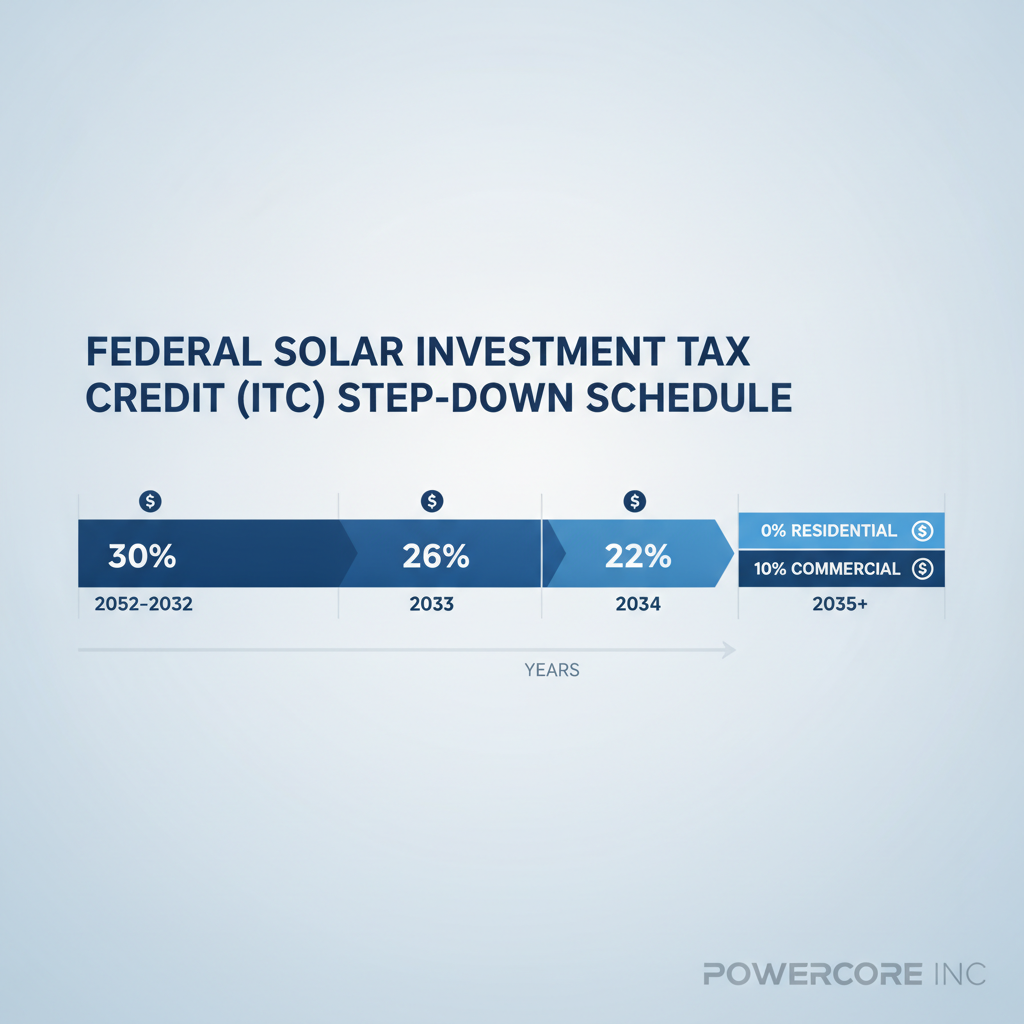
However, the rates are scheduled to decrease:
- 30%: For systems placed in service through December 31, 2032.
- 26%: For systems placed in service in 2033 (January 1, 2033 – December 31, 2033).
- 22%: For systems placed in service in 2034 (January 1, 2034 – December 31, 2034).
- 0%: For residential systems placed in service after December 31, 2034. (Commercial systems will receive a permanent 10% credit.)
This step-down schedule underscores the importance of acting sooner rather than later. While 2032 might seem far off, the process of going solar – from initial consultation and design to permitting and installation – takes time. Waiting risks missing the highest incentive tier or even facing unforeseen delays that push your project into a lower credit bracket.
Why the Step-Down Matters for California Homeowners
For California homeowners, the 30% ITC represents potentially thousands of dollars in savings. Consider a typical California solar installation, which can range from $20,000 to $40,000 or more depending on system size and complexity. A 30% credit on a $30,000 system is $9,000. If that drops to 26%, it's $7,800 – a $1,200 difference. While $1,200 might not seem like a massive amount in the context of a full system, it's substantial savings that could be used for other home improvements or simply kept in your pocket.
Moreover, the cost of solar equipment and installation, while generally trending downwards over the long term, can fluctuate due to supply chain issues, material costs, and labor availability. Securing your system and the 30% credit now hedges against potential future price increases while guaranteeing the maximum federal incentive.
Beyond the ITC: California's Golden State Incentives
While the federal ITC is a powerful driver, California offers its own robust suite of incentives that further sweeten the deal for homeowners considering solar. Understanding these programs is crucial for maximizing your overall financial benefits.
Net Energy Metering (NEM) and its Evolution
Net Energy Metering (NEM) has been a cornerstone of California's solar success, allowing solar homeowners to send excess electricity generated by their panels back to the grid in exchange for credits on their utility bill. This effectively allows homeowners to use the grid as a giant battery, storing surplus energy for use at night or on cloudy days.
California recently transitioned from NEM 2.0 to NEM 3.0 (officially called the 'Net Billing Tariff') for customers of PG&E, SCE, and SDG&E, significantly altering the economics for new solar installations. NEM 3.0 drastically reduces the value of exported solar energy credits, particularly for systems without battery storage. Under NEM 3.0, the export credit rates are much lower than the retail rates you pay for electricity, especially during peak evening hours when solar production is low but demand is high.
This shift makes battery storage an almost essential component for new solar systems in California. By storing excess solar energy generated during the day and discharging it during high-cost peak hours, homeowners can minimize their reliance on the grid when electricity is most expensive and maximize the value of their self-generated power. Powercore Inc specializes in seamlessly integrating battery storage solutions with new and existing solar arrays, helping you navigate the complexities of NEM 3.0.
Self-Generation Incentive Program (SGIP)
The Self-Generation Incentive Program (SGIP) is another vital California incentive, primarily aimed at supporting distributed energy resources, especially battery storage. SGIP provides rebates for installing energy storage systems in homes and businesses. While the program has undergone various stages and funding levels, it continues to offer significant financial assistance, particularly for low-income households or those in high fire-threat areas.
SGIP rebates can substantially offset the cost of battery storage, making it more accessible for homeowners to combine solar with storage. This combination is particularly powerful under NEM 3.0, allowing you to optimize your energy usage and further reduce your utility bills. Our experts at Powercore Inc can help you determine your eligibility for SGIP and assist with the application process.
Property Tax Exclusion for Solar
One often-overlooked financial benefit in California is the property tax exclusion for solar energy systems. Under current state law, the added value that a solar energy system brings to your home is excluded from property tax assessments. This means you can increase your home's value without increasing your property tax bill, providing a direct financial advantage that continues for the life of the system.
Local Incentives and Utility Programs
Beyond state-wide programs, some cities, counties, or local utility providers in California may offer their own unique incentives, rebates, or financing options for solar and energy efficiency upgrades. While less common for direct solar panel installation rebates today, these programs often focus on specific energy efficiency measures or low-interest loan programs. Powercore Inc stays abreast of these regional opportunities to ensure our clients capture every possible saving.
The Comprehensive Benefits of Going Solar with Powercore Inc
Choosing to go solar is a significant decision, and partnering with the right contractor makes all the difference. Powercore Inc, with our dual California CSLB licenses (#1134334 General B and #1098175 C-10 Electrical), brings unparalleled expertise and a holistic approach to home energy solutions.
Long-Term Financial Stability and ROI
Investing in solar offers remarkable long-term financial stability. By generating your own electricity, you significantly reduce or even eliminate your monthly utility bills. This frees you from the volatility of rising electricity rates, providing predictable energy costs for decades. With the combined force of the 30% federal tax credit and California's state-specific incentives, the payback period for a solar system can be surprisingly short, leading to substantial returns on investment over its 25+ year lifespan.
Increased Home Value
Studies consistently show that homes with solar panels sell faster and for more money than comparable homes without solar. A solar energy system is considered a premium upgrade, enhancing your property's appeal and market value, all while being exempt from property tax increases in California. This benefit is compounded by the fact that your home will offer lower operating costs to potential buyers.
Environmental Stewardship
Beyond the financial gains, going solar means contributing to a cleaner, more sustainable future. By reducing your reliance on fossil fuels, you decrease your carbon footprint and support California's ambitious renewable energy goals. This commitment to environmental responsibility resonates with many homeowners and adds intrinsic value to your investment.
Powercore Inc: Your All-in-One Solution Provider
What truly sets Powercore Inc apart is our comprehensive suite of services. We don't just install solar panels; we transform your entire home's energy profile. Our expertise extends far beyond electricity generation:
- Solar & Battery Storage: Expert design and installation of high-performance solar PV systems integrated with state-of-the-art battery storage solutions, optimized for NEM 3.0.
- HVAC: Upgrading to energy-efficient HVAC systems can dramatically reduce your overall energy consumption, making your solar investment even more impactful. We ensure your heating and cooling are as efficient as possible.
- Roofing: As a licensed General B contractor, we can address any roofing needs *before* solar installation, ensuring a sound, long-lasting foundation for your panels. This avoids future complications and ensures maximum system longevity.
- ADUs & Remodels: Expanding your living space or undertaking a major renovation? We integrate solar and energy efficiency seamlessly into your project, ensuring your new spaces are powered sustainably and cost-effectively.
- EV Charging: Power your electric vehicle with clean, self-generated solar energy, further reducing your transportation costs and carbon footprint. We install Level 2 EV charging stations.
- Siding & Decking: Enhancing your home's exterior also falls within our capabilities, providing a cohesive approach to home improvement.
- Interior Remodeling: From kitchens to bathrooms, we can handle all your interior renovation needs, integrating energy-efficient lighting and appliances that complement your solar investment.
This integrated approach means you have one trusted partner for all your home's major improvement and energy needs. No need to juggle multiple contractors; Powercore Inc delivers a streamlined, efficient, and expert experience from start to finish across all of California.
Strategic Planning to Maximize Your Solar Investment
To truly capitalize on the 30% federal tax credit before any future step-down and leverage California's incentives, careful planning is essential. Here's how Powercore Inc guides you through the process:
Professional Energy Assessment and System Sizing
The first step is a thorough assessment of your home's energy consumption, roof characteristics, and future energy needs (e.g., adding an EV, expanding your home). Our experts use this data to design a custom solar PV system that is optimally sized to meet your specific requirements, ensuring maximum energy offset and financial return.

Choosing the Right Equipment
The quality and type of solar panels, inverters, and battery storage solutions significantly impact system performance and longevity. We work with leading manufacturers to offer high-efficiency, durable products that are best suited for California's climate and your home's specific energy profile. We'll explain the pros and cons of various options, ensuring you make an informed decision.
Navigating Permitting and Installation
The permitting process for solar installations in California can be complex, involving local municipalities and utility companies. Powercore Inc handles all the necessary paperwork, permits, and inspections, streamlining the process to ensure your project progresses efficiently and in compliance with all regulations. Our C-10 Electrical Contractor license ensures all electrical work is performed to the highest standards of safety and quality.
Financing Options
We understand that the upfront cost of solar can be a concern. Powercore Inc offers various financing solutions, including solar loans, to make going solar accessible and affordable. We'll help you explore options that allow you to start saving immediately, often with monthly payments lower than your previous utility bills.
The Powercore Inc Advantage in California
As a California-based company serving the entire state, Powercore Inc is deeply familiar with the unique energy landscape, regulations, and incentives specific to our diverse regions. Our dual licensing as a General B and C-10 Electrical Contractor provides an unmatched level of expertise and flexibility, allowing us to manage every aspect of your project in-house.
- Local Expertise: Deep understanding of California's NEM 3.0, SGIP, and local permitting requirements.
- Integrated Services: One contractor for solar, roofing, HVAC, and general home improvements, ensuring seamless project execution.
- Certified Professionals: Our teams are highly trained and certified, delivering superior craftsmanship and adherence to safety standards.
- Customer-Centric Approach: We prioritize clear communication, transparency, and tailored solutions to meet your unique needs and goals.
Conclusion: Act Now for Maximum Solar Savings
The financial benefits of going solar in California are significant, especially with the federal solar tax credit currently at 30% and robust state incentives like SGIP complementing the evolving NEM landscape. However, the clock is ticking on these optimal rates, with the solar tax credit step-down schedule looming in the future.
Don't let this golden opportunity pass you by. By planning your solar installation now, you can lock in the highest available federal incentive, take full advantage of California's programs, and secure a future of energy independence and substantial savings for your home. Powercore Inc is your trusted partner, ready to guide you through every step of this rewarding journey.
Ready to explore how much you can save and how a custom solar and energy solution can benefit your California home? Contact Powercore Inc today for a free consultation. Our experts are standing by to answer your questions and help you design the perfect system to maximize your savings before the tax credit steps down. Call us now at 916-699-8778 and take the first step towards a brighter, more sustainable, and financially savvy future!