

Introduction: Powering Your Future with Solar Savings
As California homeowners increasingly embrace renewable energy, understanding the financial landscape of solar investment is more critical than ever. The federal solar Investment Tax Credit (ITC) stands as a cornerstone of these incentives, offering substantial savings that make solar power an incredibly attractive option. However, the future of the federal solar ITC beyond 2026 introduces important considerations for those planning to transition to clean energy. This comprehensive guide will equip you with the knowledge to navigate these changes, maximize your incentives, and secure your home's energy future with Powercore Inc, your trusted California dual-licensed General B & C-10 Electrical Contractor.
From understanding the intricacies of the federal solar ITC 2026 phase-down to leveraging California's unique state-specific programs, we'll explore how strategic planning today can unlock a lifetime of benefits. Don't let potential changes in tax credits deter your green energy ambitions; instead, let them empower you to act decisively and intelligently.
Understanding the Federal Solar ITC: Your Key to Significant Savings
The federal Residential Clean Energy Credit, commonly known as the solar Investment Tax Credit (ITC), is a powerful incentive designed to encourage homeowners to invest in solar energy systems. It allows you to deduct a percentage of the cost of installing a new solar energy system from your federal taxes. This credit has been instrumental in making solar accessible and affordable for millions of Americans, significantly reducing the upfront investment.
What is the ITC?
At its core, the ITC is a non-refundable tax credit. This means it reduces the amount of income tax you owe, dollar for dollar. If the credit exceeds your tax liability in a given year, you can typically carry forward the unused portion to future tax years, ensuring you don't lose out on the benefit. The credit applies to the cost of purchasing and installing solar panels, as well as associated equipment like inverters, mounting hardware, and even certain battery storage systems.
Current ITC Rate and Eligibility
Under the Inflation Reduction Act of 2022, the federal solar ITC was restored to its full 30% rate for systems installed between 2022 and 2032. This means that if you install a qualifying residential solar system, you can claim 30% of the total cost as a tax credit. This rate applies to both new solar installations and certain additions to existing systems, including standalone battery storage installed after 2022, even if not paired with solar. To be eligible, you must own your solar energy system, either outright or through a solar loan. Systems installed via a lease or Power Purchase Agreement (PPA) typically do not qualify the homeowner for the ITC, though the system owner (the leasing company) may benefit.
For a deeper dive into ownership models, explore our article: Solar Ownership vs. Lease: Your California Wealth-Building Guide.
For detailed, up-to-date information on eligibility and claiming the credit, always refer to the official IRS guidelines: IRS Residential Clean Energy Credit.
The ITC Beyond 2026: What You Need to Know
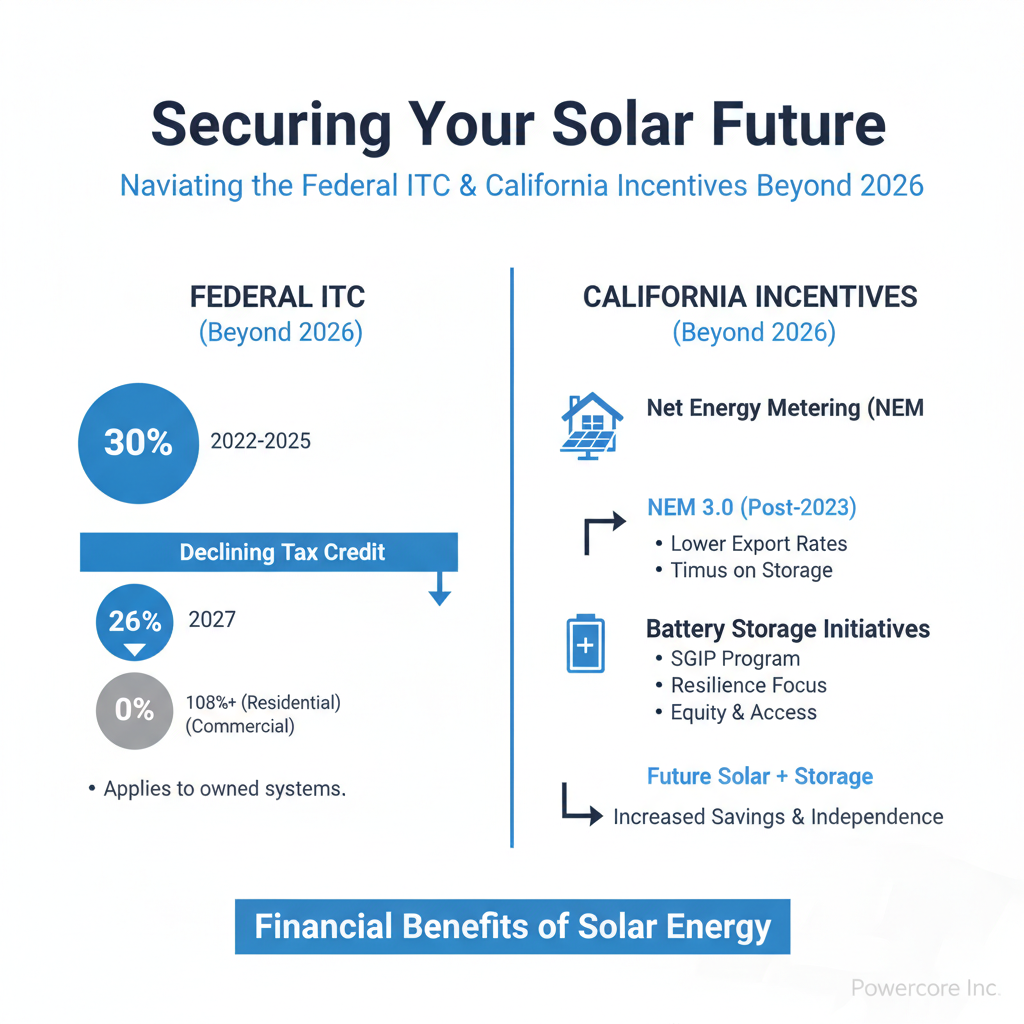
While the 30% federal solar ITC is a powerful incentive today, its future is subject to a scheduled step-down. Understanding this timeline is crucial for California homeowners considering solar, as it directly impacts the potential savings on their investment.
The Phased Reduction Schedule
The current 30% federal solar ITC is set to remain in effect for systems placed in service through December 31, 2032. After this period, the credit will begin to phase down:
- 2022-2032: 30% of the cost
- 2033: 26% of the cost
- 2034: 22% of the cost
- 2035 and beyond: The residential credit is scheduled to expire, unless Congress extends or modifies it.
This phased reduction means that every year you delay your solar installation past 2032, you could be leaving thousands of dollars in potential tax credits on the table. For instance, a $30,000 solar system installed in 2032 would yield a $9,000 credit, while the same system in 2033 would only offer $7,800 – a difference of $1,200.
Why Planning Beyond 2026 is a Critical Year for Solar Investment
While the first step-down isn't until 2033, the discussion around the federal solar ITC 2026 is important for several reasons:
- Long-Term Planning: Even though the 30% rate holds until 2032, discussions and potential legislative changes can occur at any time. Homeowners who plan their installations with an eye towards these future shifts can make more informed decisions.
- Installation Lead Times: Solar projects, especially comprehensive ones that include battery storage or integrate with other home improvements, can have lead times for permitting, equipment delivery, and installation. Starting the process well before a deadline ensures you can lock in the higher incentive rate.
- Market Dynamics: As the ITC approaches its step-down, there could be increased demand, potentially affecting equipment availability or installation schedules. Acting proactively helps you avoid potential bottlenecks.
For California residents, understanding the federal solar ITC 2026 outlook is crucial for maximizing savings. Powercore Inc recommends initiating your solar assessment sooner rather than later to ensure you can capitalize on the maximum available incentives.
The California Advantage: State-Specific Incentives and Regulations
Beyond the federal solar ITC, California offers a unique and evolving landscape of state-specific incentives and regulations that can further enhance the financial benefits of going solar. As a leader in renewable energy adoption, the Golden State provides additional layers of support, particularly for battery storage.
Navigating NEM 3.0: Optimizing Your Solar Value
California's Net Energy Metering (NEM) program, specifically NEM 3.0, significantly impacts how solar homeowners are compensated for excess energy sent back to the grid. Unlike previous iterations, NEM 3.0 places a greater emphasis on Solar & Battery Storage. Under NEM 3.0, the export rate for excess solar energy is lower than the retail rate of electricity. This shift makes battery storage an almost essential component for maximizing your solar investment, allowing you to store surplus energy generated during peak solar production hours and use it during higher-cost peak demand times, or when your panels aren't producing.
Strategically sizing your solar and battery system under NEM 3.0 requires expert knowledge to ensure optimal self-consumption and financial returns. Powercore Inc, with our deep understanding of California's energy policies, specializes in designing systems that thrive under NEM 3.0, ensuring you get the most value from your solar panels.
California Battery Storage Incentives
Recognizing the critical role of energy storage, California offers robust incentives for residential battery systems. The most prominent of these is the Self-Generation Incentive Program (SGIP). SGIP provides rebates for installing eligible energy storage technologies, significantly offsetting the cost of batteries.
SGIP is particularly valuable for homeowners looking to:
- Enhance energy independence and resilience during power outages.
- Reduce reliance on the grid during peak utility rate hours.
- Optimize their solar investment under NEM 3.0 by maximizing self-consumption.
The combination of the federal solar ITC (which now includes standalone battery storage) and California's SGIP can make battery storage highly affordable, transforming your home into a truly energy-independent powerhouse. Powercore Inc can guide you through the complexities of SGIP eligibility and application, ensuring you capture every available incentive. Learn more about state-specific programs on our California Battery Storage Incentives page.
Maximizing Your Investment: Combining Federal and State Benefits
The true power of going solar in California lies in the strategic combination of federal and state incentives. By understanding how the federal solar ITC works in conjunction with California's NEM 3.0 and SGIP, homeowners can achieve unparalleled savings and energy independence.
Strategic Planning for Peak Savings
Here’s how to strategically combine these incentives:
- Leverage the 30% Federal ITC: Apply this credit to the total cost of your solar system, including eligible battery storage components. Remember, the federal solar ITC 2026 is still at its peak 30% rate, making the coming years optimal for maximizing this federal benefit.
- Integrate Battery Storage with SGIP: Utilize California's SGIP to further reduce the out-of-pocket cost of your battery system. This not only makes storage more affordable but also crucial for optimizing savings under NEM 3.0.
- Optimize for NEM 3.0: Design your system with sufficient battery capacity to store excess solar production and discharge it during high-cost peak hours, minimizing your reliance on grid electricity when it's most expensive.
Consider the following hypothetical example of a California homeowner's potential savings:
Example: A $30,000 solar + battery system in California:
- Initial System Cost: $30,000
- Federal Solar ITC (30%): -$9,000 (Reduces federal tax liability)
- SGIP Battery Rebate: Up to -$4,000 - $6,000 (Varies by eligibility, reduces upfront cost)
- Net Cost After Incentives: As low as $15,000 - $17,000
- Annual Electricity Bill Savings: $1,500 - $2,500+ (Estimated, varies by consumption, rates, and NEM 3.0 optimization)
- Potential Payback Period: 5-8 years (Estimated, varies)
This combined approach drastically reduces your initial investment and accelerates your return on investment (ROI). It's a testament to the fact that while the federal solar ITC 2026 outlook is important, current incentives are still incredibly robust.
Understanding the full scope of costs and savings requires a detailed assessment. Our article, Understanding the Cost for Installing Solar Panels: A Caring Guide for Homeowners, provides additional insights into budgeting for your solar journey.
The Long-Term Value of Solar: Beyond Tax Credits
While the federal solar ITC and California incentives offer compelling immediate financial benefits, the value of solar energy extends far beyond these upfront savings. Investing in solar, especially with battery storage, delivers significant long-term advantages for your home, your wallet, and the environment.
Energy Independence and Utility Bill Savings
One of the most appealing aspects of solar is the promise of energy independence. By generating your own electricity, you become less reliant on volatile utility rates and the unpredictable fluctuations of the energy market. California homeowners, in particular, face some of the highest electricity rates in the nation. Solar panels, especially when paired with battery storage under NEM 3.0, allow you to lock in predictable energy costs for decades, often resulting in substantial monthly savings on your utility bills.
Furthermore, battery storage provides critical resilience during power outages, which are becoming more frequent in California due to wildfires and grid strain. With a robust battery system, your home can remain powered even when the grid goes down, offering peace of mind and uninterrupted comfort.
Increasing Home Value
Numerous studies have shown that homes with solar panel systems sell faster and at a premium compared to comparable non-solar homes. Appraisers are increasingly recognizing the added value of a owned solar energy system, factoring in the reduced energy costs and environmental benefits. This increase in home value provides an additional layer of financial return on your solar investment, making it a wise choice for long-term equity growth.
Environmental Impact
Beyond the financial benefits, going solar is a powerful statement for environmental stewardship. By harnessing clean, renewable energy from the sun, you significantly reduce your home's carbon footprint and contribute to a healthier planet. This commitment to sustainability resonates with many California homeowners and aligns with the state's broader environmental goals. Choosing solar is an investment in a cleaner, greener future for generations to come.
Holistic Home Energy Solutions with Powercore Inc
At Powercore Inc, we understand that a modern home energy strategy goes beyond just solar panels. As a California dual-licensed General B & C-10 Electrical Contractor (CSLB #1134334 and #1098175), we offer a comprehensive suite of services designed to make your home more efficient, resilient, and environmentally friendly. Our expertise ensures a seamless integration of all your energy needs, providing you with a single, trusted partner.
Integrating Solar & Battery Storage
We specialize in designing and installing customized Solar & Battery Storage systems that are perfectly suited to California's unique energy demands and regulations, including NEM 3.0 and SGIP. Our team works with top-tier equipment, ensuring reliability, performance, and maximum savings. From initial consultation to final inspection, Powercore Inc handles every aspect of your solar and battery installation with precision and professionalism.
EV Charging for a Sustainable Future
As electric vehicles become increasingly common, integrating an EV Charging Stations into your home's energy ecosystem is a smart move. Powercore Inc can install efficient and safe EV charging solutions, ensuring your electric vehicle is powered by your own clean, renewable energy. This not only reduces your transportation costs but also further minimizes your carbon footprint, creating a truly sustainable lifestyle.
Powercore Inc: Your California Expert
Our commitment to excellence and customer satisfaction is unwavering. We serve all of California, providing expert guidance and flawless execution for residential solar and storage projects. Whether you're considering your first solar system or looking to upgrade your existing setup to optimize for the future, Powercore Inc is here to help you navigate the complexities of energy solutions, especially concerning the federal solar ITC 2026 changes and California's specific incentives. We pride ourselves on delivering robust, reliable, and cost-effective solutions that stand the test of time.
Learn more about our dedication to quality and service on our About Powercore page or explore our Residential Solar & Storage services.
Ready to Secure Your Solar Future?
The time to act is now. With the federal solar ITC at its peak 30% rate and California offering generous incentives for battery storage, there has never been a better moment to invest in solar energy. Don't let the approaching federal solar ITC 2026 considerations catch you off guard. Empower yourself with energy independence, significant financial savings, and a reduced environmental footprint.
Contact Powercore Inc today for a personalized consultation. Our expert team is ready to design a custom solar and battery storage solution that maximizes your incentives and meets your unique energy needs. Call us at 916-699-8778 or visit our contact page to start your journey towards a brighter, more sustainable future.